

REVIEW · CANADA AUDIO TOURS
The Sights of Canmore: a Smartphone Audio Walking Tour
Canmore tells its story on foot. This self-guided route combines mountain views and local history, using GPS audio to lead you past coal-mining monuments, old civic buildings, sculptures, and the Policeman’s Creek Boardwalk. I like the freedom to start and stop whenever you want, and the optional trivia game adds a little fun without turning the walk into a classroom.
The route covers about 5 kilometers round trip and usually takes 90 minutes to two hours. I also like the low price of $8.22 per person, especially for a private experience with no fixed departure time. The main consideration is that you must bring your own charged smartphone or tablet, and the tour is only available in English.
Key details before you walk

- Coal-mining stories anchor the route: Canmore’s early mining years come into focus at the coal cars monument and Canmore Miners’ Union Hall.
- GPS audio keeps you moving: Commentary plays automatically as you reach each point of interest, while a live map shows your route and position.
- The walk covers 5 kilometers: Allow 90 minutes to two hours, or longer if you stop at shops, parks, or nearby attractions.
- The trivia game is optional: After each audio segment, you can answer a location-based question on your device.
- You can use it on your own schedule: Download the tour over Wi-Fi, then listen without a signal or mobile data during the walk.
- The final stop is unusually local: The Big Head Sculpture connects an odd-looking landmark with the origin of Canmore’s name.
How this Canmore walk works
This is not a live walking tour with a guide in front of you. It is a GPS-powered audio route that you download to your device. Once the tour is saved over Wi-Fi, the app uses your location to trigger commentary as you approach each stop.
That setup gives you control. You can pause for coffee, stop to browse Main Street, take a break on the boardwalk, or split the walk into two sessions. You are not tied to a departure time, and you can use the tour anytime rather than only on the date selected during booking.
The tradeoff is simple: you are responsible for following the map and managing your device. If you prefer asking questions, hearing spontaneous stories, or moving at a guide’s pace, a live tour may suit you better. If you want privacy and flexibility, this format is a good fit.
The route begins near 909A Railway Avenue and ends back at the meeting point. The first listed stop is Three Sisters Gallery, then the walk moves through central Canmore and returns through a series of historic and outdoor sites.
More Audio Walking Tours in Canada
- Halifax Churches, Gardens & Graveyards: a Smartphone Audio Walking Tour
★ 4.5 · 25 reviews - Halifax Boardwalk & Seaport: a Smartphone Audio Walking Tour
★ 4.0 · 19 reviews - Explore Halifax with 3 Unique Smartphone Audio Walking Tours
★ 4.0 · 16 reviews
From Three Sisters Gallery to the railway tracks
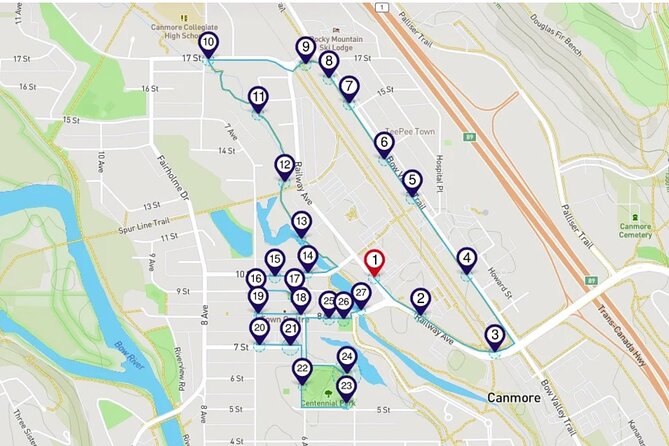
The opening section introduces you to Canmore through its sights, sculptures, and coal-mining connections. You will cross near Bow Valley Trail and Railway Avenue, where the audio explains how the Canadian Pacific Railway affected the town’s growth.
That railway stop gives useful context for the rest of the walk. Canmore was not simply a pretty Rocky Mountain town waiting for visitors. Transportation helped connect the area to wider markets, while mining shaped its working life and buildings.
At Sidney Street and Bow Valley Trail, you will see a British red telephone box. It is a small, playful detail, but it gives the tour variety. The route does not focus only on major monuments. It also points out objects you might pass without a second glance.
The next two stops feature black bear and grizzly bear sculptures. The commentary compares the animals and places them within the wider Rocky Mountain setting. These stops should appeal to families, since the sculptures offer clear visual markers and the trivia questions give children something to do besides follow an adult with a phone.
Mountain names, an inukshuk, and the coal cars
At Bow Valley Trail and 15 Street, the route turns your attention north toward several mountain peaks. You will hear stories about the names of Princess Margaret Mountain, Squaw’s Tit, Mount Charles Stewart, Mount Lady MacDonald, and Mount Grotto.
The value here is not only the view. Names shape how you read a mountain range. After this stop, you may look at the peaks with a little more curiosity instead of seeing them as one grand wall of rock.
Near 17 Street, the tour points out a large inukshuk and explains what these stone figures represent. This is another short stop, about three minutes, so it adds cultural context without slowing the whole route.
Then comes one of the clearest historical markers: the coal-mining cars monument at Railway Avenue and Bow Valley Trail. Here, the tour explains how important mining was in Canmore’s early years. The monument helps connect the town’s modern streets with its industrial past.
I consider this section one of the route’s strongest parts. You get a mountain view, a cultural symbol, and a direct reminder that Canmore was once a mining community before it became a major base for outdoor recreation.
Policeman’s Creek Boardwalk and the best open-air pause

The walk spends about 10 minutes at the Policeman’s Creek Boardwalk, longer than at most other stops. This is a natural place to slow down and enjoy the route rather than simply collect information.
The commentary covers the Bow River, the Canmore Nordic Centre, and local festivals and events. The boardwalk also gives you a change of pace after the roadside sculpture stops. Instead of listening beside an intersection, you are walking through one of Canmore’s more pleasant public spaces.
I would not rush this section. The stated tour time is 90 minutes to two hours, but the app allows you to pause. If you want photographs, a quiet break, or a closer look at the surroundings, this is one of the easiest places to add time.
The route then moves to 10 Street and 6 Avenue for a view of Mount Rundle. The audio explains the mountain and its importance to Canmore’s visual identity. The stop is short, but the subject is large enough to reward a few extra minutes outside the formal commentary.
More Smartphone Audio Tours in Canada
- Cabot Trail: a Smartphone Audio Driving Tour
★ 4.5 · 118 reviews - Icefields Parkway: a Smartphone Audio Driving Tour
★ 4.0 · 118 reviews - Smartphone Audio Driving Tour between Banff and Calgary
★ 4.0 · 25 reviews - Smartphone Audio Driving Tour between Lake Louise and Calgary
★ 4.0 · 15 reviews
Murals, museums, and Friendship Park

At 719 10 Street, you will see a mural of Isabelle Dube and hear the tragic story connected with it. This stop adds a personal human story to the broader account of mines, railways, and mountains.
The Canmore Museum and Geoscience Center comes next. The museum has more than 10,000 artifacts and has welcomed visitors since 1984. The audio tour points it out, but admission is not included, so you should treat it as an optional extra rather than part of the paid experience.
That distinction matters. The $8.22 fee covers the digital walking tour, not entry to museums or other attractions. If you decide to go inside, you will need to pay separately and allow more time than the advertised walking duration.
Friendship Park offers another short stop. Here, you will learn what Canmore shares with the Japanese city of Higashikawa. The park itself is small, so this is mainly a brief cultural detail along the route rather than a major destination.
Main Street, an old inn, and the miners’ union

The route then reaches Main Street near 8 Avenue and 6 Street. You will pass shops, restaurants, and galleries, making this a useful point to pause for food or browsing.
The audio points out the Canmore Inn & Suites, described as a building dating to 1890 and associated with Count Eugene de Rambouville. This stop helps you notice the older buildings among the newer commercial activity.
The Canmore Miners’ Union Hall is one of the most important historical stops. The commentary explains the building’s role and the often difficult relationship between the town and its miners. This is where the tour’s social history becomes more direct. Mining was not only an economic activity. It also shaped local politics, working conditions, and community life.
You may find this stop more rewarding than the shorter sculpture stops because it gives a clearer sense of how Canmore functioned as a working town. The audio format also lets you stand outside and take in the building while the story plays.
Centennial Park and Ralph Connor Memorial United Church

Centennial Park includes three points of interest: views of the Three Sisters Mountains, the Stan Rogers stage, and the festivals and events held in the park. Like Policeman’s Creek Boardwalk, this is a 10-minute section rather than a quick roadside note.
The park makes a sensible place to pause. You can listen to the commentary, enjoy the mountain view, and decide if you want to extend the break. The mention of the Stan Rogers stage also shows how public spaces carry the town’s cultural life, not just its tourist appeal.
Next comes Ralph Connor Memorial United Church, described as one of the earliest Presbyterian churches built in Alberta. The audio explains the mystery behind its name. The church adds a religious and architectural layer to a route that otherwise focuses heavily on mining, transportation, public art, and mountains.
Because the walking tour is built from short segments, you do not need to spend a long time at any one place. That is convenient, though it also means the level of detail may feel introductory if you already know Canmore well.
NWMP Barracks and the Big Head Sculpture

The NWMP Barracks is one of the route’s most significant historic attractions. The audio explains how the barracks helped maintain law and order during Canmore’s rougher early years.
This stop broadens the story again. You have already heard about railway development and mining labor. The barracks adds the role of policing and government authority in a growing settlement.
The final featured stop is the Big Head Sculpture. The tour explains the unusual sculpture and its connection to the name Canmore itself. It is an entertaining finish because the object is visually memorable and the story links a modern public artwork with the town’s identity.
A good walking tour should leave you seeing familiar places differently. By the final stop, the coal cars, church, barracks, mountain names, and sculptures have turned Canmore from a collection of attractive streets into a town with several distinct layers.
Price, timing, and practical value
At $8.22 per person, this is inexpensive by guided-tour standards. You are paying for a self-guided audio route rather than a live guide, but the app includes a GPS map, automatic commentary, trivia questions, and flexible use.
The number of people selected during booking equals the number of devices allowed to download the tour. That is important for couples and families. One phone can carry the experience for a small group, but each additional device requires another participant selection.
The advertised duration is 90 minutes to two hours for a 5-kilometer return route. You should add time if you plan to browse Main Street, enter the museum, stop at a park, or take photographs.
Download the tour over Wi-Fi before setting out. No signal or mobile data is needed during the walk once the content is saved. A charged phone is essential, and you must supply the smartphone or tablet yourself.
The activity is private in the sense that only your group participates. It is also available daily from midnight to 11:30 p.m., with flexible use dates listed through February 16, 2027. You can cancel up to 24 hours before the experience for a full refund.
What I like, and what I would watch for
I like the way the route mixes major sights with small discoveries. The red telephone box, bear sculptures, inukshuk, mural, and Big Head Sculpture keep the walk from becoming a long sequence of plaques and dates.
I also like the balance of outdoor stops and historical buildings. Policeman’s Creek Boardwalk and Centennial Park give you room to breathe, while the Miners’ Union Hall and NWMP Barracks provide stronger historical focus.
The commentary has been praised for being funny, and that tone matters. A pleasant voice and a few light moments can make a self-guided route feel less mechanical. The walk is also described as a good length, with attractive sights and trails.
The main weakness is the limited review record and modest overall rating of 3.8 from four ratings. That does not tell you exactly what went wrong, but it is a reminder to keep expectations realistic. This is a compact, introductory town walk, not an all-day historical seminar or a wilderness hike.
Seasonal closures and access problems are also possible. Recommended attractions may be closed or unavailable for reasons beyond the operator’s control. The route itself may still work, but you should not assume every interior attraction will be open.
Who should book this Canmore audio walk?
I would recommend it to independent visitors who want an affordable introduction to Canmore without joining a group. It suits couples, families, and solo walkers who like choosing their own pace.
It is especially useful on a first visit, when you want a framework for the town before deciding where to spend more time. The route points out museums, shops, parks, historic buildings, sculptures, and mountain views in one circuit.
I would choose another format if you want a live guide, personal conversation, detailed answers, or a highly specialized account of mining history. The English-only audio also limits its usefulness for anyone who is not comfortable listening in English.
Should you book it?
Book this tour if you want a low-cost introduction to Canmore with no fixed schedule. The coal-mining cars, Policeman’s Creek Boardwalk, Miners’ Union Hall, NWMP Barracks, and Big Head Sculpture give the walk enough range to justify the small fee.
Skip it if you already know central Canmore well or dislike using your phone while sightseeing. For most first-time visitors, though, the flexibility is the point. Download it before you leave, keep an eye on your battery, and allow extra time for Main Street and the two longer park and boardwalk stops.
FAQ
How long does the Canmore audio walking tour take?
The tour takes approximately 1 hour 30 minutes to 2 hours. The route is about 5 kilometers round trip, and you can take longer because the tour has no time limit.
Where does the tour start?
The meeting point is 909A Railway Avenue, Canmore, Alberta, T1W 1P3. The activity ends back at the meeting point.
Is this a guided group tour?
No. This is a private, self-guided smartphone audio tour. Only your group participates, and the commentary plays through your device.
Do I need a mobile signal during the walk?
No. You should download the tour over Wi-Fi before starting. Once downloaded, the tour does not require a signal or mobile data during the walk.
Does the tour include a smartphone or tablet?
No. You must provide your own smartphone or tablet. The number of travelers selected equals the number of devices permitted to download the tour.
What language is the tour offered in?
The tour is offered in English.
Are attraction admissions included?
No. Admission tickets are not included. The Canmore Museum and Geoscience Center is one of the attractions pointed out along the route, but entry requires a separate ticket.
Can I pause or stop the tour?
Yes. You can start and stop anywhere along the route and use the tour at your own pace. The tour has flexible dates and no time constraint for completion.
Is the tour suitable for most people?
Most people can participate, and service animals are allowed. The route is near public transportation, but the provided information does not specify detailed accessibility conditions for every section.
Just added around Canada
- Queen Street West: An audio tour exploring Toronto’s coolest street★ 3.5 · 2 reviews
- Toronto’s Waterfront: a Smartphone Audio Walking Tour★ 5.0 · 5 reviews
- St. John’s Audio Walking Tour★ 4.0 · 4 reviews
- Irish Loop Smartphone Audio Driving Tour★ 4.5 · 7 reviews
- Fruit alcohol tasting + Velvet Orchards audio tour★ 5.0 · 2 reviews
- APP Self-Guided Tours Quebec with Audioguide★ 3.0 · 2 reviews
- Quebec City Self-Guided Driving Audio Tour★ 4.0 · 7 reviews
- Smartphone Audio Driving Tour between Wasaga Beach and Toronto★ 4.5 · 3 reviews
Smartphone Audio Tours, compared.

Colosseum & Forum with Audio Guide App -Optional Arena
Read our review →
Timed Entry to Michelangelo’s David + Audio App
Read our review →
Cathedral & Brunelleschi’s Dome Ticket & Audio App
Read our review →
Michelangelo’s David Priority Ticket & Audio App
Read our review →
Uffizi Priority Ticket & Masterpieces Audio App
Read our review →
Castel Sant’Angelo Entry Ticket & Digital Audioguide
Read our review →
Pantheon Priority Entry Ticket & Audio Guide App
Read our review →Browse the lists this tour appears in