
REVIEW · ITALY AUDIO TOURS
Florence: Michelangelo’s David Priority Ticket & Audio App
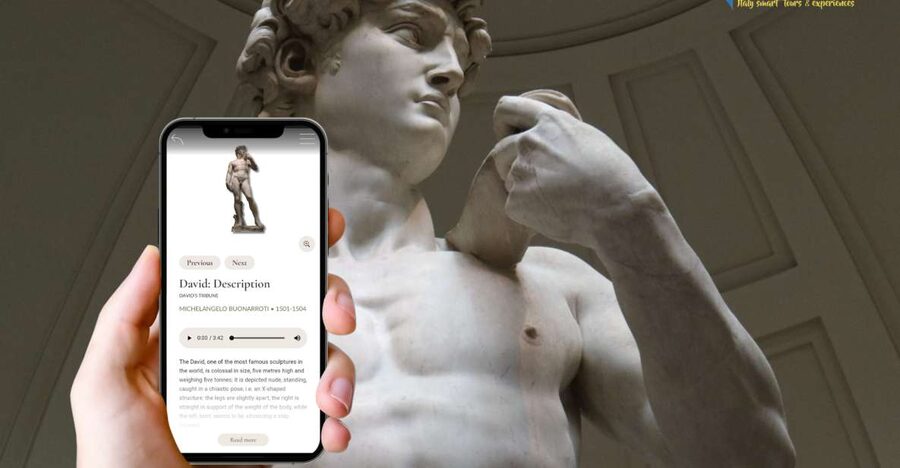
Michelangelo’s David rewards a close look. This priority ticket gets you past the ticket-buying and pickup lines, then lets you explore the Accademia Gallery at your own pace. I like the clear meeting system near Via Ricasoli 57, and I like having an audio app to explain David, the unfinished Prisoners, and the gallery’s other works. The main catch is that the app can be awkward to download, especially when phone service is weak.
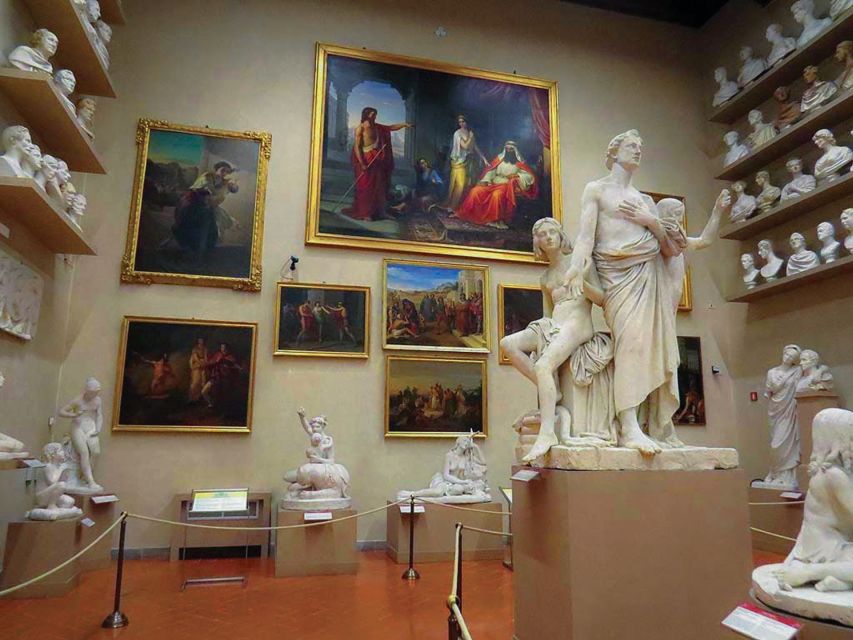
The Accademia is smaller than Florence’s Uffizi, but David gives it serious weight. You also get paintings by Botticelli, Ghirlandaio, Gaddi, and others, plus an old-instrument room with a Medicean Quintet violin by Stradivarius. This is a good choice if you want structure without being tied to a live group, though the audio content may feel brief if you want a full art lecture.
Key points at a glance
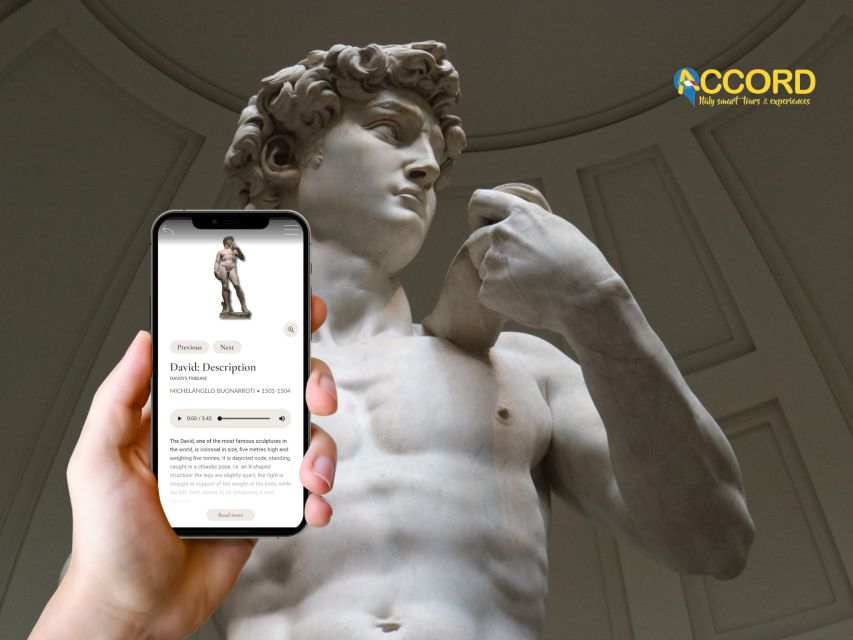
- David is the main event: See Michelangelo’s original marble sculpture and walk around it to watch his expression change with your viewpoint.
- Priority entry saves real time: Meet staff near the gallery, receive your ticket, and join the entry route instead of waiting in the regular ticket line.
- The audio app keeps you independent: Listen in English, Italian, Spanish, French, German, and several other languages while moving at your own pace.
- The Prisoners add a rougher side of Michelangelo: These unfinished figures show bodies emerging from marble, not just polished final statues.
- The musical-instrument room is an easy-to-miss bonus: Its collection includes a Stradivarius violin from the Medicean Quintet.
- Bring your own setup: You need a charged phone, downloaded app, and earphones. Large bags and luggage are not allowed.
Why priority entry matters at the Accademia
At $23 per person, this is not the cheapest way to see a museum in Florence. You are paying for more than admission, though. You are paying for a reserved time, help from an on-site host, and a way around the ticket-buying line, which can be long when Florence is busy.
The meeting point is just outside the Accademia at Via Ricasoli 57, in front of the Carrefour Express supermarket. Look for an assistant wearing a yellow vest and an ACCORD identification badge. This detail matters because the street around the museum can be crowded, and arriving at the wrong door wastes the very time you paid to save.
Plan to arrive 15 minutes early. The English and Italian-speaking staff introduce you to the security entrance and provide the reserved ticket. You still pass through museum security, so priority entry does not mean walking straight inside without a check. At busy times, security can take about 10 to 15 minutes.
The difference between this route and the regular line is most useful during Easter, summer, and other busy periods. One visitor who had failed to find tickets through the official site found this option especially helpful because the ordinary line was still long. Another got inside in less than 10 minutes after reaching the meeting point. Timing is not guaranteed, but the system generally removes the most frustrating part of the visit: waiting just to buy or collect a ticket.
The hosts are not live museum guides. Their job is practical: find you, hand over the ticket, point you toward the right entrance, and help with the app when possible. One useful detail from the booking experience is that staff have sometimes helped when the app download caused trouble. Still, do not rely entirely on last-minute assistance. Install the app over Wi-Fi before leaving your accommodation if you can.
More Smartphone Audio Tours in Italy
- Rome: Colosseum & Forum with Audio Guide App -Optional Arena
★ 4.2 · 24,770 reviews - Florence: Timed Entry to Michelangelo’s David + Audio App
★ 4.6 · 19,496 reviews - Florence: Cathedral & Brunelleschi’s Dome Ticket & Audio App
★ 4.4 · 6,973 reviews
Meeting the original David
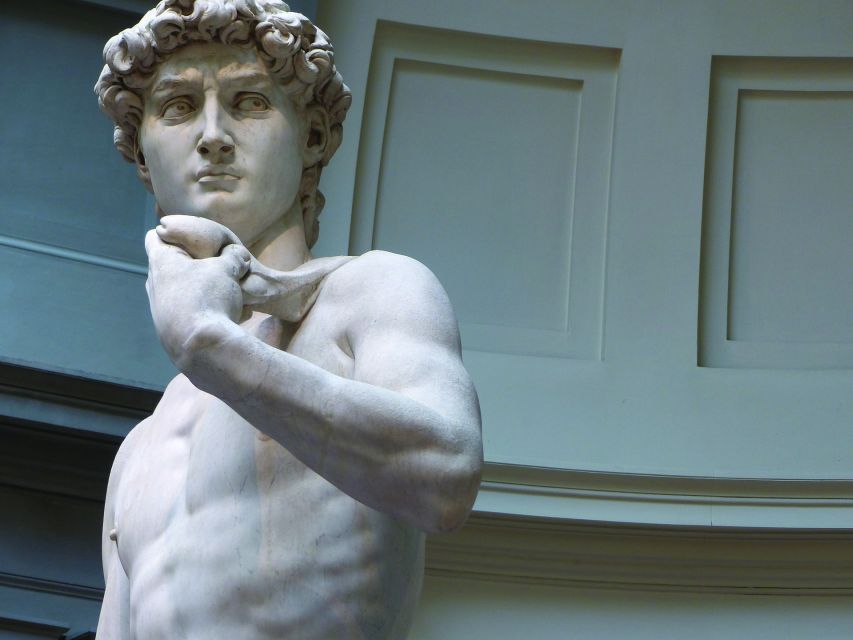
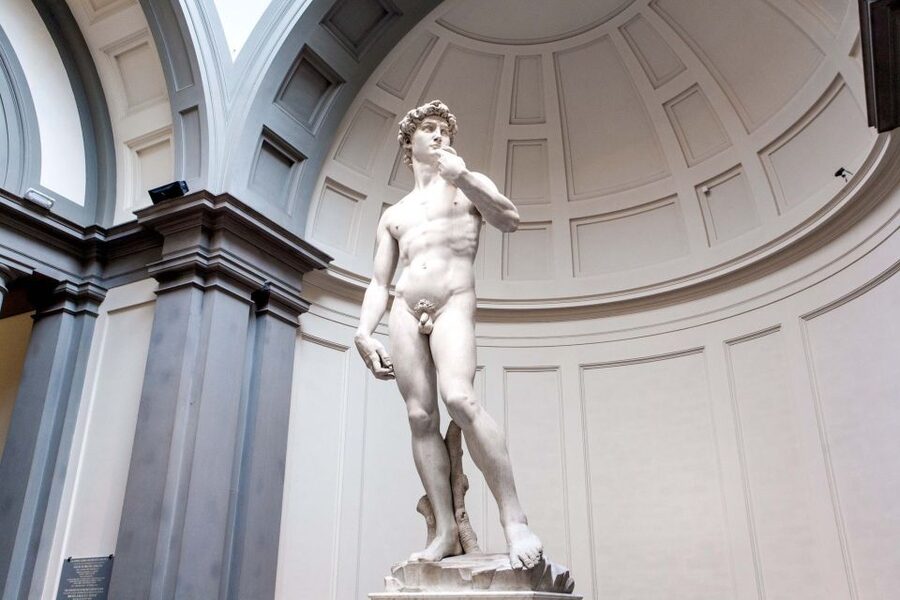
The Accademia’s long central gallery leads to its star attraction. Michelangelo’s David was carved from a single block of marble and represents the biblical hero just before or around his victory over Goliath. In Florence, the statue also came to symbolize the city’s defense of civil liberty during the republic’s independent years.
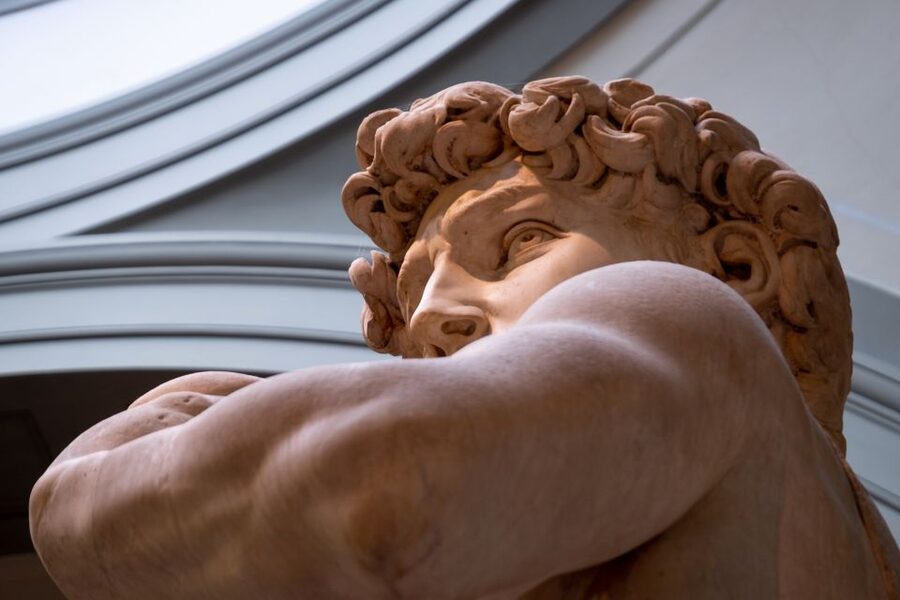
The first view is powerful because of the statue’s scale and calm focus. Then take your time. Walk around the figure and notice how the face seems to change as you move. From one angle, David looks alert and ready. From another, he appears thoughtful and almost still. The oversized hands and feet are part of the sculpture’s visual force, helping the figure read clearly from a distance while adding to its human tension.
Photos cannot give you the same sense of surface. Look closely at the hair, veins, hands, and posture. The marble seems soft in places, especially around the face and limbs, while the stance holds a tight sense of preparation. This is the sort of work that rewards a few quiet minutes after the first glance.
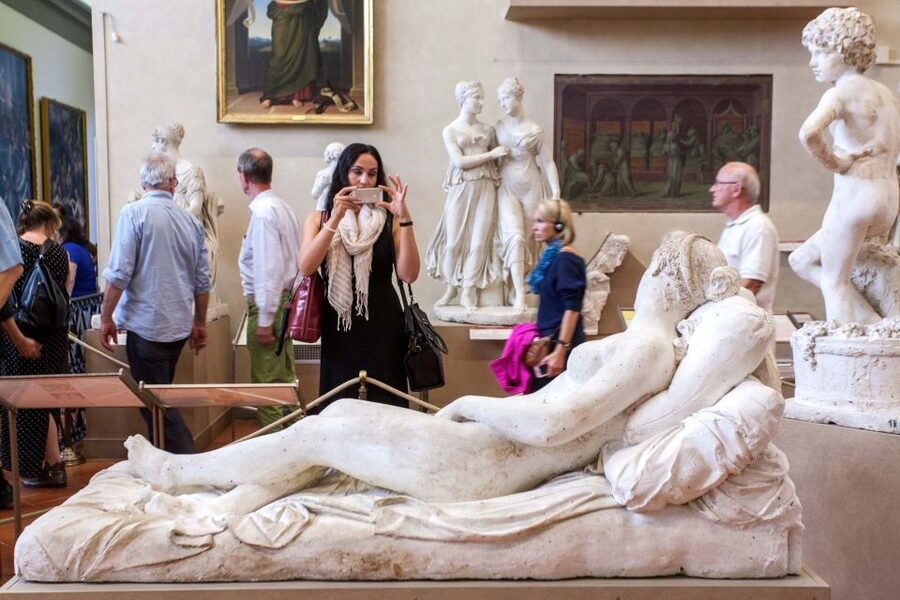
The room can feel crowded, especially around the sculpture. A timed entrance helps control the number of people inside, but you should not expect solitude. The good news is that the gallery is compact, and you do not need a whole day to see its main rooms. The less good news is that David attracts nearly everyone at once, so patience is part of the experience.
The audio app gives useful context about the statue’s biblical subject and political meaning. It also helps explain why this particular sculpture became such a powerful symbol in Florence. Still, the app is designed as a self-guided aid, not a full private lecture. Several people found it informative but wanted more content, while others used it only for the main highlights.
Michelangelo’s Prisoners and St. Matthew
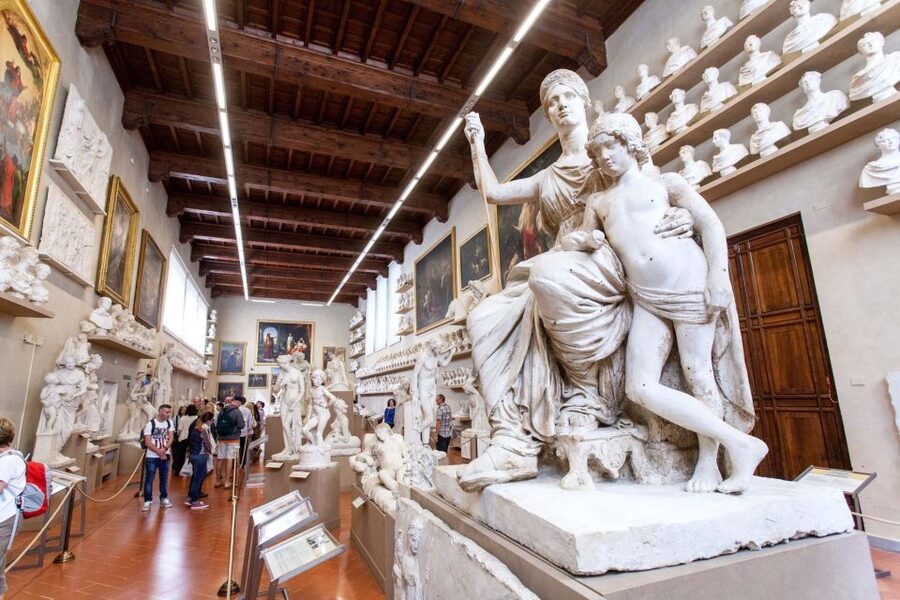
Do not hurry past the other Michelangelo sculptures. The Prisoners, also called the Slaves, are among the most memorable works in the museum after David. These figures were intended for the tomb of Pope Julius II, a project that was never completed.
Their unfinished state is the point. You can see bodies struggling out of blocks of stone, with some surfaces still rough and blocked in. Instead of presenting a perfectly finished body, Michelangelo lets you see the creative process and the resistance of the marble. The effect is more physical and mysterious than a polished statue.
St. Matthew also shows Michelangelo working toward a finished figure. The sculpture helps you compare different stages of the process and understand how much of the artist’s effect comes from what he leaves unresolved. The audio app can make these pieces easier to appreciate, especially if you have not studied Renaissance sculpture before.
I would give these works more time than their position in the gallery might suggest. Many people come for David, take a few photographs, and leave. The Prisoners offer a quieter, more unusual encounter with Michelangelo’s methods.
Botticelli, Ghirlandaio, Gaddi, and other Renaissance works
The Accademia is not only a one-statue museum. Its paintings and sculptures provide a useful picture of Florentine art across several periods and styles. You can see works connected with Andrea Orcagna, Taddeo Gaddi, Domenico Ghirlandaio, Filippino Lippi, and Sandro Botticelli.
The experience is more manageable than a huge museum visit. You can focus on the central Michelangelo collection, then move through the painting rooms without feeling that you must conquer every corridor. The audio app points out selected works and gives you a basic framework for looking at them.
That framework is valuable because Renaissance religious paintings can seem repetitive at first glance. Details such as gestures, color, saints’ attributes, and the arrangement of figures help separate one work from another. Even a short explanation can turn a quick walk past a panel into a more attentive look.
The tradeoff is depth. If you want a detailed account of every painting, this audio app may not be enough. It highlights important pieces rather than offering a long scholarly treatment of the full collection. You can use it as a guide to the main rooms and then spend extra time with whatever catches your eye.
Same place, a different route to walk:
- Rome: Pantheon Fast-Track Ticket and Official Audioguide
★ 4.5 · 27,353 reviews - Rome: City Sightseeing Hop-on Hop-off Bus with Audioguide
★ 4.0 · 16,045 reviews - Pompeii: Entry Ticket with Audio Guide
★ 4.1 · 13,491 reviews - Venice: La Fenice Opera House Entry Ticket with Audio Guide
★ 4.6 · 11,742 reviews
The Stradivarius violin and old musical instruments
The musical-instrument collection is an unexpected part of the visit. It comes from the Cherubini Conservatory’s department of musical instruments and includes a violin by Antonio Stradivarius belonging to the Medicean Quintet.
This room changes the mood of the museum. After marble figures and religious paintings, you get objects made for sound, performance, and courtly life. The Stradivarius is the clear draw, but the collection is worth a few minutes even if you came mainly for Michelangelo.
It is also an easy room to overlook. If you follow the crowd straight to David and then toward the exit, you may miss it. Check the museum layout and your app’s suggested route so you do not leave without seeing the instruments.
The collection does not replace a concert, of course. You will not hear the violin played as part of this visit. Its value is in seeing the craft and historical importance of an instrument connected with the Medici court.
Using the mobile audio app
The audio guide is included, but earphones are not. Bring your own pair, charge your phone, and download the application before you arrive. The instructions are sent with your voucher, and a WhatsApp reminder is expected the day before the visit.
The app supports English, Italian, Spanish, German, French, Russian, Chinese, Japanese, Polish, Turkish, Portuguese, Dutch, Korean, Hungarian, Greek, Croatian, and Romanian. This broad language selection is useful for mixed-language groups, though the on-site staff are specifically described as English and Italian speakers.
The best feature is freedom. You can pause, skip, replay, or ignore sections without holding up a group. You can also stand in front of David for as long as you like, then move to another work when you are ready. I prefer this format for a small museum because it lets you balance listening with simply looking.
The weak point is preparation. Some phones have had trouble downloading the app, and poor mobile service can make the process harder. Install it using Wi-Fi, check that it opens, and keep the voucher instructions available. One visitor found the app easy to use, while another could not download it at the meeting point because there was no service.
The audio is best treated as a helpful companion, not the reason to buy the ticket. The priority entry is the main value. If the app works perfectly, it adds welcome context. If it does not, the museum and the reserved entrance still make up most of the experience.
Timing, bags, water, and food extras
The activity is listed as lasting one day because your ticket is valid for the selected date and time, not because you spend an entire day inside the gallery. Most people will want enough time for David, the Prisoners, the paintings, and the musical instruments, but the exact pace is yours.
Choose an earlier time if you want a calmer start. Several bookings found early slots especially effective for avoiding the worst queues. Later appointments can still work, but Florence’s popular museums often feel more crowded as the day progresses.
Do not bring luggage or large bags. The museum permits one water bottle per person, with a maximum size of 500 milliliters. This is worth planning around because you do not want to arrive with a suitcase and discover that it cannot enter.
The package also lists a bonus selection of Tuscan food tastings, including extra-virgin olive oil, truffle specialties, schiacciata, and cantuccini. Treat this as an added perk rather than the core reason to book. The museum ticket, priority route, and audio app are the parts that shape your visit.
The Accademia is wheelchair accessible. Children need a passport or identity card, and adults should bring their own passport or ID as well.
Is $23 good value?
The answer depends on your schedule and tolerance for lines. If you have plenty of time, are visiting in a quiet period, and can secure a suitable timed ticket elsewhere, you may prefer to arrange entry on your own. In that case, the audio app and host may not justify the extra cost.
For a first Florence visit, I see stronger value. David is one of the city’s essential sights, and missing your intended time because the ticket line is slow can disrupt the rest of your day. At $23, the service is reasonably priced for the convenience of a reserved entrance, on-site directions, and a self-guided explanation.
It is especially useful if you have limited time, are visiting during a crowded season, or could not find a ticket through the official site. One booking arrived during a busy Easter period and found the peace of mind worthwhile. Another used the ticket simply to see the highlights quickly before moving on.
Do not buy it expecting a private tour. You will not have a live art historian leading you room by room. You will have a ticket, a host, and a phone-based guide. That is a good fit for independent visitors, couples, families with older children, and anyone who dislikes being moved through a museum in a group.
Should you book the Accademia priority ticket?
I would book this experience if seeing David is a top priority and your Florence schedule is tight. The priority route removes much of the ticket-line uncertainty, while the app gives you enough context to understand why David, the Prisoners, and the surrounding collection matter.
I would hesitate only if you already have a reliable timed ticket, dislike using your phone in museums, or want a detailed live explanation of every room. Install the app before you leave, arrive 15 minutes early, bring earphones, and look for the yellow-vested ACCORD assistant at Via Ricasoli 57.
For most first-time visitors, the $23 is a sensible payment for time and peace of mind. David is worth seeing in person, and the rest of the Accademia is much better when you do not have to rush through it after standing in a long ticket line.
FAQ
Where is the meeting point?
The meeting point is at Via Ricasoli 57, in front of the Carrefour Express supermarket, a short distance from the Accademia Gallery entrance. Look for an assistant wearing a yellow vest and an ACCORD ID badge.
How early should I arrive?
Arrive 15 minutes before your scheduled activity time. This gives the host time to provide your ticket and direct you to the correct entrance.
Does the ticket include skip-the-line access?
It includes a reserved entrance that lets you skip the ticket-buying and ticket-pickup lines. You still need to pass through the museum’s security check.
How long can the security check take?
At the busiest times, the security line takes approximately 10 to 15 minutes.
Is there a live tour guide?
No. The experience includes English and Italian-speaking on-site staff, plus a multilingual mobile audio guide app. It does not include a live museum tour.
Do I need to bring earphones?
Yes. Earphones are not included, so bring your own pair for the mobile audio guide.
Which languages are available in the audio app?
The app is available in English, Italian, Spanish, German, French, Russian, Chinese, Japanese, Polish, Turkish, Portuguese, Dutch, Korean, Hungarian, Greek, Croatian, and Romanian.
Can I bring a large bag or luggage?
No. Luggage and large bags are not allowed inside. You may bring one water bottle per person, with a maximum capacity of 500 milliliters.
Is the Accademia Gallery wheelchair accessible?
Yes, the activity information states that the Accademia Gallery is wheelchair accessible.
Just added around Italy
- Torino Walking Tour with Audio and Written Guide by a Local★ 4.5 · 35 reviews
- Medieval Canals and Fountains: A Treviso Self-Guided Audio Tour★ 4.5 · 4 reviews
- Trapani Walking Tour with Audio and Written Guide by a Local★ 4.0 · 8 reviews
- Trento Walking Tour with Audio and Written Guide★ 4.5 · 11 reviews
- Sicily: Selinunte Park Entry Ticket & Sicily Digital Audio Guide★ 4.5 · 4 reviews
- Taormina Walking Tour with Audio and Written Guide by a Local★ 4.5 · 41 reviews
- Taranto Walking Tour with Audio and Written Guide by a Local★ 5.0 · 5 reviews
- Siracusa Walking Tour with Audio and Written Guide by a Local★ 5.0 · 59 reviews
Smartphone Audio Tours, compared.

Colosseum & Forum with Audio Guide App -Optional Arena
Read our review →
Timed Entry to Michelangelo’s David + Audio App
Read our review →
Cathedral & Brunelleschi’s Dome Ticket & Audio App
Read our review →
Uffizi Priority Ticket & Masterpieces Audio App
Read our review →
Castel Sant’Angelo Entry Ticket & Digital Audioguide
Read our review →
Pantheon Priority Entry Ticket & Audio Guide App
Read our review →
Orsay Museum Entry Ticket and Digital Audio Guide App
Read our review →Browse the lists this tour appears in