
REVIEW · CANADA AUDIO TOURS
APP Self-Guided Tours Quebec with Audioguide
Quebec City rewards slow looking. This self-guided audio tour gives you a full day to explore Old Quebec at your own pace, from the grand Château Frontenac and Dufferin Terrace to Place Royale, the Citadel, Parliament, and the Plains of Abraham. I like the freedom of a private tour for one group, and I like the low price of $9.61, especially if you want historical context without paying for a live guide.
The main drawback is technical, not cultural. One booking problem involved a missing access link, and the provider explained that the email had to be confirmed before the tour could open. Since the experience is non-refundable, I would make sure your email is valid and the audio access works before setting out.
Key points at a glance
- A full Old Quebec route: The roughly 10 to 12-hour plan links the city’s most important sights, including Château Frontenac, Place Royale, the Parliament Building, the Citadel, and Battlefields Park.
- A very low group price: At $9.61 for a group of up to one person, this is priced more like a digital walking aid than a traditional guided excursion.
- English mobile access: The tour is offered in English and uses a mobile ticket, so your phone is central to the experience.
- Strong historical range: You move from the French colonial church at Notre-Dame-des-Victoires to British defensive works, Quebec politics, museums, and the Plains of Abraham.
- You control the pace: The activity is private to your group, with no fixed live guide setting the walking speed.
- Check access before walking: Email confirmation matters. A ticket alone may not be enough to open the tour information.
What this self-guided Quebec City tour is really offering
This is best understood as a sightseeing framework, not a traditional guided walk. You receive an English audio experience on your mobile device, then move between major sights in Quebec City on your own. The route begins and ends in Quebec City, and only your group participates.
That format has clear strengths. You can linger at a church, stop for lunch, browse a shop, or skip an attraction that does not suit you. You are not tied to a guide’s schedule or to a large group gathered around a flag. For a city as compact and walkable as Old Quebec, that independence can be useful.
The route also covers a lot. The listed stops total about ten hours before you add time for walking, meals, photos, museum visits, and pauses. In practice, you should think of this as a full-day plan, not a quick morning stroll. The audio content may help you understand what you are seeing, but the experience depends on your phone, your access link, and your willingness to manage the day yourself.
At $9.61 for one person, the value is easy to see if the audio opens correctly. You are paying very little for a structured route through some of the city’s most important sights. The tradeoff is that admission tickets are generally not included, and the product does not provide the personal attention or live conversation of a private human guide.
More Self-Guided Audio Tours in Canada
- Self Guided Audio Driving Tour of the North Shore of PEI
★ 4.0 · 24 reviews - Self-Guided Audio Driving Tour in Icefields Parkway
★ 5.0 · 24 reviews - Self-Guided Audio Tours for the Canadian Rockies
★ 5.0 · 18 reviews
Starting with Château Frontenac and Dufferin Terrace
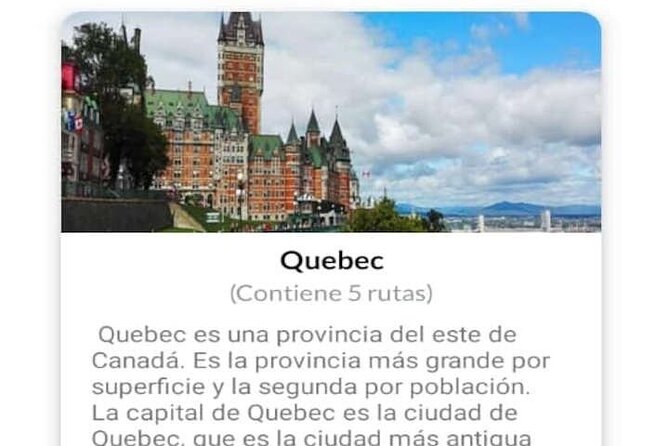
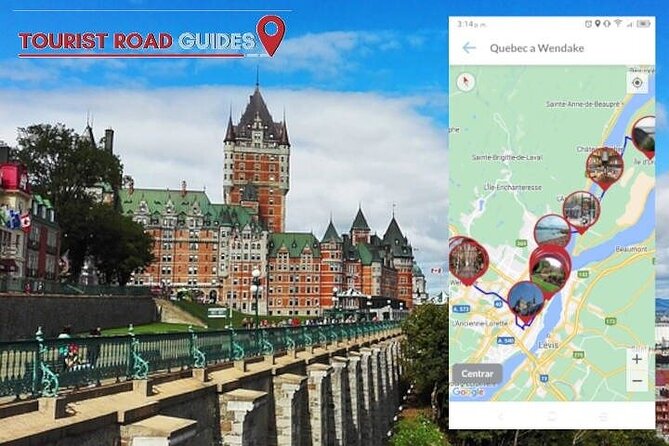
Your first major stop is Fairmont Le Château Frontenac, the grand hotel that defines many views of Quebec City. Built in 1892 and 1893 for the Canadian Pacific Railway, it was designed by Bruce Price in a château style that blends Gothic Revival and French Renaissance ideas.
The hotel has 610 rooms and suites, along with restaurants, bars, and shops. You can admire the exterior without buying an admission ticket, but the one-hour estimate may tempt you to look beyond the famous roofline. The building has hosted Charles Lindbergh, Winston Churchill, and Eleanor Roosevelt. It also hosted the Quebec Conferences of 1943 and 1944, when Allied leaders discussed World War II strategy.
I like this opening because it gives you an immediate sense of Quebec City’s scale and character. Château Frontenac is not just a photogenic hotel. It connects railway expansion, international politics, luxury travel, and the city’s French-inspired architecture in one place.
From there, Dufferin Terrace gives you room to breathe. Built in 1838 for private use by the Governor General of Canada, it opened to the public in 1879. The terrace is suited to a walk, a picnic, or a pause with views over the St. Lawrence River.
The suggested visit is 30 minutes, but you may want longer if the weather is good. In winter, the terrace becomes a skating rink. Restaurants and shops line the area, so this is also a practical place to break up the historical material with food or a short rest.
Place Royale and Canada’s oldest stone church
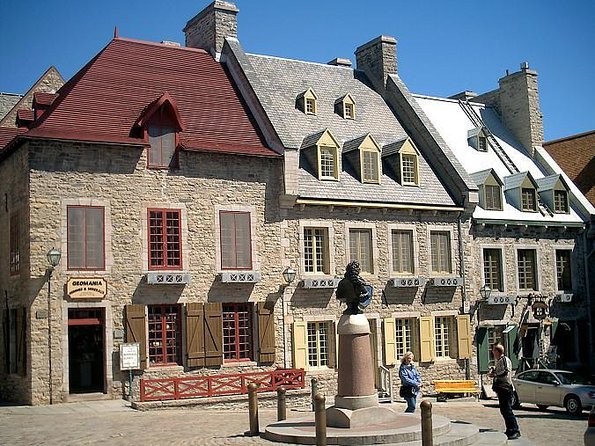
Place Royale is one of the most atmospheric sections of the route. Cobblestone streets, old buildings, shops, and restaurants give you a chance to experience Old Quebec as a lived-in district rather than a string of isolated monuments.
The square is tied to the city’s early French period, and the audio tour can help connect the buildings around you to that story. The suggested stop lasts an hour, which is reasonable if you walk slowly and take photos. You may need more time if you plan to enter nearby attractions or eat in the area.
Notre-Dame-des-Victoires Catholic Church sits on Place Royale. Built between 1688 and 1723, it is identified as the oldest stone church in Canada that still retains its original walls. The church began as a chapel dedicated to the Infant Jesus. It later took the name Notre-Dame-de-la-Victoire after the Battle of Quebec in 1690, then Notre-Dame-des-Victoires after the British fleet led by Admiral Hovenden Walker was dispersed in 1711.
The building is French Baroque, with carved stone, a three-section nave, transept, and presbytery. Its neoclassical bell tower was added in 1800. I find this stop particularly valuable because the church is modest in size but carries several layers of Quebec’s political and religious past.
The stated visit is one hour, though admission is not included. You should check the church’s current opening arrangements separately if entering is important to you. As with several stops on this route, the audio tour can explain the setting, but it does not replace an entry ticket.
The Morrin Centre and the many layers of Old Quebec
The Morrin Centre adds an English-speaking chapter to a city often introduced through its French identity. This National Historic Site began more than 200 years ago as one of Quebec City’s first prisons. It now contains a major cultural center and a striking library.
That change in purpose makes the building worth attention. The one-hour estimate gives you time to appreciate the contrast between the prison’s original role and its current use. The stop also helps prevent the tour from presenting Quebec City as a place with only one language or one historical tradition.
Old Quebec itself is listed as a UNESCO World Heritage Site. This portion of the route is where the city’s cobblestone streets, historic buildings, restaurants, and shops come together. I would use the audio here as a background layer, then allow yourself freedom to wander a little.
A self-guided route is especially practical in this part of town. You can pause the commentary while you browse, return to a point you missed, or shorten the stop if your feet are tired. The experience is not designed around a fixed group, so you can make those choices without holding anyone up.
Same place, a different route to walk:
- Cabot Trail: a Smartphone Audio Driving Tour
★ 4.5 · 118 reviews - Icefields Parkway: a Smartphone Audio Driving Tour
★ 4.0 · 118 reviews - Niagara: Behind The Falls, Skylon Tower Ticket & Tesla Audio Tour
★ 3.5 · 69 reviews - A 7th-Gen Local’s View of Downtown Charlottetown: An Audio Tour
★ 4.5 · 27 reviews
Porte Saint-Louis, Parliament, and Quebec’s political identity
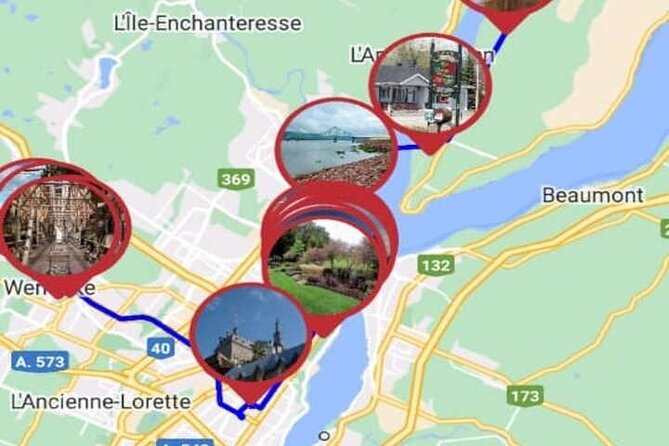
The route then moves toward Porte Saint-Louis, a city gate built in 1878. It is named for King Louis IX of France and uses a Victorian neo-Gothic design. Two towers flank the gate, with a drawbridge crossing the moat in front.
The gate offers a useful transition from the older core toward the Parliament area. It is also close to other major sights, including Château Frontenac and the Citadel. The supplied plan does not assign a separate duration or admission cost to the gate, so treat it as an outdoor landmark along the walk rather than a formal indoor visit.
The Parliament Building was designed by Eugène-Étienne Taché and built between 1877 and 1886. Its Second Empire style uses a red brick and limestone façade, eight floors, and a copper dome. Inside, the National Assembly hall has an upper gallery, frescoes, and marble columns.
The building matters beyond its architecture. It represents Quebec’s political autonomy and French identity. A one-hour stop makes sense if you want to appreciate both the exterior and any available interior access, but admission is not included. Check current entry arrangements before counting on a full interior visit.
In front of Parliament is La Fontaine de Tourny, a 13-meter bronze fountain created in 1853 by French sculptor Mathurin Moreau. It was shown at the 1855 World’s Fair in Paris, purchased by Maison Simons in 2003, restored, and donated to Quebec City in 2007 for the city’s 400th anniversary.
The fountain includes a central column with four figures representing Quebec’s rivers: the Saint Lawrence, Saguenay, Manicouagan, and Saint Maurice. Four smaller fountains refer to agriculture, trade, shipping, and industry. It is an easy outdoor stop, and it adds visual detail to the Parliament visit without requiring another ticket.
Museum of Civilization and the Citadel
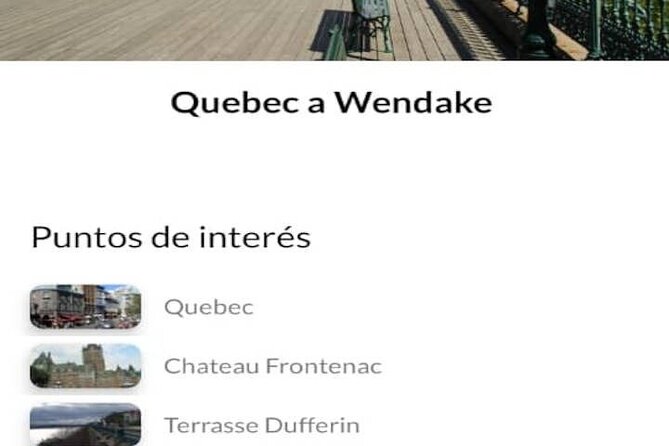
The Museum of Civilization offers the route’s broadest cultural stop. Opened in 1988, it focuses on culture and civilizations around the world, with special attention to Quebec and North America. Its collection includes more than 1.5 million objects, including archaeological material, artworks, historical documents, and photographs.
The suggested visit is one hour, but that is only enough for a sample. Admission is not included, so you need to decide if the museum fits your budget and available time. If you enjoy museums, this may be one of the places where the ten-hour schedule becomes optimistic.
The Citadelle of Québec shifts the focus from culture to defense. Built between 1820 and 1831, it follows a defensive system associated with the French engineer Vauban. The fortress has a star-shaped plan, moat, and walls. It also contains a museum telling the story of the fort.
A one-hour stop can give you an introduction and city views, including panoramas toward the St. Lawrence River. Admission is not included. Since the Citadel is one of the city’s major attractions, you should treat the audio tour as a way to reach and frame the site, not as a substitute for the full paid visit.
The contrast between the Citadel and Notre-Dame-des-Victoires is one of the route’s best features. Within the same day, you move from a French Baroque church to a later military complex built under British rule. That makes the city’s changing control and competing identities easier to understand.
La Pointe and the Plains of Abraham
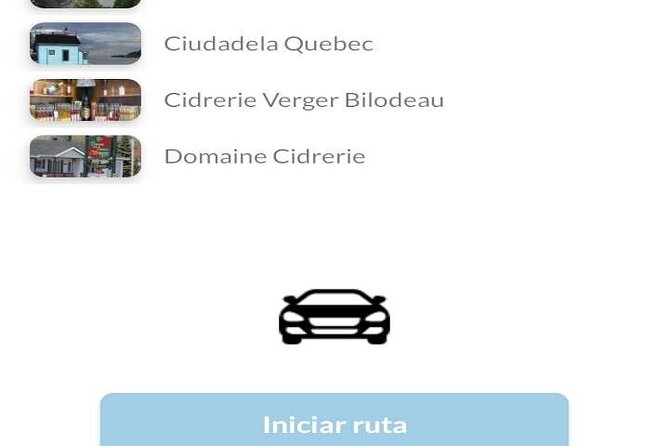
La Pointe-de-Québec is described as the original site of Quebec City. Samuel de Champlain founded the city in 1608, and this area was home to the first French settlers. It was also connected with major events such as the Battle of the Plains of Abraham in 1759.
The stop is presented as both historical and cultural, with museums, theaters, and art galleries in the wider area. It is free to visit, and the suggested duration is one hour. The description is broad, so do not expect a tightly defined attraction with a clear entrance gate. Think of it as a district-level stop that gives context to Quebec City’s beginnings.
Battlefields Park, also called Parc des Champs-de-Bataille, covers about one square mile, or 2.5 square kilometers. It preserves the site of the 1759 battle that decided the fate of New France. The park was created in 1881 and includes the Wolfe and Montcalm Monument, the National Battlefields Museum, and a Martello Tower.
The suggested visit is 30 minutes, with admission not included. That is enough for a short walk and a few monuments, but not enough for an extended museum visit and a broad tour of the grounds. The park is also used for picnics, hikes, and bike rides, so you may prefer to spend less time at an earlier indoor stop and give this open space more attention.
The route also names Laval University. Founded in 1663 as the Séminaire de Québec by Saint Francis de Laval, it is identified as Canada’s oldest university and Quebec’s largest. It has about 40,000 students and offers programs across fields such as medicine, law, engineering, business, and the arts.
The supplied plan does not assign a duration or admission cost to this stop. Use it as a point of historical context rather than assuming a campus tour is included.
Price, access, and the practical tradeoff
At $9.61 for a group of up to one person, the price is the strongest feature. A full-day route through major landmarks at this cost can be excellent value if you mainly want orientation and historical commentary.
The word group is slightly awkward here because the listed capacity is up to one person. This is effectively an individual self-guided experience, not a shared group tour. You are not paying for transportation, entry tickets, meals, or a live guide.
The experience is offered in English and uses a mobile ticket. Confirmation is sent at booking, and service animals are allowed. Most people can participate, but the route includes cobblestones, long periods on foot, outdoor areas, and a large number of stops. The supplied information does not give a precise accessibility route, so you should confirm specific mobility needs before purchase.
The biggest caution is access to the audio content. One purchaser received a ticket but not an obvious link to the walk. The provider explained that the email had to be confirmed and offered a refund in that case. I would check your confirmation immediately, complete any email verification, and make sure the tour opens before you begin sightseeing.
The cancellation terms are strict. The experience is non-refundable and cannot be changed for any reason. That makes the pre-departure check especially important.
Who should book this Quebec City audio tour?
I would recommend it to an independent visitor who wants a ready-made route and does not need a live guide. It suits a solo visitor particularly well, since the price is listed for one person and the activity is private.
It also suits anyone who wants to combine free outdoor sights with optional paid entries. You can walk past Château Frontenac, Dufferin Terrace, Place Royale, Porte Saint-Louis, La Fontaine de Tourny, La Pointe, and parts of Battlefields Park without buying admission. Then you can choose to pay for the Citadel, Museum of Civilization, Morrin Centre, Parliament, or the church if open and relevant to your interests.
I would be more cautious if you want a polished, hands-off experience. You must manage your own phone, route, timing, tickets, meals, and stops. The long plan may also feel ambitious in one day, especially if you enter several attractions.
Should you book it?
Book this experience if you want a very inexpensive English audio route through Quebec City’s major historic districts and you are comfortable organizing the day yourself. The range is impressive, and the private format lets you set the pace.
Skip it if you need guaranteed personal guidance, included admission, easy cancellation, or a tour that works without careful phone setup. Before paying, confirm that the email address is correct and that the audio access is available. At $9.61, it can be a smart way to get your bearings, but only if the digital access works as intended.
FAQ
Where does the Quebec City audio tour start?
It starts in Quebec City, Quebec, Canada, and ends back at the meeting point.
How long does the self-guided tour take?
The estimated duration is 10 to 12 hours.
What language is the audio tour offered in?
The experience is offered in English.
Is the tour private?
Yes. Only your group participates, and the listed capacity is up to one person.
Are admission tickets included?
No. Admission is not included for the listed stops such as Château Frontenac, Dufferin Terrace, Place Royale, Notre-Dame-des-Victoires, the Morrin Centre, Parliament, the Museum of Civilization, the Citadel, and Battlefields Park.
Is Old Quebec included?
Yes. Old Quebec is one of the stops, and it is listed as free admission.
Can service animals participate?
Yes. Service animals are allowed.
Can I cancel or change the booking?
No. The experience is non-refundable and cannot be changed for any reason.
Just added around Canada
- Queen Street West: An audio tour exploring Toronto’s coolest street★ 3.5 · 2 reviews
- Toronto’s Waterfront: a Smartphone Audio Walking Tour★ 5.0 · 5 reviews
- Irish Loop Smartphone Audio Driving Tour★ 4.5 · 7 reviews
- St. John’s Audio Walking Tour★ 4.0 · 4 reviews
- Fruit alcohol tasting + Velvet Orchards audio tour★ 5.0 · 2 reviews
- Quebec City Self-Guided Driving Audio Tour★ 4.0 · 7 reviews
- Smartphone Audio Driving Tour between Wasaga Beach and Toronto★ 4.5 · 3 reviews
- Layers of Natural History: Picton Nature Self-Guided Audio Tour★ 5.0 · 4 reviews
Self-Guided Tours, compared.

Acropolis Ticket & Optional Self-Guided Audio Tours
Read our review →


Ultimate Acadia National Park Self-Guided Driving Audio Tour
Read our review →
Santorini: Akrotiri Ticket with Optional Self-Guided Audios
Read our review →
Browse the lists this tour appears in