
REVIEW · CANADA AUDIO TOURS
Toronto’s Waterfront: a Smartphone Audio Walking Tour
Toronto’s waterfront rewards slow, curious walkers. This self-guided audio tour turns a 4.5-kilometre route into a useful first look at the city, linking parks, public art, sports venues, military sites, and the lakefront. I like the automatic GPS commentary, which lets you keep your phone in your hand without constantly searching for the next stop. I also like the freedom to pause for photos, food, or a longer look at the views.
The low price is another strong point. At $8.21 per person, it costs far less than a conventional guided walk and stays available for flexible use. The tradeoff is simple: you are responsible for your own phone, battery, navigation, and attention. The route can take 45 minutes to 90 minutes, but a relaxed walk with stops may take more than two hours.
Key points at a glance

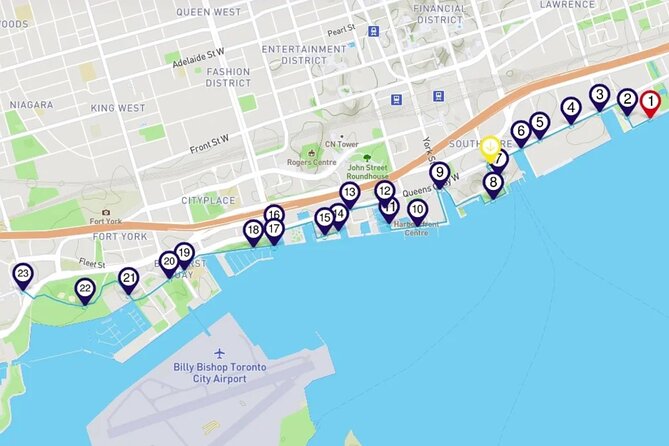
- A 4.5-kilometre waterfront route: Walk from Sugar Beach to Princes’ Gates through Toronto’s central lakefront.
- GPS-triggered audio: Commentary begins as you approach each point of interest, with a live map showing your position.
- Twenty named stops: Expect the CN Tower, Rogers Centre, Toronto Music Garden, Power Plant, HTO Park, and more.
- Flexible timing: Start, stop, and resume whenever you like, with no fixed tour date or group meeting time.
- A useful first-day introduction: The route explains Toronto’s waterfront, transport links, industry, parks, sports, and public art.
- Low-cost, private sightseeing: Only your group takes part, and no attraction admissions are included.
Sugar Beach is a pleasant place to begin
The tour starts at Sugar Beach, beside Toronto’s eastern waterfront. It is a practical meeting point because the route quickly introduces you to the city’s mix of industry, public space, and redevelopment.
The first audio segment sets the tone for the walk. You are not simply looking at the lake and nearby buildings. You are hearing how this part of Toronto developed and why the waterfront matters to the city.
From Sugar Beach, you move toward Lower Jarvis Street and Queens Quay East. This section provides context about Toronto’s industrial past. That background is useful because the waterfront is not just a line of parks and viewpoints. Factories, shipping, transport, and newspapers all helped shape the city you see today.
The nearby Redpath Sugar facility gives that story a physical landmark. The tour points out the waterfront factory and explains its history. This is one of the route’s better features: instead of treating the shoreline as scenery alone, the commentary connects what you see with Toronto’s working past.
More Audio Walking Tours in Canada
- Halifax Churches, Gardens & Graveyards: a Smartphone Audio Walking Tour
★ 4.5 · 25 reviews - Halifax Boardwalk & Seaport: a Smartphone Audio Walking Tour
★ 4.0 · 19 reviews - Explore Halifax with 3 Unique Smartphone Audio Walking Tours
★ 4.0 · 16 reviews
One Yonge Street and the story of Toronto’s streets

At One Yonge Street, the audio points out the Toronto Star Building. You hear about the newspaper’s long connection with the city, dating back to 1892. The stop gives you a reason to look up at a building that might otherwise become part of the downtown background.
The next stop is at Yonge Street and Queens Quay West. Here, the commentary turns to Yonge Street, once associated with the Guinness World Record for the longest road. This is a good example of the tour’s approach. It offers short pieces of civic trivia that make familiar streets easier to remember.
Do not expect a full urban history course at each stop. The supplied timing gives roughly five minutes per point, so the audio is designed as a compact introduction. You get a useful fact, some context, and directions to the next location rather than a long lecture.
Jack Layton, the ferry terminal, and island views
The statue of Jack Layton and the nearby Jack Layton Ferry Terminal provide another change of subject. The audio introduces Layton and points out the terminal, giving you a little political and local history along the route.
At York Street and Queens Quay West, you get a good view toward the Toronto Islands. This is one of the route’s most scenic moments, and the tour explains what you are seeing rather than leaving you to guess at the geography.
The island views also help you understand Toronto’s setting. The route keeps bringing your attention back to the relationship between the city and the lake. You see downtown from the waterfront, then later pass parks and paths that open the view again.
Art and public space at the Power Plant and Simcoe WaveDeck

The Power Plant Contemporary Art Gallery is included as a possible place to visit. The audio gives you a short introduction and explains why the gallery may be worth your time. Since the walking tour does not include admission, you can decide on the spot if you want to add an indoor visit.
At the Simcoe WaveDeck, the route becomes playful. The deck looks warped, but the shape is intentional public art that you can walk across. This is the sort of stop that works well with an audio guide because the commentary draws your attention to a detail you might otherwise treat as an odd piece of pavement.
The route includes other nearby places that are not formal points of interest. You can spend as much time as you like in these areas, but the audio does not promise a full description of every nearby attraction. Keep your expectations focused on the listed stops.
More Smartphone Audio Tours in Canada
- Cabot Trail: a Smartphone Audio Driving Tour
★ 4.5 · 118 reviews - Icefields Parkway: a Smartphone Audio Driving Tour
★ 4.0 · 118 reviews - Smartphone Audio Driving Tour between Banff and Calgary
★ 4.0 · 25 reviews - Smartphone Audio Driving Tour between Lake Louise and Calgary
★ 4.0 · 15 reviews
CN Tower and Rogers Centre: Toronto’s big landmarks

The CN Tower needs little introduction, but the audio gives you background about the former world’s tallest building. You will have clear chances to look up at it as you walk along the waterfront.
This stop does not include admission to the tower. That is important when you plan your budget. The tour gives you information and an outside view, but you need a separate ticket if you want to go up.
Rogers Centre follows as another major Toronto landmark. The commentary introduces the stadium and identifies it as the home of the Blue Jays. Sports fans will get a little extra value here, while other visitors still gain a useful orientation point in the downtown area.
The pairing works well. The CN Tower gives you Toronto’s architectural icon, while Rogers Centre adds the city’s sports identity. Both are easy to recognize later as you continue exploring downtown.
HTO Park and the Spadina Bus song
HTO Park offers a softer section of the walk. As you pass through the park, the audio explains the meaning behind its unusual name. The setting gives you a short break from tall buildings and major attractions.
At Spadina Avenue and Lake Shore Boulevard West, the tour points toward one of Toronto’s busiest streets. It also includes a song from the 1980s about the Spadina Bus. This is an unusual touch, and it keeps the experience from feeling like a string of dry facts.
The route is not trying to be formal or solemn at every point. Small details such as this song give the audio a lighter tone. If you prefer a quiet walk with no extra entertainment, you may find that feature less appealing, but it adds personality for many people.
Toronto Music Garden and Billy Bishop Airport

The Toronto Music Garden is one of the most distinctive stops. The audio explains the unusual story behind its design as you walk through the garden. You are given a reason to pay attention to how the space is arranged, not just to its plants and paths.
This is a good place to pause the tour. The experience has no strict schedule, so you can listen to the commentary, stop the audio, and spend more time in the garden before continuing. That flexibility is one of the best reasons to choose this format instead of a fixed group walk.
At Queens Quay West and Bathurst Street, the route gives you a view of Billy Bishop Airport on the Toronto Islands. The audio explains the airport and its place on the waterfront. You may also use this point to get a better sense of the city’s transport network, with downtown streets, the lake, islands, and airport all in the same view.
Little Norway, naval history, and the waterfront trails

Little Norway Crescent is a small park with a World War Two connection. The tour explains why the park was created and commemorates its historical purpose. It is a quieter stop, but that is part of its value. You get a break from the most famous sights and a reminder that Toronto’s waterfront has military and civic stories as well as tourist landmarks.
The route then connects with the Waterfront Trail. The audio introduces the trail and explains its role along the shoreline. Later, you walk part of the Martin Goodman Trail, which extends for more than 20 kilometres along the waterfront.
These trail sections are among the most practical parts of the route. They help you understand how the city’s waterfront functions as a public walking and cycling corridor. You are not only moving between attractions. You are also seeing how residents use the shoreline.
At HMCS York, the audio points out this naval waterfront fixture, in place since 1959, and explains its purpose. This stop adds another layer to the route’s story, linking the lakefront with Canada’s navy.
Princes’ Gates completes the walk
The final formal stop is Princes’ Gates, at the entrance to the Canadian National Exhibition grounds. The audio explains the gates and the annual exhibition held inside them.
This is a fitting finish because the route ends with another recognizable piece of Toronto’s civic identity. It also gives you a clear endpoint at 800 Lake Shore Boulevard West. The experience runs from Sugar Beach to the CNE area, crossing much of the central waterfront along the way.
The tour can also be taken in the opposite direction. The experience is said to be very similar either way, so you can choose the direction that fits your plans. If you begin at Sugar Beach, you finish near Princes’ Gates. If you start at the western end, you reverse the route.
How the GPS audio system works
Before setting out, download the tour over Wi-Fi. Once it is on your device, no signal or mobile data is required during the walk. That matters if you want to avoid using data or are unsure about coverage.
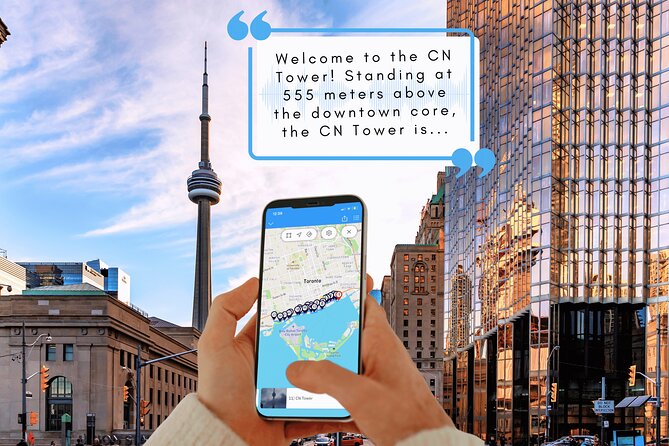
A live GPS map shows your location and the route ahead. As you approach a point of interest, the guide commentary plays automatically. You can also stop and start the tour wherever you like.
The tour includes a location-based trivia game. After the commentary plays, you look at your device and tap your answer. This gives you something active to do between stops and may appeal to families or anyone who likes a little structure.
Audio plays through the phone or tablet speaker, so headphones are optional. Headphones may be more comfortable near traffic or around busy public spaces, but you need to supply your own. You also need to supply the smartphone or tablet.
Timing, price, and practical value
The listed price is $8.21 per person, and the number of people selected at booking matches the number of devices that can download the tour. That detail matters if two people want to listen on separate phones.
For the cost, I see this as a strong-value orientation walk. A short guided introduction can quickly cost much more, while this option gives you route guidance, commentary, trivia, and flexible use. You can keep the tour and enjoy it at another time, not only on the original booking date.
The listed duration is about 45 minutes to 90 minutes. In practice, you should allow longer if you stop for pictures, visit the Power Plant, linger in the Music Garden, or pause at the viewpoints. One person described taking slightly more than two hours, which makes sense for a 4.5-kilometre walk with breaks.
There is no pressure to keep up with a group. You can pause for a coffee, stop at a park, or resume the next day. That is especially useful if you are fitting the waterfront between other plans.
Who should choose this self-guided walk?
I would recommend it to a first-time visitor who wants a quick introduction to Toronto without giving up personal freedom. The route covers major landmarks while adding less obvious details about industry, newspapers, the navy, public parks, and transport.
It also suits people who dislike crowded group tours or who prefer to listen at their own pace. A private format means only your group takes part, with no guide waiting for late arrivals and no fixed walking speed.
Families may enjoy the trivia game and the variety of sights. Independent visitors may appreciate the flexible dates and the ability to stop whenever a place catches their interest.
The main limitation is the lack of a live guide. If you want questions answered on the spot, personal stories, or a carefully adjusted route, this audio format will feel less personal. It also depends on your device, so download the tour first and start with enough battery.
Free cancellation is available if you cancel at least 24 hours before the scheduled start time. Cancellations within 24 hours are not refunded, and changes in that period are not accepted. The tour is offered in English, service animals are allowed, and most people can participate. Public transport is nearby.
Should you book it?
Book this tour if you want an inexpensive, flexible way to get your bearings along Toronto’s waterfront. The best parts are the GPS guidance, the wide mix of stops, the easy pacing, and the amount of useful context packed into a low-cost walk.
Skip it if you want a personal guide, a tightly scheduled sightseeing program, or admission to the CN Tower and other attractions. For everyone else, this is a smart first look at the shoreline, especially if you can give it two hours and allow time to stop along the way.
FAQ
How long is the Toronto waterfront audio tour?
The approximate duration is 45 minutes to 1 hour 30 minutes. You may need more time if you stop for photos, explore nearby places, or take longer breaks.
How far is the walking route?
The route covers approximately 4.5 kilometres.
Where does the tour start?
The tour starts at Sugar Beach in Toronto’s St Lawrence-East Bayfront-The Islands area.
Where does the tour end?
The endpoint is Princes’ Gates at the Canadian National Exhibition grounds, listed at 800 Lake Shore Boulevard West.
Can I take the tour in either direction?
Yes. The experience is similar in either direction, so you can begin at Sugar Beach or near Princes’ Gates.
Do I need mobile data during the walk?
No. You should download the tour using Wi-Fi before you begin. The tour does not require a signal or mobile data during the experience.
Do I need headphones?
No. Headphones are optional. Audio can play through your smartphone or tablet speaker.
Are attraction tickets included?
No. Admission tickets are not included. The tour provides outside commentary and route guidance, including information about the CN Tower, Rogers Centre, and the Power Plant.
What happens if I cancel?
You can receive a full refund if you cancel at least 24 hours before the experience start time. Cancellations made less than 24 hours before the start time are not refunded.
Just added around Canada
- Queen Street West: An audio tour exploring Toronto’s coolest street★ 3.5 · 2 reviews
- St. John’s Audio Walking Tour★ 4.0 · 4 reviews
- Irish Loop Smartphone Audio Driving Tour★ 4.5 · 7 reviews
- Fruit alcohol tasting + Velvet Orchards audio tour★ 5.0 · 2 reviews
- APP Self-Guided Tours Quebec with Audioguide★ 3.0 · 2 reviews
- Quebec City Self-Guided Driving Audio Tour★ 4.0 · 7 reviews
- Smartphone Audio Driving Tour between Wasaga Beach and Toronto★ 4.5 · 3 reviews
- Layers of Natural History: Picton Nature Self-Guided Audio Tour★ 5.0 · 4 reviews
Smartphone Audio Tours, compared.

Colosseum & Forum with Audio Guide App -Optional Arena
Read our review →
Timed Entry to Michelangelo’s David + Audio App
Read our review →
Cathedral & Brunelleschi’s Dome Ticket & Audio App
Read our review →
Michelangelo’s David Priority Ticket & Audio App
Read our review →
Uffizi Priority Ticket & Masterpieces Audio App
Read our review →
Castel Sant’Angelo Entry Ticket & Digital Audioguide
Read our review →
Pantheon Priority Entry Ticket & Audio Guide App
Read our review →Browse the lists this tour appears in