
REVIEW · NAPLES AUDIO TOURS
Herculaneum: skip the line entry ticket (art) + audioguide & map
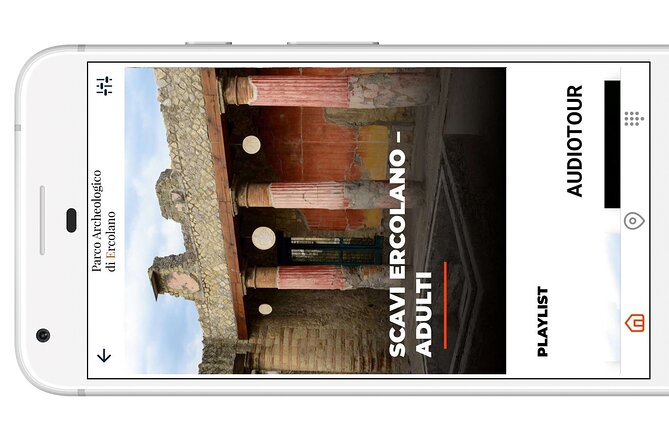
The smaller site can leave the bigger impression. This self-guided Herculaneum visit gives you skip-the-line entry, an audio guide, and a map for exploring a remarkably well-preserved Roman town at your own pace. I like the freedom to pause at houses, villas, mosaics, and the old city wall without staying with a live guide.
I also like that the visit is private to your group, even though the experience is not led by a tourist guide. The audio guide is generally informative and easy to use, but you should know that its instructions may not be clearly indicated, and some information can feel repetitive.
Plan on about three hours inside the archaeological park, with the full activity taking roughly two to four hours. If you have already visited Pompeii, Herculaneum may feel quieter and more compact, so I recommend seeing Herculaneum first if you plan to visit both.
Key points to know before you go
- Herculaneum before Pompeii: The smaller, better-preserved site can lose some of its impact if you see it after Pompeii.
- Self-guided exploration: You receive an audio guide and map, but no live tourist guide accompanies your group.
- Roman daily life on display: Houses, villas, mosaics, and the sea-facing city wall help bring ordinary life into view.
- Around three hours on site: The visit suits visitors who want time to look closely without committing to a full-day tour.
- Simple meeting point: Start and finish at the Herculaneum Ticket Office in Ercolano.
- Good cancellation flexibility: You can receive a full refund if you cancel at least 24 hours before the start time.
Why Herculaneum feels different from Pompeii
Pompeii is the larger name, but Herculaneum often delivers the sharper look at Roman domestic life. The site was buried differently during the eruption of Mount Vesuvius in 79 AD. One review describes it as being covered under marsh rather than ash, which helps explain why parts of the town are so well preserved.
That preservation is the main reason to visit. You are not simply walking around foundations. You can look at houses, villas, mosaics, and other remains that help show how a Roman town worked from the inside. The experience is less about racing from one famous monument to another and more about noticing details as you move through the streets.
I find the old city wall especially useful for understanding the setting. A view of the wall that once bordered the sea helps explain where Herculaneum sat and why the town had a strong connection to the coast. It gives the ruins a clearer sense of place than a map alone can provide.
Herculaneum is also more compact than Pompeii, which makes it a practical choice if you want a major archaeological site without giving up an entire day. You can spend about three hours examining the remains, listening to the commentary, and taking breaks at your own pace.
More Skip-the-Line Tickets in Naples:
- Mount Vesuvius: Skip-the-Line Ticket and Smart Digital Guide
★ 4.2 · 2,780 reviews - Pompeii: Skip-the-Line Entry Ticket with Audio Guide or Tour
★ 4.1 · 1,364 reviews - Herculaneum: Skip-the-Line Entry Ticket with Audio Guide
★ 4.3 · 870 reviews
What is included at the Ticket Office
Your meeting point is the Herculaneum Ticket Office at 80056 Ercolano, in the Metropolitan City of Naples. This is also the ticket redemption point, and the activity ends back there after your visit.
The package includes an Herculaneum entrance ticket listed as an artecard, an audio guide, and a map. The entry ticket matters most if you want to avoid arranging admission separately. The map gives you a basic way to orient yourself, while the audio guide supplies the historical explanations as you move around.
There is no tourist guide included. That distinction is important. You will not have a person leading your group from building to building, answering questions in real time, or adjusting the pace around your interests.
The activity is private, meaning only your group participates. In practice, this gives you freedom rather than a private guided tour. You can stop for a longer look at a mosaic, move ahead when a section interests you less, or listen to commentary when you choose.
The audio guide was described as easy to use and informative, though a little repetitive. Another useful warning is that the audio guide was not always clearly indicated. I would pay close attention when collecting or activating it, and ask at the ticket office if you are unsure how to begin.
Walking through houses, villas, and mosaics
The itinerary has one main stop: the Archaeological Park of Herculaneum. That sounds simple, but the park itself provides the substance of the visit. You wander through the remains of a Roman town rather than follow a series of separate attractions around Naples.
Start by using the map to get your bearings. Then choose a steady pace. The audio guide works best when you treat it as a companion rather than a strict route. Listen near the buildings it describes, then give yourself time to look without commentary.
The houses and villas are the heart of the experience. They show the private side of Roman life, while the street plan and public areas help place those homes within a functioning town. The mosaics add visual detail, but they work best when you connect them to the spaces around them rather than viewing them as isolated decoration.
I would not rush from one audio stop to the next. Herculaneum rewards slow looking. You might notice how a room connects to another, how a house opens toward the street, or how the surviving decoration changes your sense of the people who once used the space.
The audio content is useful for supplying context, especially if Roman archaeology is new to you. Still, the commentary can become repetitive. If you already know a lot about Roman towns, you may prefer to listen selectively and spend more time reading the site visually.
The old city wall and the view toward the sea
One of the most helpful details at Herculaneum is the city wall that once bordered the sea. It gives you a clear physical clue about the town’s former position and helps explain why the setting matters.
This is the kind of feature that can be easy to miss with a quick visit. A live guide might call attention to it, but here you need to use the map and audio guide actively. If the route does not immediately point it out, ask at the ticket office where to find the relevant section or watch for the audio stop connected with the wall.
The sea-facing setting also gives the ruins a different character from Pompeii. Herculaneum is not only a place where the eruption buried buildings. It is a town whose location shaped its daily life, and the wall helps make that point visible.
The site’s preservation is another major strength. One account explains that Herculaneum was buried under marsh rather than ash, which helped protect more of its built environment. That is why the visit can feel unusually direct. You are looking at surviving domestic spaces, not only traces of where buildings once stood.
A few more audio tours around Naples worth a look
- From Naples: Caserta Palace Ticket and Train with Audioguide
★ 4.3 · 348 reviews - Naples: Pompeii Self Guided Audio Tour
★ 3.9 · 211 reviews - Naples: National Archaeological Museum Tour & Digital Guide
★ 4.2 · 177 reviews - Naples: National Archaeological Museum audio guide
★ 4.0 · 155 reviews
How the audio guide affects the visit
The audio guide is both the main strength and the main limitation of this experience. It lets you explore independently and adds information without requiring a scheduled live tour. For many people, that is enough structure for a three-hour visit.
I like self-guided audio at a site such as this because you can control the rhythm. You do not have to wait while a group gathers, and you can pause when a room catches your attention. A private group can also make its own decisions instead of following strangers.
The practical weakness is that the audio guide may not be clearly marked or explained at first. Do not assume the process will be obvious. Confirm what you have received, how to start it, and how the map relates to the audio stops before walking away from the ticket office.
The content is informative, but it can repeat itself. That is not a serious flaw if you listen in short sections. If a passage feels familiar, move on and return your attention to the buildings. The park itself is the main attraction, not the recording.
This setup suits independent visitors who enjoy learning while walking. It is less suitable if you want detailed conversation, specialist interpretation, or someone to answer questions about a particular house or mosaic.
Herculaneum or Pompeii first?
The order matters. I recommend Herculaneum before Pompeii if you intend to visit both.
Herculaneum is smaller and more intimate. Its strong preservation can make it feel remarkably focused, especially when you move through the houses, villas, and mosaics. Afterward, Pompeii’s larger scale may feel like a natural expansion of the story.
The reverse order can create a problem. After several hours at Pompeii, you may expect Herculaneum to provide the same scale and range. Instead, its compact size may seem underwhelming, even though its preservation is one of its greatest strengths.
This is not a reason to skip Herculaneum. It is a reason to set the right expectations. You are choosing a concentrated archaeological visit, not a second Pompeii.
If Herculaneum is your only ancient site near Naples, the experience should feel more complete. You can give the houses, mosaics, and city wall the attention they deserve without comparing every street to Pompeii.
Timing, transport, and physical effort
The visit lasts roughly two to four hours, with about three hours allocated to the archaeological park. That makes it easier to fit into a Naples-area day than a longer guided excursion.
The meeting point is in Ercolano, not central Naples. The activity information says the site is near public transportation, so it is practical to plan your route around the Herculaneum Ticket Office. The supplied details do not specify a particular train, bus, or transfer, so check your transport plan before setting out.
You should leave enough time to find the ticket office and redeem the entrance ticket. A late arrival could reduce the time available inside, especially if you want to listen to much of the audio guide.
The activity says most people can participate, and service animals are allowed. No special physical requirements are provided, so you should judge the site according to your own comfort with walking around an archaeological park. The duration is manageable, but this is still an outdoor historical site where you will spend time moving between remains.
The private format is useful for families, couples, or friends who want to keep their own pace. It does not mean you receive a private archaeologist or guide. Think of it as independent entry with tools for orientation.
Is the ticket good value?
No price is provided here, so I cannot judge the exact cost against competing tickets. The value depends on how much you want the audio guide and how much convenience you place on having admission and orientation arranged together.
The package earns its keep if you want three things in one booking: entry, basic navigation, and recorded explanations. You avoid the work of arranging those parts separately, and you can spend your time inside rather than figuring out what to see next.
The value is weaker if you expect a personal guide. There is no tourist guide included, and the audio narration may repeat information. People who prefer conversation and tailored explanations may find a small live tour more satisfying, even if it costs more.
For an independent visit, the arrangement is straightforward. You meet at the Herculaneum Ticket Office, collect the included materials, and explore the park. If you already know the site well, the ticket and map may matter more than the audio guide.
The experience has a middling overall rating of 2.8 from five ratings, so I would book with realistic expectations. The strongest response is directed at Herculaneum itself, which is repeatedly described as fascinating and exceptionally well preserved. The weaker points concern the delivery of the audio guide and one cancellation involving a Spanish-speaking guide.
That cancellation deserves a clear explanation. The experience is offered in English, while one account describes a last-minute cancellation after a Spanish guide became ill. Since this activity does not include a tourist guide and is listed as English-only, confirm the language and exact service you are booking if language support is important to you.
Who should book this Herculaneum visit?
I would choose this for an independent visitor who wants a structured archaeological visit without joining a larger guided group. It suits you if you like setting your own pace, listening to information in short sections, and spending time with houses and mosaics rather than rushing through a checklist.
It also works well for someone with a limited schedule. Two to four hours is enough to make the visit worthwhile without taking over your day in Naples.
Families and small groups may appreciate the private format because nobody outside your party controls the pace. Couples who want quiet time at the site may also prefer it to a live group tour.
I would look for another option if your main goal is expert commentary, detailed questions, or a guide who points out every important feature. The audio guide is useful, but it cannot adjust itself to your interests.
If you are visiting Pompeii too, book this one first. That single planning choice can make the difference between seeing Herculaneum as a distinct and beautifully preserved town or treating it as a smaller repeat of the day before.
Should you book it?
Book this experience if you want independent entry to Herculaneum with an audio guide and map already included. The park’s preserved houses, villas, mosaics, and sea-facing wall provide plenty to see, and three hours gives you enough time to look closely.
Skip it in favor of a live guided option if you need a person to lead you, answer questions, or explain the site in a language other than English. Also remember that the audio guide may be hard to identify at first and somewhat repetitive.
For most self-directed visitors, the best plan is simple: visit Herculaneum before Pompeii, confirm the audio guide at the ticket office, and allow yourself time to wander without rushing from stop to stop.
FAQ
Where does the Herculaneum experience start?
It starts at the Herculaneum Ticket Office in Ercolano, Metropolitan City of Naples, Italy. This is also the ticket redemption point.
Where does the activity end?
The activity ends back at the meeting point, the Herculaneum Ticket Office.
How long does the visit take?
The experience lasts approximately two to four hours, with about three hours listed for the archaeological park.
Is a live tourist guide included?
No. The package includes an entrance ticket, audio guide, and map, but it does not include a tourist guide.
What language is offered?
The experience is offered in English.
Can I cancel for a full refund?
Yes. You can cancel at least 24 hours before the experience start time for a full refund. Cancellations or changes made within 24 hours are not refunded or accepted.
Just added around Naples
- Mount Vesuvius Skip the Line Ticket + Multilingual Audio Guide★ 4.0 · 32 reviews
- Naples: Royal Palace Entry Ticket with Digital Audio Guide★ 4.0 · 3 reviews
- From Naples Explore Pompeii Freely with Your Personal Audioguide★ 3.5 · 3 reviews
- Pompeii from Naples: Smart Audio Guide with Travel Instructions★ 5.0 · 4 reviews
- Interactive audio guide for the historic center of Naples★ 5.0 · 43 reviews
- Naples from Above: Castel Sant’Elmo Access & Audio Guide★ 3.0 · 2 reviews
- Naples: Herculaneum Entry Ticket with Digital Audio Tour★ 3.5 · 6 reviews
- Audioguided Vespa Tour of Naples (Vespa with driver)★ 5.0 · 9 reviews
Skip the Line, compared.

Topkapi Palace and Harem Skip-the-Line-Tickets & Audio Guide
Read our review →
Pantheon Reserved Entry Ticket with Audio Guide
Read our review →
Borghese Gallery Skip-the-Line Ticket & Audioguide
Read our review →
Skip the Line: Vatican & Sistine Chapel Ticket with Audio Guide
Read our review →
Skip-the-line Entry Ticket with Audio Guide & Map
Read our review →
Mount Vesuvius: Skip-the-Line Ticket and Smart Digital Guide
Read our review →
Borghese Gallery Skip-the-Line Tickets with Audioguide
Read our review →
Taormina: Ancient Theater Skip-the-Line Ticket & Audio Guide
Read our review →Browse the lists this tour appears in