

REVIEW · NAPLES AUDIO TOURS
Pompeii from Naples: Smart Audio Guide with Travel Instructions
Pompeii rewards patience. This self-guided day trip from Naples pairs a GPS-powered mobile audio guide with instructions for getting to and from the ruins, so you can explore without joining a fixed group. I like the freedom to linger at a favorite house, skip a less interesting temple, and share one guide across multiple phones. The clear route planning and round-trip transport advice are also useful, especially if you are visiting Pompeii independently for the first time.
The main trade-off is simple: you must manage your own transportation and pay roughly 30 euros extra for entrance and public transport. You also need active mobile data or roaming, a charged phone, and enough energy for a long day on ancient streets. If you want a live archaeologist beside you, this is not the right format. If you prefer control, quiet, and a lower price, it is a smart option.
Key points to know before booking
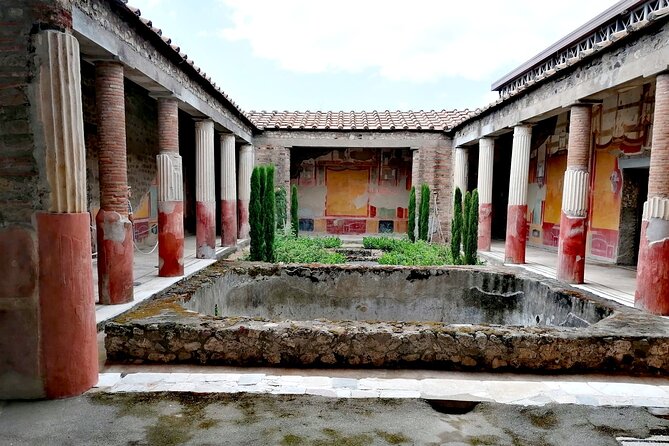
- GPS directions lead you from site to site, with audio, photos, and historical information on your phone.
- The full route can take eight to ten hours, depending on how many of the 18 suggested stops you visit.
- One Smart Audio Guide can be used on multiple phones at the same time, which helps a couple or small family share the cost.
- Transportation help covers the journey from Naples to Pompeii and back, but tickets are not included.
- WhatsApp support is available throughout the day, giving you a human contact if the app or route causes trouble.
- The itinerary is private and flexible, with no strangers, fixed commentary schedule, or pressure to keep pace.
How the Smart Audio Guide works in Pompeii
You receive access to the app before the experience begins. Once you are inside Pompeii, GPS helps identify your position and points you toward the next attraction. The app combines spoken commentary with photographs and written information, so you can listen, look, and move at your own pace.
That flexibility matters in Pompeii. The ancient city covers a large area, and your interest may change once you see the ruins in person. You might spend longer than expected in a richly decorated house, then decide that another temple deserves only a quick look. A group tour rarely gives you that choice.
The route includes 18 stops, with most suggested at about 30 minutes and the sculpture of the Centaur by Igor Mitoraj at about 20 minutes. Those times add up to a long day before you include transport, food, pauses, and wrong turns. Treat the itinerary as a menu, not a command. You can follow the whole route or create a shorter visit around the places that matter most to you.
The app is praised for being precise and easy to use. That is important because Pompeii can feel confusing on a first visit. Ancient streets do not always make modern sense, and some buildings are tucked away from the main paths. GPS guidance cannot replace common sense, but it should help you get your bearings.
A few more audio tours around Naples worth a look
- Mount Vesuvius: Skip-the-Line Ticket and Smart Digital Guide
★ 4.2 · 2,780 reviews - Pompeii: Skip-the-Line Entry Ticket with Audio Guide or Tour
★ 4.1 · 1,364 reviews - Herculaneum: Skip-the-Line Entry Ticket with Audio Guide
★ 4.3 · 870 reviews
Getting from Naples to Pompeii

The experience begins in Naples, with travel information for the round trip. The instructions are part of the value here. You are not simply handed an audio file and left to work out the day yourself. You receive guidance for reaching Pompeii and returning to Naples afterward.
Public transportation tickets are not included, and the supplied cost estimate is about 30 euros for entrance and transport. Add that amount to the $24.10 tour price when judging the total cost. The audio guide is inexpensive compared with a private guide, but it is not an all-inclusive Pompeii ticket.
The opening hours shown for this experience cover every day from noon to 11:30 p.m., from December 23, 2024, through February 4, 2027. These are booking hours rather than a promise that Pompeii itself is open for a late-night visit. Check the app instructions and current site details before setting out.
Your phone must have active roaming or mobile data. This is not a small technical footnote. The app uses your location, and you may need data for directions, commentary, or WhatsApp support. Downloading or checking the app before leaving Naples is sensible, but the supplied instructions still require mobile connectivity during the outing.
Villa dei Misteri and Pompeii’s civic center
The Villa dei Misteri is a strong opening stop because its frescoes give you an immediate sense of Pompeii’s visual power. Several rooms carry painted scenes linked to rituals, ceremonies, and the cult of Dionysus. The audio commentary can help you look beyond the colors and notice how the paintings fit into the rooms around them.
Allow about 30 minutes here, though art lovers may want longer. The villa is away from some of Pompeii’s busiest central sights, so the GPS route is especially useful. If your time is limited, you may choose to save this stop for a quieter, more focused visit rather than rushing through it.
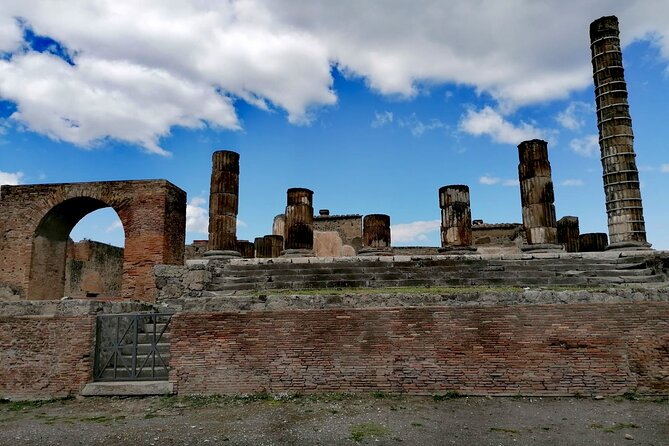
The Forum then shifts your attention from private life to public life. This large rectangular space measures about 38 by 142 meters and was lined with major public buildings, temples, and statues. The scale is easier to understand when you imagine it as the civic heart of the city rather than simply an open paved area.
The Temple of Jupiter sits at one end of this public zone. It began as a temple to Jupiter, the Roman sky and thunder god, and later served the Capitoline Triad of Jupiter, Juno, and Minerva. The stop is useful for understanding how religion and government shared the same public setting.
Next comes the Basilica, a civic building used for meetings, legal business, and commercial activity. It is not a church in the modern sense. The audio guide can help you read the building through its original function, which is often harder to grasp from the surviving columns alone.
The Sanctuary of Apollo completes this central cluster. A surrounding colonnade enclosed the courtyard and created a formal setting for religious ceremonies. These first five stops work well together because they introduce Pompeii’s public, political, and religious life before you move into more personal spaces.
The Lupanar, theaters, and public entertainment

The Lupanar, or Lupanare Grande, is one of Pompeii’s most widely known buildings. It was the city’s main brothel and offers a direct, sometimes uncomfortable look at Roman attitudes toward sex. The stop is brief enough to fit into most visits, but the subject may not suit young children or anyone who prefers to skip adult material.
The Teatro Grande gives you a very different view of public life. It held roughly 5,000 to 6,000 spectators, making it a major entertainment venue. As you look across the structure, the important point is not only its size but the idea of a city gathering in one place for performance.
The amphitheater is an especially worthwhile stop. Built around 70 BCE, it is described as the oldest surviving stone amphitheater in the Roman world. That date places it before the Colosseum in Rome, a fact that makes the building more interesting than its plain exterior might suggest.
The route also includes the Palestra Grande, a large exercise and training space. Its scale reflects the Roman interest in athletics, physical training, and social activity. You can compare it with the theaters and amphitheater to see how much of Pompeii’s public life centered on organized crowds.
These sites are good choices if you want more than houses and mosaics. They show how Pompeii functioned as a community, with formal spaces for law, religion, sport, theater, and spectacle.
Same place, a different route to walk:
- From Naples: Caserta Palace Ticket and Train with Audioguide
★ 4.3 · 348 reviews - Naples: Pompeii Self Guided Audio Tour
★ 3.9 · 211 reviews - Naples: National Archaeological Museum Tour & Digital Guide
★ 4.2 · 177 reviews - Naples: National Archaeological Museum audio guide
★ 4.0 · 155 reviews
Pompeii’s baths, gardens, and private houses

The Stabian Baths are among the oldest baths in the Roman world, with early construction dating to the Samnite period, before Roman control. The complex changed over time, which makes it useful for seeing how buildings were adapted rather than built once and left alone.
The Praedia of Julia Felix offers a more domestic setting. It belonged to Julia Felix, a wealthy and enterprising woman whose name appears in a property rental advertisement found during excavation. The site can help you picture Pompeii not only as a city of public monuments but also as a place where private owners managed property and business.
The Casa del Fauno is famous for the bronze dancing faun found in the impluvium, a basin designed to collect rainwater in the atrium. The house gives you a clear sense of Roman domestic planning, with the atrium acting as a central organizing space. Its name comes from the statue, but the arrangement of rooms is just as important.
The House of the Dioscuri takes its name from Castor and Pollux, twin figures in Greek and Roman mythology associated with strength and the protection of sailors. The audio guide can provide the mythological background while you examine the decorative program of the house.
At the Casa di Meleagro, look for the atrium, the central impluvium, and the large peristyle courtyard with columns. The house is a good example of how Roman homes used a sequence of open spaces to bring light, air, and ceremony into private architecture.
The Casa dei Vettii is linked to two freedmen, Aulus Vettius Conviva and Aulus Vettius Restitutus. Inscriptions connect the house with these owners, offering a useful reminder that Pompeii’s prosperous residents did not all come from old aristocratic families.
The Casa del Menandro rounds out the residential section. A storage room held a hoard of more than 100 silver objects, including cups, plates, and bowls. That detail gives the house a practical angle: Pompeii’s homes were not just display spaces but working places where valuable household goods were stored and managed.
You will not absorb all these houses equally in one day. I would choose two or three for careful attention, then use the others as shorter stops. The app gives you the choice, which is one of its best features.
The Igor Mitoraj sculpture and Torre di Mercurio

The Centaur by Polish artist Igor Mitoraj adds a modern note to an ancient setting. Mitoraj is known for classical themes interpreted through modern sculpture, so this stop creates a conversation between Pompeii’s ancient forms and a later artist’s response to them.
The suggested time is about 20 minutes. It is an easy stop to shorten if you are tired, but art lovers may appreciate the change of pace after so many ruins and wall paintings.
Torre di Mercurio is thought to have been a multi-story building, possibly with living quarters above and shops or workshops below. Its possible mix of residential and commercial use gives you another glimpse of ordinary urban life. Not every structure in Pompeii was a grand house or temple. Some buildings served several purposes at once.
Is the $24.10 price good value?

At $24.10 per person, the guide is reasonably priced for a private, self-paced experience, especially if two people can use one app at the same time. The included route planning, photos, audio commentary, return-trip instructions, and WhatsApp assistance add practical value.
The final cost is higher once you add roughly 30 euros for entrance and public transportation. That does not make the experience poor value, but you should compare it with the price of a live guided tour before booking. The savings come from independence, not from having every expense bundled together.
I would choose this format if I already knew I wanted to explore at my own speed. It is also useful for a small group with different interests. One person can linger over frescoes while another moves on, then you can regroup without disrupting a guide’s schedule.
I would pay more for a live guide if Roman archaeology were the main reason for my visit and I wanted questions answered on the spot. This app gives you a great deal of information, but it cannot react to your curiosity in the way a good human guide can.
Who should book this Pompeii experience?
This works best for independent visitors who are comfortable using a smartphone and following directions. It suits couples, families, and small private groups that dislike being tied to a fixed pace.
You should also be ready for a physically demanding day. The experience recommends moderate physical fitness, and Pompeii requires time on foot across a large archaeological site. Comfortable shoes, water, sun protection, and a charged phone are sensible preparations, although food and drinks are not included.
The format is less suitable if you dislike phone-based tours, have unreliable mobile data, or want door-to-door transportation included. You also need to accept that a GPS app can guide you, but it cannot remove every uncertainty from a large ancient site.
Free cancellation is available if you cancel at least 24 hours before the start time. Cancellations within 24 hours are not refunded, and changes inside that window are not accepted.
Final verdict: a flexible way to see Pompeii
I would book this experience if I wanted a low-cost private tour structure without a group leader. Its strongest points are the precise GPS route, the ability to skip or extend stops, the useful Naples transport instructions, and the chance to use one guide on multiple phones.
The biggest caution is the extra work. You arrange public transport, buy admission separately, keep your data working, and manage your own day. If you are comfortable with that, the Smart Audio Guide gives you a clear path through Pompeii and enough choice to make the visit feel personal.
FAQ
How long does the Pompeii experience take?
The full experience takes approximately eight to ten hours, including the journey from Naples and the visit to Pompeii.
Is transportation from Naples included?
Travel information for the round trip is included, but public transportation tickets are not included.
Are Pompeii entrance tickets included?
No. Entrance tickets are not included. The supplied estimate for entrance and public transportation is about 30 euros.
Can I use the audio guide on more than one phone?
Yes. One Smart Audio Guide can be used on multiple phones at the same time.
Do I need mobile data or roaming?
Yes. You must have active roaming or mobile data because the app uses your phone during the experience.
Is this a group tour?
No. It is a private activity for your own group, with no strangers joining you.
Can I cancel for a full refund?
Yes, if you cancel at least 24 hours before the experience start time. Cancellations made less than 24 hours in advance are not refunded.
Just added around Naples
- Mount Vesuvius Skip the Line Ticket + Multilingual Audio Guide★ 4.0 · 32 reviews
- Naples: Royal Palace Entry Ticket with Digital Audio Guide★ 4.0 · 3 reviews
- From Naples Explore Pompeii Freely with Your Personal Audioguide★ 3.5 · 3 reviews
- Interactive audio guide for the historic center of Naples★ 5.0 · 43 reviews
- Naples from Above: Castel Sant’Elmo Access & Audio Guide★ 3.0 · 2 reviews
- Naples: Herculaneum Entry Ticket with Digital Audio Tour★ 3.5 · 6 reviews
- Audioguided Vespa Tour of Naples (Vespa with driver)★ 5.0 · 9 reviews
- 3-Days Audio Guide for Pompeii, Herculaneum, Vesuvius and Naples★ 5.0 · 7 reviews
Naples Audio Tours, compared.

Mount Vesuvius: Skip-the-Line Ticket and Smart Digital Guide
Read our review →
Skip-the-Line Entry Ticket with Audio Guide or Tour
Read our review →
Herculaneum: Skip-the-Line Entry Ticket with Audio Guide
Read our review →
Caserta Palace Ticket and Train with Audioguide
Read our review →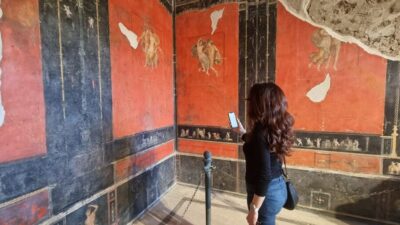

National Archaeological Museum Tour & Digital Guide
Read our review →

Royal Palace Entry Ticket with Digital Audio Guide
Read our review →Browse the lists this tour appears in