
REVIEW · NAPLES AUDIO TOURS
Herculaneum: Skip-the-Line Entry Ticket with Audio Guide
Ancient doors still open after 2,000 years. Herculaneum is a compact Roman town with original wooden doors, colorful frescoes, mosaics, and furniture that make daily life feel unusually close. I like the freedom to wander at your own pace, and I like that the audio guide adds useful context without tying you to a group. The main drawback is that the ticket and audio collection process can be confusing, and the numbered audio stops do not always match the site perfectly.
This is a strong choice if you want a quieter alternative or companion to Pompeii. The site is easier to cover in two to four hours, though you can spend most of a day if you stop often. Bring identification for the audio device, wear shoes with a good grip, and ask clearly where to collect the map and audio guide before entering.
Key points to know before you go
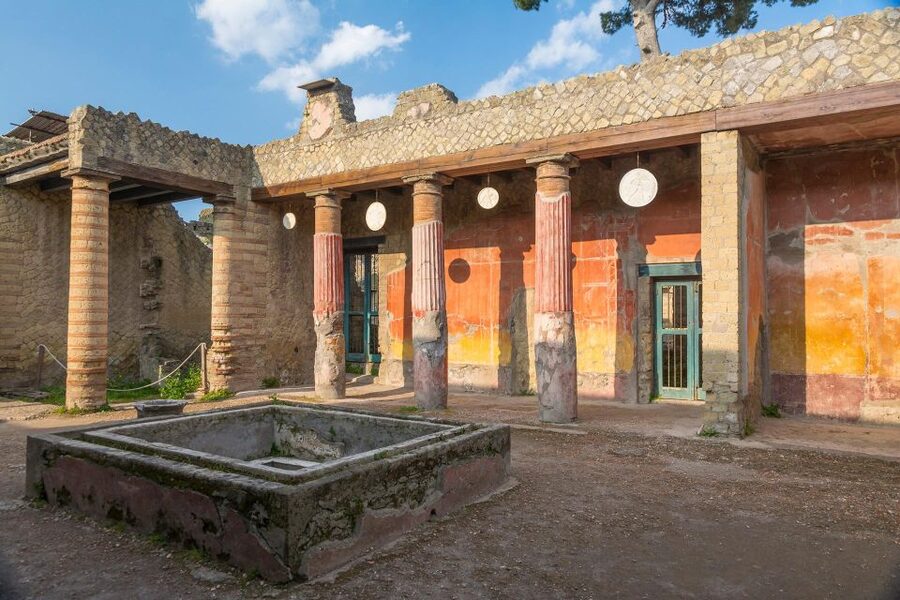
- Herculaneum is smaller than Pompeii but often more intact: Wooden beams, doors, wall paintings, mosaics, and household details survive in remarkable condition.
- The $15 price needs careful checking: The entry ticket may need to be selected as an extra, so confirm that your booking includes both admission and the audio guide.
- The audio guide works at your own pace: English, French, German, Italian, and Spanish are available, but some site numbers and audio numbers can be hard to match.
- Allow at least two to three hours: Four hours gives you time for the main streets, houses, boat sheds, museum displays, and pauses.
- Go early for a calmer visit: The site tends to become busier later, and morning light and cooler temperatures make the uneven streets easier.
- The final boat-shed area is especially moving: This is where people sought escape toward the sea during the eruption of Vesuvius in 79 AD.
Why Herculaneum feels different from Pompeii
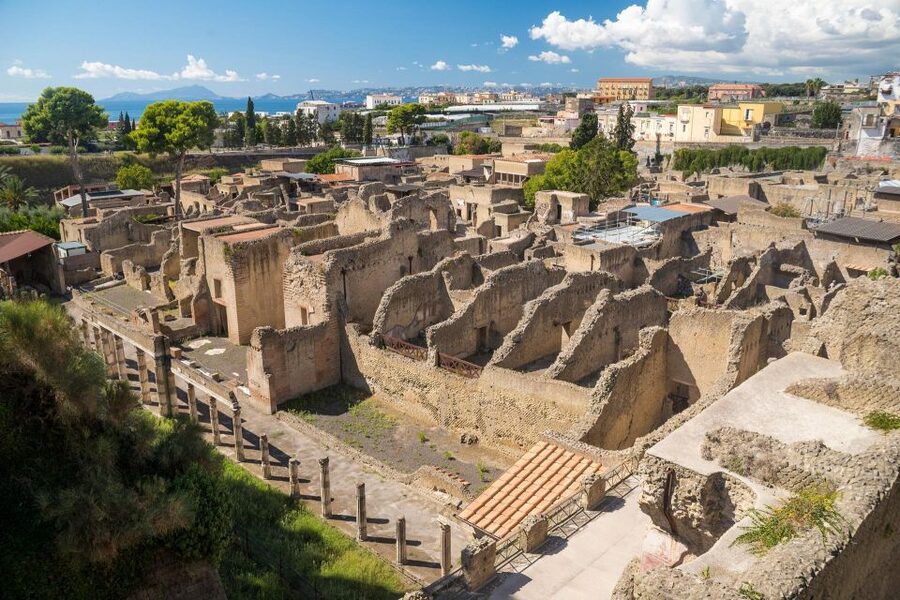
Herculaneum was a Roman town on the Bay of Naples, buried during the eruption of Mount Vesuvius in AD 79. Pompeii is much larger and gives you long streets and broad urban views. Herculaneum is more compact, but many individual buildings are preserved with startling detail.
That difference matters. At Pompeii, you may spend hours trying to grasp the scale of the city. At Herculaneum, I find it easier to picture one household, one shop, or one street corner. You can pause beside a painted wall and then look at the threshold, floor, doorway, and upper-level supports nearby. The details work together.
The volcanic material that covered Herculaneum helped preserve wood and other objects that usually disappear from ancient sites. You may see wooden doors, beams, counters, decorative plaster, and household fittings. The preservation does not make the place cheerful. It makes it personal. You are not only looking at ruins. You are looking at homes interrupted by disaster.
The site also includes the area where around 300 people died while waiting for rescue near the sea. This section changes the tone of the visit. The colorful houses and elegant rooms give way to one of the most sorrowful parts of the archaeological park.
More Skip-the-Line Tickets in Naples:
- Mount Vesuvius: Skip-the-Line Ticket and Smart Digital Guide
★ 4.2 · 2,780 reviews - Pompeii: Skip-the-Line Entry Ticket with Audio Guide or Tour
★ 4.1 · 1,364 reviews - Vesuvius National Park Skip-The-Line Ticket and Audio Guide
★ 3.4 · 141 reviews
Arriving at the archaeological park
The meeting point is the Herculaneum ticket office. Show your booking there, then follow the staff instructions for admission and the audio guide. This sounds simple, but the practical arrangement may involve more than one desk.
Some people have been directed to an audio-guide office first, then back toward the ticket line. Others have found the entrance process quick, with no queue at all. At busy times, that back-and-forth could cost you time, so ask one direct question at the start: Where do I collect the audio guide, and where do I present the entry ticket?
The skip-the-line benefit is also variable. On quieter mornings, especially outside the busiest periods, there may be little or no queue to skip. The ticket remains useful, but do not assume it will always produce a dramatic time saving.
If your booking option says audio guide, no ticket, you need to add the Herculaneum entry ticket separately. This is the most important price detail. The advertised cost of about $15 per person can be good value when admission is included, but it is not the same deal if you have purchased only the audio component.
You may need to leave a passport, identity document, or another accepted form of identification while using the audio device. Bring a passport or ID card, and ask what the staff will accept. One visitor reported that an insurance card was accepted, but an official passport or identity card is the safest choice.
How the audio guide and map work
The audio guide is designed for independent exploring. You choose the buildings that interest you, listen to the matching explanation, and move on when you are ready. That is a real advantage over a fixed group, especially if one person wants to study a mosaic while another wants to keep walking.
The device includes a site map, and a printed map may also be available. Ask for one at the beginning. A map makes the compact site easier to understand and helps you plan a route rather than repeatedly retracing your steps.
The weak spot is the numbering. Some audio stops do not match the numbers you see on the buildings, and the physical route does not always follow the numerical order. At times, the commentary can seem to jump to another house. This is not a reason to abandon the guide, but you should expect to spend a few minutes getting oriented.
I suggest walking a short distance first, then testing the audio against one or two clear points. Once you understand the number system, the guide becomes much easier. Keep the volume up, as one person found the device rather quiet. The supplied device may work with headphones or earbuds, though Bluetooth use is not consistently available.
The content itself is one of the strongest parts of the experience. It explains what you are seeing, how Roman households were arranged, and how different parts of the town functioned. Some app content also offers 3D and 360-degree views of objects as they may have appeared before the eruption. That can help when a room is now partly bare.
The first streets: shops, fountains, and public life
Use the map to locate the market area, public fountains, and main streets. These spaces help you move beyond the grand houses. Herculaneum was not just a collection of wealthy villas. It was a working town with places to buy goods, collect water, meet neighbors, and move through the day.
The ancient market gives the site an everyday quality. You can imagine the practical business of buying food and supplies, rather than only admiring decoration. Public fountains also show how the town served its residents and organized shared resources.
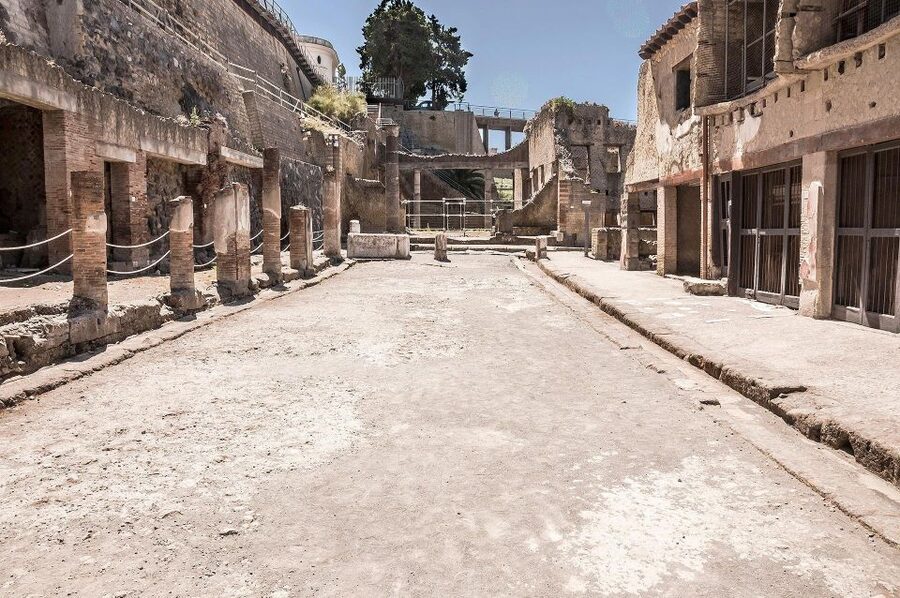
The streets are made of cobbles, and several paths include steep steps. Comfortable shoes are essential. This is not a smooth museum floor, so take your time, particularly when turning into houses or moving between different levels.
The compact layout is helpful. You can cover the principal areas without needing a full day of walking, yet there is enough detail to reward a slow pace. Benches and places to stop are available in parts of the park, and several people have used the visit as a relaxed half-day outing with a packed lunch.
A few more audio tours around Naples worth a look
- From Naples: Caserta Palace Ticket and Train with Audioguide
★ 4.3 · 348 reviews - Naples: Pompeii Self Guided Audio Tour
★ 3.9 · 211 reviews - Naples: National Archaeological Museum Tour & Digital Guide
★ 4.2 · 177 reviews - Naples: National Archaeological Museum audio guide
★ 4.0 · 155 reviews
Villas with painted walls and wooden doors
The houses are the heart of Herculaneum. Look closely at the floors, wall decoration, thresholds, courtyards, and doorways. The famous appeal here is not simply that the buildings are old. It is that parts of them still look like buildings.
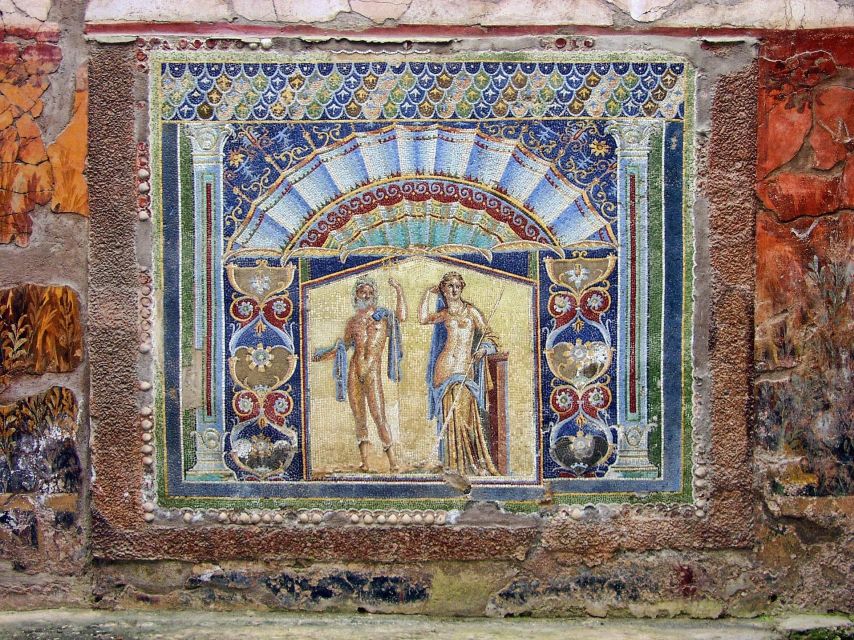
Some rooms retain colorful frescoes. Others show mosaics or traces of domestic decoration. Original wooden doors and beams are especially striking because wood rarely survives at ancient sites. These details give you a better sense of texture and comfort than a bare stone wall ever could.
The audio guide can help explain how the rooms may have been used. Listen for the differences between public-facing areas and private spaces. You will also see how the housing of enslaved people differed from the lavish rooms of wealthy Roman families. That contrast is valuable because it keeps the visit from becoming a parade of beautiful surfaces.
The best approach is not to rush from one famous room to the next. Stand at a doorway and look across the house. Notice how the rooms connect. Then look down at the floor and up at the surviving plaster. Herculaneum rewards close attention more than speed.
Several buildings may be closed temporarily, and some rooms are not always clearly marked from the inside. If a house seems confusing, use the map and audio description together. Do not worry about following the official numerical sequence. You can visit the sites in any order.
Temples, statues, and Roman belief
The park includes ancient temples and representations of Roman gods. These areas add a public and religious dimension to what might otherwise feel like a domestic tour.
The statues and sacred images are worth seeing with the audio explanation, since their meaning may not be obvious from appearance alone. The guide helps connect the object to Roman worship and the role of religion in civic life.
You will also encounter archaeological objects displayed near the entrance or exit in the Antiquarium. This museum area includes artifacts and furniture recovered from the town. It is easy to overlook if you are eager to reach the ruins, but it helps explain what you have been seeing in the houses.
I would save time for the museum even if you have only two hours. The buildings show the town in place, while the objects show the material life that filled those rooms. Together, they make a more complete visit.
The boat sheds and the human cost of AD 79
The lower area near the old shoreline is among the most serious parts of the park. This is where around 300 people waited for rescue from the sea during the eruption. The boat and the skeletal remains make the disaster immediate rather than abstract.
You may find this section emotionally difficult. It is not just another archaeological stop, and it should not be treated as a quick photo opportunity. Give yourself time to understand what happened and why these people had gathered there.
Several routes through the park can lead you to this area at different points. Some people prefer to finish here because it creates a powerful final impression. Others go early, then explore the houses with a clearer sense of what the eruption meant. Both approaches work.
The setting also gives you a better idea of Herculaneum’s relationship with the sea. The town was not an isolated inland settlement. Its shoreline shaped daily life and became the focus of desperate escape during the eruption.
How long you need and when to go
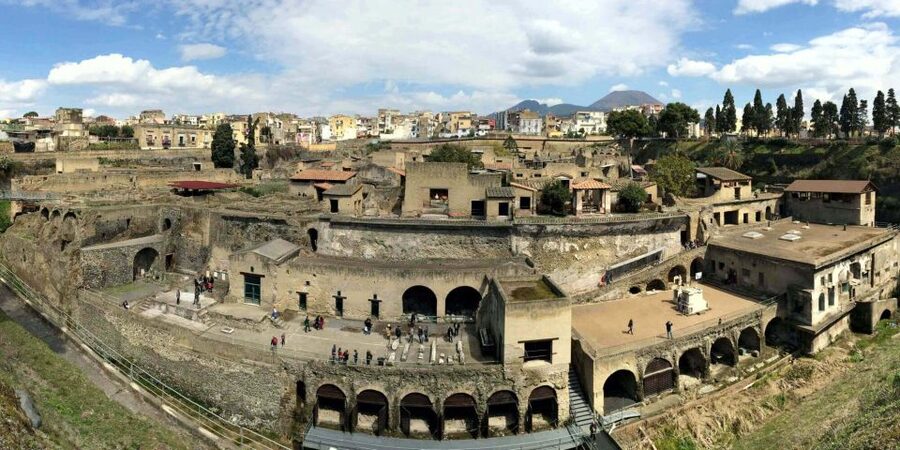
Two hours is enough for a focused visit covering the major houses and streets. Three hours gives you time for the audio commentary, the Antiquarium, and the boat-shed area. Four hours suits anyone who likes to read every description, study frescoes, stop for breaks, or revisit favorite rooms.
Although the ticket is valid for one day, the practical question is your energy. The cobbles and steps can make a full day tiring, particularly in hot weather. A morning visit is a smart choice because the site is generally calmer early and becomes busier as the day goes on.
The park has a café and somewhere to buy a snack and drink. You may also find places suitable for a packed lunch. Toilets have received mixed comments, so do not expect a polished modern facility.
Herculaneum is easy to pair with other stops in the Naples area, but allow enough time for the ruins. A rushed visit would miss the small details that make this site special. If you are coming from Naples, the EAV train from Garibaldi is one reported option, followed by roughly a 12-minute walk from the station. Confirm current transport details before setting out.
Is a guided upgrade better than the audio guide?
The included audio guide is the better value if you like independence, want to stop often, or have different interests within your group. It also lets you avoid the pace of a scheduled tour.
A live guide can be worth the extra cost if you want help reading the site as a whole. Tony was praised for combining humor with strong explanations and for adjusting the pace in hot weather. Fabio was also singled out for explaining the major areas at a steady pace. Amara was described as able to answer questions and explain how an ordinary Roman family lived.
Those upgrades are not part of this audio-guide package, so treat them as a separate option. I would choose the audio guide for flexibility and a live guide for interpretation, orientation, and questions. Neither is automatically better. It depends on how much help you want while walking.
What the $15 price is really buying
At around $15 per person, the experience can be excellent value if it includes park admission, the audio device, and a map. Herculaneum offers more than a quick look at ruins. You get preserved houses, painted rooms, public spaces, temples, artifacts, and the shoreline area.
The catch is the ticket selection. Check the exact booking choice before paying. If you select the audio-guide-only option, you may need to purchase entry at the park. That can remove much of the expected value and may create an extra queue.
The audio guide is not flawless. Numbering problems, occasional site closures, low volume, and unclear handoffs at the entrance reduce the convenience. Still, the guide gives useful explanations, and the ability to explore without a group makes the package worthwhile for many people.
Free cancellation up to 24 hours before the visit and reserve-now, pay-later booking add flexibility. Those terms are useful if your Naples plans depend on weather, transport, or a visit to Pompeii on another day.
Who should book this Herculaneum experience?
I would recommend it to first-time visitors who want Roman history in a manageable setting, families who prefer to set their own pace, and anyone who found Pompeii too large or crowded. It also suits people who enjoy architecture, domestic details, mosaics, and painted walls more than a long guided lecture.
It may be less suitable if you need completely clear wayfinding or dislike uneven ground. The audio system requires patience, and the ticket collection process is not always obvious. Anyone with mobility concerns should take particular care with the cobbles and steep steps, since the supplied information does not promise step-free access.
Should you book it?
Book it if you want a flexible, affordable visit to one of the best-preserved Roman sites near Naples. Confirm that the entry ticket is included, arrive early if possible, ask for the map, and allow at least three hours.
Choose a live guide instead if you want a smooth route and someone to explain the site as you go. But if you are happy to pause, backtrack, and solve a few numbering quirks, the audio guide gives you plenty of information and room to explore Herculaneum in your own way.
FAQ
Is the Herculaneum entry ticket included?
It depends on the option selected. The entry ticket must be chosen as an extra when booking the audio-guide option labeled no ticket, so check the booking details carefully.
How long does the Herculaneum visit last?
The activity is valid for one day. Most people should allow two to four hours, depending on how closely they study the houses, audio stops, museum displays, and boat-shed area.
Which languages are available for the audio guide?
The audio guide is available in English, French, German, Italian, and Spanish.
Do I need identification?
Yes. Bring a passport or ID card. Identification may be held as security while you use the audio device.
What should I wear?
Wear comfortable shoes. The site has cobblestones and some steep steps.
Is there a live guide included?
No. This experience includes an audio guide and map, not a live guide. Guided-tour upgrades may be offered separately.
Where do I meet for the activity?
Show your ticket at the Herculaneum Archaeological Park ticket office.
Can I cancel the booking?
Yes. You can cancel up to 24 hours in advance for a full refund. Reserve-now, pay-later booking is also available.
Just added around Naples
- Mount Vesuvius Skip the Line Ticket + Multilingual Audio Guide★ 4.0 · 32 reviews
- From Naples Explore Pompeii Freely with Your Personal Audioguide★ 3.5 · 3 reviews
- Pompeii from Naples: Smart Audio Guide with Travel Instructions★ 5.0 · 4 reviews
- Naples: Royal Palace Entry Ticket with Digital Audio Guide★ 4.0 · 3 reviews
- Interactive audio guide for the historic center of Naples★ 5.0 · 43 reviews
- Naples from Above: Castel Sant’Elmo Access & Audio Guide★ 3.0 · 2 reviews
- Naples: Herculaneum Entry Ticket with Digital Audio Tour★ 3.5 · 6 reviews
- Audioguided Vespa Tour of Naples (Vespa with driver)★ 5.0 · 9 reviews
Skip the Line, compared.

Topkapi Palace and Harem Skip-the-Line-Tickets & Audio Guide
Read our review →
Pantheon Reserved Entry Ticket with Audio Guide
Read our review →
Borghese Gallery Skip-the-Line Ticket & Audioguide
Read our review →
Skip the Line: Vatican & Sistine Chapel Ticket with Audio Guide
Read our review →
Skip-the-line Entry Ticket with Audio Guide & Map
Read our review →
Mount Vesuvius: Skip-the-Line Ticket and Smart Digital Guide
Read our review →
Borghese Gallery Skip-the-Line Tickets with Audioguide
Read our review →
Taormina: Ancient Theater Skip-the-Line Ticket & Audio Guide
Read our review →Browse the lists this tour appears in