
REVIEW · BERLIN AUDIO TOURS
Berlin Walking Tour with Audioguide on Your Smartphone
Berlin rewards curious walkers. This self-guided audio tour links the Brandenburg Gate, Checkpoint Charlie, Museum Island, and Alexanderplatz in one long city stroll. I like the freedom to pause for coffee or lunch, and I like that the app includes an offline map with GPS help. The main catch is that the advertised two hours may become four once you stop for photos, food, and museums.
At $6.61 per person, this is a low-cost way to get your bearings in central Berlin. You need your own phone and headphones, and the app has had occasional freezing and GPS issues, so keep a little patience in your pocket along with your transit ticket.
Key points to know before you go
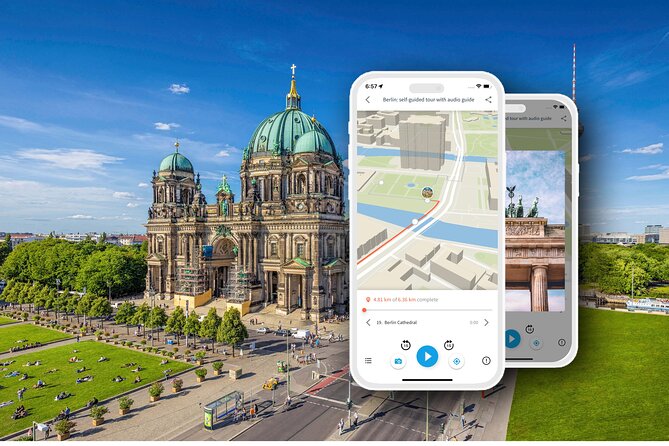
- A major-landmark route: The walk connects Pariser Platz, the Brandenburg Gate, the Holocaust Memorial, Checkpoint Charlie, Gendarmenmarkt, Bebelplatz, Museum Island, and Alexanderplatz.
- Flexible timing: You can pause the audio whenever you want, take a coffee break, and restart without waiting for a group.
- Low price, useful coverage: At $6.61, the tour offers 24 recordings and one year of access.
- Bring your own equipment: The phone, headphones, food, drinks, transport, and entrance tickets are not included.
- Plan for extra time: The route is advertised at about two hours, but a careful walk with stops can take closer to four.
- Technology matters: The GPS is generally easy to follow, though the app may freeze or point imperfectly at times.
Starting at Pariser Platz and the Brandenburg Gate
The walk begins at Pariser Platz, one of Berlin’s best orientation points. The square frames the Brandenburg Gate and gives you an immediate sense of how the modern capital has rebuilt around its most famous symbols.
The audio introduces the square as a place shaped by war, division, and reunification. That context matters here. Pariser Platz is not just a handsome open space for photographs. It is a place where Berlin’s past and present meet, with formal buildings and a steady stream of people moving toward the city’s government district.
The Brandenburg Gate receives its own stop, which makes sense. Its neoclassical columns and Quadriga statue are easy to admire, but the more useful part of the commentary is the explanation of how the gate changed meaning over time. Once connected with Berlin’s division, it now represents reunification.
You get about ten minutes assigned to each of these first stops, though you should treat that as a suggestion rather than a rule. The audio tour lets you replay a section, so you can listen again after taking photographs or stepping aside for passing pedestrians.
More Audio Walking Tours in Germany
- Berlin Cathedral Ticket & Audio Tour with a City Walk
★ 4.1 · 28 reviews - Trier: City Walk with Audio Guide in 7 Languages on your Phone
★ 4.0 · 19 reviews - Cologne Walking Tour with Audioguide: City and Cathedral
★ 4.5 · 14 reviews
The Reichstag and the story of modern Berlin

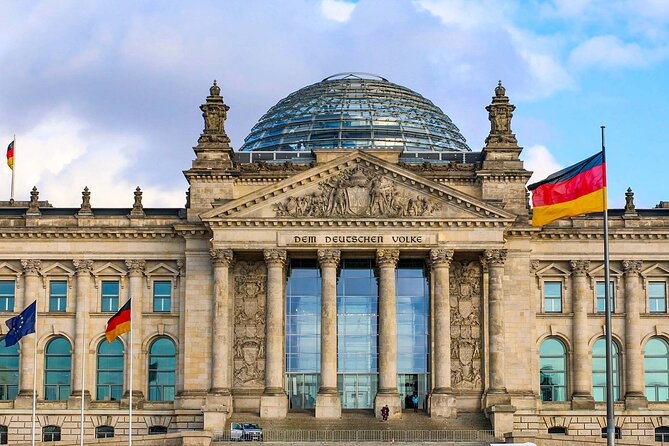
The Reichstag follows naturally from the Brandenburg Gate. It is Germany’s parliamentary building, and its glass dome is presented as a symbol of openness and democratic government.
The route gives you a useful architectural contrast: historic walls below, modern glass above. You can view the building from outside as part of this tour, but entrance to the dome is not included. Any admission ticket or reservation requirement must be handled separately.
This is one of the places where the audio format works well. You can look at the building while hearing why its design matters, rather than trying to read a long paragraph on your phone. Just remember that the commentary is not a substitute for a live guide who can answer questions or change the pace for your group.
A quiet pause at the Holocaust Memorial
The Memorial to the Murdered Jews of Europe is one of the most serious stops on the route. Its field of concrete slabs creates a shifting sense of space as you walk between them. The memorial is designed for personal reflection, not quick sightseeing.
The tour allows about ten minutes here, but I would not rush this stop. The underground Information Centre adds historical context, though its entrance is separate from the free outdoor memorial and any admission arrangements are not included in the tour price.
The audio can help you understand why the memorial is arranged as it is. Still, the tone and length of a recording may not suit everyone at such a solemn place. You may prefer to pause the app, walk quietly, and continue only when you are ready.
The Führerbunker site and Berlin’s difficult memory

The former Führerbunker site is handled in a stark way. Today, the location is a parking area with an information display. There is no preserved underground complex to tour.
That absence is part of the point. The stop helps explain where Hitler spent his final days while also showing how Berlin treats a site tied to Nazi rule. You will not find dramatic ruins or a grand monument here. Instead, expect a modest, sobering place that asks you to think about how history is marked, erased, and explained.
The route’s short stop here is suitable for a quick orientation. If you want detailed Nazi-era history, you will need additional reading or a separate museum visit.
More Smartphone Audio Tours in Germany
- E-ticket to Berlin Botanical Garden with Audio Tour
★ 5.0 · 2 reviews - 800 Years of History: A Munich GPS Audio Tour
★ 4.5 · 12 reviews - Dusseldorf: City Walk Audio Guide in 7 Languages on your Phone
★ 4.5 · 11 reviews - Koblenz: City Walk with Audio Guide in 7 Languages on your Phone
★ 4.5 · 5 reviews
East Berlin touches: Ampelmännchen and the Trabant
The Ampelmännchen, the little traffic-light figures from East Germany, add a lighter note after the memorial stops. Their distinctive shape has become one of Berlin’s most recognizable bits of street design.
The audio uses them to explain how an East German symbol survived reunification and became part of the city’s shared identity. Watch for the figures at pedestrian crossings as you continue. This is a small detail, but it helps you notice Berlin rather than simply march between major monuments.
The Trabant, or Trabi, brings another East German reference. The car was once an everyday symbol of life behind the Iron Curtain and is now associated with nostalgia and city tours. This walking route points out its cultural meaning, but it does not include a ride.
That distinction matters. You are seeing the Trabi as part of the city’s story, not joining a car excursion. If you are looking for a hands-on activity, this stop will be more interesting as context than as an attraction by itself.
Checkpoint Charlie and the Cold War city

Checkpoint Charlie is one of Berlin’s most famous Cold War sites. The checkpoint booth you see today is a replica, but the location remains important because it marks a former crossing between East and West Berlin.
The audio explains the border crossing, escape attempts, and the city’s divided past. You can also find a museum nearby, but its entrance fee is not part of this experience. The outdoor visit is free, while museum admission requires a separate decision and budget.
This stop can feel crowded and commercial, especially compared with the more reflective memorial sites. The audio helps restore some historical focus. Listen before you arrive if possible, then look past the photo opportunity and consider what the crossing meant to people who could not move freely through their own city.
Gendarmenmarkt’s grand architectural pause
Gendarmenmarkt offers a sharp change in mood. The square is framed by the German Cathedral and French Cathedral, with the Konzerthaus and Schiller Monument adding to the formal design.
This is a good place to stop the audio and look around. The symmetrical arrangement is easy to understand from ground level, while the commentary explains the square’s architectural and cultural importance. Cafes around the area also make it a practical break point.
Some sections of this tour may feel less detailed than a specialist architecture tour. If you care strongly about dates, designers, and building history, you may want extra information. For a low-cost orientation walk, though, the stop gives you enough to appreciate the setting.
Bebelplatz and the book-burning memorial
Bebelplatz is one of the more rewarding stops because the memorial is easy to miss. Beneath the square, a glass panel lets you look into an underground room lined with empty bookshelves. It recalls the Nazi book burning and the attack on intellectual freedom.
The audio points out this detail, which is exactly the sort of thing you might pass without noticing. I like this stop because it changes the way you look at the pavement beneath your feet. Berlin often places its strongest historical reminders in ordinary-looking spaces.
The surrounding buildings include the State Opera, St. Hedwig’s Cathedral, and Humboldt University. You can pause here to take in the architecture, but the tour does not include entry to the opera, cathedral, or university.
Frederick the Great and Unter den Linden
The equestrian statue of Frederick the Great gives the route a dose of Prussian history. The monument dominates part of Unter den Linden and presents the king in formal military style.
This stop is most useful if you want to understand the older political traditions that shaped Berlin before the twentieth century. The commentary connects the statue with Frederick’s role and the boulevard around it.
The nearby German State Opera adds another cultural marker. Its neoclassical setting and long performance tradition make it worth noticing, even if you are only viewing the exterior. Opera and ballet tickets are not included, so think of this part of the route as a preview rather than a performance visit.
Museum Island and Berlin Cathedral
Museum Island is among the most important cultural areas on the route. The island includes five museums and is listed as a UNESCO World Heritage site. The audio introduces the area as a place where ancient objects, archaeology, and art gather along the Spree.
You should set aside extra time if you want to enter any museum. The audio tour only provides orientation, and admission fees are separate. Museum Island can easily turn this walk into a full day if you begin adding collections and exhibitions.
Berlin Cathedral is another major sight nearby. Its large dome, ornate interior, and terrace views make it a powerful landmark from outside and inside. The tour points out its Baroque design and imperial connections, but entry is not included.
This is one reason the two-hour estimate can be misleading. Even a short stop at the cathedral, followed by a look at Museum Island, can add a substantial amount of time.
Marx and Engels Forum, Red Town Hall, and Alexanderplatz
The Marx and Engels Forum presents another side of Berlin’s political past. Statues and reliefs honor the founders of communist theory, while nearby traces of the Berlin Wall connect the park to the city’s divided era.
The setting is calmer than Checkpoint Charlie. You can use the audio to connect the monument with East German political history, then take a short rest before continuing.
Red Town Hall provides a change in architectural character. Its red-brick Neo-Renaissance facade houses Berlin’s city government, and the nearby Neptune Fountain adds a formal centerpiece. The stop helps connect Berlin’s civic life with its architecture.
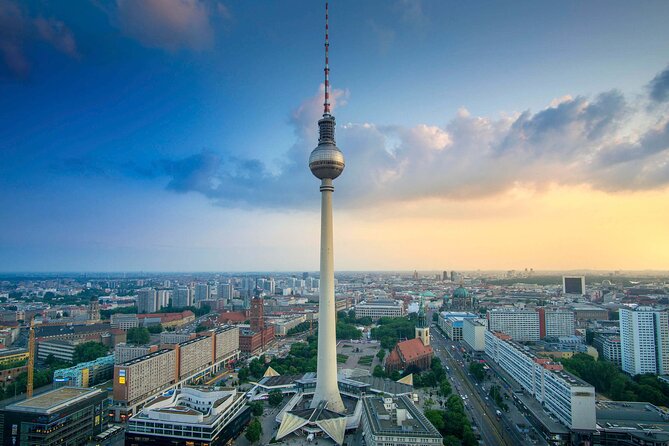
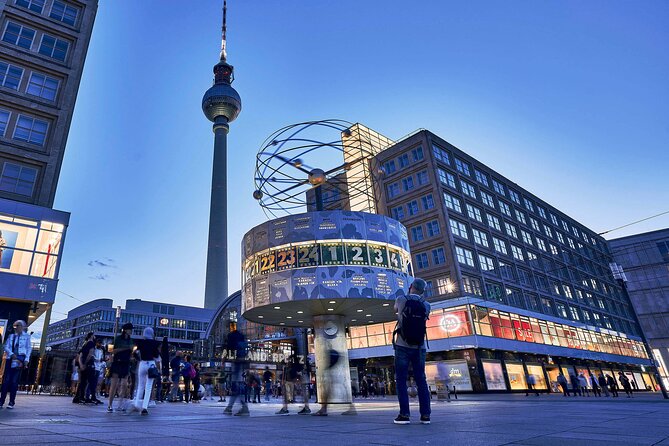
The final major stop is Alexanderplatz. The square is a transport hub and a center for shops, cafes, and city movement. The Weltzeituhr, or world time clock, is a notable detail, while the Television Tower dominates the skyline.
The audio introduces the tower as a GDR-era landmark and a symbol of the city’s changing identity. You can buy a separate ticket to visit its observation deck, but that is not included. Alexanderplatz works well as the endpoint because you can continue by public transport or stop for food after finishing the route.
How the app works in real use
You download the app on an iPhone or Android phone, activate the purchase, and follow the route on the included map. The package includes 24 audio recordings, landmark illustrations, GPS navigation, and one year of access in your chosen language. English is the available language for this offering.
The offline map is especially useful because it reduces dependence on a constant data connection. Still, download and activate everything before you start. Bring headphones, and keep your phone charged for the full walk.
The GPS is generally straightforward, but it may not always point perfectly. Some users have found the app freezes and needs to be closed and reopened. The route remains usable, but I would save the support address, [email protected], before setting out in case activation goes wrong.
The map moves directionally, and there may not be an option to keep it fixed north. If you prefer traditional navigation, use nearby landmarks and road signs as a backup rather than trusting the blue dot alone.
Timing, walking effort, and real value
The advertised duration is about two hours. In practice, the full route can take around four hours when you stop for photographs, listen carefully, take a lunch break, or enter a museum or landmark.
The route covers a large slice of central Berlin. You should expect a substantial walk, with one report noting more than 10,000 steps on a similar guided outing. Comfortable shoes matter, and you should plan a bathroom and food break instead of trying to push through.
At $6.61, the value is clear if you want basic historical orientation without paying for a private guide. You get one year of access, so you can use the tour at a slower pace or return to sections later. The price is less compelling if you expect detailed architectural scholarship, live answers, or flawless technology.
Free cancellation is available when you cancel at least 24 hours before the scheduled start time. Cancellations inside that window are not refunded, and the date and time selected at checkout are approximate because the app can be used at any time.
Who should book this Berlin audio walk?
I would recommend it to independent visitors who want a broad first look at central Berlin. It suits you especially well if you prefer stopping for coffee, taking photographs, or lingering at a memorial without holding up a group.
It also works for couples and small groups who want to share one route while keeping their own pace. The maximum is listed as 20 participants, but this is not a live group walk. You will not have a human guide beside you.
I would be more cautious if you dislike phone navigation, need a perfectly polished app, or want extensive discussion of architecture and politics. Families should also consider the serious subject matter at the Holocaust Memorial and Führerbunker site.
Should you book it?
Book this tour if you want an inexpensive introduction to Berlin’s major sights and value the freedom to pause, replay, and wander. The best parts are the carefully connected route, the Bebelplatz memorial detail, and the ability to explore without a group leader.
Skip it if you need guaranteed technical reliability or a live historian. Download the app before arrival, bring headphones and a charged phone, and allow four hours rather than two. With those expectations, this is a practical, low-cost way to put Berlin’s complicated past into view.
FAQ
Where does the Berlin walking tour start?
It starts at Pariser Platz, 10117 Berlin, Germany.
Where does the tour end?
The activity ends back at the meeting point.
Is this a guided tour with a live person?
No. It is a self-guided tour delivered through a mobile app. No human guide is included.
What devices can I use?
The audio guide app is available for iPhone and Android devices.
Are headphones included?
No. You need to bring your own headphones, as well as your own smartphone.
How long does the tour take?
The stated duration is approximately two hours. In practice, it can take longer, especially if you stop for meals, photographs, or additional sightseeing.
Are entrance tickets included?
No. Transportation, food, drinks, and entrance fees are not included. The outdoor stops listed along the route are free, but museums, the Reichstag dome, Berlin Cathedral, and the Television Tower may require separate arrangements or tickets.
More Audio Walking Tours in Berlin
- Sofia: City Monuments Guided Walking Tour with Audio Guide
★ 4.5 · 825 reviews - Florence: 2.5 hour Audio Guided Walking Tour led by Host
★ 4.6 · 293 reviews - Self Guided Classic Freedom Trail Location Aware (GPS) Walking Audio Tour
★ 4.5 · 258 reviews - Valletta: Self-Guided Historical Walking Tour (Audio Guide)
★ 3.7 · 251 reviews
More Smartphone Audio Tours in Berlin
- Rome: Colosseum & Forum with Audio Guide App -Optional Arena
★ 4.2 · 24,770 reviews - Florence: Timed Entry to Michelangelo’s David + Audio App
★ 4.6 · 19,496 reviews - Florence: Cathedral & Brunelleschi’s Dome Ticket & Audio App
★ 4.4 · 6,973 reviews - Florence: Michelangelo’s David Priority Ticket & Audio App
★ 4.4 · 6,812 reviews
Just added around Berlin
- Self-Guided Audio Tour-The Fall of the wall: A light for humanity★ 4.5 · 8 reviews
- Self Guided Tours Berlin With 100 Captivating Audio Stories★ 5.0 · 2 reviews
- Take the U Train: An Audio Story of Berlin’s Oldest Elevated Railway Line★ 4.0 · 2 reviews
- E-ticket to Berlin Botanical Garden with Audio Tour★ 5.0 · 2 reviews
- Berlin Self-Guided Audio City Tour★ 4.5 · 2 reviews
- Hop-on Hop-off Berlin Tour with Audio Guide★ 3.0 · 11 reviews
- Berlin’s Museum Island: A Self-Guided Audio Tour★ 3.5 · 3 reviews
- Berlin: Französischer Dom Viewing Platform with Audio Guide★ 4.1 · 43 reviews
Smartphone Audio Tours, compared.

Colosseum & Forum with Audio Guide App -Optional Arena
Read our review →
Timed Entry to Michelangelo’s David + Audio App
Read our review →
Cathedral & Brunelleschi’s Dome Ticket & Audio App
Read our review →
Michelangelo’s David Priority Ticket & Audio App
Read our review →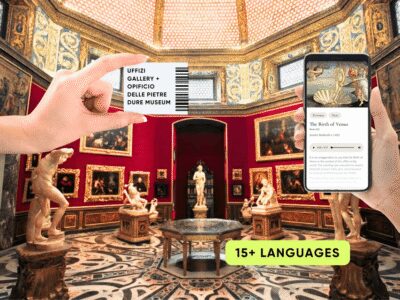
Uffizi Priority Ticket & Masterpieces Audio App
Read our review →
Castel Sant’Angelo Entry Ticket & Digital Audioguide
Read our review →
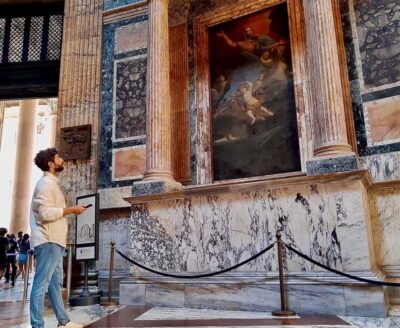
Pantheon Priority Entry Ticket & Audio Guide App
Read our review →Browse the lists this tour appears in