
REVIEW · ROME AUDIO TOURS
Trastevere: A Self-guided Audio Tour of Rome’s Medieval Village
Old Rome feels different across the Tiber. This 50-minute audio walk through Trastevere leads you from Piazza Trilussa past medieval lanes, old gates, lively squares, and neighborhood details that are easy to miss when you are focused on Rome’s big monuments. The narration is GPS-triggered, so the story arrives as you reach each point.
I like the freedom to stop for coffee, photos, or gelato without holding up a group, and I like that the app works offline. The main drawback is that you need to stay close to the mapped route. If you wander too far, the app can get stuck and may need to be restarted.
Key points to know before you go
- Piazza Trilussa is the starting point, placing you right at one of Trastevere’s best-known gathering spots.
- Porta Settimiana offers a Roman military connection, though the gate you see today was heavily restored in the late 1400s.
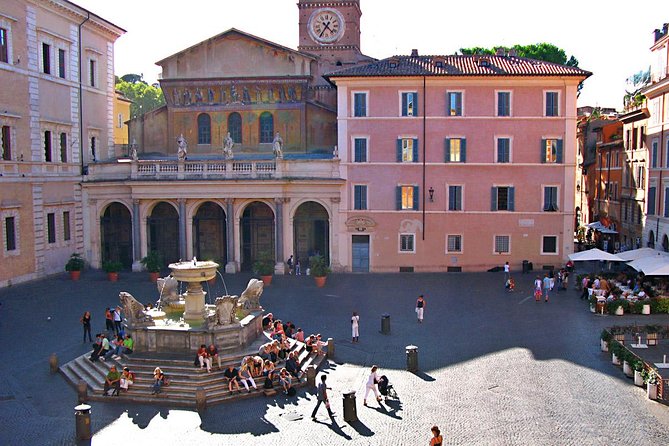
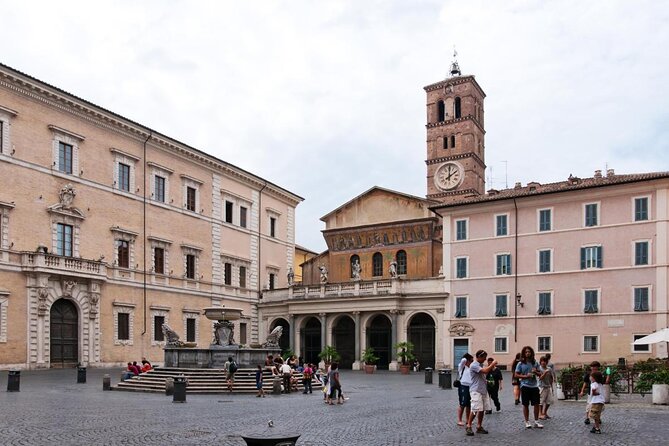
- Piazza di Santa Maria is the neighborhood’s social center, especially after dark when young Romans gather there.
- The Fontana della Botte gives you a small, playful piece of local identity, representing Trastevere as one of Rome’s rioni.
- The audio, map, and route work offline, useful if you want to avoid relying on mobile data.
- The price is modest at $9.99, especially if you want a private walk without paying for a live guide.
Why Trastevere works well for a self-guided walk
Trastevere is one of Rome’s most atmospheric districts, but it can be hard to appreciate without some direction. The area is a maze of narrow streets, small piazzas, old walls, and restaurant-lined corners. A self-guided audio tour gives you a reason to look around instead of simply following the crowd toward dinner.
I like this format because it leaves room for your own pace. You can pause the tour for a photograph, step into a café, or linger in a square without worrying about a group schedule. You also avoid the usual problem of trying to hear a guide over traffic, conversation, and footfall.
The tradeoff is simple: this is not a personal conversation with a guide. You cannot ask follow-up questions, request a longer explanation of a church or building, or change the route to match your interests. The narration gives you a focused introduction to Trastevere, not a full course in Roman architecture.
The strongest part is the sense of company created by the voice narration. The audio has been designed to feel as though a local is walking with you, and the content includes practical suggestions for lunch, coffee, and gelato. That makes the tour more useful than a string of dates and names.
More Self-Guided Audio Tours in Italy
- Self Guided Audio Tour-Coliseum & the Gladiator’s Legends
★ 3.5 · 49 reviews - The Roman Jewish Ghetto: A Self-Guided Audio Tour
★ 4.0 · 8 reviews - Self Guided Audio Tour with 100 Captivating Stories in Rome
★ 4.5 · 7 reviews
Starting at Piazza Trilussa
The walk begins at Piazza Trilussa, one of the easiest places in Trastevere to recognize. The square sits near the river and gives you a clear starting point before you move into the neighborhood’s smaller streets.
Starting here is practical for two reasons. First, the piazza is close to public transportation. Second, it puts you near the social side of Trastevere before the route turns toward older architectural details.
You should begin with your phone charged and the app ready. Since the route uses GPS triggers, give yourself a moment to confirm that the map is following your position before setting off. The offline feature means you can download the audio, map, and geodata in advance rather than depending on a strong connection in every narrow lane.
Piazza Trilussa can feel active, especially later in the day. If you want the calmest beginning, starting earlier may make it easier to hear the narration and orient yourself. The listed operating hours run from midnight to midnight every day, so you are not tied to a narrow departure window.
Porta Settimiana and the edge of Aurelian Rome
One of the most useful historical stops is Porta Settimiana, a gate connected with the Aurelian Walls. Emperor Aurelian ordered Rome’s major defensive walls in 271 AD, and Trastevere was partly brought inside that fortified boundary.
That fact changes the way you see the neighborhood. Trastevere is often treated as a charming restaurant district, but this stop reminds you that it once occupied a strategic position beside the river and the wider city. The gate is a small piece of a much larger defensive system.
There is an important qualification. The structure visible today was heavily restored in the late 1400s. You are not looking at an untouched third-century gateway, and the audio tour is useful here because it helps separate the ancient role of the site from the later appearance.
This is also a good example of what the tour does best. It connects an ordinary-looking urban feature to a wider Roman story without requiring you to enter a museum or buy another ticket. You get context while standing in the street, then continue at your own pace.
If architecture is your main interest, you may want more detail than the short route provides. One of the useful improvements would be a longer explanation of the gate’s design, later alterations, and relationship to the rest of the walls. For a 50-minute neighborhood walk, though, the stop gives you a clear historical anchor.
Piazza di Santa Maria after dark
Piazza di Santa Maria is Trastevere’s main square and one of the route’s most important social stops. It is not just a place to admire buildings. It is a meeting point, particularly for the young people who gather in the district after sunset.
This gives the tour a welcome change of pace. Porta Settimiana points you toward military Rome. Piazza di Santa Maria shows you how the neighborhood functions as a living part of the city today.
The square is a good place to pause the audio and watch the flow around you. You might find it more crowded and noisy in the evening, which can make the narration harder to hear. On the other hand, visiting after dark lets you experience the social energy that makes Trastevere more than a daytime photo stop.
I like the way this portion connects history with daily life. You are not being asked to look only at old stone. You are also encouraged to notice how a Roman square is used now, with people meeting, lingering, and moving between the surrounding streets.
Keep your expectations realistic. The tour does not promise an extended nightlife route or a detailed food crawl. It offers useful suggestions for lunch, coffee, and gelato, but food and drinks are not included. Treat the square as a place to take in the atmosphere, then choose your own stop if something catches your eye.
More Self-Guided Audio Tours in Rome:
- Self-Guided Audio Tour – The gods of the Palatine
★ 3.5 · 5 reviews - Discover Marvellous Rome: Self-Guided Audio Tour
★ 5.0 · 2 reviews - Athens: Acropolis Ticket & Optional Self-Guided Audio Tours
★ 4.1 · 2,542 reviews - Gettysburg Battlefield Self-Guided Driving Audio Tour
★ 4.5 · 910 reviews
The Fontana della Botte and Trastevere’s local character
The Fontana della Botte, or Fountain of the Barrel, is a small but memorable stop. It represents Trastevere among a set of nine fountains commissioned in 1927 by sculptor Pietro Lombardi. Each fountain was designed to reflect a particular Roman district, known as a rione.
That local focus is valuable. Big Roman monuments tend to dominate sightseeing, while neighborhood symbols can slip past unnoticed. The fountain gives you a compact way to think about Trastevere’s identity and how Rome’s districts have been represented through public art.
The barrel design also makes the stop easy to remember. You do not need a long lecture to understand the basic idea: this is a fountain tied specifically to the character of Trastevere.
I would not book this walk expecting an hour of grand fountains and major monuments. The appeal is smaller and more personal. You are seeing details that reward attention, with the narrator explaining why they matter.
This is also where the route’s balance becomes clear. It mixes Roman history, modern neighborhood life, and modest street features. If you prefer only famous sights, parts of the walk may feel too ordinary. If you enjoy learning why a local corner matters, the fountain is exactly the sort of detail that makes the walk worthwhile.
What the GPS audio format feels like
The VoiceMap application supplies the narration, route map, and location data. GPS triggers the audio as you move through the walk, so you do not have to keep stopping to read instructions or search for the next paragraph.
That hands-free approach is a real advantage. You can pay attention to the streets instead of staring at your screen every few seconds. The map remains available when you need to check your position, but the experience is designed to be heard while walking.
There is one practical rule you should take seriously: stay on the mapped route. A direct note from the tour experience is that leaving the route can cause the app to stop responding, forcing you to restart the guide. In a district with many similar-looking lanes, this matters.
Before you begin, download everything and check that the audio loads. Offline access is included, but it only helps if the files are ready before you walk. Keep your phone accessible, use headphones if appropriate, and remain aware of traffic and other people in the street.
The app-based format is especially good for independent visitors. You can start when convenient, pause whenever you wish, and avoid joining a large group. It is less suitable if you want a guide to adapt the walk on the spot.
How much value do you get for $9.99?
At $9.99 per person, this is priced as a low-cost introduction to Trastevere rather than a major sightseeing purchase. You are paying for lifetime access to the tour, the app, and offline audio, maps, and geodata.
That lifetime access improves the value if you are staying in Rome long enough to return to the neighborhood. You could also use the audio at a time that suits your schedule instead of paying for a fixed departure. The private format means only your group participates, which is another advantage for couples, families, or friends who do not want to follow strangers.
The price does not include transport, food, drinks, or admission to museums and other attractions along the way. In practical terms, the walk itself is inexpensive, but your full outing may cost more once you add a meal or stop for coffee and gelato.
I see the best value here in flexibility. A live private guide would offer more personal attention, but usually at a higher price. A printed guidebook might provide more broad background, but it would not trigger audio based on your location. This tour sits between the two: more guided than wandering alone, less personal than hiring someone.
The short length is both a benefit and a limit. Fifty minutes is easy to fit into a busy day, but it means the route cannot cover every corner of Trastevere. If you want a fuller exploration, use this as an introduction and continue on your own afterward.
Who will enjoy this Trastevere walk most?
I would recommend it most strongly to first-time visitors who want an easy orientation to Trastevere without committing to a long group tour. It also suits repeat visitors looking for a different way to see a familiar district.
The tour should work well for:
- Couples who want to walk independently
- Families who prefer a flexible schedule
- Solo visitors who like audio guidance
- People who enjoy local food suggestions alongside history
- Anyone trying to avoid a large organized group
- Visitors who need offline access while walking
You should think twice if you want a detailed architectural study, extensive Roman history, or a route focused mainly on lesser-known side streets. One useful criticism is that the walk could include more history and architecture, along with a larger section in the less popular part of the neighborhood.
Most people can participate, and service animals are allowed. The tour is near public transportation, but transportation itself is not included. You need your own smartphone, since one is not supplied.
Timing, route discipline, and practical tips
The route is listed as available every day around the clock, giving you plenty of choice. Still, the best time depends on what you want. Daytime makes it easier to see architectural details and follow the map. Evening gives you a better sense of Piazza di Santa Maria as a social gathering place.
I would allow more than the stated 50 minutes if you want photographs, food, or pauses. The recorded portion is approximately 50 minutes, but your actual outing will be longer if you stop along the way.
Use these simple habits to avoid trouble:
- Download the audio and map before leaving.
- Begin at Piazza Trilussa with your phone charged.
- Keep the map route in view when streets become confusing.
- Stay near the GPS path so the narration does not freeze.
- Leave time for coffee, lunch, or gelato, since those purchases are separate.
- Treat the route as an introduction, not a complete tour of every Trastevere sight.
The listed endpoint is Casa Dante at Piazza Dante 8, Rome. Check the route in the app before starting, since the exact walking line is more useful than relying on a general neighborhood map.
Should you book the Trastevere audio tour?
Book it if you want a low-cost, flexible introduction to Trastevere with a voice guiding you from one point to the next. The best reasons are the offline access, the local food suggestions, the freedom to walk privately, and the way the route combines old defenses, social squares, and neighborhood art.
Skip it if you need a live expert, extensive architecture, or a carefully customized route. The app depends on staying on course, and the short walk cannot cover the whole district.
For $9.99, I think it is a sensible choice for an independent visitor who wants more purpose than simply wandering, but less structure than a scheduled tour. Download it before you go, follow the map closely, and leave room afterward to explore Trastevere on your own.
FAQ
How long does the Trastevere audio tour take?
The tour lasts approximately 50 minutes. Your total time may be longer if you stop for photos, coffee, lunch, or gelato.
Where does the tour begin?
The starting point is Piazza Trilussa in Rome.
Where does the tour end?
The listed ending point is Casa Dante, Piazza Dante 8, Rome.
Does the tour work without Wi-Fi or mobile data?
Yes. The audio, maps, and geodata can be accessed offline through the VoiceMap application.
Is a smartphone included?
No. You need to bring your own smartphone.
Are food, drinks, transportation, or attraction tickets included?
No. Food, drinks, transportation, and entrance fees for museums or other attractions are not included.
Can I cancel or change the booking?
No. The experience is non-refundable and cannot be changed after booking.
Just added around Rome
- Pantheon Skip the Line Entry Tickets with Digital Audio Guide★ 3.5 · 52 reviews
- St. Peter’s Basilica: Dome Climb with Lift & Audioguide★ 4.5 · 13 reviews
- Audio guide in Vatican Museums and Sistine Chapel★ 4.5 · 12 reviews
- Navova square underground with audioguide★ 4.5 · 17 reviews
- The Roman Jewish Ghetto: A Self-Guided Audio Tour★ 4.0 · 8 reviews
- Experience: The Pantheon Audio Tour★ 4.5 · 4 reviews
- St. Mary’s Basilica, Pope Francis Tomb Audio Tour with Crypt★ 4.0 · 3 reviews
- The Colosseum’s Attic with 3rd, 4th & 5th Levels with Audio Guide★ 4.5 · 20 reviews
Self-Guided Tours, compared.

Acropolis Ticket & Optional Self-Guided Audio Tours
Read our review →


Ultimate Acadia National Park Self-Guided Driving Audio Tour
Read our review →

Santorini: Akrotiri Ticket with Optional Self-Guided Audios
Read our review →
Browse the lists this tour appears in