
REVIEW · ROME AUDIO TOURS
Self Guided Audio Tour with 100 Captivating Stories in Rome
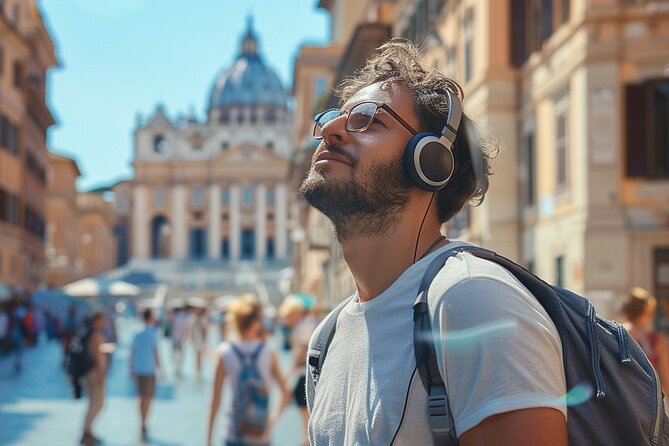
Rome rewards curiosity. This browser-based audio tour gives you 100 location stories across the city, from the Colosseum and Pantheon to quiet hilltop gardens and old bridges. I like the freedom to pause whenever you want, and I like that the guide works through your browser with no app to install. The main drawback is that you need internet access, headphones, and your own sense of direction.
At $3.59 per person, this is an unusually inexpensive way to add context to a Rome walk. You can listen for one hour or spread the stories across several days, depending on your energy and sightseeing plans. The audio uses storytelling and soundscapes rather than a person walking beside you, so it suits independent visitors more than anyone seeking conversation or detailed personal guidance.
Key points to know before you start

- A huge range of Rome sights: Stories cover ancient monuments, grand churches, fountains, bridges, parks, neighborhoods, and viewpoints.
- A flexible one to eight hour format: You decide how much to hear and when to stop.
- No download required: Open the link in your phone browser, follow the map, and listen with your own headphones.
- Especially useful for short visits: A 60-minute route can provide key details without taking over your whole day.
- Free outdoor stops: Many locations, including fountains, piazzas, bridges, and hills, have no admission charge.
- A low-cost supplement, not a full guided tour: You get stories and directions, but no in-person guide, ticket handling, or offline access.
How the Rome audio tour works
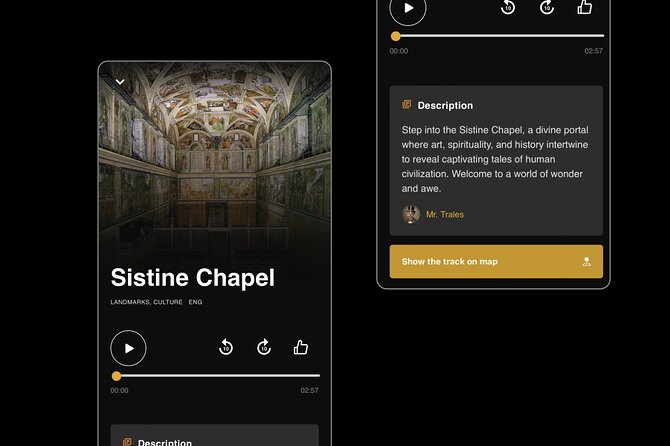
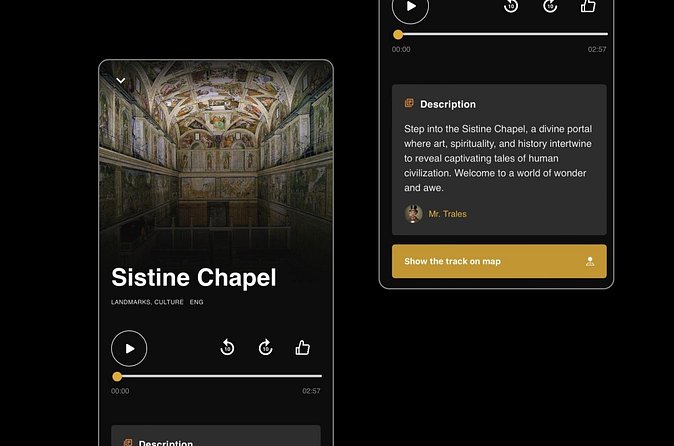
The format is simple. You receive a link, open it on your smartphone, and use the web app and map to find location-based stories. Your phone needs internet access, and you need to bring your own headphones.
The audio begins and ends at the general meeting point in Rome, but the practical idea is much looser than a fixed group walk. You can start at a fountain, church, bridge, or piazza that fits your plans. Pause the narration for photographs, coffee, a museum visit, or a long look at a statue. Then resume when you are ready.
I see this flexibility as the tour’s greatest strength. Rome is not a city where you always want to march from one sight to the next. You may find yourself waiting to enter the Pantheon, crossing the city for a reservation, or stopping because a small church is open. An audio guide that waits for you is far more useful than a rigid schedule.
The supplied route includes around 100 location-based stories, while the named highlights cover a broad selection of central and outlying sights. The experience is offered in English only. Soundscapes add atmosphere, but the actual quality of your visit will still depend on your phone connection and headphones.
More Self-Guided Audio Tours in Italy
- Self Guided Audio Tour-Coliseum & the Gladiator’s Legends
★ 3.5 · 49 reviews - The Roman Jewish Ghetto: A Self-Guided Audio Tour
★ 4.0 · 8 reviews - Self-Guided Audio Tour – The gods of the Palatine
★ 3.5 · 5 reviews
Ancient Rome: Colosseum, Forum, and the Pantheon
Start with the three heavyweight sights: the Colosseum, Roman Forum, and Pantheon.
At the Colosseum, the narration focuses on gladiators, public spectacles, and emperors. That is the right approach here. The building is enormous, but its scale can make it hard to picture the people who once filled it. A story-led explanation helps turn tiers of stone into a place of public entertainment and imperial power.
The Roman Forum needs even more help. What looks like a spread of columns and broken walls was once the center of Roman political and civic life. The audio story gives you a way to connect the remains with the public activity that took place here. If you are walking through the Forum itself, listen slowly and stop often. There is no advantage in rushing through a site this dense.
The Pantheon offers a different kind of ancient experience. This former temple is remarkably complete, and its dome remains the key visual moment. The story points you toward the building’s religious and architectural importance, including its connection with gods and imperial grandeur. The supplied timing for major stops is often around 10 minutes, but you should allow extra time for queues and looking around.
These three stories work well together, but they are not necessarily one continuous walk. The app gives you options across Rome, not a single tight route. Plan your day around the sights you already want to enter.
Fountains, piazzas, and Rome’s grand public rooms
The audio guide is particularly strong for Rome’s outdoor spaces. Trevi Fountain, the Spanish Steps, Piazza Navona, Piazza Venezia, Campo de’ Fiori, and Piazza del Popolo all receive their own stories.
Trevi Fountain is an easy place to use a short 10-minute audio segment. The story covers the fountain’s history and mysteries while you take in the theatrical design. Admission is free, although the square can be crowded. The audio lets you listen after finding a spot at the edge rather than trying to stare at your phone while moving through a packed area.
The Spanish Steps are another good short stop. The narration looks at the stories connected with the stairway and the stones beneath your feet. You can pair this with Piazza di Spagna, which appears separately in the route. The repeated coverage is useful if you want a more focused story, though it may feel redundant if you listen to every version.
Piazza Navona receives more than one treatment, including a specific story about the Fountain of the Four Rivers. This is a sensible arrangement because the square contains several subjects: its long shape, artistic decoration, and the elaborate fountain at its center. The fountain story deals with beauty, history, and intrigue, while the wider piazza story gives you a broader setting.
Campo de’ Fiori brings a different mood. Its marketplace atmosphere and older stories make it a good contrast with the formal spaces nearby. The route groups it with the Navona and Pantheon area, so you can create a useful walking sequence through central Rome.
Piazza Venezia appears more than once in the available stories, including a focus on the ancient city and a broader look at the square. Piazza del Popolo also has repeated coverage, with one story centered on its identity as the People’s Square. These overlaps give you choice, but they also mean you should check the map and avoid playing duplicate material by accident.
Churches that reward a slower listen

Rome’s churches can be visually overwhelming. An audio guide helps you decide what deserves your attention.
St. Peter’s Basilica receives a 10-minute story describing its religious and artistic importance. The experience does not include entry or a physical guide, so you will need to handle any security, opening, or ticket arrangements yourself. Still, a short introduction can help you notice more once inside.
The Basilica of Saint Mary Major has a longer 20-minute story. That extra time makes sense for one of Rome’s largest Marian churches, where architecture, legend, and religious art all matter. Santa Maria in Trastevere also receives a dedicated story, with attention to its early origins and long place in Rome’s religious life.
Other church stops include Santa Costanza, Santa Sabina, and Saint John Lateran. Santa Costanza is presented through the story of two imperial sisters. Santa Sabina takes you to the Aventine Hill, where older layers of Rome remain close at hand. Saint John Lateran brings in the Laterani family and the church’s important place in the city.
The best way to use these stories is not to treat them as a checklist. Choose one or two churches that fit your day, listen outside, then continue indoors if the building is open. Since the tour does not provide entrance arrangements, its value comes from context rather than access.
More Self-Guided Audio Tours in Rome:
- Trastevere: A Self-guided Audio Tour of Rome’s Medieval Village
★ 4.5 · 3 reviews - Discover Marvellous Rome: Self-Guided Audio Tour
★ 5.0 · 2 reviews - Athens: Acropolis Ticket & Optional Self-Guided Audio Tours
★ 4.1 · 2,542 reviews - Gettysburg Battlefield Self-Guided Driving Audio Tour
★ 4.5 · 910 reviews
Hills, gardens, and Rome’s best viewpoints
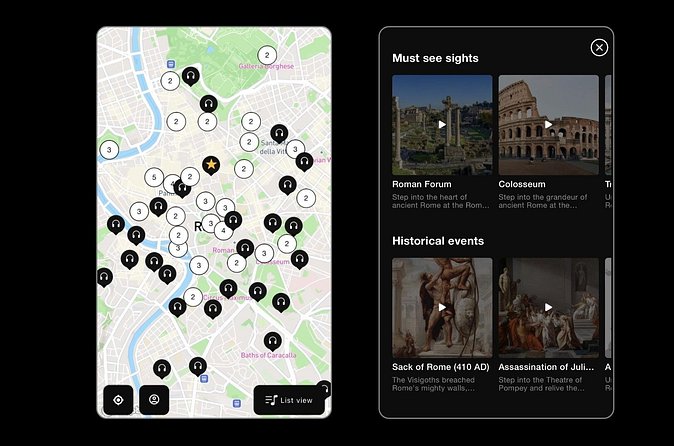
Rome’s hills offer some of the nicest breaks from the central monuments. The audio stories include Villa Borghese, the Pincian Hill, the Orange Trees Garden, Aventine Hill, Janiculum Hill, and Villa Doria Pamphili.
Villa Borghese connects art, gardens, and the legacy of Cardinal Scipione Borghese. It is a good choice when you want a slower stretch of sightseeing. The story is listed at about 10 minutes, leaving you free to continue walking or add another nearby stop.
The Pincian Hill looks at the old gardens of Rome’s elite. The Orange Trees Garden on Aventine Hill adds ancient stories and broad city views. These are ideal places for an audio tour because you can listen while standing still, taking photographs, or resting on a bench.
Janiculum Hill appears under several names, including Colle del Gianicolo and Janiculum Hill. Stories here include gods, heroes, and Villa Lante al Gianicolo, a historic villa associated with Giulio Romano. The repeated hill coverage may be confusing on the map, so select the story that best matches your exact position.
Villa Doria Pamphili moves farther from the center and looks at a 17th-century villa and its grounds. It is useful for anyone who wants more than the standard ancient-city circuit. The Park of the Aqueducts goes even farther, covering a large 240-hectare area where monumental water channels cross open ground.
These outer stops make the tour more than a list of famous squares. They also create a practical challenge: you cannot comfortably cover everything in one compact walk. Use the map to build separate neighborhood outings.
Bridges, islands, and the Tiber

The Tiber crossings give the tour a strong sense of Rome as a river city.
Ponte Sisto is presented through its old stories and artistic details. Ponte Sant’Angelo, the pedestrian bridge leading toward Castel Sant’Angelo, is treated as a Roman structure that changed over time. Pons Fabricius and Pons Cestius carry you farther into antiquity, with stories about their age and role over the river.
Tiber Island adds a story about healing, resilience, and creative adaptation. It is a compact stop with a clear theme, and you can combine it with the bridges nearby.
The Mouth of Truth is another memorable short stop. The audio tells the story of the huge carved face and the old challenge associated with placing your hand inside its mouth. This is exactly the sort of small attraction that benefits from context. Without a story, it can seem like a curious stone disk. With one, it becomes part of Rome’s long habit of mixing legend, religion, and public spectacle.
Ancient streets and Rome after dark

Via del Corso provides a link between major squares and a useful way to understand modern movement through the historic center. Its story connects ancient glory with the busy life of the street today.
Via Veneto gives you a look at Rome’s la dolce vita era and the film stars associated with the street. It is a lighter change of pace after the ancient monuments and churches. Piazza Barberini and Piazza della Repubblica also show how Rome’s public spaces changed over time. Piazza della Repubblica focuses on the ancient baths beneath the modern square.
The stories at Piazza della Minerva and Piazza Farnese are more specialized. Piazza della Minerva examines the site’s connection with Pompey’s temple to Minerva Calcidica. Piazza Farnese follows the ambitions of Cardinal Alessandro Farnese and the square’s 16th-century design.
If you enjoy architectural detail and urban history, these shorter stories may be among the most rewarding. If you prefer only the biggest sights, you can skip them without losing the basic experience.
A useful plan for one hour or several days
A 60-minute session is a sensible first test. One praised run-through is described as charming and packed with key details, which suggests that the audio can work well in a focused hour. You could choose the Pantheon, Trevi Fountain, Spanish Steps, and Piazza Navona, or concentrate on the Colosseum and Forum.
For a longer day, build your own cluster:
- Ancient center: Colosseum, Arch of Constantine, Roman Forum, Piazza del Campidoglio, and Oppian Hill.
- Central squares: Pantheon, Piazza Navona, Campo de’ Fiori, Piazza Farnese, and the Trevi Fountain.
- Tiber route: Ponte Sant’Angelo, Ponte Sisto, Tiber Island, Pons Fabricius, and Pons Cestius.
- Hill and garden route: Aventine Hill, Orange Trees Garden, Janiculum Hill, Pincian Hill, and Villa Borghese.
The one to eight hour estimate should not be read as a fixed tour length. You can stop and start at any place, so the real duration depends on how many stories you choose and how much time you spend at each sight.
Is $3.59 good value?
At $3.59, the price is easy to justify if you want basic orientation across many parts of Rome. A single inexpensive audio experience gives you far more coverage than a short conventional walk, and the stories remain available for your chosen route during the activity.
The value is lower if you want a person to answer questions, manage entry, or keep a group moving. There is no physical guide, and admission tickets are not included. Offline access is also not included, so your phone must stay connected.
I would treat this as a low-cost layer of information, not a replacement for every museum guide or specialist tour. It is especially useful for free outdoor sights, where a little explanation can make a fountain, bridge, or square much more memorable.
Who should book it?
Book this if you like independent sightseeing, want English audio, and prefer to set your own pace. It suits repeat visitors who want to explore parts of Rome beyond the standard circuit, as well as first-time visitors who need a simple introduction to the city.
It may not suit you if you have hearing difficulties, dislike listening through headphones, or want direct contact with a guide. The activity is private to your group, but that means private access to the web guide, not a private human guide.
The experience is non-refundable and cannot be changed after booking, so make sure you have a compatible smartphone, headphones, and internet access before paying. Service animals are allowed, public transportation is nearby, and most people can participate.
Final verdict
I would book this audio tour as an inexpensive companion for a Rome visit, especially if I had several days and wanted stories for different neighborhoods. The wide choice of locations and pause-and-resume format give you genuine freedom.
Just keep your expectations in check. You are buying easy access to short stories and soundscapes, not entry tickets or personal guidance. At $3.59, that is a fair trade for independent visitors who want Rome to explain itself a little as they walk.
FAQ
How much does the audio tour cost?
The price is $3.59 per person.
How long does the experience last?
You can use it for approximately one to eight hours, depending on how many stories you choose and how often you stop.
Is the tour guided by a person?
No. It provides a browser-based audio guide rather than a physical in-person guide.
Does the tour work through a web browser?
Yes. You receive a link and access the guide through your browser without downloading an app.
Do I need internet access?
Yes. Offline access is not included, so your smartphone needs an internet connection.
Do I need to bring headphones?
Yes. Smartphones and headphones are not included.
What language is available?
The audio guide is offered in English.
Are admission tickets included?
No. The listed outdoor stops have free admission, but the experience does not include entry tickets to attractions.
Can I pause and resume the audio?
Yes. You can start and stop at any time and continue at your own pace.
Is this suitable for people with hearing impairment?
The experience is not recommended for people with hearing impairment.
Is the activity private?
Yes. Only your group participates in the activity, although there is no physical guide accompanying you.
Can I cancel for a refund?
No. The experience is non-refundable and cannot be changed after booking.
Just added around Rome
- Pantheon Skip the Line Entry Tickets with Digital Audio Guide★ 3.5 · 52 reviews
- Trastevere: A Self-guided Audio Tour of Rome’s Medieval Village★ 4.5 · 3 reviews
- St. Peter’s Basilica: Dome Climb with Lift & Audioguide★ 4.5 · 13 reviews
- Audio guide in Vatican Museums and Sistine Chapel★ 4.5 · 12 reviews
- Navova square underground with audioguide★ 4.5 · 17 reviews
- The Roman Jewish Ghetto: A Self-Guided Audio Tour★ 4.0 · 8 reviews
- Experience: The Pantheon Audio Tour★ 4.5 · 4 reviews
- Self-Guided Audio Tour – The gods of the Palatine★ 3.5 · 5 reviews
Self-Guided Tours, compared.

Acropolis Ticket & Optional Self-Guided Audio Tours
Read our review →


Ultimate Acadia National Park Self-Guided Driving Audio Tour
Read our review →

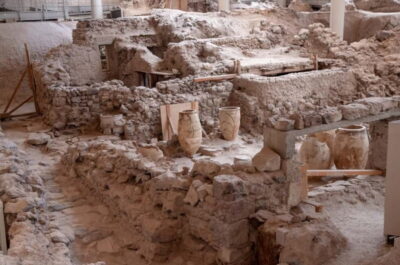
Santorini: Akrotiri Ticket with Optional Self-Guided Audios
Read our review →
Browse the lists this tour appears in