
REVIEW · FRANCE AUDIO TOURS
Lyon Walking Tour with Audioguide on Your Smartphone
Lyon rewards walkers who follow its layers. This self-guided tour links grand squares, silk-worker passageways, Roman remains, churches, museums, and river views through 29 audio recordings narrated by a professional historian. You use your own phone, headphones, and the app’s offline map, moving from Place Bellecour through central Lyon and back again.
I like the freedom to stop for a coffee, snack, or extra photographs without holding up a group. I also like the price: at $8.42 per person, it costs less than most guided walks and remains available for one year. The main catch is simple: downloading and activating the app may take patience, and there is no human guide to help if the technology misbehaves.
Key points to know before you go

- Place Bellecour begins the route: Start at Lyon’s huge central square, with easy access to the city’s historic districts.
- The route covers several sides of Lyon: You visit the Presqu’île, Vieux Lyon, Fourvière, the Rhône, Croix-Rousse, and major Roman and religious sites.
- You set the pace: The advertised walk takes about three hours, but you can pause, skip stops, or spread the route across several days.
- The app works offline: Download the audio, illustrations, and route map before setting out so you are not dependent on a mobile signal.
- Transportation and entry fees are extra: The tour itself does not include a smartphone, headphones, funicular fare, museum admission, or other transport.
- This is a quiet way to sightsee: It suits independent walkers, but not people looking for conversation or a small group atmosphere.
A low-cost introduction to Lyon
At $8.42, this is best viewed as a city orientation with commentary, not a full guided excursion. You get a planned walking route, location-based audio, landmark illustrations, and a map that helps you move between stops. That structure is useful in Lyon, where the city’s key sights are spread across the Saône, Rhône, Presqu’île, Old Town, Fourvière, and Croix-Rousse.
The value is strongest if you already enjoy walking and can handle a phone app. A conventional private guide gives you conversation and instant answers. This tour gives you privacy, flexibility, and a very low price. You can listen closely at one stop, pause the narration for lunch, or return to a favorite church later.
The tour has an average rating of 4.3 from 14 ratings, with especially strong praise for the route, clear explanations, and freedom to set your own timing. One useful detail is that the audio includes stories about silk merchants, the Lumière filmmakers, and Lyon’s place as France’s gastronomic capital. That wider context makes the walk feel like more than a checklist of monuments.
More Audio Walking Tours in France
- Strasbourg Walking Tour with Audioguide on Your Smartphone
★ 4.0 · 42 reviews - Colmar Walking Tour with Audioguide on Your Smartphone
★ 4.5 · 22 reviews - Toulouse : Walking tour with audio guide à télécharger
★ 3.1 · 19 reviews
Starting at Place Bellecour
The route begins at Place Bellecour, Lyon’s enormous open square and one of the easiest meeting points in the city. The equestrian statue of Louis XIV gives you a clear landmark, while cafés and shops around the edges provide practical places to get water or a quick bite before walking.
The scheduled stop is only about 10 minutes, but you can take longer. Use this first section to learn how the app works before moving on. You will need to download the audio guide app, activate your purchase, and follow the marked route on the map. The date and time selected during checkout are approximate because you can use the tour at any time during the access period.
From Bellecour, the route leads toward the Théâtre des Célestins. The theater’s Italian-style design and ornate interior introduce Lyon’s performing arts tradition. The audio is particularly helpful here because a brief look at the facade cannot explain how the building fits into the city’s cultural life. Admission to the walking route is free, but attending a performance is a separate matter.
Churches and the old center
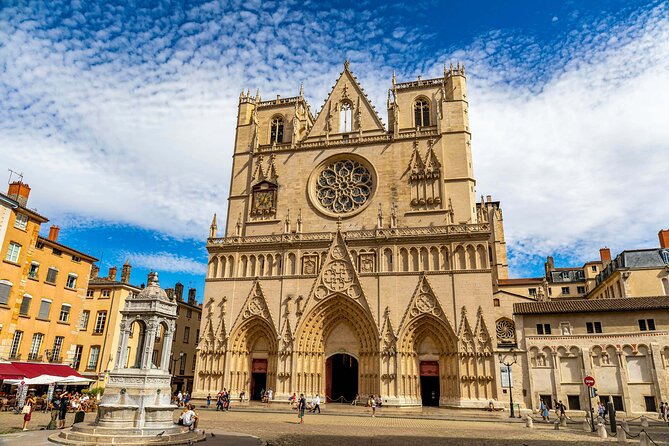
The Cathedral of St. John the Baptist brings you into Vieux Lyon, the city’s most atmospheric historic quarter. Its construction reaches back to the 12th century, and its mix of Romanesque and Gothic design rewards a slower look. Inside, the astronomical clock is one of the main details to watch for, along with the stained glass.
The listed stop is 10 minutes, which is enough for a first look but not a full study of the cathedral. Opening access can vary, so you should treat the audio commentary as useful even if you cannot enter. One of the advantages of this tour is that the explanations continue to provide value when a church or other building is closed.
Next comes the Funiculaire de Lyon, known locally as La Ficelle. The railway links the central city with Fourvière and Saint-Just, and its long service adds a small piece of Lyon transport history to the route. The tour does not include transportation, so you should expect to pay separately if you ride it. That extra cost is modest compared with the price of the tour, but it is still worth planning for.
The funicular also changes the feel of the walk. Instead of treating Fourvière as a distant hill, you reach it quickly and save energy for the basilica and viewpoints. If you choose not to ride, the route may take longer and require more effort, but the audio guide itself remains usable.
Fourvière and the best city views

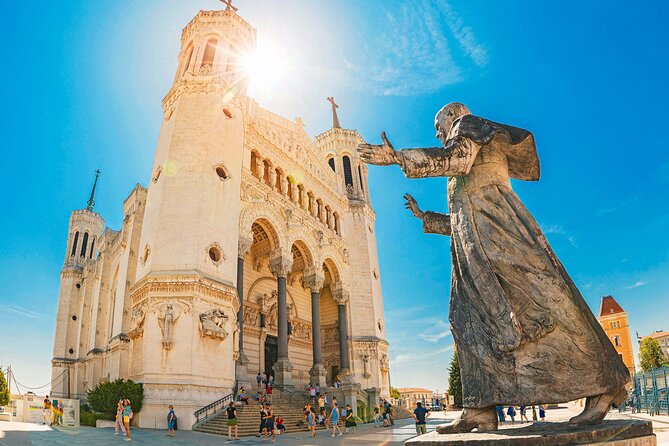
The Basilica of Notre-Dame de Fourvière is one of Lyon’s most recognizable buildings. Its neo-Gothic and Byzantine elements create a more ornate appearance than the cathedral below, with mosaics and stained glass filling the interior. The terraces provide broad views over Lyon, making this one of the places where you should pause rather than rush through a 10-minute audio segment.
The basilica is also a good example of why a self-guided format can work well. You can listen to the description, then put your phone away and study the decoration at your own pace. I would allow extra time here if views and architecture matter to you.
The Museum of Cinema and Miniatures comes later in the Old Town portion of the route. It occupies a Renaissance building and combines two subjects: film props, costumes, and special effects, plus highly detailed miniature scenes. The museum requires its own admission ticket, so it is not included in the $8.42 price.
You should decide in advance if you want to enter. The audio tour can point out the museum and explain its role, but it cannot replace the collections inside. If you are interested in filmmaking or miniature craftsmanship, this is one of the strongest optional additions along the route. If you are watching your budget, simply enjoy the exterior and continue.
More Smartphone Audio Tours in France
- Paris: Orsay Museum Entry Ticket and Digital Audio Guide App
★ 4.4 · 3,170 reviews - Caen: Memorial Museum Entry Ticket & Optional Audio App
★ 4.6 · 272 reviews - Paris Orsay Museum Entry Ticket with Digital Audio Guide
★ 3.5 · 93 reviews - Paris: Rodin Museum Ticket & Optional Digital AudioGuide App
★ 4.7 · 56 reviews
Traboules, towers, and Lyon’s silk past

La Longue Traboule is one of the route’s most distinctive stops. A traboule is a covered passage linking streets, courtyards, and buildings, and this one runs from Rue Saint-Jean toward Rue des Trois Maries. Its twists, stairways, and enclosed spaces show how Lyon’s old buildings were connected behind their street fronts.
The passage is closely linked with the city’s silk workers and residents. That makes it an important stop for understanding Lyon as a working city, not just a collection of pretty facades. The audio stories about silk merchants add useful human detail to what might otherwise look like a quick shortcut.
The Pink Tower, or Tour Rose, offers another memorable Old Town detail. Its pink color, spiral staircase, and position among the traboules make it an easy place to recognize and photograph. The route here can feel slightly less direct than a standard street walk because the historic passages do not always behave like modern roads. The app’s map is especially helpful.
One small improvement would be clearer street and square names in the spoken descriptions. That point matters when you are standing among several similar lanes and trying to match the commentary to the right doorway. Keep the map open and look for the landmark illustrations before moving on.
St. Bonaventure and Lyon’s printed word

The Church of St. Bonaventure sits near Place des Cordeliers and offers a calmer stop amid the central city. Its Gothic vaulting, stained glass, and older architectural details make it worth entering when open. The 14th-century church gives the route another change of mood after the passageways and viewpoints of Vieux Lyon.
The Museum of Printing and Graphic Communication follows as a more unusual cultural option. Lyon played an important part in Renaissance printing, and the museum presents presses, rare books, typesetting tools, and other stages in the development of printed communication. Some displays and workshops are interactive, though entry is separate from the audio walk.
I like this pairing because it broadens the tour beyond famous buildings. You learn about worship, commerce, books, design, and the tools that spread ideas. Still, both the church and museum deserve more than the standard 10-minute allocation if you want to see their interiors properly.
St. Nizier, Terreaux, and the Opera House
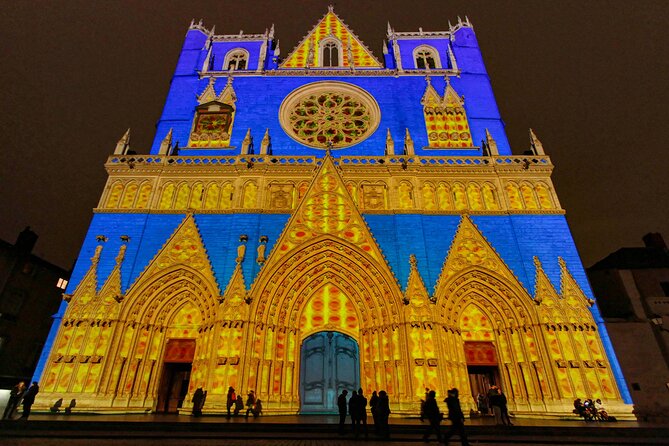
Église Saint-Nizier is one of the Presqu’île’s major landmarks. Its foundations reach back to the sixth century, while the visible building combines a Gothic facade with a Renaissance bell tower. Inside, stained glass and carved details tell a long story of religious change and rebuilding.
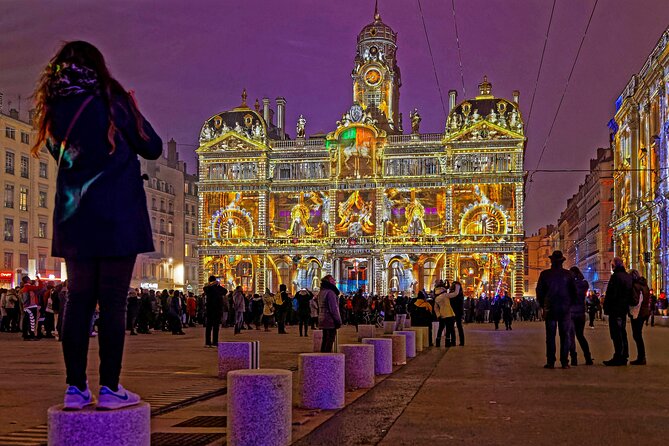
Place des Terreaux shifts the route back into open civic space. The square is framed by Lyon’s City Hall and the Museum of Fine Arts, with the dramatic Bartholdi Fountain at its center. The fountain’s horses and chariot create one of the city’s most recognizable public artworks, and nearby cafés make this another natural pause point.
The Opéra Nouvel adds a strong modern note. The original 19th-century opera house was redesigned by Jean Nouvel, who placed a striking glass dome above the older structure. You may not attend a performance, but the exterior shows how Lyon has adapted historic buildings for present-day cultural use.
These three stops work well together because they show different kinds of public life: worship, government, art, and performance. The audio guide helps connect them, while your own walking pace lets you choose which facades deserve extra attention.
Along the Rhône and into Roman Lyon
The Rhône section provides a change from stone streets and enclosed courtyards. Its banks offer space for walking, cycling, sitting, cafés, parks, and seasonal events. The route’s 10-minute stop is enough to appreciate the river as part of everyday Lyon, though you may want a longer pause if the weather is pleasant.
The final major site is the Amphitheater of the Three Gauls in Croix-Rousse. Built in 19 AD, it hosted gatherings of Gallic tribes and public performances under Roman rule. Only part of the structure remains, so do not expect a complete arena. The value lies in imagining the political and cultural role of the site and seeing how ancient Lyon reaches into a modern neighborhood.
Because the route covers so much ground, the three-hour estimate should be treated as a guide rather than a strict timetable. Listening, taking photographs, entering optional museums, riding the funicular, and stopping for food can easily extend the outing. One useful feature is the one-year access period. You can complete the walk in one day, revisit sections, or spread it across several days.
Using the app without frustration
The app is central to the experience, so prepare before you leave your accommodation. Download it, activate the purchase, and confirm that the audio and offline map are available. Bring your own headphones because none are supplied, and remember that you also provide the smartphone.
Most of the technical work happens before the first stop. Once the app is running, the route is reported to be easy to follow, with location points and landmark images helping you move from one place to the next. The map is particularly useful in Vieux Lyon, where narrow lanes and traboules can make orientation less obvious.
The activation process has caused trouble for at least one purchaser, while another found the initial download difficult but the tour simple to use afterward. That is practical warning enough: do not wait until you are standing at Place Bellecour. If the code does not work, support is available through TouringBee at [email protected].
The audio includes 29 recordings, so you are not limited to the ten-minute descriptions attached to the main stops. The soft French music noted in the commentary can add atmosphere, though some people may prefer to listen without background sound. You control the volume and can pause whenever you like.
Who should book this Lyon walk?
I would choose this tour if I wanted a cheap, independent introduction to Lyon and liked the idea of mixing sightseeing with cafés, photographs, and spontaneous stops. It also works well for a national holiday or a day when museums and other attractions are closed, since the route itself takes place on public streets and does not require admission.
It suits solo visitors, couples, families with older children, and anyone who dislikes being hurried along. It is also useful if you want to revisit a section later because your access lasts one year.
I would choose a human-led walk instead if conversation, local questions, and social contact are important to you. This is not a group experience, and no guide waits at Place Bellecour. You also need to budget separately for the funicular, museum entries, food, transportation, and any headphones or phone accessories you need.
Free cancellation is available up to 24 hours before the local start time. Changes or cancellations inside that window do not qualify for a refund.
Should you book it?
Book it if you want good value and complete control over a broad Lyon route. The strongest parts are the clear itinerary, the stories about silk, cinema, printing, and Roman Lyon, and the ability to take the route in one stretch or several short outings.
Skip it if app setup frustrates you, you need a live guide, or you want every museum and transport fare included. For most independent walkers, though, $8.42 buys a useful framework for seeing Lyon without tying you to a group schedule.
FAQ
How long does the Lyon smartphone audio tour take?
The route takes approximately three hours, but you can make it longer by stopping for food, entering museums, riding the funicular, or spending extra time at the basilica and river.
Where does the tour begin?
It begins at Place Bellecour, Pl. Bellecour, 69002 Lyon, France.
Where does the tour end?
The activity ends back at the meeting point at Place Bellecour.
Is a human guide included?
No. This is a self-guided experience, and no guide will be waiting at the starting point.
What do I need to bring?
You need your own smartphone and headphones. Transportation and entrance tickets are not included.
Does the tour require entry fees?
The walking route itself does not require an entry fee. Optional attractions such as the Museum of Cinema and Miniatures and the Museum of Printing and Graphic Communication require separate admission.
Can I use the tour on another day?
Yes. Your purchase provides access for one year, and the audio guide can be used at a time and date of your choice.
Is the audio guide available in English?
Yes. The tour is offered in English, and the app is available for both iPhone and Android.
Just added around France
- Toulouse Self-Guided Audio Experience★ 3.5 · 3 reviews
- Toulouse : Albi and Cordes/Ciel Day Trip with audio guides★ 4.0 · 70 reviews
- Toulouse : Carcassonne Day Trip by Coach with audio guides★ 4.0 · 73 reviews
- Rouen Cathedral Self Guided Audio Tour★ 4.0 · 2 reviews
- Rouen: Audio Guided City and Joan of Arc Tour★ 4.0 · 2 reviews
- Rouen audio guided tour★ 4.0 · 19 reviews
- The Hardest City to Invade: Saint Malo’s Secrets Audio Guide★ 4.5 · 9 reviews
- The Tuileries Garden’s Classic Sights: A Self-Guided Audio Tour★ 4.0 · 3 reviews
Smartphone Audio Tours, compared.

Colosseum & Forum with Audio Guide App -Optional Arena
Read our review →
Timed Entry to Michelangelo’s David + Audio App
Read our review →
Cathedral & Brunelleschi’s Dome Ticket & Audio App
Read our review →
Michelangelo’s David Priority Ticket & Audio App
Read our review →
Uffizi Priority Ticket & Masterpieces Audio App
Read our review →
Castel Sant’Angelo Entry Ticket & Digital Audioguide
Read our review →
Pantheon Priority Entry Ticket & Audio Guide App
Read our review →Browse the lists this tour appears in