
REVIEW · FRANCE AUDIO TOURS
Strasbourg Walking Tour with Audioguide on Your Smartphone
Strasbourg rewards slow wandering. This smartphone audio tour links 33 city sights with a GPS route, short historical recordings, and an offline map, making it a handy way to get oriented without joining a group. You begin near Pont Kuss, walk through Petite France and the cathedral quarter, then return to the starting point.
I like the freedom to pause for coffee, lunch, photographs, or a hotel break. I also like the price: at $6.73, it costs less than many guided walks and gives you one year of access. The tradeoff is that most recordings last only two or three minutes, so you get a useful introduction rather than a full lesson in Alsatian history.
Five useful things to know before you walk
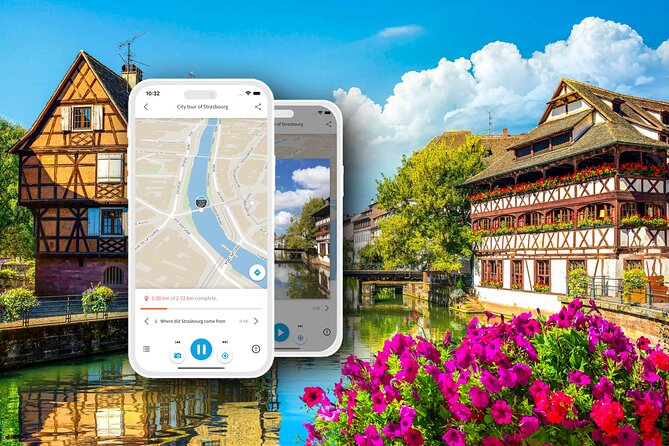
- The route connects 33 sights, including Petite France, the Ponts Couverts, Barrage Vauban, Saint-Thomas Church, and Strasbourg Cathedral.
- The audio works offline after you download the map and recordings, though the initial setup requires your phone connection.
- The tour is self-guided, with no person waiting at Pont Kuss and no fixed departure time.
- You need your own phone and headphones, and the app can use plenty of battery during the walk.
- Short recordings keep the pace moving, but anyone wanting detailed stories may find the commentary too brief.
- The route is best for first-time visitors who want an overview before deciding where to spend more time.
What this Strasbourg audio walk is really like
This is not a traditional walking tour with a guide holding an umbrella. It is a route on your phone, supported by 33 audio recordings narrated by a professional historian, landmark illustrations, and GPS navigation.
You download the iPhone or Android app, activate the purchase, and follow the route from the map. The meeting point is Pont Kuss on Rue du Maire Kuss. The activity ends back there, although the flexible format means you can stop and continue later during the one-year access period.
The advertised walking time is about two and a half hours. That is a sensible estimate if you move steadily and listen at each stop. In practice, you can turn it into a full morning, a long afternoon, or a stop-and-start city walk. One useful feature is that the audio guide is not tied to a particular date or departure hour.
Bring headphones. The tour does not provide them. Also bring a charged phone, because one person reached the final two stops with no battery after starting at 95 percent. Put the phone in airplane mode after downloading the content if you do not need mobile service. That helps conserve power.
More Audio Walking Tours in France
- Colmar Walking Tour with Audioguide on Your Smartphone
★ 4.5 · 22 reviews - Toulouse : Walking tour with audio guide à télécharger
★ 3.1 · 19 reviews - Montmartre Paris Walking Tour with Audioguide on Your Smartphone
★ 4.5 · 17 reviews
Starting with Saint-Pierre-le-Vieux and Grande Rue
The first stop is Église Protestante Saint-Pierre-le-Vieux, a church with an unusual split personality. Its Catholic and Protestant sections reflect Strasbourg’s complicated religious past and long tradition of coexistence.
You get about ten minutes here, enough to look at the Romanesque and Gothic details, stained glass, and interior spaces while the recording supplies the basic story. This is a good opening stop because it puts the city’s religious divisions into human scale. You are not just looking at an old church. You are seeing how Strasbourg’s identity developed between French and German cultural worlds and across different Christian traditions.
The route then moves along Grande Rue. This is one of the better places to simply walk and look up. Half-timbered houses, shops, restaurants, and cafes fill the street, and the architecture shifts between medieval and Renaissance forms.
The audio guidance helps you notice details you might otherwise pass without a glance. Still, this is a busy urban street, not a quiet museum. Leave room for pedestrians, and expect to pause the recording if you stop for photographs or step into a shop.
Petite France, where the route earns its keep
Place Benjamin Zix leads you into Petite France, the part of Strasbourg most likely to appear on postcards. Half-timbered houses line canals, balconies carry flowers, and the narrow streets invite slow walking.
The square is a practical pause point. You can sit at a cafe, grab food, or simply look across the water before continuing. The route describes Benjamin Zix, the Alsatian artist after whom the square is named, and places the area within its older working life as a district of fishermen, millers, and tanners.
The next stops, Pont du Faisan and Petite France, are close together. Pont du Faisan is also called the Pont Tournant, or Turning Bridge. Its pivoting design allowed boats to pass through the narrow canal. The recording is short, but the mechanism gives you something specific to watch for instead of another general description of pretty buildings.
The Petite France stop itself is only about five minutes in the suggested schedule. That is not enough time to appreciate every lane, canal, and view. I recommend treating the audio stop as a starting point, then pausing the tour to wander. This is one place where strict obedience to the two-and-a-half-hour estimate would work against the experience.
Ponts Couverts and Barrage Vauban

The route visits the Ponts Couverts and Barrage Vauban in several closely related stops. At first, this may feel repetitive, but the overlap helps you see the defensive system from different angles.
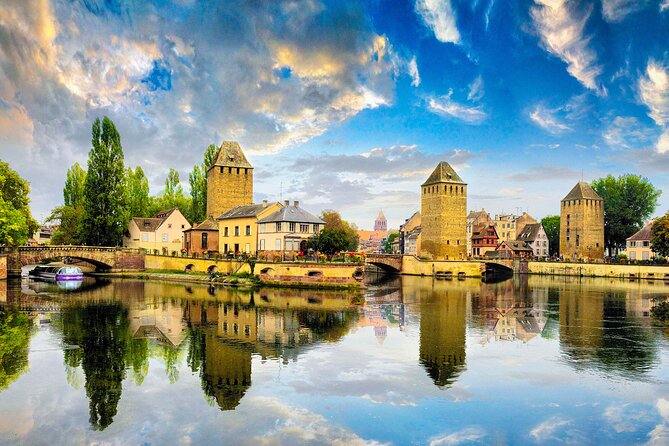
The Ponts Couverts date from the 13th century and include three bridges and defensive towers. Despite the name, the bridges are no longer fully covered in the way many visitors expect. Their purpose was to protect the city and control movement along the waterways.
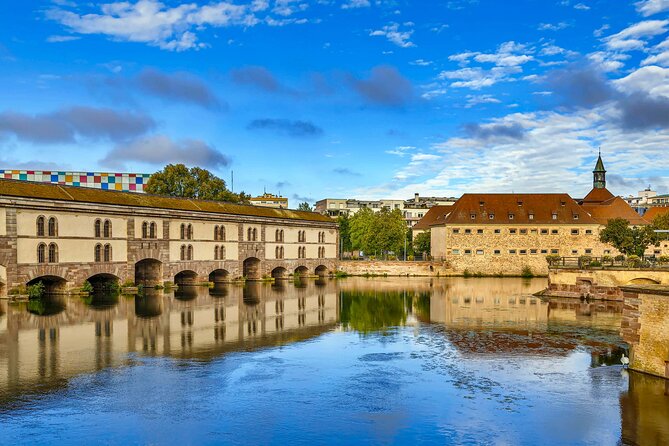
Nearby, Barrage Vauban belongs to the 17th century and was designed by military engineer Sébastien Le Prestre de Vauban. The structure could help flood parts of the city during an attack. Its covered gallery contains sculptures and exhibits, and the upper terrace gives you views across Petite France and toward Strasbourg’s skyline.
The terrace is the main reason to slow down here. A short recording can explain the engineering, but the view gives the structure its full meaning. You see how the Ill River, bridges, towers, and old houses fit together. If the route feels crowded with names at this stage, simply take the audio in small pieces and give yourself time to look.
More Smartphone Audio Tours in France
- Paris: Orsay Museum Entry Ticket and Digital Audio Guide App
★ 4.4 · 3,170 reviews - Caen: Memorial Museum Entry Ticket & Optional Audio App
★ 4.6 · 272 reviews - Paris Orsay Museum Entry Ticket with Digital Audio Guide
★ 3.5 · 93 reviews - Paris: Rodin Museum Ticket & Optional Digital AudioGuide App
★ 4.7 · 56 reviews
Saint-Thomas Church and the old center
Église Saint-Thomas brings the walk back toward the historic center. This Gothic church is especially important for music lovers because it contains an 18th-century Silbermann organ associated with Wolfgang Amadeus Mozart.
The church also holds the Mausoleum of Maurice de Saxe. These details give the stop more variety than a simple architecture lesson. You get religious history, music, sculpture, and the story of a major memorial in one place.
Next comes Place Gutenberg, named for Johannes Gutenberg, inventor of the printing press. A statue marks his connection to the square, which is surrounded by cafes, restaurants, and shops. The square also provides views toward the cathedral and may host markets or fairs.
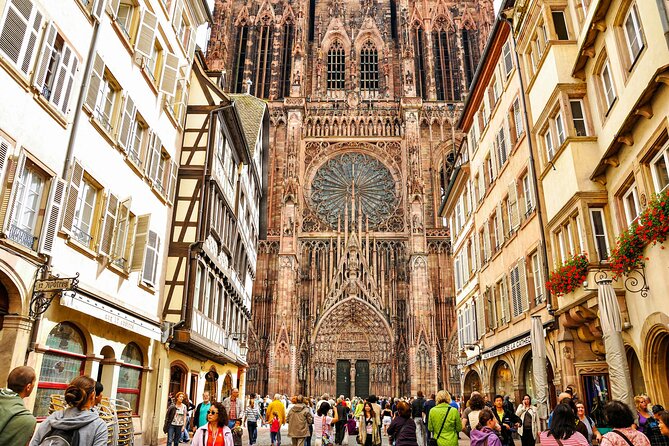
Rue Mercière offers one of the clearest approaches to Strasbourg Cathedral. The street is lined with half-timbered buildings, cafes, restaurants, and small shops. Keep your eyes at the end of the street, where the cathedral’s façade comes into view. This is a classic Strasbourg moment, and the audio guide gives it enough context without forcing you to stop for long.
Strasbourg Cathedral and Maison Kammerzell
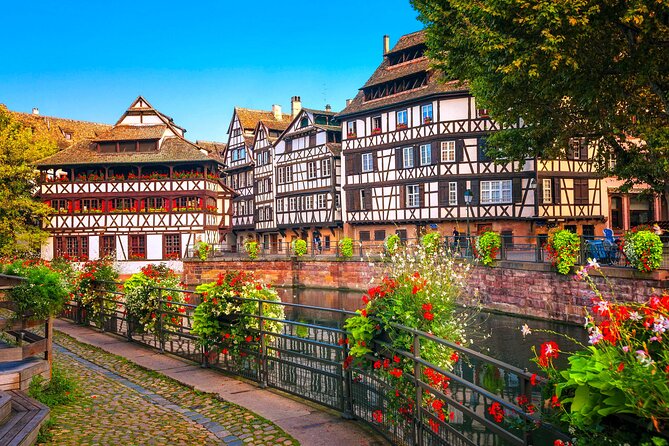
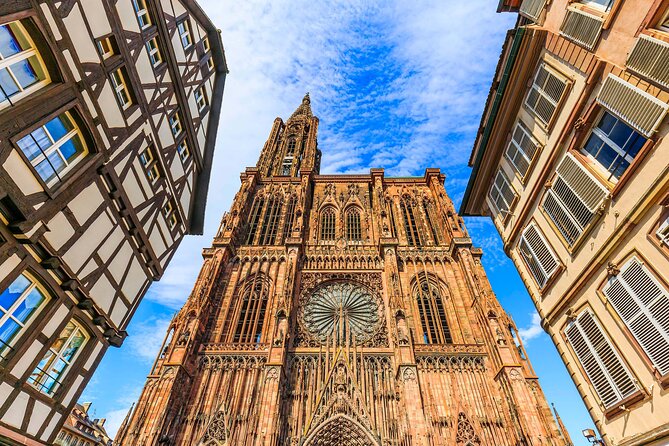
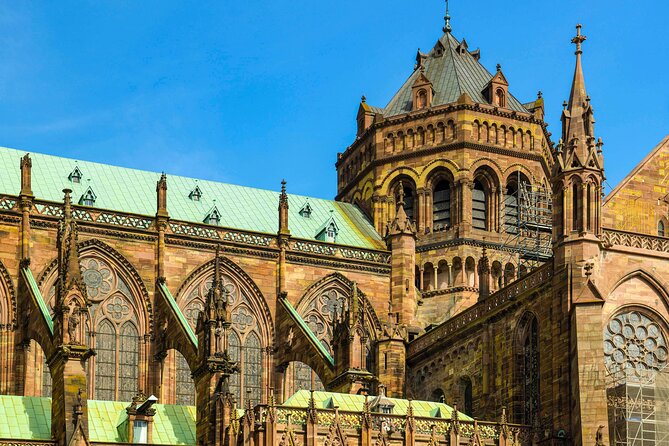
The cathedral deserves more time than the suggested five-minute stop. Its Gothic façade, sculptures, stained glass, astronomical clock, and organ can occupy a full visit on their own.
The route points out the 15th-century building and its famous spire. If you want the city view, the climb to the platform involves 332 steps. That climb is not included in the audio tour, and entrance fees are not included either, so plan for separate tickets if you choose to go inside or up the tower.
The cathedral is also a good place to pause the app. Listen to the introduction, then explore at your own pace. A recording cannot compete with standing beneath the vaults or watching the astronomical clock operate.
Maison Kammerzell sits nearby. Its carved wooden façade, sculptures, and frescoes make it one of Strasbourg’s most memorable historic buildings. The house dates to the 15th century and now contains a restaurant serving traditional Alsatian food.
You do not need to dine there to appreciate the exterior. If you do decide to eat, allow extra time and treat the restaurant as a separate choice rather than part of the timed walking schedule.
Small squares, dark stories, and Alsatian life
Place du Marché aux Cochons de Lait is a compact square with an unusually literal name: Suckling Pig Market Square. It offers a quieter pause among half-timbered buildings, cafes, and local shops.
The stop is brief, but these smaller places help prevent the walk from becoming a parade of only famous monuments. Strasbourg’s character is often easiest to sense in a little square where people sit, shop, and pass through their day.
Pont du Corbeau crosses the Ill and carries a darker story. The Raven Bridge once served as a site for public executions in the medieval period. Today it offers views of the riverbanks and old architecture, but the historical detail gives the bridge a sharper edge.
The final listed attraction is Musée Alsacien. Housed in several 17th-century buildings beside the Ill, the museum presents traditional Alsatian life through period furniture, painted cabinets, costumes, household objects, workshops, and recreated rooms.
Entrance is not included, so you will need a separate ticket if you go inside. The audio guide can point you toward the museum, but it does not replace the museum visit. If you want to understand how people lived in Alsace, this is one of the most useful optional stops on the route.
How good is the audio commentary?
The recordings are clear and short. That is their strength when you want to keep walking, check several sights in one morning, or avoid standing still with a guide for ten minutes at every monument.
The downside is depth. Two or three minutes is enough for a date, a name, an architectural feature, or a memorable anecdote. It is not enough for a detailed account of Strasbourg’s politics, religious conflicts, wartime changes, or Alsatian culture.
The tone also includes occasional pronunciation quirks. Strasbourg was pronounced in an unusual way in one recording, which may bother language-conscious listeners. It is a small flaw, but worth noting.
The app includes pictures to help identify the correct landmark. That matters because some streets and bridges can look similar, and one person found a few mentioned places hard to locate. Use the image and GPS map together rather than relying only on the spoken directions.
Price, value, and practical limits
At $6.73 per person, this is inexpensive city orientation. The value comes from the combination of low cost, one year of access, offline route information, and the ability to stop whenever you want.
It is particularly good for a solo visitor, a couple with different walking speeds, or anyone who dislikes large groups. You can listen quietly, pause for a meal, return to a hotel, and resume without losing the tour.
The main cost is not money. It is attention to setup. You must download the app, activate the purchase, and make sure the content is ready before leaving. Instructions have caused confusion for some people, including one failed download experience. Check the access link before you set out and contact the provider if it does not work.
This is also not the best choice if you want lively conversation, questions answered on the spot, or a guide who can adjust the route to your interests. There is no human guide at the meeting point, and the maximum listed group size of 20 does not mean you will be placed in a guided group. You walk independently.
Free cancellation is available up to 24 hours before the experience start time. Changes or cancellations inside that window are not refundable.
Who should choose this walk?
I would choose it if you are visiting Strasbourg for the first time and want a clear route through the central sights. It gives you a useful framework, then lets you decide where to linger.
It suits independent walkers, solo visitors, couples, and families who want to avoid a fixed schedule. The flexible format also works well if you are fitting Strasbourg around a train, hotel break, meal, or river cruise.
One practical warning: river cruises use timed tickets, so do not assume you can buy one whenever you feel like it. If you plan to add a cruise, arrange it early and leave enough time for the return to your train or other commitment.
I would skip this tour if you expect a detailed lecture at every stop. The commentary is an introduction, not a specialist course. You will get the best value by using it to find the sights, then spending your extra time inside the cathedral, Barrage Vauban, or Musée Alsacien.
Should you book the Strasbourg smartphone tour?
Book it if you want cheap, flexible orientation with reliable coverage of the main historic center. The route brings together Strasbourg’s churches, bridges, canals, defensive works, squares, and landmark buildings in a sensible walk.
Do not book it expecting a personal guide or long stories. Download everything before you leave, bring headphones, charge your phone, and allow extra time in Petite France and at the cathedral.
For $6.73, the drawbacks are manageable. If you value independence more than conversation, this is a practical way to meet Strasbourg on your own terms.
FAQ
Where does the Strasbourg audio tour start?
It starts at Pont Kuss on Rue du Maire Kuss, 67000 Strasbourg, France.
Where does the tour end?
The activity ends back at the meeting point.
How long does the walking tour take?
The estimated duration is about two hours and 30 minutes.
Is there a human guide?
No. This is a self-guided tour, and no guide will be waiting at the meeting point.
Which languages are available?
The tour is offered in English.
Does the tour require Wi-Fi during the walk?
No. The map and audio recordings are available offline after you download them. You need a connection to download and activate the app before starting.
Do I need to bring headphones?
Yes. Headphones are not provided, so you should bring your own.
Is a smartphone included?
No. You must use your own iPhone or Android smartphone.
Are entrance fees included?
No. Entrance tickets and fees are not included. This applies to attractions such as the cathedral tower or Musée Alsacien if you choose to visit them.
How long can I use the audio guide?
You receive access for one year after purchase.
Can I cancel for a full refund?
Yes, if you cancel at least 24 hours before the experience start time. Cancellations made less than 24 hours in advance are not refunded.
Just added around France
- Toulouse Self-Guided Audio Experience★ 3.5 · 3 reviews
- Toulouse : Albi and Cordes/Ciel Day Trip with audio guides★ 4.0 · 70 reviews
- Toulouse : Carcassonne Day Trip by Coach with audio guides★ 4.0 · 73 reviews
- Rouen Cathedral Self Guided Audio Tour★ 4.0 · 2 reviews
- Rouen: Audio Guided City and Joan of Arc Tour★ 4.0 · 2 reviews
- Rouen audio guided tour★ 4.0 · 19 reviews
- The Hardest City to Invade: Saint Malo’s Secrets Audio Guide★ 4.5 · 9 reviews
- The Tuileries Garden’s Classic Sights: A Self-Guided Audio Tour★ 4.0 · 3 reviews
Smartphone Audio Tours, compared.

Colosseum & Forum with Audio Guide App -Optional Arena
Read our review →
Timed Entry to Michelangelo’s David + Audio App
Read our review →
Cathedral & Brunelleschi’s Dome Ticket & Audio App
Read our review →
Michelangelo’s David Priority Ticket & Audio App
Read our review →
Uffizi Priority Ticket & Masterpieces Audio App
Read our review →
Castel Sant’Angelo Entry Ticket & Digital Audioguide
Read our review →
Pantheon Priority Entry Ticket & Audio Guide App
Read our review →Browse the lists this tour appears in