

REVIEW · ROME AUDIO TOURS
Rome Walking Tour with Audioguide on Your Smartphone
Rome rewards wandering, and this tour gives your wandering a useful shape. For $7.14, you follow a phone-based route from the Pincian Hill through grand squares, imperial monuments, the Trevi Fountain, and the Colosseum. You get 21 audio recordings, an offline map, landmark illustrations, and a full year of access.
I like the freedom to stop for coffee, split the route over two days, or repeat a favorite section. I also like the route’s mix of famous sights and quieter corners, including Piazza Mignanelli and Piazza San Silvestro. The main drawback is simple: this is not a human-led tour, and the audio may feel brief if you want long, scholarly explanations at every stop.
Five things to know before you go
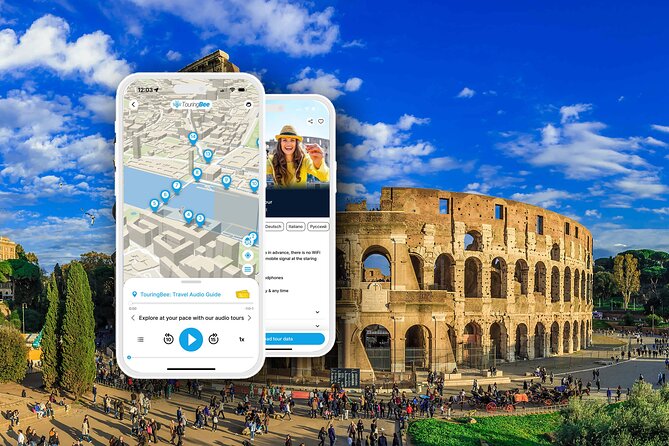
- The route covers about 2 hours and 30 minutes, including roughly 1 hour and 10 minutes of walking and time spent at the stops.
- You begin at Viale Valadier, near Villa Borghese and the Terrazza del Pincio, then finish back at the same meeting point.
- The app works offline after downloading, but you need location services enabled for the GPS route to work properly.
- You bring the essentials yourself: a smartphone, headphones, and any food or drinks you want along the way.
- Your access lasts one year, so you can complete half the route now and return to the rest later.
- The price covers sightseeing guidance only, not transportation, attraction admission, or a live guide.
What this Rome audio tour is really like
This is best understood as a sightseeing route with commentary, not a traditional tour group. You download the app for iPhone or Android, activate your purchase, and follow the map from one point to the next. The listed booking time is only an approximate placeholder, since you can use the tour at your chosen time after activation.
That flexibility is the heart of the experience. Rome is not a city that rewards being rushed. You might spend extra time at the Trevi Fountain, stop for lunch near Via del Corso, or pause at the Pincian Terrace as the light changes over the city. With one year of access, you do not need to finish everything in one march.
The route is designed for a maximum of 20 people, but there is no human guide leading that group. In practice, you use the audio privately on your own phone. That means no waiting for a large group, no trying to hear a guide over street noise, and no fixed pace. It also means you are responsible for starting the right recording and keeping an eye on the map.
The 21 audio recordings are intended to provide concise context and storytelling at the sights. One weakness is that the commentary can feel short to anyone expecting several minutes of detailed history at every monument. Think of it as a helpful voice in your ear, not a full course in Roman history.
More Audio Walking Tours in Italy
- Pantheon in Rome Walking Tour with Audioguide on Your Smartphone
★ 5.0 · 2 reviews - Florence: 2.5 hour Audio Guided Walking Tour led by Host
★ 4.6 · 293 reviews - Verona Walking Tour with Audio and Written Guide by a Local
★ 4.5 · 157 reviews
Starting above Rome at Terrazza del Pincio
The meeting point is on Viale Valadier, a practical starting place near the upper edge of Villa Borghese. From here, the route begins at Terrazza del Pincio, one of Rome’s best city viewpoints.
The terrace looks across rooftops toward landmarks such as the Spanish Steps and St. Peter’s Basilica. It is especially appealing later in the day, when the city takes on warmer colors. The stop itself is short, listed at about five minutes, but you can easily linger if you want to get your bearings before walking into the historic center.
The route then leads through Piazza del Popolo. This broad square makes a strong opening because it brings together Egyptian obelisks, historic churches, and monumental architecture in one place. Look for the paired churches of Santa Maria dei Miracoli and Santa Maria in Montesanto. Their similar facades help explain why Piazza del Popolo feels so carefully composed.
You are not charged admission for these outdoor stops. That keeps the low price honest, though you should remember that the route does not include entrance tickets to paid sites later on.
Walking Via del Corso toward the Spanish Steps
Via del Corso is the long central street linking Piazza del Popolo with Piazza Venezia. The tour allows about 10 minutes here, but the actual walk is part of the experience. You pass shops, cafes, historic facades, and the everyday Roman traffic that makes this street feel like a working city rather than an open-air museum.
This section is useful because it connects the sights. Instead of jumping between isolated monuments by vehicle, you see how Rome’s squares and streets fit together. The route also gives you a chance to pause for a drink or a quick snack, though food and drinks are not included.
Via Condotti takes you into a different side of Rome. This is the city’s luxury shopping street, lined with designer names and polished window displays. Even if you are not shopping, it is worth seeing how the city’s fashion culture sits beside ancient columns and Baroque churches.
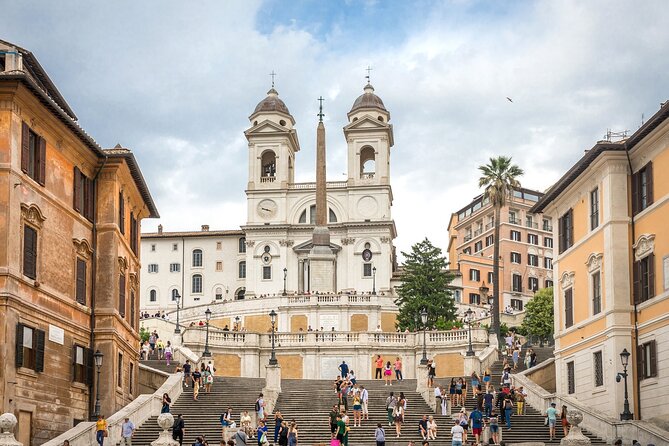
The Spanish Steps arrive shortly after. You can climb the 135 steps for views over Piazza di Spagna, though the tour itself does not include a reserved entry or special access. The square is a natural place to stop and watch the flow of people. The nearby cafes and boutiques make it easy to turn a five-minute audio stop into a longer break.
Piazza Mignanelli, next to the Spanish Steps, provides a quieter pause. Its central Column of the Immaculate Conception, topped by a statue of the Virgin Mary, gives you a clear subject for the audio commentary and photographs. This is one of the route’s nicer choices because it moves you a short distance away from the busiest part of the Spanish Steps.
From quiet squares to the Trevi Fountain

Piazza San Silvestro is another small break from the major tourist route. The square is framed by historic buildings and cafes, with the Church of San Silvestro nearby. The stop is listed at five minutes, but it works best as a breathing space between larger sights.
Next comes the Column of Marcus Aurelius in Piazza Colonna. Its spiral carvings show scenes from the emperor’s military campaigns. From street level, the column is easy to miss if you do not know what you are looking at, so an audio guide earns its keep here. The commentary helps turn a tall carved monument into a story rather than just another piece of stone.
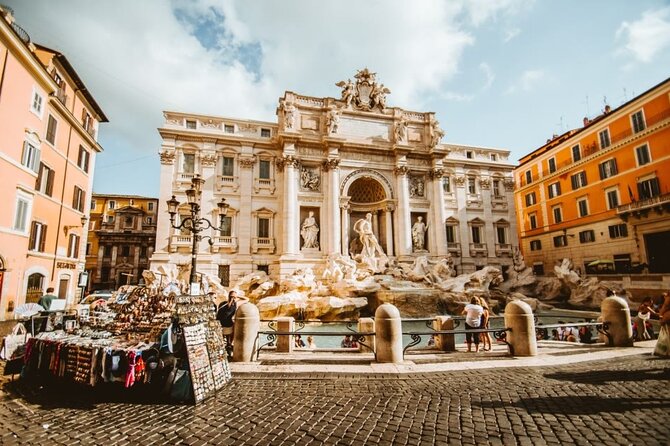
Then comes Trevi Fountain, the route’s most obvious crowd magnet. The fountain’s sculpture, water, and Baroque design make it one of Rome’s essential stops. The traditional coin toss is part of the fun, but you should expect a busy setting and plan to keep your phone secure.
The suggested time is 10 minutes, which is enough to hear the recording and take a quick look. It is not much if you want photographs from several angles or a quieter moment. Visiting at night is suggested because the fountain is illuminated, but the audio tour does not restrict you to a particular hour. Your best strategy is to treat the listed duration as a minimum, not a command.
More Smartphone Audio Tours in Italy
- Rome: Colosseum & Forum with Audio Guide App -Optional Arena
★ 4.2 · 24,770 reviews - Rome: Castel Sant’Angelo Entry Ticket & Digital Audioguide
★ 4.7 · 5,347 reviews - Rome: Castel Sant’Angelo Entry Ticket & Audio App
★ 4.3 · 4,952 reviews - Rome: Pantheon Priority Entry Ticket & Audio Guide App
★ 4.1 · 3,234 reviews
Augustus, Ara Pacis, and the city’s imperial memory
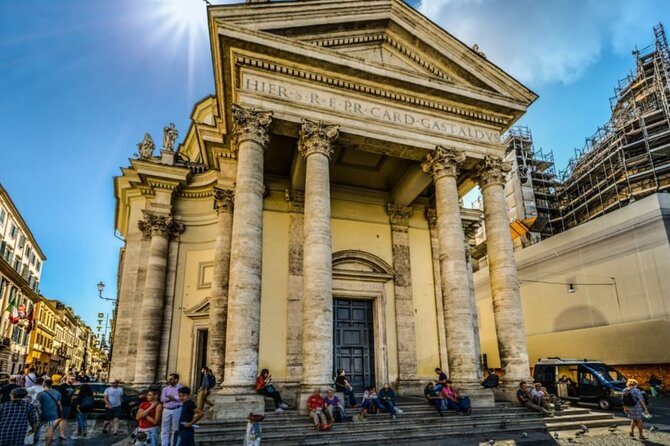
The route includes the Mausoleum of Augustus, an enormous ancient tomb connected with Rome’s first emperor. Restoration work may affect what you can see, so this is more of an exterior historical stop than a guaranteed interior visit.
Nearby, the Ara Pacis Augustae presents a striking contrast between ancient sculpture and modern design. The altar is housed in a glass structure, allowing you to see the carved reliefs while also noticing the modern architectural setting around them. An entrance fee may apply if you choose to go inside, and that cost is not part of this audio tour.
Palazzo Borghese adds an aristocratic note. The building is associated with an art collection that includes works by Bernini and Caravaggio, as well as elegant rooms and gardens. The important practical point is that the tour only covers the route and commentary. It does not include admission, so check access arrangements and ticket prices separately if you want to go inside.
These stops show why this route is more than a list of Rome’s headline sights. You move between imperial monuments, churches, shopping streets, fountains, and grand private buildings. The experience is strongest when you enjoy that variety rather than expect every stop to offer a major interior visit.
Trajan’s Column and the Vittoriano
Villa Aldobrandini appears later on the route as a Baroque setting with gardens, terraces, sculpture, and a water theater. The description presents it as a place of aristocratic design and art. Because the timing is only about five minutes, you should think of this as a quick orientation stop unless you decide to spend extra time there.
Trajan’s Column is one of the route’s most important ancient monuments. Its spiral frieze records scenes from Trajan’s wars in Dacia, wrapping around the column in a carved narrative. You will not be able to study every scene in detail from the street, but the audio explanation gives you a reason to look closely.
The nearby Mercati di Traiano adds another layer. These ancient structures once formed a commercial complex and now include the Museum of the Imperial Fora. Again, entrance is not included. You can appreciate the exterior without paying, or make a separate plan for the museum if ancient urban life interests you.
The Imperial Fora continue the story with temples, columns, and civic spaces built by emperors including Caesar and Trajan. This area can be hard to read without context because the ruins spread across a large archaeological zone. The map and illustrations are particularly useful here, helping you connect scattered remains with the buildings that once occupied the site.
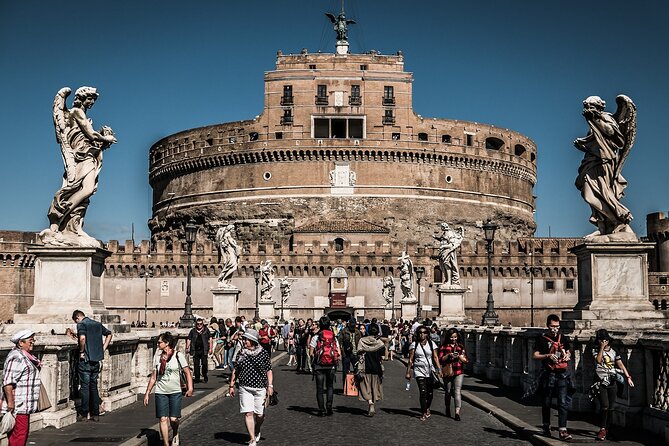
The Vittoriano, also called the Altar of the Fatherland, brings you into modern Italian national history. Its white marble mass dominates Piazza Venezia, with statues and terraces that look across central Rome. The route points you toward the building, but any museum or terrace admission is extra.
Ending at the Colosseum

The final major sight is the Colosseum, Rome’s most famous amphitheater. The tour helps place it within the wider imperial route, after you have already seen the Imperial Fora and Trajan’s monuments.
You can view the exterior without a ticket, but entering the Colosseum requires admission. Tickets for the arena, underground areas, and other sections are not included in the $7.14 cost. If you want to go inside, arrange that separately and allow much more time than the five-minute style of stop used in the audio route.
This is an important distinction. The audio tour can guide you to the Colosseum and explain what you are seeing, but it is not a Colosseum entry experience. You should not buy it expecting reserved access or a guided visit inside the amphitheater.
After the final points, you return to the original meeting point. The route’s total timing includes about 1 hour and 10 minutes of walking and stop time beyond the audio segments. Your actual day will be longer if you enter attractions, shop, eat, or take photographs.
The app, map, and practical setup
Download the audio guide before you set out. Once the tour data is stored on your phone, the app works without an internet connection. That is useful in Rome, where you may not want to rely on mobile data while checking directions.
The GPS map is meant to guide you from stop to stop. Location services need to be enabled, and you should test the app before leaving your accommodation. If the map does not track your position correctly, check those settings first.
The illustrations are a small but useful feature. Rome gives you a lot to look at, and a sketch or image can help you identify the correct column, church, or facade when several monuments are close together.
Bring your own headphones. They are not supplied, and neither is a smartphone. Also bring water and anything you want to eat, since food and drinks are excluded. Public transportation is nearby, but getting to the starting point and moving beyond the walking route are your responsibility.
Who gets the best value from $7.14
At this price, the tour offers excellent value if you want a low-cost orientation walk with historical prompts. A live guide would normally cost much more, while this option gives you a route, audio commentary, illustrations, and a year to use the material.
The value is even better if you split the route. You can complete the first half on one day and return later, which is helpful if your feet need a rest or you want to enter the Ara Pacis, Mercati di Traiano, or Colosseum along the way.
The price is less convincing if you expect deep commentary at every point. The audio is designed for a two- to three-hour outing, not a full lecture series. You also need to manage the technology yourself, including downloads, activation, headphones, and GPS settings.
I would choose this for a first day in Rome, especially if you want to understand the shape of the center before returning to individual sights. It also suits independent walkers, couples who prefer their own pace, and anyone who dislikes being tied to a group schedule.
I would choose a live guide instead if you want questions answered on the spot, detailed archaeological interpretation, or help getting inside paid attractions.
Cancellation and timing details
You receive confirmation at booking, and free cancellation is available until at least 24 hours before the scheduled start time. Changes or cancellations made inside that 24-hour window are not accepted for a refund.
The selected date and time do not limit the tour to that exact appointment. The audio guide is available at any time after activation, and access continues for one year. That makes the booking time less important than it first appears.
Should you book this Rome audio tour?
Book it if you want a cheap, flexible way to connect major Rome sights without a guide hurrying you along. The route has real variety, the offline map is practical, and the ability to return within a year is unusually generous for a $7.14 purchase.
Skip it if your main goal is interior access to the Colosseum, detailed expert discussion, or a fully managed day. You will need separate tickets, your own phone and headphones, and enough independence to follow the map.
For most visitors, I would use it as a first-day framework. Let the audio show you where the major pieces fit, then return to the places that deserve more time. Rome rewards that approach, and this little app can help you start without spending much.
FAQ
How long does the Rome smartphone audio tour take?
The tour lasts approximately 2 hours and 30 minutes. About 1 hour and 10 minutes is used for walking and time at the stops, although your visit may take longer if you pause or enter attractions.
Where does the tour start and finish?
It starts at Viale Valadier, 00187 Roma RM, Italy, and ends back at the same meeting point.
Is there a human guide?
No. This is a self-guided experience delivered through a mobile app. You activate the purchase and follow the route using the app’s map.
Does the audio guide work without internet?
Yes. After you download the tour data, the app can function without an internet connection. Location services should be enabled for the GPS map.
Do I need to bring headphones?
Yes. Headphones are not included, so you need to bring your own. You also need your own compatible smartphone.
Are attraction tickets included?
No. Transportation, food, drinks, and entrance tickets are not included. The tour guides you to sights such as the Colosseum, Ara Pacis, and Mercati di Traiano, but any paid entry costs extra.
How long can I access the tour?
You receive one year of access to the tour in your chosen language. You can use it more than once and complete the route in separate visits.
More Audio Walking Tours in Rome
- Sofia: City Monuments Guided Walking Tour with Audio Guide
★ 4.5 · 825 reviews - Self Guided Classic Freedom Trail Location Aware (GPS) Walking Audio Tour
★ 4.5 · 258 reviews - Valletta: Self-Guided Historical Walking Tour (Audio Guide)
★ 3.7 · 251 reviews - Cape Cod & Provincetown Self-Guided Driving & Walking Audio Tour
★ 4.0 · 207 reviews
More Smartphone Audio Tours in Rome
- St. Peter’s Basilica, Optional Dome Access & Rome Audio App
★ 3.8 · 2,052 reviews - Rome: Colosseum Express Entry with Audio Guide App
★ 4.0 · 1,507 reviews - Rome: Roman Forum Super Pass Entry with Audio Guide App
★ 4.2 · 750 reviews - Pantheon Full Experience With Host & Interactive Audio App
★ 4.3 · 587 reviews
Just added around Rome
- Pantheon Skip the Line Entry Tickets with Digital Audio Guide★ 3.5 · 52 reviews
- Trastevere: A Self-guided Audio Tour of Rome’s Medieval Village★ 4.5 · 3 reviews
- St. Peter’s Basilica: Dome Climb with Lift & Audioguide★ 4.5 · 13 reviews
- Audio guide in Vatican Museums and Sistine Chapel★ 4.5 · 12 reviews
- Navova square underground with audioguide★ 4.5 · 17 reviews
- The Roman Jewish Ghetto: A Self-Guided Audio Tour★ 4.0 · 8 reviews
- Experience: The Pantheon Audio Tour★ 4.5 · 4 reviews
- St. Mary’s Basilica, Pope Francis Tomb Audio Tour with Crypt★ 4.0 · 3 reviews
Smartphone Audio Tours, compared.
Colosseum & Forum with Audio Guide App -Optional Arena
Read our review →
Timed Entry to Michelangelo’s David + Audio App
Read our review →
Cathedral & Brunelleschi’s Dome Ticket & Audio App
Read our review →
Michelangelo’s David Priority Ticket & Audio App
Read our review →
Uffizi Priority Ticket & Masterpieces Audio App
Read our review →
Castel Sant’Angelo Entry Ticket & Digital Audioguide
Read our review →
Pantheon Priority Entry Ticket & Audio Guide App
Read our review →Browse the lists this tour appears in