
REVIEW · ATHENS AUDIO TOURS
Athens: Roman Agora E-Ticket and Audio Guide
Ancient Athens gets wonderfully compact here. I like the skip-the-ticket-line entry and the freedom to explore at your own pace, while the audio stories add useful context to a site you could otherwise cross in 20 minutes. The Gate of Athena Archegetis, Tower of the Winds, and old mosque give this small archaeological area surprising variety.
I also like that the tour works offline, so you do not need roaming data once the app is downloaded. The main drawback is orientation: the audio guide can be hard to follow in the correct order, and $18 feels high if you only spend 45 minutes on site or find the entrance nearly empty.
Key points at a glance

- Meet the Winds: The Tower of the Winds is the Roman Agora’s most memorable structure, with weather, timekeeping, and mythology tied together in one small monument.
- A pocket-size ancient site: You can see the main remains in about 45 minutes to an hour, making this easy to fit between larger Athens sights.
- Skip the ticket queue: The adult ticket includes skip-the-line service, though free and reduced-price tickets must be obtained at the on-site booth.
- Explore without a guide group: The audio tour runs on your own Android or iOS phone in English, Spanish, German, French, Italian, or Greek.
- Look beyond Roman Athens: The Gate of Athena Archegetis, the mosque, fountain house, public toilets, and shops reveal several layers of city life.
- Prepare your phone first: You need a charged smartphone, headphones, 100 to 150 MB of storage, and time to download the app before arriving.
A small site with a big historical sweep

The Roman Agora is one of Athens’ most manageable ancient monuments. You are not signing up for a half-day expedition. The usual visit lasts 45 minutes to one hour, which makes this a useful stop before or after the Acropolis, Plaka, or nearby ancient sites.
The setting also gives you a helpful view toward the Acropolis. You are close enough to connect the Roman Agora with the wider story of Athens, yet the site itself feels more contained and less demanding than the Acropolis complex.
I like this scale. You can pause at a column, listen to a short story, and then move on without losing the thread of the visit. If you prefer huge ruins and long walking routes, the Roman Agora may feel brief. If you want a clear look at ancient civic life without spending several hours on your feet, it works well.
The title can be slightly confusing. The site is called the Roman Agora, but its story reaches across more than the Roman period. It helps you picture the practical side of Athens: trading, public services, water, weather, timekeeping, worship, and later religious use.
More Smartphone Audio Tours in Athens
- Athens: Ancient Agora E-Ticket and Audio Tour
★ 3.9 · 413 reviews - Athens: Roman Agora & Ancient Agora E-ticket & 2 Audio Tours
★ 4.1 · 107 reviews - Acropolis Self-Guided Smartphone Tour w/Audio & 3D(No entry)
★ 3.9 · 62 reviews
Entering through the Gate of Athena Archegetis
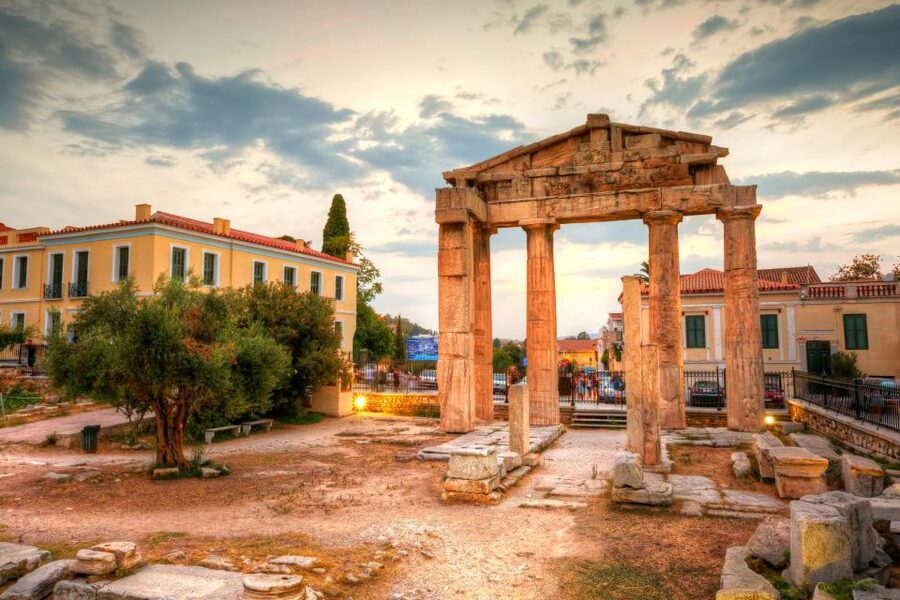
The Gate of Athena Archegetis gives the visit a strong opening. Its large marble columns are among the clearest visual markers in the complex, and the audio tour uses the monument to introduce the purpose of the agora.
This was not simply a place for admiring ruins. An agora served everyday needs, and the remains here point to a working civic area with shops and public facilities. The audio content is designed around short stories rather than a long academic lecture, so you can connect each stop with a practical question: What happened here? Who used it? Why did the Romans alter the older Greek city?
The gate is also a useful orientation point. Before walking farther, take a moment to look at the layout and match the audio instructions to the structures in front of you. This matters because the self-guided route does not provide a live person to correct you if you turn the wrong way.
You will want comfortable shoes, though this is not a strenuous walk. The site is partially accessible for people with disabilities, but the information provided does not promise full access across every area.
Meeting the Tower of the Winds
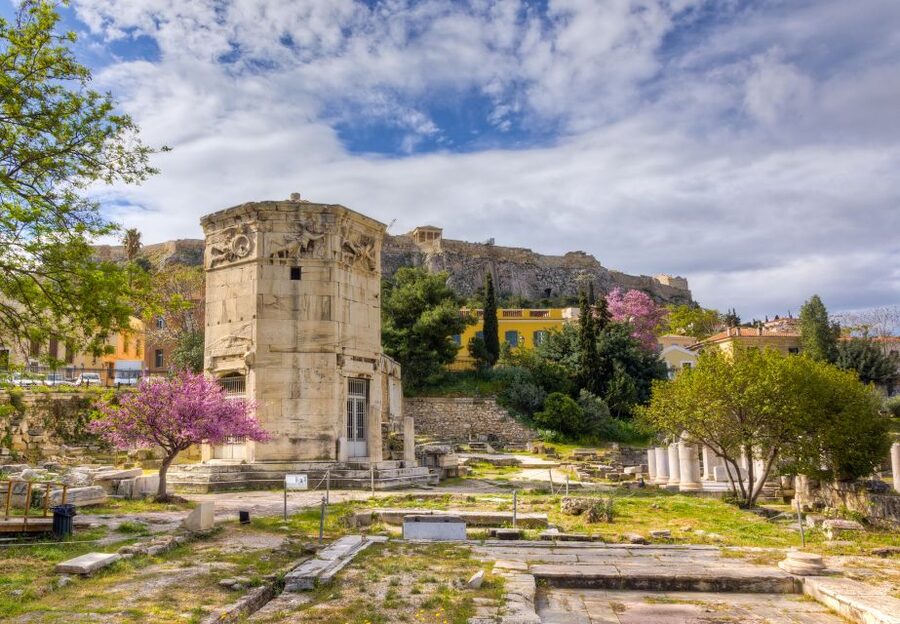
The Tower of the Winds is the main reason many people remember the Roman Agora. It is a small, octagonal building with a practical purpose: it functioned as a water clock, sundial, and wind indicator.
The name comes from the carved figures of the winds around the upper section. The audio tour brings those figures into the story, helping you understand why the building is more than a handsome stone shell. Ancient engineers were trying to measure time and weather in ways that served daily life.
This is where the audio guide earns its $18 price more convincingly. Without context, you might admire the carvings and move on. With a good explanation, you can look upward and connect the figures, the building’s shape, and its timekeeping role.
Give this stop extra time. Walk around it if the route allows, listen to the full segment, and use the app’s text or map if you lose your place. The guide is available in six languages, but the content is delivered through your own phone, not through a supplied audio device.
You can replay the material later, too. That is useful if you want to listen at home, revisit a section you missed, or use the related Athens city walking tour included in the app.
Finding the mosque and later layers of Athens
The mosque adds a different chapter to the visit. It reflects the period after the Roman use of the site and helps show how central Athens changed over time.
That mixture is one of the Roman Agora’s strengths. You are not looking at a single frozen moment. Greek, Roman, and later Ottoman-era layers appear within a small area, and the audio stories help tie them together.
The mosque is not as visually dominant as the Tower of the Winds, but it prevents the visit from becoming a narrow lesson about classical antiquity. You see how buildings and public spaces can be reused, altered, or given new meaning as the city changes.
I would not expect a long, detailed treatment of every later period. The tour is short and story-based. It gives you a useful outline, then leaves you to look closely at the remains.
More Smartphone Audio Tours in Greece
- Athens National Archaeological Museum E-Ticket with Audio Guide
★ 3.0 · 57 reviews - Acropolis Museum E-Ticket and Multilingual Audio Guide
★ 4.0 · 42 reviews - Acropolis E-Ticket with Audio Guide & Athens City Audio Tour
★ 3.5 · 28 reviews - Athens Audioguide – TravelMate app for your smartphone
★ 4.1 · 11 reviews
Fountain house, public toilets, and ancient shops

The smaller remains are easy to overlook, but they may be the most revealing part of the visit. The fountain house points to the importance of water in urban life. The shops suggest the commercial activity that made the agora useful. The Vespasianae, or public toilets, bring the ancient city down to earth in a way that grand temples cannot.
These details give you a more ordinary picture of Athens. People needed water, bought goods, used public facilities, and moved through the city for practical reasons. The Roman Agora was not only a place of impressive architecture. It was part of the machinery of daily life.
The audio tour’s short anecdotes are well suited to these modest remains. A long lecture would be excessive here, but a few minutes of explanation can make a low wall or partial foundation easier to understand.
Do not rush straight from one famous monument to the next. Look at the ground plan and listen for the sections about function. The shops and public services help explain why the agora mattered even when the grander buildings were elsewhere.
How the smartphone audio tour works
You receive the entry ticket and an activation link by email. Before you arrive, download the app and the audio tour to your phone. The content includes narration, written information, and maps, and it works offline after downloading.
That preparation is important. You need a charged Android phone running version 5.0 or later, or an iPhone with a supported iOS system. The app does not work with Windows phones, iPhone 5 or 5C and older models, iPod Touch 5th generation and older, iPad 4th generation and older, or iPad Mini 1st generation.
Set aside 100 to 150 MB of storage. Download everything while you have a reliable internet connection, then open the app before leaving your hotel. Check your spam folder if the access email does not appear quickly.
Bring your own headphones. Neither a phone nor headphones are provided, and the audio will be far less useful if you are trying to hold your phone up while examining the ruins.
The audio guide can be used repeatedly and at any time, including before or after your visit. You can preview the material before arriving, although listening on site will make the descriptions easier to match with the buildings.
The biggest weakness: finding the right order
A self-guided tour gives you privacy and flexibility, but it also puts the navigation work on you. The audio route can be difficult to follow, especially if you start listening before you have identified your position.
I recommend this simple approach:
- Download the map and audio before you leave.
- Open the map at the entrance and identify the first stop.
- Listen to one segment at a time instead of playing the full tour continuously.
- Match the building in front of you with the image or written description.
- Pause the narration while walking between stops.
This is not a live guided tour. There is no guide to point toward the next monument, answer questions, or adjust the pace for your group. If you enjoy controlling your own schedule, that is a benefit. If you want a smooth narrative with constant direction, the route may frustrate you.
The app also includes a self-guided Athens walking tour. That can add value if you plan to explore the city on foot, but the Roman Agora ticket itself remains the main product.
Is $18 good value for 45 minutes?
At $18 per person, the price is reasonable only if you value convenience and interpretation. The Roman Agora is small, and you may finish the physical visit in less than an hour. Buying a ticket on site may be simple when the area is quiet, so the skip-the-line feature is not automatically worth paying extra for every visitor.
The audio guide is the stronger part of the package. It turns a short stop into a more meaningful lesson about timekeeping, weather, commerce, public facilities, and changing religious use. The content is especially useful if you are not already familiar with the Roman period in Athens.
There is one important pricing detail. Free and reduced admission tickets do not receive skip-the-line privileges and must be obtained at the ticket booth. Also, the booking is based on the device used, not simply the number of people in your group. If two people want to listen separately on two phones, plan accordingly.
Because the activity is non-refundable, check your schedule and phone compatibility before purchasing. The starting times vary, so confirm availability for the day you want.
Who will enjoy this Roman Agora visit?
I would recommend this experience to:
- Independent visitors who dislike fixed group schedules
- History-minded visitors who want context without a live guide
- First-time Athens visitors building a short itinerary around central sites
- People who already own headphones and are comfortable using an app
- Couples or friends who want to pause and move at different speeds
- Anyone interested in ordinary ancient life, not only temples and statues
I would be more cautious if you want a full guided experience, have an older phone, or dislike navigating with a map. Families should also check whether each child needs a separate device or whether everyone can comfortably share one audio source.
The site is partially accessible, but the supplied information does not describe every surface or route. If you need detailed accessibility planning, confirm conditions before booking.
My recommendation for the right kind of visitor
Book this if you want a short, self-paced stop with useful storytelling and you are willing to prepare your phone in advance. I especially like it for visitors who have already seen the Acropolis and want a quieter look at how Athens functioned beyond its famous monuments.
Skip it if you only want the cheapest possible entry or if you expect a guide to lead you from point to point. At $18, the visit depends on using the audio content well. Listen carefully at the Tower of the Winds, Gate of Athena Archegetis, mosque, shops, fountain house, and Vespasianae, and the compact site becomes much more than a quick walk past stones.
FAQ
How long does the Roman Agora visit take?
The visit lasts about 45 minutes to one hour. You can move at your own pace and replay the audio content as needed.
Is a live guide included?
No. This includes a self-guided audio tour on your smartphone, not a live guide.
Which languages are available?
The audio guide is available in English, Spanish, German, French, Italian, and Greek.
Do I need my own phone and headphones?
Yes. You need a charged Android or iOS smartphone and your own headphones. The phone and headphones are not included.
Can I use the audio tour without mobile data?
Yes. The app includes offline text, narration, and maps after you download the content. This helps you avoid roaming charges.
Can I buy a reduced-price ticket and skip the line?
No. Free and reduced admission tickets must be obtained at the ticket booth on site and do not include skip-the-line privileges.
Just added around Athens
- Temple of Olympian Zeus: Self-Guided Audio Tour on your Phone (without ticket)★ 4.0 · 8 reviews
- Athens Ticket Pass: Acropolis & 6 Sites with 5 Audio Guides★ 3.5 · 84 reviews
- Ancient Agora of Athens: A Self-Guided Audio Tour★ 3.5 · 3 reviews
- Self Guided Tour In Athens With 100 Captivating Audio Stories★ 4.0 · 4 reviews
- Athens Hop-On Hop Off w/ Acropolis & Acr.Museum tickets & 3 audio★ 3.0 · 5 reviews
- E-ticket for Kerameikos with Audio Tour on Your Phone★ 5.0 · 4 reviews
- Audioguided tour of Athens’ alternative neighbourhood of Exarchia★ 5.0 · 2 reviews
- Private Audio Guided Walking Tour in Athens★ 3.5 · 2 reviews
Smartphone Audio Tours, compared.

Colosseum & Forum with Audio Guide App -Optional Arena
Read our review →
Timed Entry to Michelangelo’s David + Audio App
Read our review →
Cathedral & Brunelleschi’s Dome Ticket & Audio App
Read our review →
Michelangelo’s David Priority Ticket & Audio App
Read our review →
Uffizi Priority Ticket & Masterpieces Audio App
Read our review →
Castel Sant’Angelo Entry Ticket & Digital Audioguide
Read our review →
Pantheon Priority Entry Ticket & Audio Guide App
Read our review →Browse the lists this tour appears in