

REVIEW · USA AUDIO TOURS
Sights of Downtown Houston Smartphone Audio Walking Tour
Houston tells its story one block at a time. This $10.99 self-guided audio tour links old homes, public buildings, theaters, churches, and skyscrapers across downtown, giving you a useful introduction to the city’s past without tying you to a group schedule. I like the mix of civic history and everyday city life, especially the walk from the 1847 Kellum-Noble House to the Cotton Exchange.
I also like the freedom: download the tour on Wi-Fi, start whenever you want, and pause for photos, lunch, or a closer look at a building. The main drawback is the app. GPS autoplay may not work reliably, and you may need to restart recordings manually. Bring patience, a charged phone, and enough time for roughly four miles of flat walking.
Key points at a glance

- Start at an 1847 Houston home: The Kellum-Noble House gives the tour an early and suitably historic opening.
- A long, flat downtown walk: Plan on two to three hours, with one previous participant estimating about four miles.
- Strong architecture focus: Art Deco buildings, City Hall, the Ideson Library, churches, theaters, and the Cotton Exchange fill the route.
- Good value for independent explorers: At $10.99, you get a private tour for your own group with no fixed departure time.
- Download before you go: The route is designed to work without a signal or mobile data after the content is saved.
- Allow for app troubleshooting: The GPS map and automatic narration can help, but manual playback may be needed.
Starting with Houston’s oldest surviving stories
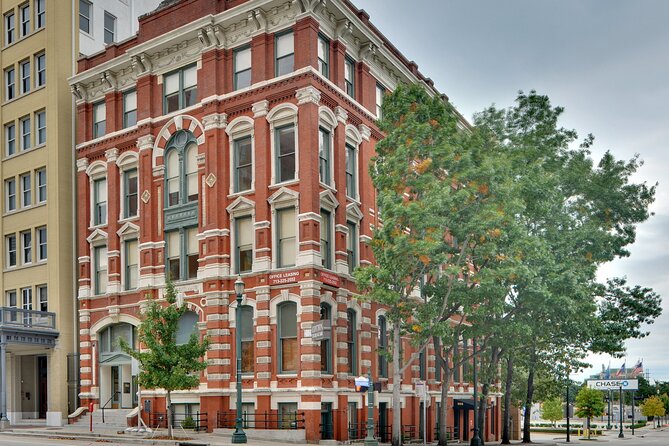
The tour begins at the Kellum-Noble House at 212 Dallas Street, one of Houston’s oldest homes. Built in 1847, it gives you a clear starting point for understanding how much the city has changed. Houston is now known for modern towers and a huge regional economy, but this first stop points you toward the smaller settlement that came before them.
From there, the route moves to a museum complex devoted to preserving and explaining Houston and the surrounding area. Several historic buildings are gathered here, so this part of the walk adds physical context to the narration. Instead of hearing only dates and names, you get a chance to look at old structures and consider how early Houston was built.
A cabin believed to be one of the oldest surviving structures in the city comes next. The tour explains its place in Houston’s cultural past. This is one of the more useful stops for anyone who wants more than a modern downtown stroll, since the cabin connects the city’s large present-day identity with its earliest surviving buildings.
You also encounter a house known by three names. The audio explains why, which gives the stop a small mystery before supplying the answer. It is a simple but effective way to keep the walk from becoming a string of dry building descriptions.
More Audio Walking Tours in the USA
- Self Guided Classic Freedom Trail Location Aware (GPS) Walking Audio Tour
★ 4.5 · 258 reviews - Cape Cod & Provincetown Self-Guided Driving & Walking Audio Tour
★ 4.0 · 207 reviews - Santa Fe Historic Downtown Smart Phone Audio App Self Guided GPS Walking Tour
★ 4.5 · 112 reviews
Sam Houston Park and the civic heart
Sam Houston Park was established in 1900 as Houston’s first public park. It is an important pause in the route because it brings together green space, historic buildings, and the memory of Houston’s earlier civic life.
I like the way this section shifts the pace. You are not only looking up at office towers. You are also moving through a place meant for public use, with old structures nearby and a reminder that downtown has long been more than a business district.
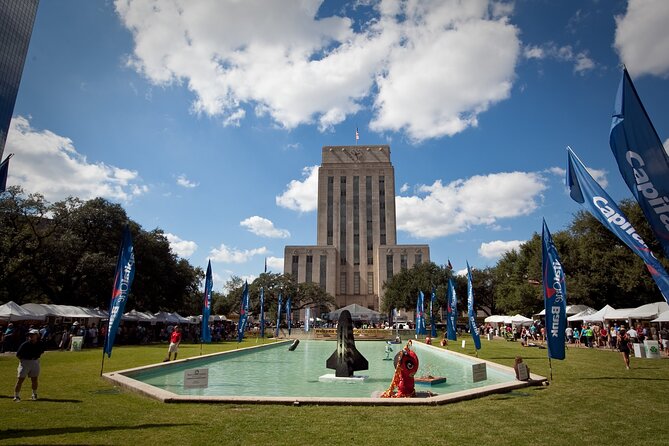
The tour then turns toward Houston City Hall. The narration covers the building’s history and its role in the city skyline. This is a practical stop for first-time visitors because City Hall helps you read the downtown center as a working civic district, not simply a collection of tall buildings.
The next stop is the historic library named for Julia Bedford Ideson, the first librarian of the Houston Public Library. The building adds a literary and educational note to the route. It also broadens the story beyond politics and commerce, showing how public institutions helped shape the city.
Architecture from Art Deco to modern Houston
Downtown Houston is especially rewarding if you enjoy architecture, and this tour gives that interest plenty of material. You hear about the Houston Music Hall Foundation, formed by local arts leaders to raise funds and support a major project. The audio explains what came from that effort, connecting local fundraising with Houston’s performing arts scene.
The route also passes a building used as the headquarters of the City of Houston’s Public Works and Engineering Department. That stop is a reminder that the city’s physical systems require their own offices, planning, and maintenance. It may not be the flashiest sight, but it helps you see downtown as a functioning place rather than a museum set.
One Art Deco building on the route was added to the National Register of Historic Places in 1983. It is considered an important example of early twentieth-century commercial architecture in Houston. Look closely at the exterior while the audio runs, since the value here comes from pairing the building’s design with its place in the city’s development.
A nearby Art Deco neighbor is presented as the city’s only complete example of a particular architectural feature. The tour saves the detail for the narration, so this is a good place to stop, look upward, and let the explanation do its work.
Another historic skyscraper was completed in 1929 and designed by Crain & Coe in the Art Deco style. That date places it in the period when Houston was taking on a more ambitious urban form. The tour’s building-by-building approach helps you notice details you might otherwise pass without a second thought.
Then comes an eye-catching structure built in 1911. The description promises an explanation of what makes it so striking, so this stop works best when you take a moment to study the building instead of treating the audio as background noise.
Churches, hotels, theaters, and public life

The Episcopal cathedral on the route was founded in 1839 and is the oldest continually operating church in Houston. Its age gives you another useful measure of the city’s development. After seeing commercial towers and government buildings, this church brings the story back to a long-running community institution.
A historic hotel built in 1913 is named for William Marsh Rice. The tour explains its history, adding another connection between Houston’s built environment and the people whose names remain on its public buildings and institutions.
You also pass a venue whose users and namesake are explained in the commentary. The information provided for the stop does not identify those details in advance, so you will need to listen at the location. That is part of the appeal of an audio walk, but it also means you cannot preview every answer before starting.
The route includes one of the oldest and most respected theater companies in the United States. It then continues to a popular performing arts venue that plays an important role in Houston’s cultural life. Together, these stops show how the city supports theater, music, and live performance alongside its business and government centers.
I particularly like this part of the itinerary because it keeps the tour from becoming only an architecture lesson. The buildings matter, but so do the people who gather inside them and the arts groups that give downtown a social purpose after office hours.
More Smartphone Audio Tours in the USA
- Self-Guided GPS Audio E-Bike Tour Hawaii Volcanoes National Park
★ 4.5 · 131 reviews - Ultimate Portland Self-Guided Driving GPS Audio Tour
★ 4.0 · 56 reviews - Birmingham Civil Rights Walk of Freedom Smartphone Audio App Tour
★ 5.0 · 40 reviews - Self Guided GPS Audio Driving Tour Acadia NP From Hulls Cove VC
★ 4.0 · 25 reviews
Aquarium, bayou, and Old Town

An aquarium established in 2003 appears later on the walk. It is home to more than 200 species of marine animals, making it one of the route’s most family-friendly landmarks. The tour explains the attraction, but admission to the aquarium is not listed as part of the audio experience, so treat it as a sight along the route rather than an included activity.
The narration also covers Buffalo Bayou, a key feature of the Houston area. This stop adds an environmental and geographic layer to the tour. The bayou is not just a scenic reference. It helps explain the setting in which Houston developed and gives you a break from the concentration of downtown buildings.
From there, the walk reaches Old Town, known for its mix of restaurants, bars, shops, and entertainment venues. The audio explains how the area came to be. This is a useful place to pause for food or a drink if you are taking the relaxed version of the tour, though the experience itself does not include refreshments.
A majestic Art Deco theater follows. The narration focuses on what makes its design special. It is another opportunity to look closely at the details around the entrance and upper facade rather than simply marking the stop complete and moving on.
Courthouse history and Houston’s cotton trade
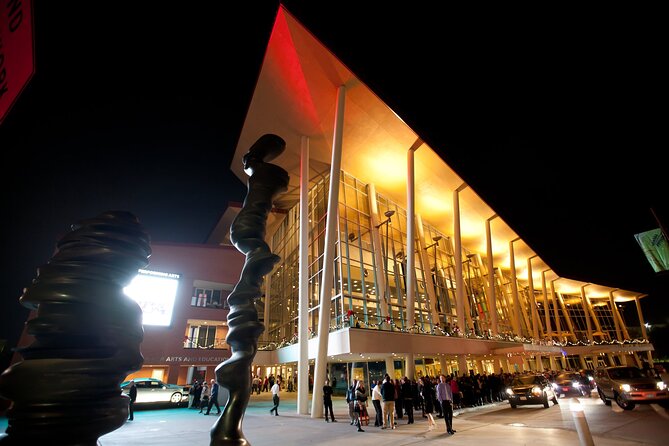
The Harris County Courthouse is an important example of early twentieth-century public architecture in Texas. The building gives the tour a strong civic finish before it turns toward Houston’s commercial past.
At Augustus Chapman Allen’s namesake landing, you hear Allen describe the area’s story in a recorded rendition. This adds a theatrical touch to the history and brings one of Houston’s founders directly into the audio. It is a small change from standard narration, but it helps give the stop a clearer voice.
The final destination is the Houston Cotton Exchange and Board of Trade at 202 Travis Street. The building was constructed in 1884 and served as a trading center for Houston’s cotton industry. The tour explains how cotton shaped the city’s economy and why this impressive structure matters.
Ending here makes sense. The route begins with an early home and closes with a building tied to the trade that helped Houston grow. You get a broad arc from settlement to commerce, then from commerce to the civic and cultural city visible today.
The tour gives turn-by-turn instructions for returning to the first stop. That matters because the endpoint is different from the beginning, and you should not assume you will finish beside your car or transit stop.
How the app works in real use

You receive a mobile ticket and download the tour over Wi-Fi before setting out. Once saved, the route should not require a signal or mobile data during the walk. The live GPS map shows the route and your position, while commentary is meant to play automatically as you reach each point.
That setup is convenient when it works. You can move at your own speed, stop for photographs, and take as long as you like. The tour belongs to your group, so you do not have to match a guide’s pace or listen to strangers asking questions.
The weak point is location recognition. GPS may fail to trigger the next recording on some phones, and you may need to play each section yourself. One person also found that leaving the app open while taking a photo could send it back to the main screen, requiring a return to the tour.
I would download everything before leaving, check location permissions, keep the phone charged, and learn how to manually start a recording before the first stop. Headphones are optional because the audio can play through the phone speaker, but headphones may make narration easier to hear in a busy downtown setting.
Time, walking effort, and value at $10.99
The stated duration is two to three hours, though your pace will decide the final time. If you stop to take pictures, study buildings, or pause in Old Town, plan toward the longer end. One account estimated the route at about four miles, all on flat ground.
That makes the tour physically simple but not especially short. You will be walking and standing for much of the experience. A moderate fitness level is recommended, and anyone who cannot comfortably cover several miles on flat pavement should plan breaks.
At $10.99 per person, the value is strongest for independent visitors who want structure but not a scheduled group. You receive narration, a route map, location triggers, customer service by phone and email, and unlimited flexibility with the date and finishing time. You can also repeat the tour, since it remains available to you through Tripvia Tours.
The price is less attractive if you expect a live guide, guaranteed automatic playback, or entry to the aquarium and other buildings. Those are not included. You are paying for a route and audio commentary, not a traditional guided sightseeing tour.
The booking is also a private activity for your group alone. That is useful for couples, families, or friends who want to stop often and set their own rhythm. Service animals are allowed, and the route is near public transportation.
Who should book the downtown Houston walk?
I would choose this tour if you enjoy history, architecture, and independent sightseeing. It suits a first visit because it introduces major downtown landmarks while explaining how Houston grew from early homes and public institutions into a large commercial city.
It also works well for repeat visitors who want to look at familiar streets with more context. The range of stops is broad: historic homes, a cabin, a park, City Hall, a library, Art Deco buildings, churches, theaters, an aquarium, Buffalo Bayou, Old Town, the courthouse, and the Cotton Exchange.
I would be cautious if you need perfect technology. The GPS problems are not a minor detail, since automatic narration is central to the format. You can still complete the route manually, but that requires more attention and makes the experience feel less polished.
Should you book it?
Book the Sights of Downtown Houston Smartphone Audio Walking Tour if you want an inexpensive, flexible introduction to the city and you are comfortable managing your phone along the way. The strongest features are the varied route, the flat streets, the historic opening and Cotton Exchange finish, and the freedom to pause whenever you like.
Skip it if you want a live person, short walking distances, or guaranteed hands-free audio. For everyone else, $10.99 is a fair price for a self-guided route that gives downtown Houston a clear storyline. Download it before you leave, allow three hours, and treat the app as a helpful tool rather than a flawless guide.
FAQ
Where does the Sights of Downtown Houston tour start?
It starts at the Kellum-Noble House, 212 Dallas Street, Houston, Texas 77002.
Where does the tour end?
The tour ends at the Houston Cotton Exchange and Board of Trade, 202 Travis Street, Houston, Texas 77002.
How long does the walking tour take?
The estimated duration is two to three hours. Your pace and the time you spend taking photographs or stopping along the route will affect the total.
How much does the tour cost?
The listed price is $10.99 per person.
Is the tour guided by a live person?
No. Davis provides the audio commentary, and the tour is self-guided through a smartphone or tablet.
Do I need mobile data during the walk?
No. You should download the tour over Wi-Fi before starting. After that, the tour is designed to work without a signal or mobile data.
Do headphones come with the tour?
No. Headphones are optional and are not included. The audio can also play through your device speaker.
Is the walking route difficult?
The route is flat, but it involves substantial walking and standing. A moderate physical fitness level is recommended, and one account estimated the distance at about four miles.
Can I take the tour whenever I want?
Yes. The tour has flexible dates and no time limit for completing it. You can take as long as you like once you begin.
Just added around the USA
- Self Guided Driving Audio Tour of Saguaro National Park★ 3.0 · 4 reviews
- Self-Guided Audio Driving Tour of Mount Lemmon★ 5.0 · 4 reviews
- Saguaro National Park Self-Guided Audio Tour★ 3.5 · 11 reviews
- A Self Guided Audio Tour in Tombstone★ 4.0 · 11 reviews
- Catskills Scenic Byway Self-Guided Driving Audio Tour★ 4.0 · 9 reviews
- Big Bend National Park Self Guided Audio Tour Guide★ 5.0 · 12 reviews
- Self-Guided Audio Driving Tour in Catskills Scenic Byway★ 4.5 · 7 reviews
- Shiloh Battlefield Self-Guided Driving Audio Tour★ 4.0 · 9 reviews
Smartphone Audio Tours, compared.

Colosseum & Forum with Audio Guide App -Optional Arena
Read our review →
Timed Entry to Michelangelo’s David + Audio App
Read our review →
Cathedral & Brunelleschi’s Dome Ticket & Audio App
Read our review →
Michelangelo’s David Priority Ticket & Audio App
Read our review →
Uffizi Priority Ticket & Masterpieces Audio App
Read our review →
Castel Sant’Angelo Entry Ticket & Digital Audioguide
Read our review →
Pantheon Priority Entry Ticket & Audio Guide App
Read our review →Browse the lists this tour appears in