
REVIEW · SEVILLE AUDIO TOURS
Seville Maestranza Bullring Tour with Audio Guide
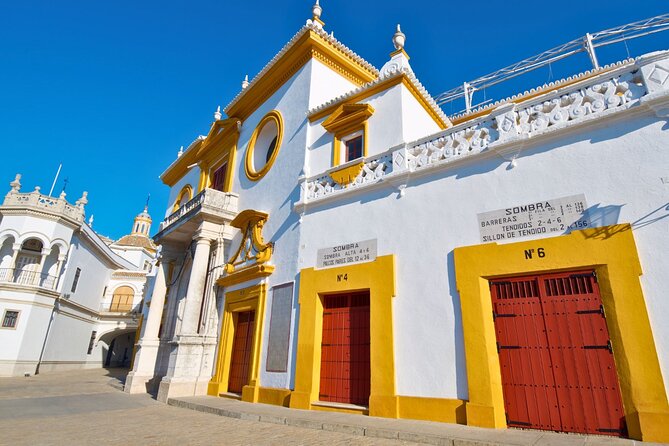
History wears a dramatic costume here. The Maestranza Bullring gives you a close look at Seville’s bullfighting tradition, from the sand of the arena to the chapel, bullpens, dressing rooms, and a fine collection of bullfighting art. I especially like the chance to see areas hidden from the ordinary plaza view, and the exhibition’s range, from Goya to Jean Cocteau.
The ornate Baroque design and unusual elliptical shape are another big draw. At about $25.14 per person, the visit can be good value if you want cultural context without committing to a live bullfight. The main caution is timing: if a bullfight or maintenance work closes part of the building, your visit may shrink to a museum stop, and the non-refundable ticket leaves little room to recover your money.
Key points before you go
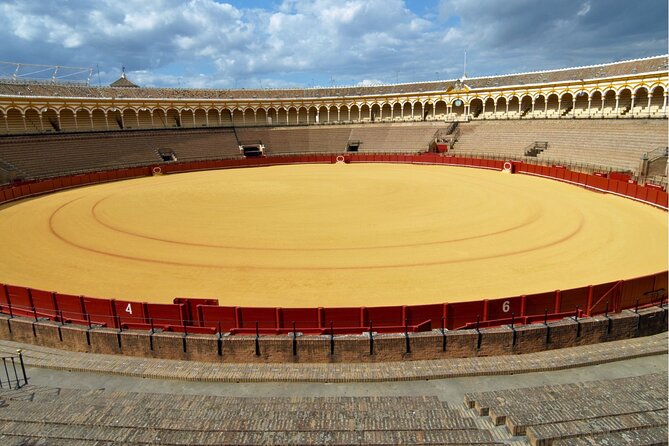
- The arena is elliptical: The unusual shape and carved stone details give the Maestranza a character different from a simple round stadium.
- You see working spaces: The route includes the bullpens, chapel, and matadors’ dressing rooms, not just the public seating and arena floor.
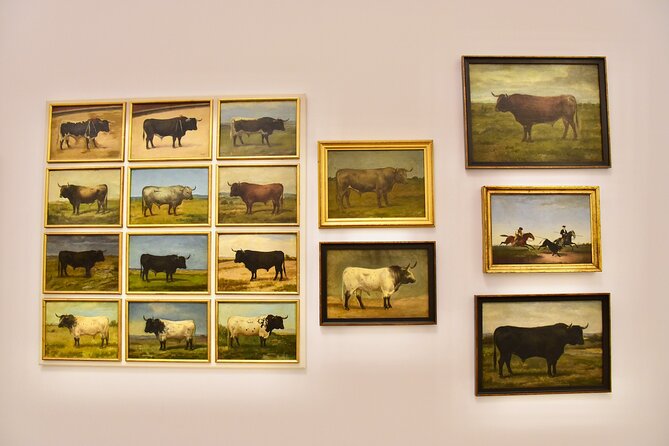
- The art collection is a major part of the visit: The exhibition includes paintings and prints from the La Maestranza collection, with artists ranging from Goya to Jean Cocteau.
- The visit usually takes one to two hours: That makes it easy to fit into a day of sightseeing in central Seville.
- An audio guide is included: It is multilingual, but bring your own way to hear downloaded information if possible, since headphones may not always be supplied.
- Closures are the key risk: A live bullfight or building work can limit access, so check conditions close to your visit if you can.
Why the Maestranza matters in Seville
The Plaza de Toros de la Real Maestranza de Caballería de Sevilla is not simply a stadium with old seats. It is one of the city’s best-known cultural sites, tied to a tradition that has shaped Spanish art, language, music, and public life for centuries.
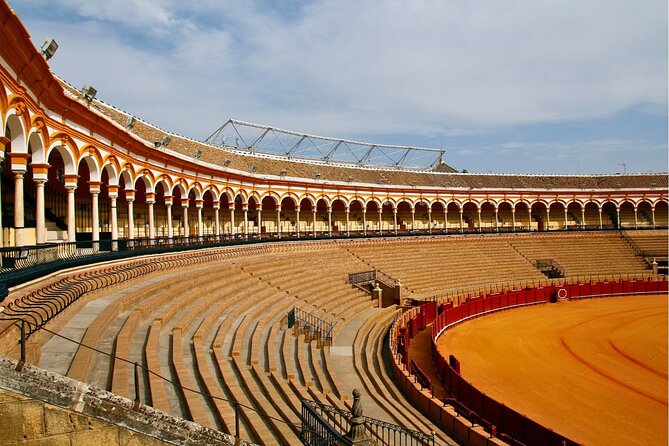
The bullring dates to 1761, giving you a useful sense of scale when you look at the structure. Seville’s Maestranza is also visually distinctive. Its Baroque architecture includes ornate stone carving, and the arena has an elliptical rather than perfectly circular form.
That shape is easy to miss in photographs. Inside, though, it changes the feel of the place. The curved seating and long oval floor create a strong sense of movement, which helps explain why the building has inspired so much visual art.
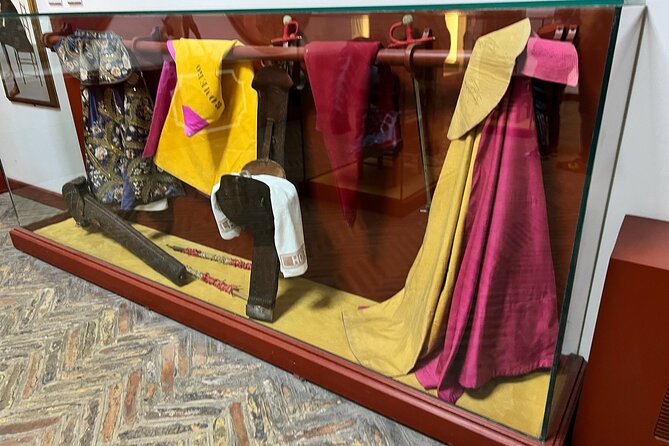
You do not need to approve of bullfighting to find the visit worthwhile. In fact, the tour gives you a chance to understand the tradition without attending a live event. You can look at its ceremonial spaces, architecture, costumes, and artwork, then decide how you feel about the subject with more context.
For me, that is the strongest reason to visit. The Maestranza is not presented only as a place of spectacle. It also functions as a museum and architectural monument.
A few more audio tours around Spain worth a look
- Barcelona: Sagrada Familia Entry Ticket with Audio Guide
★ 4.6 · 105,312 reviews - Barcelona: Casa Batlló Entry with Self-Audioguide Tour
★ 4.7 · 25,359 reviews - Granada: Alhambra Entry Ticket with Audio Guide
★ 4.1 · 5,950 reviews
Entering the arena and seeing behind the public show
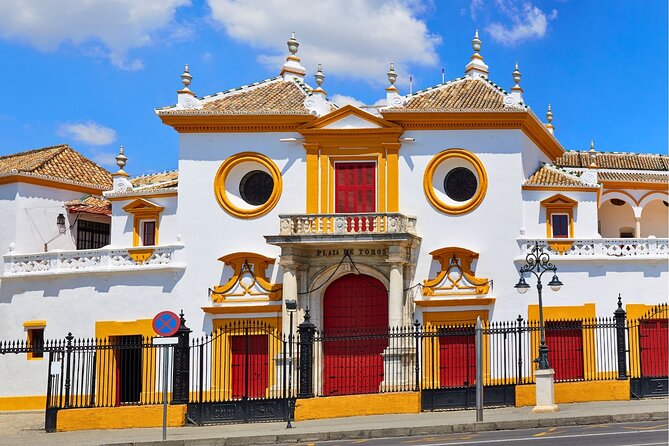
The visit begins at the Maestranza Bullring, where a reserved entrance ticket is included. There is no transportation provided, so you make your own way there. The site is near public transportation, which makes it practical to pair with other stops in Seville.
The central moment is stepping into the arena. From the floor, you can look up at the curved tiers and imagine the noise and tension of a full crowd. Even without a bullfight taking place, the setting does much of the work. The sand, seating, and enclosed shape make the arena feel like a stage built for ceremony.
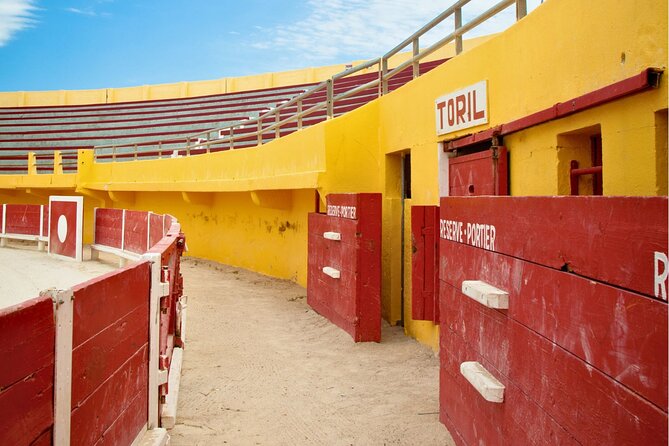
You also see the bullpens, which offer a more practical view of how the building operates. This part helps turn an abstract tradition into a physical one. You are not just looking at a decorative façade. You are seeing the spaces connected with the handling of bulls and the preparation for an event.
The chapel adds another layer. Its presence shows the religious and ceremonial side of bullfighting, where ritual and personal devotion have long been part of the occasion. The visit does not require you to treat the tradition as simple entertainment. The building itself shows that it has carried social, religious, artistic, and sporting meaning at the same time.
The matadors’ dressing rooms bring the focus back to the people involved. These rooms are part of the preparation before the public performance. They help you picture the contrast between the private tension behind the scenes and the controlled display in the arena.
Because the complete visit is estimated at one to two hours, you should have enough time to pause at these areas rather than rush through them. Still, do not assume every visit will cover every space. A live bullfight or work inside the building can affect access.
The Maestranza collection, from Goya to Cocteau
The exhibition hall is not a minor extra. It is one of the most valuable parts of the visit, especially if you enjoy Spanish art or want to understand how bullfighting entered European culture.
The exhibition is divided into two sections. The first presents paintings and prints from the La Maestranza collection, described as one of the finest collections of its kind. Prints are particularly useful for showing how bullfighting scenes were reproduced and circulated beyond the arena.
The second section contains exhibition rooms with important bullfighting art. The range of names is striking. You may see work connected with Francisco Goya, whose prints helped shape the visual language of Spanish bullfighting, alongside Jean Cocteau, a twentieth-century artist and writer drawn to the subject’s theatrical qualities.
That range keeps the collection from feeling frozen in one period. You move from older Spanish traditions toward later artistic interpretations. Bullfighting becomes more than a record of events. It becomes a subject artists used to explore movement, danger, costume, ritual, pride, and public identity.
I would allow extra attention here if art is your main interest. The arena is the obvious photograph, but the exhibition gives the visit much of its intellectual value. It also makes the Maestranza easier to appreciate if you are uncomfortable with the ethics of live bullfighting. You can examine how artists represented the tradition without needing to attend an event.
The information provided for the tour does not list individual works, so I would not arrive expecting a fixed checklist of paintings. Think of the collection as a broad visual record rather than a guided art-history lecture.
How the audio guide affects the visit
A multilingual audio guide is included with admission. That is useful because the building contains several layers of meaning, and a silent walk through the arena would leave you with only the visual impression.
The guide should help explain the bullring’s history, spaces, and role in Spanish culture. It is particularly helpful in the bullpens, chapel, and dressing rooms, where a few short explanations can make the difference between simply seeing a room and understanding why it is there.
There is one practical concern. A previous visit found no headphones available for the downloaded information, leaving the person to walk around without much explanation. I would prepare for that possibility by bringing your own headphones if the audio is delivered to your phone or another personal device.
The exact audio setup is not fully specified, so you should not assume that equipment will be handed to you at the entrance. The inclusion of a multilingual guide is a plus, but the listening arrangements may not be as polished as you expect from a major museum.
If you are visiting with someone who does not speak the same language, the multilingual option is especially useful. If your visit is mainly about architecture and photographs, the guide matters less, but it still adds context to the ceremonial areas.
Same place, a different route to walk:
- Casa Batllo Admission Ticket with Intelligent Audio Guide
★ 4.5 · 3,168 reviews - Madrid: Las Ventas Bullring Tour with Audio Guide
★ 4.6 · 3,154 reviews - Cordoba: Mosque-Cathedral E-Ticket with Audio Guide
★ 4.1 · 2,895 reviews - Nerja: Caves of Nerja Entry Ticket with Audio Guide
★ 4.6 · 1,616 reviews
The biggest risk: closures and changed access
This is where I would be careful before paying. The tour is sold as access to the arena and interior areas, but the bullring remains an active venue. A live bullfight can close much of the building, and construction or maintenance work can also affect the route.
One visit was cancelled because work was being carried out, then took place on a later attempt. Another visit occurred on a bullfight day, when most of the bullring was closed. The result was access mainly to the museum, with less than ten minutes spent in the expected tour area.
That is a serious concern because the arena is the main reason many people choose this experience. If you have paid for a reserved entrance and taken taxis across the city, a short museum-only visit is poor value.
Staff response can also vary when unexpected closures occur. A complaint about the reduced access received an apology and an explanation that this situation was unusual and outside the provider’s control. That may be true, but it does not remove the need for better advance notice.
I would contact the provider or bullring shortly before visiting and ask specifically whether the arena, chapel, bullpens, dressing rooms, and exhibition are open that day. This is particularly important during periods with scheduled bullfights or visible building work.
The admission is non-refundable and cannot be changed after booking. That makes a last-minute check even more important. You should treat the opening schedule as part of the value calculation, not as a minor detail.
Is $25.14 a fair price?
At $25.14 per person, the price is reasonable if you receive the full visit. You are paying for reserved admission, a multilingual audio guide, and access to a historic building with both architectural and artistic interest. For a one to two-hour stop, that works well as a mid-priced cultural activity.
The value is strongest for three types of visitors. First, you get a lot from it if you are curious about Seville’s traditions but do not want to attend a bullfight. Second, art lovers may find the Goya to Cocteau range worth the admission on its own. Third, anyone who enjoys historic buildings will appreciate seeing the arena from inside rather than only photographing the exterior.
The price looks less attractive if you only want a quick photograph or if you are likely to find the subject uncomfortable. It also becomes poor value if access is limited to the museum on a day when the arena is closed.
There is no food, drink, or transportation included. That is not unusual for an attraction ticket, but you should add your own transport costs if you are not already near the site. The building is near public transportation, so a taxi is not your only option.
Who will enjoy this visit most?
I would recommend the Maestranza to you if you like architecture, art, Spanish customs, or places that still have an active cultural role. It is also a good choice for a short Seville activity because the one to two-hour duration leaves room for the cathedral, palace, museums, or a long lunch afterward.
Families and mixed-interest groups may also find it workable. The route is not dependent on a long lecture, and most people can participate. The audio guide lets you take in information at your own pace, though the headphone issue means you should prepare in advance.
I would be more cautious if you are strongly opposed to bullfighting and do not want to spend time around its symbols and traditions. The visit is historical and cultural, but the bullring is still presenting a practice that some people find troubling.
I would also avoid making it a fixed centerpiece of your day without checking access. If you have only one morning in Seville, a sudden closure could leave you with a disappointing gap in your plans.
Practical ways to make the visit better
Check the status of the building before you go. Ask whether all the advertised areas are open, not merely whether the bullring itself is operating.
Bring headphones suitable for your phone or audio device. This is a small precaution, but it could make the multilingual guide much more useful.
Allow at least an hour, and preferably closer to two if you want time for the exhibition. The arena is visually powerful, but the collection deserves more than a quick pass.
Look closely at the building as you move through it. The carved stone, curved seating, and unusual oval plan are not background decoration. They are part of what makes this bullring specific to Seville.
Do not judge the visit only by the arena floor. The chapel, bullpens, dressing rooms, and art collection give you a fuller picture of the institution and its place in Spanish culture.
Finally, keep your schedule flexible enough to handle a closure. Since the ticket cannot be refunded or changed, the best protection is checking conditions before you commit.
Should you book the Maestranza Bullring Tour?
Book it if you want a short, focused look at Seville’s bullfighting culture, Baroque architecture, and related art. The full route can be worthwhile, and the exhibition’s span from Goya to Jean Cocteau gives the visit more substance than a simple stadium tour.
I would not book blindly. The non-refundable policy and the possibility of bullfight-related closures are real drawbacks. Confirm that the arena and interior spaces will be open, bring headphones for the audio guide, and choose this visit because you want the history and art as well as the famous photo.
With those precautions, the Maestranza offers a useful look at one of Seville’s most distinctive institutions. Without them, you risk paying for a much shorter museum stop than expected.
FAQ
Where is the Maestranza Bullring Tour located?
The experience takes place at the Plaza de Toros de la Real Maestranza de Caballería de Sevilla in Seville, Spain.
How long does the visit take?
The visit lasts approximately one to two hours.
What is included in the ticket?
The ticket includes reserved entrance to the Maestranza Bullring Arena, a multilingual audio guide, and booking and service fees.
Is transportation included?
No. Transportation is not included, although the bullring is near public transportation.
Is food or drink included?
No. Food and drinks are not included in the experience.
Can I see the arena during the visit?
The experience is designed to include the bullring arena, but access can be affected by a live bullfight or building work. Check the opening conditions before your visit.
Can I see the chapel and matadors’ dressing rooms?
These areas are included among the bullring’s interior spaces described for the visit. Access may depend on closures or ongoing work.
What can I see in the exhibition hall?
The exhibition hall has two sections. One presents paintings and prints from the La Maestranza collection, while the other contains bullfighting art associated with artists ranging from Goya to Jean Cocteau.
Is the audio guide available in more than one language?
Yes. A multilingual audio guide is included.
Can I cancel or change my booking?
No. The experience is non-refundable and cannot be changed for any reason after booking.
Just added around Spain
- Tenerife Scavenger Hunt and Highlights Self Guided Audio Tour★ 3.5 · 3 reviews
- Tarragona Scavenger Hunt and Highlights Self Guided Audio Tour★ 4.5 · 15 reviews
- Tarragona Cathedral Entrance + Audio Guide (WebApp)★ 4.5 · 36 reviews
- Royal Alcazar of Seville Entry Ticket with Audio Guide★ 4.0 · 42 reviews
- Sevilla Centre: City Walk Audioguide in 7 Languages on your Phone★ 3.0 · 2 reviews
- Seville Cathedral and La Giralda Entry Ticket with Audio Guide★ 3.0 · 9 reviews
- Essential Seville’s Ancient History: An Audio Tour★ 5.0 · 9 reviews
- Seville Audio guided walking tour 3h20 and 28 audio commentaries★ 5.0 · 2 reviews
Seville Audio Tours, compared.
Cathedral and Giralda Entry Ticket with Audio Guide
Read our review →
Hospital de los Venerables Ticket with Audio Guide
Read our review →
Seville Cathedral and Giralda Entry Tickets with Audio Guide
Read our review →
Royal Alcazar of Seville Entry Ticket with Audio Guide
Read our review →
Essential Seville’s Ancient History: An Audio Tour
Read our review →
Seville Cathedral and La Giralda Entry Ticket with Audio Guide
Read our review →Browse the lists this tour appears in