
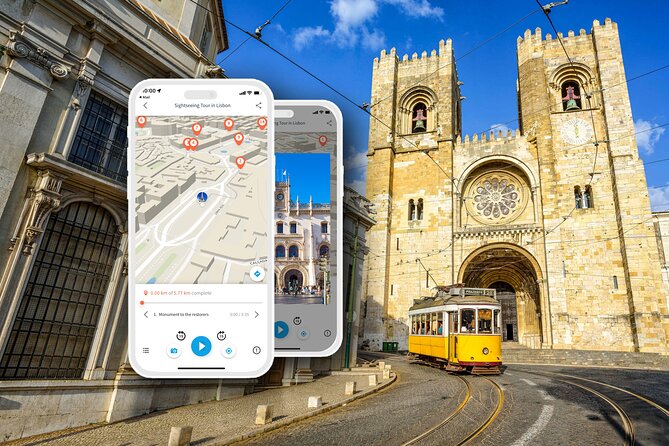
REVIEW · LISBON AUDIO TOURS
Lisbon Walking Tour with Audioguide on Your Smartphone
Lisbon rewards curious walkers. This $8.45 smartphone tour links grand squares, old streets, viewpoints, and major landmarks in about two and a half hours. I like the freedom to pause for coffee or pastel de nata, and I like the mix of Baixa, Chiado, and Alfama rather than one narrow sightseeing zone. The main drawback is simple: you must navigate the route yourself, and the app may feel confusing if you start somewhere other than Restauradores Square.
The tour includes 26 audio recordings by a professional historian, landmark illustrations, an offline route map, and one year of access. I also like the practical touches, including suggestions about food, drinks, music, pharmacies, trams, and the best time to use Tram 28. Still, bring your own phone and headphones, and do not expect a guide waiting at the meeting point.
Key points at a glance

- A low-cost route through central Lisbon: You visit Restauradores, Rossio, Baixa, Chiado, Alfama, and Praça do Comércio for less than the price of many short guided walks.
- Stories beyond monuments: The audio adds context about yellow trams, lifts, local customs, food, music, and Lisbon’s changing neighborhoods.
- A self-guided format: Start at Praça dos Restauradores, activate the app, and follow its map without a human guide.
- Strong city views: Santa Luzia, the Santa Justa Lift, São Jorge Castle, and the Rua Augusta Arch provide several fine photo stops.
- A route with hills and crowds: Lisbon’s slopes and busy central streets can make phone navigation harder, especially if you stray from the planned order.
- Useful for flexible schedules: Your access lasts one year, and the date and time selected at checkout are approximate.
What this Lisbon audio walk actually offers

This is not a traditional walking tour with a guide, group banter, or a flag to follow. It is an app-based route that turns your own phone into a portable guide. You download the application for iPhone or Android, activate the purchase, put on your headphones, and follow the map from Restauradores Square.
The advertised walking time is about two hours and 30 minutes. That is a brisk estimate because the route includes ten listed stops, several additional attractions, photo opportunities, and tempting places to pause. If you stop at Confeitaria Nacional, enter a church, visit a museum, or wait for a viewpoint to clear, plan on taking longer.
I see the format as a good match for independent visitors who dislike fixed departure times. You can pause the narration, sit with a coffee, or spend extra time in Alfama without holding up a group. The tradeoff is that you must manage the route, your battery, your headphones, and your attention to the map.
The app includes an offline map, which is helpful when mobile service is weak or you want to avoid using data. Still, keep location services enabled and begin at the stated starting point. One person had difficulty finding several stops, even with GPS, and starting from the wrong end made the route harder to follow. That is useful advice: this experience works best as designed, from Restauradores to Praça do Comércio.
More Smartphone Audio Tours in Portugal
- Lisbon: São Jorge Castle E-Ticket and Audio Guide
★ 4.3 · 2,182 reviews - Lisbon: Jerónimos Monastery E-Ticket and Audio Guide
★ 3.7 · 660 reviews - Lisbon: National Tile Museum E-Ticket & Audio Guide
★ 4.3 · 121 reviews
Restauradores Square and Rossio Station
Begin at Praça dos Restauradores, a broad central square named for Portugal’s restoration of independence in 1640. The Monument to the Restorers takes the visual lead, with its obelisk and symbolic figures. Look around the edges too, where 19th-century buildings, cafés, and the former Eden Theatre give the square a graceful urban frame.
The audio stop lasts about ten minutes. That is enough for an introduction to Lisbon’s political and architectural story, but not enough for a slow architectural study. Treat this first stop as a way to get oriented before the route moves into the city center.
Rossio Station comes next. Its Neo-Manueline façade, opened in 1890, is one of Lisbon’s most memorable railway fronts. The twin horseshoe arches are the detail to watch for. Inside, the station still serves as a practical gateway to Sintra, so you are seeing both a working transport hub and a historic building.
This is a smart early stop because it teaches you to notice Lisbon’s habit of placing grand design beside daily life. Trains continue to run, commuters pass through, and the building remains part of the city rather than a sealed monument.
Martim Moniz and Praça da Figueira
Martim Moniz Square shifts the mood. Its food stalls, markets, performances, and international influences reflect modern Lisbon’s many communities. The audio connects the place with Martim Moniz, the knight associated with the Christian conquest of Lisbon, while the square itself points toward the city’s present-day mix of cultures and cuisines.
Give yourself time here if you enjoy people-watching or casual food. The official ten-minute stop is short, and this is one place where the route may tempt you to pause. The square can also feel less polished than the formal plazas, which is part of its appeal but may not suit anyone seeking only postcard views.
Praça da Figueira offers a more traditional central Lisbon scene. It once held the city’s largest marketplace and now provides a clear view toward São Jorge Castle. The equestrian statue of King João I anchors the square, while cafés, shops, and kiosks make it an easy place for a break.
The route adds Confeitaria Nacional here, founded in 1829 and described as Lisbon’s oldest patisserie. Its old-fashioned interior and pastries provide a welcome change from monuments. Look for Bolo Rei, a Portuguese cake linked with Christmas celebrations. You do not need to turn this into a full meal, but a small pastry stop makes the audio walk feel more connected to ordinary Lisbon life.
Rossio, Carmo, and Luís de Camões Square

Praça Dom Pedro IV is better known as Rossio, one of the city’s classic meeting places. Its black-and-white wave-pattern pavement, fountains, cafés, and statue of King Pedro IV create a scene that feels unmistakably Lisbon. The D. Maria II National Theatre faces the square, adding a cultural note to an otherwise very social public space.
From here, the route points toward Carmo Convent. The ruined Gothic church is one of the most powerful sights on the walk. Its open roof and exposed arches recall the destruction caused by the 1755 earthquake. The Carmo Archaeological Museum occupies the connected site and contains artifacts from different periods of Lisbon’s past.
The audio can give the ruins meaning, but you should check your time before entering. Entrance fees are not included, and the listed ten-minute stops do not suggest a long museum visit. If you want to explore the convent carefully, treat the two-and-a-half-hour estimate as a starting point rather than a rule.
Luís de Camões Square brings you into Chiado. The statue of Portugal’s celebrated poet sits at the center, surrounded by cafés, shops, and elegant buildings. It is a useful pause between the older religious landmarks and the busier shopping streets.
I like this part of the route because it shows several sides of Lisbon in a short distance: royal squares, earthquake ruins, literary culture, and daily café life. The route does not leave you in one museum for hours. Instead, it keeps you moving through the city’s public spaces.
More Smartphone Audio Tours in Lisbon:
- Lisbon: National Palace of Ajuda E-Ticket & City Audio Guide
★ 4.1 · 87 reviews - Lisbon: National Pantheon E-Ticket & Audio City Tour
★ 4.0 · 49 reviews - E-ticket to St. George with Audio Tour and Lisbon City Audio Tour
★ 4.5 · 27 reviews - Electric Car Tour of Lisbon Old Town and Belém with GPS Audio Guide
★ 5.0 · 23 reviews
The Santa Justa Lift and Rua Augusta

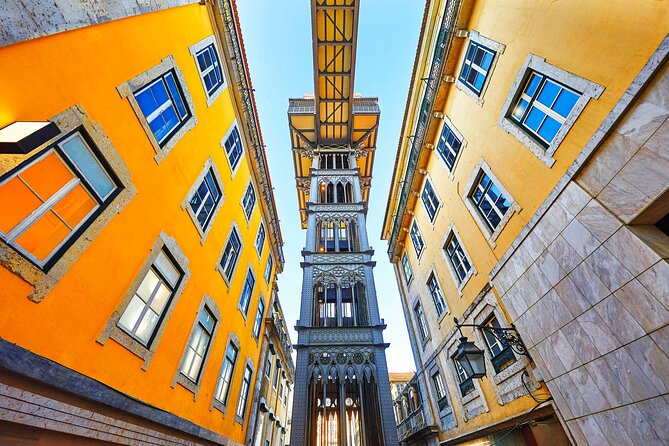
The Santa Justa Lift is one of Lisbon’s most recognizable structures. Built in 1902, this neo-Gothic iron elevator was designed by Raoul Mesnier du Ponsard, who trained under Gustave Eiffel. It links Baixa with Carmo Square and offers views toward Rossio and São Jorge Castle from its viewing platform.
The tour explains the lift’s design and purpose, which helps you see it as more than a photogenic attraction. It is also a place where you should think about time and cost. Any entrance fee is separate, and the tour price does not cover tickets to attractions.
Rua Augusta provides the city-center payoff. This pedestrian street runs through Baixa from Rossio toward Praça do Comércio, with mosaic paving, Pombaline buildings, shops, cafés, and street performers. It is easy to follow on foot, though it can be busy and distracting.
The route includes the Rua Augusta Arch, built after the 1755 earthquake as part of Lisbon’s rebuilding. If you go to the top, you get views over Baixa, the Tagus, and the square ahead. Again, admission is not included, so decide as you go based on your time and budget.
São Jorge Castle, Santa Luzia, and Lisbon Cathedral

The route then turns toward São Jorge Castle, high above the city. The fortress traces its beginnings to the sixth century and has links to both Moorish Lisbon and later Portuguese rule. Walk the walls, look across the rooftops, and use the audio to connect the site with the city below.
The castle is one of the stops where the self-guided format can work well. You can take your time with the views instead of listening while trying to keep up with a group. But the climb is part of the experience, and Lisbon’s hills can make this section tiring. Wear comfortable shoes and keep water handy.
Santa Luzia Viewpoint is one of the prettiest pauses on the route. Its terrace looks across Alfama’s red roofs toward the Tagus and the dome of the National Pantheon. Blue-and-white azulejo panels and bougainvillea add color without needing much explanation.
This is a good place to stop the recording and simply look. One of the nicest features of an audio tour is that nobody is urging you onward. If you are here in the morning or near sunset, allow extra time for photos and the view.
Lisbon Cathedral, or Sé de Lisboa, brings a heavier, older architectural note. Its Romanesque-Gothic exterior has twin towers and a rose window. Inside are chapels, relics, stained glass, and cloisters with archaeological remains connected to Roman, Visigoth, and Moorish periods.
Entrance fees are separate, and the short stop length suggests a quick exterior visit unless you choose to extend it. The cathedral sits in Alfama, where streets can be narrow and uneven. Keep the phone map visible, since this is one of the areas where a wrong turn can cost you time.
The final stretch to Praça do Comércio
The route returns toward the river through the Rua Augusta Arch and ends at Praça do Comércio, also called Terreiro do Paço. The yellow Pombaline buildings form a wide frame around the square, while the river opens out beyond it.
At the center is the equestrian statue of King José I, linked with Lisbon’s rebuilding after the 1755 earthquake. Walk under the arcades, pause near the waterfront, or consider the nearby Lisbon Story Centre if you want more background. The center is easy to recognize, making it a practical finish even if you decide not to complete every optional visit.
The tour is described as ending back at the meeting point, yet the route details finish at Praça do Comércio. That wording is worth clarifying before you set out, especially if you need to return to Restauradores. In practical terms, the listed route clearly moves from Restauradores through central Lisbon toward the river, so plan your onward transport from the final area and keep the app’s map in view.
Is $8.45 good value?

At $8.45 per person, the price is low for a route that covers several major districts and provides 26 narrated recordings. You are paying for structure, context, and convenience rather than personal attention. For an independent visitor, that can be excellent value.
The strongest value comes from the range of subjects. You get monuments, railway architecture, pastry culture, earthquake history, literature, viewpoints, trams, lifts, and practical city tips. The audio also helps prevent the walk from becoming a simple hunt for photographs.
The price looks less attractive if you want a human guide, detailed questions answered on the spot, or guaranteed navigation. You must provide the phone, headphones, transport, and any entrance tickets. The app is available in English, and access lasts one year, so you can use it at a time that suits you rather than a fixed tour departure.
The overall rating is 4.3 from four published ratings, but the small sample means you should not treat that number as a firm prediction. The useful pattern is clearer than the score: the storytelling and flexibility work well, while route-finding is the main risk.
How to make the walk work better
Start at Restauradores Square, not halfway through the route. The order is designed to make sense geographically, and beginning elsewhere can make the app harder to follow.
Download and activate the app before you begin. Check that location services are on, use the offline map, and bring headphones with a comfortable fit. Your own phone battery matters because both audio and navigation depend on it.
Allow breaks. A pastry at Confeitaria Nacional, coffee near Rossio, and extra time at Santa Luzia will make the walk more enjoyable. The person who praised the route also advised taking breaks between sections, a sensible idea given Lisbon’s hills and long list of sights.
Do not assume every stop is only ten minutes. The ten-minute labels are useful markers, not strict appointments. Carmo Convent, São Jorge Castle, the cathedral, Santa Justa, and the Rua Augusta Arch can all take longer if you pay entrance fees and explore inside.
The experience is limited to English, and no guide meets you at the start. Most people can participate, but the route includes slopes, uneven streets, and busy public areas. If you prefer a fully led walk, this is not the right format.
Should you book this Lisbon audio tour?
Book it if you want a cheap, flexible introduction to central Lisbon and enjoy learning as you walk. It is especially useful for first-time visitors who want a route through Baixa, Chiado, and Alfama without joining a fixed group.
Skip it if you need hands-on navigation, personal answers, or included entry to the major sights. The best choice is to treat it as a well-priced audio companion, not a guided excursion. Start at Restauradores, keep the map open, bring headphones, and leave room for food, views, and wrong turns.
Free cancellation is available when you cancel at least 24 hours before the start time. Cancellations inside that window are not refunded.
FAQ
How long does the Lisbon walking tour take?
The approximate duration is two hours and 30 minutes. Extra time may be needed for food, photographs, museum visits, cathedral visits, or other paid attractions.
Where does the tour start?
It starts at Restauradores Square, Praça dos Restauradores, 1250-001 Lisboa, Portugal.
Where does the experience end?
The activity information says it ends back at the meeting point. The route also lists Praça do Comércio as the final sightseeing stop, so check the app map carefully as you finish.
Is there a human guide?
No. This is a self-guided experience delivered through a mobile application.
What devices can use the audio guide?
The app is available for iPhone and Android devices.
Are headphones included?
No. You need to bring your own headphones.
Are attraction entrance tickets included?
No. Entrance fees and tickets are separate from the tour price.
What language is available?
The audio guide is offered in English.
How long can I access the tour?
You receive one year of access in your selected language.
More Audio Walking Tours in Lisbon
- Audio Guide City Walk Lisbon for Cruise Guests
★ 4.9 · 4 reviews - Sofia: City Monuments Guided Walking Tour with Audio Guide
★ 4.5 · 825 reviews - Florence: 2.5 hour Audio Guided Walking Tour led by Host
★ 4.6 · 293 reviews - Self Guided Classic Freedom Trail Location Aware (GPS) Walking Audio Tour
★ 4.5 · 258 reviews
Just added around Lisbon
- Self-Guided Audio Tour – Lisbon on Wheels: the capital of the sea★ 5.0 · 3 reviews
- Lisbon: E-ticket to St. George Castle & Audio Tour on Your Phone★ 3.0 · 18 reviews
- Riverside Ride Audio Adventure Lisbon to Belem★ 5.0 · 8 reviews
- Prazeres Cemetery: A Self-Guided Audio Tour in Lisbon★ 3.0 · 2 reviews
- Electric Car Tour of Lisbon Old Town and Belém with GPS Audio Guide★ 5.0 · 23 reviews
- National Coach Museum: E-ticket with Audio Tour on Your Phone★ 4.0 · 11 reviews
- National Palace and Gardens of Queluz: E-ticket with Audio Guide★ 3.5 · 6 reviews
- E Ticket to National Palace of Ajuda with Lisbon Audio Tour★ 4.0 · 4 reviews
Smartphone Audio Tours, compared.

Colosseum & Forum with Audio Guide App -Optional Arena
Read our review →
Timed Entry to Michelangelo’s David + Audio App
Read our review →
Cathedral & Brunelleschi’s Dome Ticket & Audio App
Read our review →
Michelangelo’s David Priority Ticket & Audio App
Read our review →
Uffizi Priority Ticket & Masterpieces Audio App
Read our review →
Castel Sant’Angelo Entry Ticket & Digital Audioguide
Read our review →
Pantheon Priority Entry Ticket & Audio Guide App
Read our review →Browse the lists this tour appears in