
REVIEW · ITALY AUDIO TOURS
Siracusa Walking Tour with Audio and Written Guide by a Local
Syracuse rewards slow wandering. This self-guided walking tour gives you a low-cost way to explore Ortigia and ancient Syracuse without keeping pace with a group. I like the freedom to pause for coffee, skip ahead, or replay a short explanation when a monument deserves more attention.
I also like the mix of audio, written notes, photos, and Google Maps links. The route covers famous sights, local stories, restaurant advice, and small details that can easily slip past you. The main drawback is that the guide depends on your phone, internet connection, and headphones, and some users have found the audio or page layout a little awkward.
At $7.84 per person, this is a strong choice if you want structure without a fixed schedule. It is less suitable if you want a live guide to answer questions, lead the way, and handle every turn for you.
Key points to know before you book
- Ortigia market to Castello Maniace: The route links major sights across Syracuse, beginning near the street market and ending at the castle.
- Greek and Roman Syracuse included: You get guidance for the Archaeological Park of Neapolis, Greek Theatre, and Ear of Dionysius, not just the old town.
- Audio and text in five languages: English, Spanish, Italian, German, and French are available through your smartphone.
- Pause whenever you like: Stop for food, rest, photographs, or a longer look at a church, then continue when ready.
- Budget-friendly format: At about $7.84, it costs far less than most live guided walks, though admission fees are extra.
- Plan your phone use: Download or activate the guide before setting out if possible, especially if you are arriving by cruise ship with weak internet service.
Why this Syracuse tour works for independent walkers
This is not a traditional walking tour with a guide holding a sign and leading a group. It is a digital route that gives you a planned path, short audio explanations, written information, and map support.
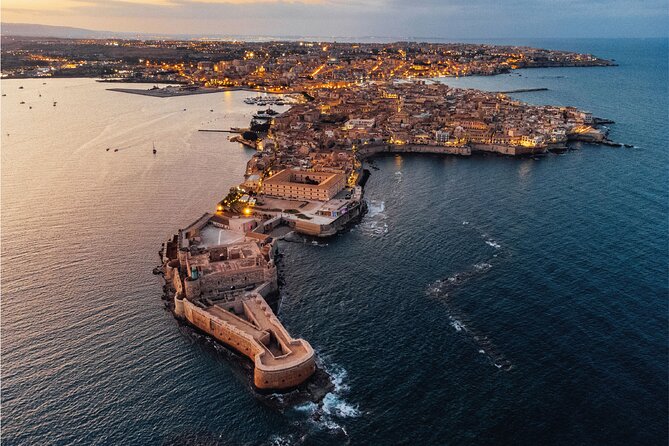
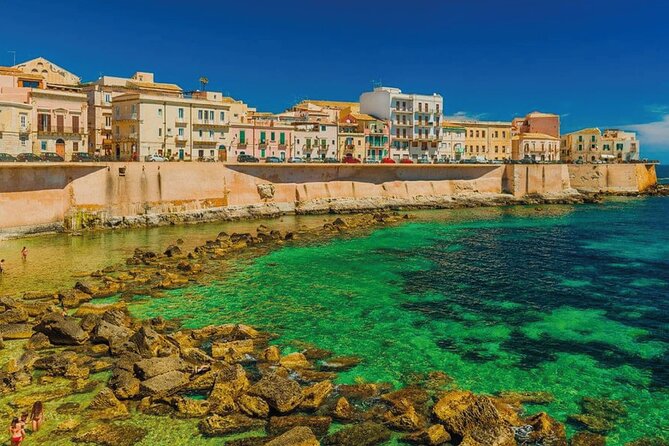
That format suits Syracuse well. Ortigia is compact enough to explore on foot, but its streets, piazzas, churches, fountains, and waterfront can pull you in several directions. A little structure helps you see the important places without turning your day into a march.
The audio sections are generally short, often around two minutes per attraction. That is a smart length. You get useful context without standing in one place with your phone pressed to your ear for ten minutes.
I especially like the control this gives you. If the Cathedral interests you, you can spend extra time there. If you are tired by the time you reach the Santuario della Madonna delle Lacrime, you can pause and continue later. A fixed group would not offer that flexibility.
The guide also suits different walking speeds. One person can listen while another reads. A parent with a stroller, a wheelchair user, or someone traveling with an older relative can take the route at a comfortable pace. The route is listed as wheelchair and stroller accessible, although the experience still involves ordinary city streets and archaeological areas, so conditions may vary at individual sights.
More Audio Walking Tours in Italy
- Florence: 2.5 hour Audio Guided Walking Tour led by Host
★ 4.6 · 293 reviews - Verona Walking Tour with Audio and Written Guide by a Local
★ 4.5 · 157 reviews - Bologna Walking Tour with Audio and Written Guide
★ 4.5 · 132 reviews
Starting among the stalls of Ortigia Market
The tour begins at the Ortigia Street Market, near Vicolo Bagnara. This is an appropriate starting point because the market introduces the commercial side of the island before you move into its monuments.
Ortigia has served as a trading center since Greek and Roman times. Its position near the port brought fish, fruit, vegetables, spices, merchants, and ideas from across the Mediterranean. The market stop lasts about 20 minutes and has no admission fee.
Give yourself time to look around rather than treating the market as a simple checkpoint. The digital guide helps explain why this part of Ortigia matters, but the real value is the chance to connect ancient trade with daily city life.
From there, the route takes you toward the Temple of Apollo. Built at the beginning of the sixth century BC, it is described as the oldest surviving example of a Doric temple in Sicily. Even if only fragments remain, the site gives you an early sense of Syracuse as a major Greek city.
The Temple of Apollo is an outdoor stop, so it works well early in the walk. You can listen, read, and look without needing to enter a building or buy a ticket.
Piazza Archimede and the Fountain of Diana
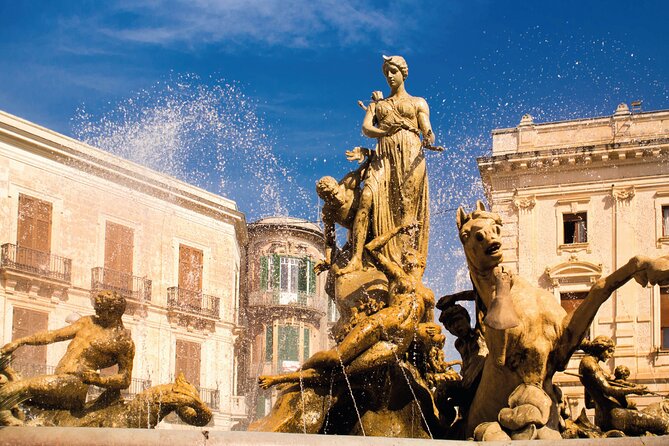
The next major stop is Fontana di Diana in Piazza Archimede. The fountain was created between 1906 and 1907 by Giulio Moschetti, a sculptor from Palermo.
This is a useful reminder that Ortigia is not simply an ancient Greek display. The island combines Greek foundations, Roman remains, medieval lanes, Baroque churches, and more recent public art. The Fountain of Diana gives the piazza a clear focal point and makes a natural pause between the market and cathedral area.
The stop is brief, about 10 minutes. That is enough for the guide’s explanation and a look around, but you may want extra time if you enjoy architectural details or people-watching.
The guide’s map is intended to keep you moving from one point to the next. Still, one practical weakness is that you may sometimes need to switch between the tour page and Google Maps to confirm the next location or distance. Keep your phone charged and be ready to use both.
Syracuse Cathedral, built over an ancient temple
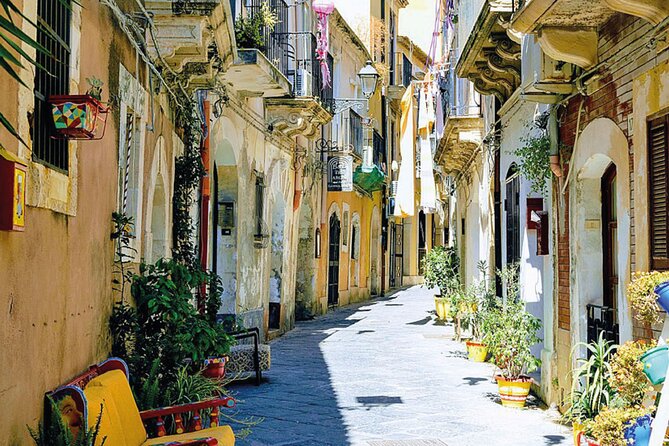
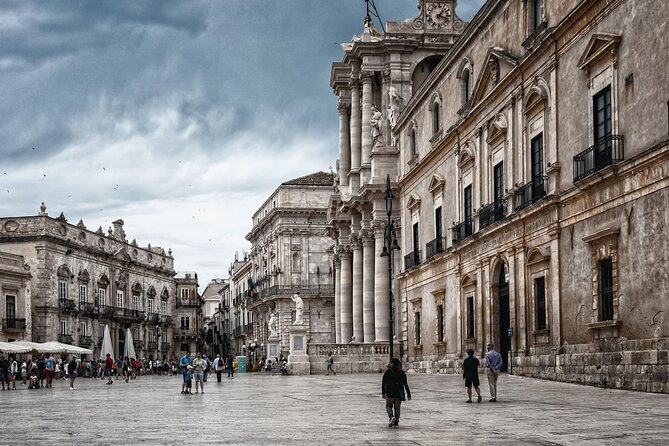
Syracuse Cathedral is one of the most important stops in Ortigia. The church was built on the foundations of a fifth-century BC Doric temple dedicated to Athena, constructed by the Greek-Siceliots.
That layered construction is the point. You are not looking at separate ancient and Christian monuments. The cathedral lets you see how a sacred site can be reused and reshaped across centuries.
The stop is planned for about 25 minutes, but admission is not included. The route can explain the building from outside, while entry allows you to see the interior for yourself. Check the current opening arrangements before committing to a visit, since the tour price does not cover the ticket.
This is one place where the text feature matters. A written explanation lets you read at your own speed, especially if the audio connection falters or you want to return to a detail later.
Same place, a different route to walk:
- Rome: Pantheon Fast-Track Ticket and Official Audioguide
★ 4.5 · 27,353 reviews - Rome: Colosseum & Forum with Audio Guide App -Optional Arena
★ 4.2 · 24,770 reviews - Florence: Timed Entry to Michelangelo’s David + Audio App
★ 4.6 · 19,496 reviews - Rome: City Sightseeing Hop-on Hop-off Bus with Audioguide
★ 4.0 · 16,045 reviews
The Arethusa Spring and Ortigia’s waterfront
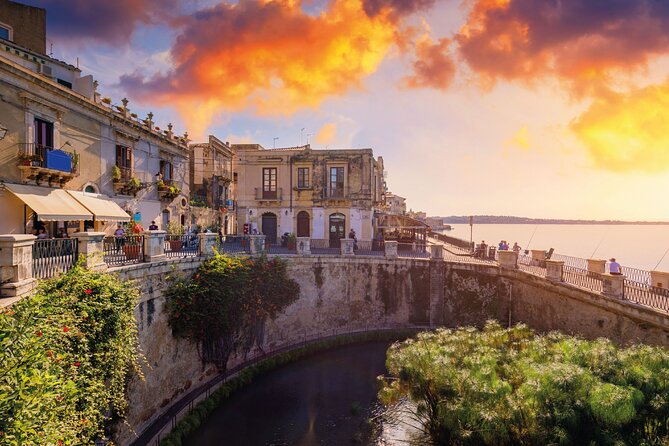
The Fonte Aretusa, or Arethusa Spring, is one of Ortigia’s most memorable natural sights. Fresh water rises close to the sea, and the spring has inspired poets and writers since ancient times.
It is also known locally as a funtana re papiri, the fountain of papyrus. The stop takes about 10 minutes and is free to visit.
This is a good place to slow down. The guide provides the historical and cultural explanation, while the spring itself gives you a change of pace after the busier piazzas and stone streets.
The itinerary later ends at Castello Maniace, so the waterfront section helps connect the inland squares with the edge of the island. The exact walking time between stops is not always built into the guide as clearly as it could be. If you want a precise distance, use the linked Google Maps route.
Ancient Syracuse at Neapolis Archaeological Park
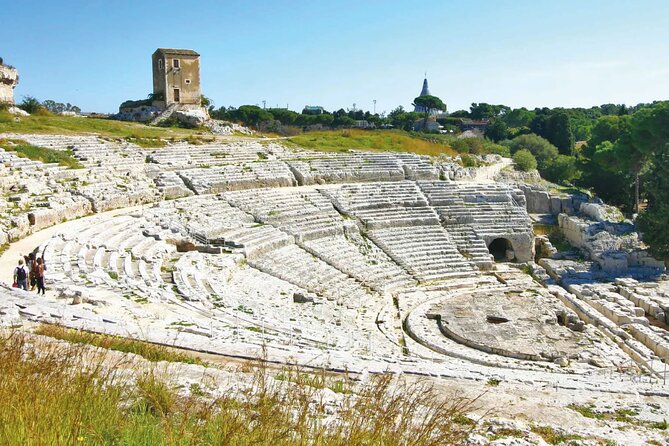
The tour then reaches the Archaeological Park of Neapolis, in the northwestern part of Syracuse. The park covers roughly 240,000 square meters and is one of the largest archaeological areas in the Mediterranean.
This is the part of the experience that requires the most planning. The suggested visit lasts about 1 hour and 30 minutes, but admission is not included. You should treat the park as a substantial stop rather than a quick add-on to an Ortigia walk.
The Greek Theatre is the star. It was one of the largest theatres in ancient Greece, together with the theatre in Athens, and its size still gives you a sense of Syracuse’s importance in the ancient world.
The Ear of Dionysius is another highlight. This famous cave belongs to the Latomia del Paradiso, stone quarries cut by workers following the limestone veins. Its name and dramatic shape have made it one of the park’s best-known sights.
The digital guide helps you understand what you are seeing, which is valuable in a large archaeological area where ruins can otherwise blur together. Still, do not expect the $7.84 fee to cover park admission, transport, or a live specialist. You are paying for interpretation and route support, not entrance services.
A practical point: the complete route may be ambitious for one day if you want to spend serious time at Neapolis and also linger in Ortigia. One useful approach is to treat the guide as a menu. Follow the Ortigia section on one day, then use the Neapolis and sanctuary information separately.
Two important sanctuaries outside the old town

The Santuario della Madonna delle Lacrime is a striking modern religious site tied to a reported miracle in 1953. According to the story, an image of the Immaculate Heart of Mary in the Iannuso home began to weep.
The stop lasts about 20 minutes and is free. It adds a modern devotional chapter to a route otherwise dominated by Greek ruins and historic churches.
The Santuario di Santa Lucia al Sepolcro takes about 15 minutes. It lies outside Syracuse’s old walls on the site associated with the martyrdom and burial of Saint Lucy, the city’s patron saint.
These stops broaden the tour beyond the usual postcard route. They are especially useful if you want to understand Syracuse as a living religious city, not only as an archaeological destination.
They also help explain why the listed duration is four to five hours even though the timed stops add up to less than that. Walking between areas, entering sites, checking directions, and taking breaks fill the remaining time. You can complete the route faster, but you can also make a full day of it.
What the digital guide does well

The strongest feature is freedom. You are not tied to a departure time, group pace, or fixed commentary. Stop for a meal, take a rest, or replay a section without holding anyone else up.
The content is available in audio and written form in English, Spanish, Italian, German, and French. That gives you a choice between listening through your phone speaker and reading quietly.
The guide also includes:
- Restaurant advice aimed at authentic local food
- Notes on monuments, history, and curiosities
- Photos to help identify some sights
- A route connected to Google Maps
- Information you can revisit after the walk
The food suggestions are a welcome touch. A map can show you where to go, but advice about what to eat gives the route a more personal feel.
The short explanations are another strength. You can absorb the essential story of a place and then look up from the screen. The guide is not trying to replace a full lecture.
Where the technology can slow you down
The phone-based format has limits. You need a smartphone with an internet connection, and the activation details are included in your voucher. Read those instructions carefully before you arrive.
If you are coming from a cruise ship, download or open the guide before leaving the vessel. Internet bandwidth can be poor, and one person in a group may end up reading the text aloud if the audio will not load.
There have also been occasional problems with pages overlapping, audio not working at two stops, and the connection crashing. The written notes and photos provide a useful backup, but the experience is smoother when you have headphones and a fully charged phone.
Headphones are not included. You can use your phone speaker, but headphones are better in busy streets and make it easier for two people to share the experience without disturbing others.
The map support is helpful, but directions and distances to the next point are not always as clear as they could be. You may need to jump into Google Maps, find the next sight, and then return to the guide. That is manageable, but it can pull your attention away from the city.
Price, timing, and who gets the best value
At $7.84 per person, this is inexpensive for a four to five-hour sightseeing plan. The price is especially good for solo visitors, couples, and small groups who want historical background without paying for a private guide.
Group discounts are available, adding to the value for larger parties. The experience can accommodate up to 104 participants, but that does not mean you are walking in a group of 104. The format is self-guided, so the maximum mainly reflects how many people can use the digital service.
Admission to Syracuse Cathedral and Neapolis Archaeological Park is not included. Add those costs to your day’s budget, along with any transport you use between Ortigia and the archaeological area.
Free cancellation is available if you cancel at least 24 hours before the start time. Inside that window, the payment is not refunded, and changes are not accepted.
Should you book this Syracuse audio walk?
Book it if you want an affordable route, short explanations, local food suggestions, and complete control over your schedule. It is particularly useful if you dislike walking in a tight group, need frequent rests, or want to stop and restart throughout the day.
It also works well for a first visit when you want enough direction to avoid missing the main sights. The combination of Ortigia, Neapolis, and the two sanctuaries gives you a broad picture of Syracuse.
Skip it if you want a guide beside you, detailed answers to spontaneous questions, or a fully managed route with tickets included. You should also think twice if your phone connection is unreliable and you cannot prepare the guide in advance.
For independent walkers who are comfortable with a smartphone, this is a smart buy. Use it as a flexible companion rather than a rigid four-hour march, and the low price leaves room in your budget for a proper Sicilian meal.
FAQ
Where does the Syracuse walking tour begin?
It begins at the Ortigia Street Market near Vicolo Bagnara, 96100 Siracusa, Italy.
Where does the tour end?
The stated endpoint is Castello Maniace at Piazza Federico di Svevia 5 in Syracuse.
How long does the experience take?
The approximate duration is four to five hours. Individual stops have suggested times, but you can move faster or slower because the tour is self-guided.
What languages are available?
Audio and written content are available in English, Spanish, Italian, German, and French.
Is the tour wheelchair and stroller accessible?
Yes, the experience is listed as wheelchair and stroller accessible. Individual streets and archaeological areas may still have different surfaces or conditions.
Do I need a smartphone and internet connection?
Yes. You need a smartphone with an internet connection to activate and use the digital guide. The activation instructions are provided in your voucher.
Are headphones included?
No. You can listen through your phone’s speakers or use your own headphones.
Are admission tickets included?
No. Admission is not included for Syracuse Cathedral or the Archaeological Park of Neapolis. The listed stops at the market, Fountain of Diana, Arethusa Spring, and the sanctuaries are described as free.
Can I cancel for a full refund?
Yes, if you cancel at least 24 hours before the experience start time. Cancellations made less than 24 hours before the start time are not refunded.
Just added around Italy
- Torino Walking Tour with Audio and Written Guide by a Local★ 4.5 · 35 reviews
- Medieval Canals and Fountains: A Treviso Self-Guided Audio Tour★ 4.5 · 4 reviews
- Trapani Walking Tour with Audio and Written Guide by a Local★ 4.0 · 8 reviews
- Trento Walking Tour with Audio and Written Guide★ 4.5 · 11 reviews
- Sicily: Selinunte Park Entry Ticket & Sicily Digital Audio Guide★ 4.5 · 4 reviews
- Taormina Walking Tour with Audio and Written Guide by a Local★ 4.5 · 41 reviews
- Taranto Walking Tour with Audio and Written Guide by a Local★ 5.0 · 5 reviews
- Syracuse Scavenger Hunt & Highlights Self Guided Audio Tour★ 4.5 · 4 reviews
Walking Tours, compared.

City Monuments Guided Walking Tour with Audio Guide
Read our review →

Self Guided Classic Freedom Trail Location Aware (GPS) Walking Audio Tour
Read our review →
Self-Guided Historical Walking Tour (Audio Guide)
Read our review →
Cape Cod & Provincetown Self-Guided Driving & Walking Audio Tour
Read our review →
Verona Walking Tour with Audio and Written Guide by a Local
Read our review →
Royal Walking Tour and Buckingham Palace Audio Tour
Read our review →
Bologna Walking Tour with Audio and Written Guide
Read our review →Browse the lists this tour appears in