
REVIEW · POMPEII AUDIO TOURS
Herculaneum and Pompeii in one day: Audioguides + Tkts (art)
Ancient cities, two very different stories. This six-hour self-guided outing pairs Pompeii and Herculaneum with authorized audioguides and entry tickets, letting you choose which site comes first. I like the freedom to set your own pace, and I like the contrast between Pompeii’s broad streets and public spaces and Herculaneum’s remarkably preserved homes. The main drawback is the handling: you must collect devices at separate places, and some visitors lost time finding the Pompeii pickup point or exchanging vouchers.
This works best for independent visitors who want historical context without joining a fixed group. The audioguides are available in English, Italian, French, Spanish, and German, but the instructions can be technical, and older site references may not match current barriers or construction changes. Allow extra time for the Circumvesuviana train and do not treat the six-hour label as six uninterrupted hours inside the ruins.
Key points to know before you book
- Two archaeological parks in one day: Pompeii gives you scale and city planning, while Herculaneum offers closer views of domestic life.
- Choose your starting point: You can begin at either site, a useful option if your train schedule or accommodation favors one direction.
- Separate Pompeii pickup: Exchange your voucher at Tempio Travel on the first floor of the EAV station at Via Villa dei Misteri 1 before heading to the park.
- Herculaneum pickup is inside the park: Look for the Audioguide Desk at the archaeological park entrance and show your booking confirmation.
- Train tickets are extra: The Circumvesuviana connects Pompei Scavi Villa dei Misteri and Ercolano Scavi, usually with a change at Torre Annunziata.
- Bring identification and headphones: Your ID is held as a deposit for each device, and personal jack headphones are not supplied.
Why combine Pompeii and Herculaneum?
Pompeii and Herculaneum were both damaged and buried by the eruption of Mount Vesuvius, but they offer very different visits.
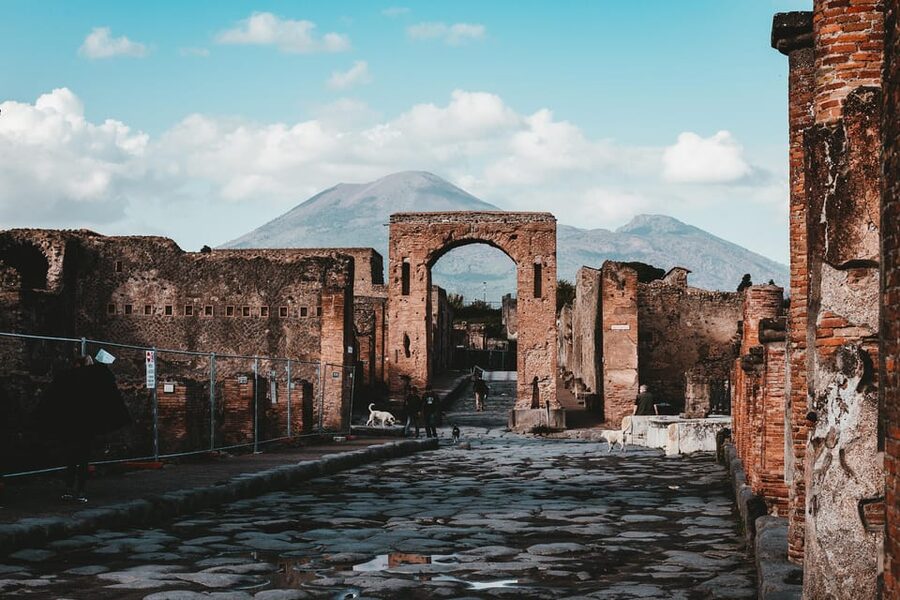
Pompeii is the larger site. Its streets, villas, public buildings, and forums help you understand how a Roman town functioned on a citywide scale. You can spend hours simply moving through its blocks and seeing how homes, shops, religious buildings, and public spaces fit together.
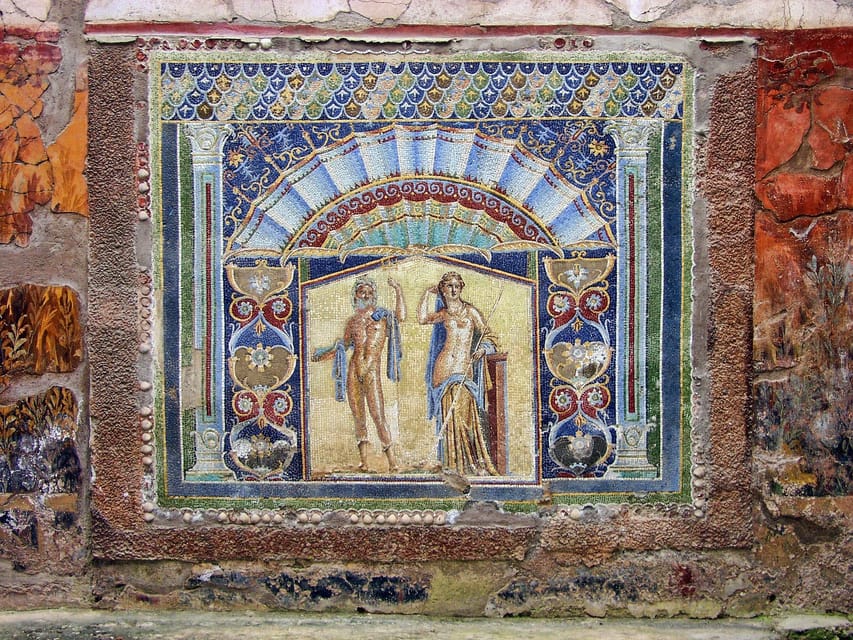
Herculaneum is smaller and more compact. The volcanic material that covered it preserved details that are often lost elsewhere, including mosaics, frescoes, and wooden structures. Its houses can feel more intimate because you are often looking closely at rooms rather than walking across a huge urban grid.
That contrast is the main reason I consider the combination worthwhile. Seeing only Pompeii gives you scale but can leave you tired and overloaded. Seeing only Herculaneum gives you superb preservation but less of a sense of a full ancient city. Together, they create a more rounded picture.
The compromise is time. Six hours is a tight schedule once you include ticket collection, train travel, walking between stations and entrances, and returning the audio devices before closing. You will need to keep moving and accept that you cannot inspect every building.
More One-Day Trips in Pompei Campania:
- From Paris: Giverny Day Trip with Audio Guide or Live Guide
★ 4.3 · 2,372 reviews - Athens: Peloponnese Highlights Day Trip and V.R. Audio Guide
★ 4.5 · 1,425 reviews - Giverny and Monet’s House Half Day Trip from Paris Guide or Audio
★ 4.0 · 1,319 reviews
Starting at Pompeii: the ticket exchange matters
If Pompeii is your first stop, begin at the EAV station called Pompei Scavi, Villa dei Misteri. The local partner’s office, Tempio Travel, is on the first floor at Via Villa dei Misteri 1.
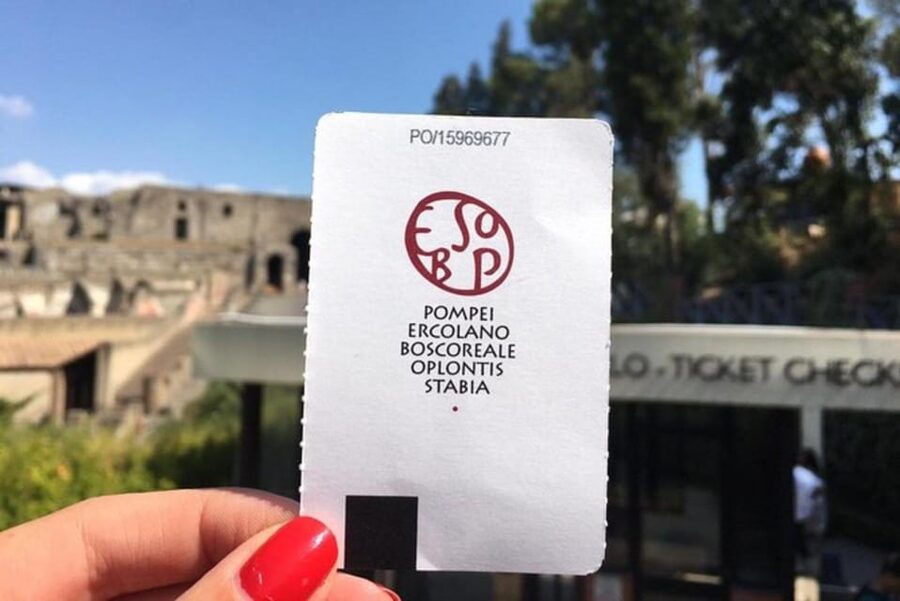
This is not the same as walking straight to the archaeological park entrance. You must exchange your voucher at the office first, collect the audio device, and then walk several hundred meters to the dedicated line at Porta Marina Inferiore in Piazza Esedra.
That extra step is easy to miss. One practical complaint about this arrangement was that the skip-the-line benefit felt less useful when a separate queue was needed to exchange tickets. I would arrive early, keep the booking confirmation ready, and ask the office staff to point out the quickest route to Porta Marina Inferiore.
The dedicated access can still save time once your documents are sorted, especially at busy periods. Just remember that skip the line does not mean skip every procedure. You are avoiding the regular entry process, not the voucher exchange.
Pompeii’s opening hours change with the season. From October 15 through March 15, the park is listed as open from 9:00 to 17:00, with last entry at 15:30. From March 16 through October 15, it is listed as open from 9:00 to 19:00, with last entry at 17:30. Check the exact date carefully because the seasonal wording overlaps on October 15.
What Pompeii gives you in a short visit
Pompeii rewards a broad approach. Rather than trying to inspect every house, use the map and audio device to select a few areas that help you understand the city.
The site’s streets and public spaces show the shape of Roman urban life. You get a sense of movement, trade, domestic architecture, and public gathering places. The audio guide adds context that a bare walk through ancient walls cannot provide, particularly when you want to understand why a room or building mattered.
The supplied device works through numbered points. You select the relevant number as you reach each location. It can be used hands-free, or with standard jack headphones if you bring your own.
This format gives you privacy and control. You can pause, replay, skip ahead, or stop for photographs without waiting for a group. It also avoids the problem of trying to hear a guide while standing in a crowded archaeological space.
There are limits. The explanations use architectural terms, including words such as atrium, without always explaining them for newcomers. If Roman building design is new to you, the information may feel more academic than conversational. The site is also changing as conservation work continues, so directions such as to the right of the barrier may no longer fit what you see.
My advice is to treat the audio guide as a useful companion, not a perfect turn-by-turn route. Use the map to confirm where you are, and be ready for a reference point to have moved.
Moving from Pompeii to Herculaneum by train
Transportation between the parks is not included. The recommended connection is the local Circumvesuviana train between Pompei Scavi Villa dei Misteri and Ercolano Scavi, usually with a change at Torre Annunziata.
Because the train schedule and connection take time, your six-hour outing includes more than archaeological sightseeing. Plan the order around your wider day. Starting at Herculaneum may make sense if you are staying closer to Naples or want to finish near that rail route. Starting at Pompeii may suit you if you arrive at the Pompei Scavi station and want to handle the Tempio Travel office first.
You are responsible for buying the train tickets. Do not assume the archaeological package covers local transport. Keep your booking details and identification easy to reach while changing trains and collecting the second audio device.
The train connection is part of the practical cost of the day, both in money and time. If you need a relaxed visit with long pauses, one park in a day may be a better choice. If your priority is seeing both sites and comparing them directly, the connection is manageable with early planning.
A few more audio tours around Pompei Campania worth a look
- Pompeii: Skip-the-line Entry Ticket with Audio Guide & Map
★ 3.9 · 3,153 reviews - Pompeii: Skip-the-Line Entry Ticket with Digital Guide App
★ 4.1 · 770 reviews - Pompeii: Skip-the-Line Entry & Audioguide
★ 3.8 · 225 reviews - Pompeii: Skip-the-Line Ticket with Audio Guide and Map
★ 4.0 · 117 reviews
Herculaneum’s smaller scale and finer details
At Herculaneum, go directly to the entrance of the Archaeological Park and look for the Audioguide Desk. Staff will have the reservation information, so you do not need to visit the Pompeii office for this device.
The site’s appeal is its preservation. Houses, mosaics, frescoes, and wooden elements survived in ways that make the ancient environment feel unusually close. Herculaneum is not simply a smaller Pompeii. Its compact layout and domestic details produce a different kind of visit.
I would use Herculaneum as the place to slow down and look carefully. Notice room layouts, decorative surfaces, and the evidence of everyday construction. The audio guide is especially useful here because a small house can otherwise appear to be a set of bare rooms without much explanation.
The same caution about technical language applies. Terms from ancient architecture may be unfamiliar, and the audio route may refer to features that have shifted during conservation work. Bring patience and use the map to match the narration with the structure in front of you.
Herculaneum follows a similar seasonal schedule. From October 15 through March 15, hours are listed as 9:00 to 17:00, with last entry at 15:30. From March 16 through October 14, hours are listed as 9:00 to 19:00, with last entry at 17:30.
How the authorized audioguide works
The devices are described as the only ones authorized for tour operators by the Pompeii Archaeological Park. That matters because you are not relying on an unofficial phone app or a random recorded walk.
The system uses numbered explanations. At Pompeii, you collect the device at the Tempio Travel office. At Herculaneum, you collect it at the desk inside the park. The device can be worn hands-free, or used with standard jack headphones.
Personal headphones are not included. Bring compatible jack headphones if you prefer not to hold the device or listen through its built-in setup. Your passport or ID card is required as a deposit, and the device must be returned before the office closes according to the park schedule.
Take care of the equipment. If it is damaged, lost, or stolen, you are responsible for repair or replacement costs. This is a small point, but it matters when you are carrying the device through crowded entrances, uneven ruins, and a train transfer.
The content appears strongest when you want background and historical interpretation without a live guide. It is less ideal if you need simple language, constant route direction, or help adapting the visit to changing site conditions.
What the $88 price really buys you
At $88 per person, this is not a cheap entry ticket. The value depends on how much you want from the day.
You receive two entrance tickets, audio devices for both parks, a site map, multilingual help at the Pompeii office, and dedicated access at Porta Marina Inferiore. You also gain the freedom to start at either location and set your own rhythm.
That package can be useful if you want both sites but do not want a private transfer or a fixed guided group. The audio devices add more than simple admission, particularly at Pompeii, where the size of the site can make unmarked ruins hard to interpret.
The value weakens if the pickup process costs you significant time or if the devices fail. One booking reported that the audio guides did not work and found the ticket exchange process made the skip-the-line benefit feel pointless. Another person lost about half an hour to the handling at each site and felt buying directly at the ticket office would have been faster.
Those problems are not a reason to reject the package automatically, but they are a reason to arrive prepared. Confirm both pickup points before you go, test each device as soon as you receive it, and ask staff to replace a unit that does not function.
An optional upgrade to a guided Pompeii visit was considered worthwhile by one person who had already done Herculaneum with the self-guided format. That suggests a useful compromise: use the audio guide at one site and choose a live guide for Pompeii if you want more explanation and help finding your way.
Timing, comfort, and access
Wear comfortable shoes and clothes. Both parks require walking on ancient surfaces, and the day also includes movement between stations, entrances, and pickup points.
Food and drinks are not included. Plan around the seasonal closing time rather than assuming you can eat whenever you like. The later summer closing time gives you more room, but the train connection and device return still require attention.
The information supplied for this experience contains a conflict about wheelchair access. One section describes the activity as wheelchair accessible, while another says it is not suitable for wheelchair users. Contact the provider before booking if access is important to you, and ask specifically about both archaeological parks, the entrance routes, and the train connection.
The package is also listed as unsuitable for people over 95 and for people with hearing impairments. The latter is clear: the main content is delivered through audio devices. You may want to consider a written guide or live assistance instead.
Free parking may be available, if the lot is open and spaces remain, at Osteria Nonna Cherubina, Via Andolfi 46 in Pompei. It is not gated, and availability is not guaranteed, so do not build your entire plan around it.
Who should book this experience?
I would recommend it to an independent visitor who wants both archaeological parks, speaks one of the five available languages, and is comfortable managing trains, maps, and ticket procedures.
It suits you if you like stopping when you wish, skipping rooms that do not interest you, and spending extra time with a mosaic or fresco. It also suits anyone who wants more structure than a plain entry ticket but less commitment than a full group tour.
I would hesitate if you want a relaxed day, direct transport, or a guide who can explain architectural terms in simple language. I would also think twice if you are uncomfortable with separate device deposits and returns, or if you need completely reliable step-free access.
Book only after checking the start time, opening hours, transport connection, and pickup instructions. Free cancellation up to 24 hours before the experience and reserve-now-pay-later terms make planning less risky, but they do not solve the on-site logistics.
FAQ
Can I choose which archaeological park to visit first?
Yes. You can begin at Pompeii or Herculaneum, depending on your plans and transport route.
Where do I collect the Pompeii audioguide?
Collect it at the Tempio Travel office on the first floor of the EAV station at Via Villa dei Misteri 1. After that, enter Pompeii through the dedicated line at Porta Marina Inferiore in Piazza Esedra.
Where do I collect the Herculaneum audioguide?
Go to the Audioguide Desk inside the Archaeological Park of Herculaneum and show your booking confirmation.
Is transportation between Pompeii and Herculaneum included?
No. You must pay separately for the Circumvesuviana train. The recommended connection runs between Pompei Scavi Villa dei Misteri and Ercolano Scavi, usually with a change at Torre Annunziata.
Do I need to bring headphones?
Headphones are not included. The devices can be used hands-free or with standard jack headphones, so bring your own compatible pair if you prefer.
What do I need to leave as a deposit for the audioguide?
You must provide a valid passport or ID card. The document is returned when you return the device. You are responsible for damage, loss, or theft.
Should you book it?
Book this experience if your goal is maximum independence in one busy day. The two parks complement each other, the authorized audio devices add useful context, and the flexible starting point helps you fit the visit around local trains.
Skip it if you want a calm, polished, fully guided outing with no ticket exchange or route confusion. For the best result, arrive early, verify the Pompeii office location, bring headphones and identification, test both devices, and leave enough time for the Circumvesuviana connection. That preparation turns a potentially awkward package into a practical way to see two extraordinary Roman sites.
Just added around Pompei Campania
- Pompeii: Pre-reserved ticket with audio guide★ 3.2 · 15 reviews
- Pompeii: Skip-the-Line Ticket with Audio Guide and Map★ 4.0 · 14 reviews
- Pompeii Tour_Skip the line ticket + audioguide★ 4.7 · 17 reviews
- Pompeii, skip-the-line ticket with smartphone audio guide on App★ 3.0 · 4 reviews
- Pompeii: Skip-the-Line Ticket with Audio Guide and Map★ 3.9 · 5 reviews
- Pompeii: Skip the Line Ticket + Audioguide★ 3.3 · 13 reviews
- Pompeii & Herculaneum: Skip-the-line & Digital Guide App★ 4.0 · 35 reviews
- Pompeii Skip-the-Line Ticket and Audioguide★ 4.2 · 7 reviews
1-Day Tours, compared.

Giverny Day Trip with Audio Guide or Live Guide
Read our review →
Peloponnese Highlights Day Trip and V.R. Audio Guide
Read our review →
Giverny and Monet’s House Half Day Trip from Paris Guide or Audio
Read our review →

Albi and Cordes/Ciel Day Trip with Audio Guides
Read our review →
Meteora Day Trip with Central Pickup & Audio Guide
Read our review →
Rethymno: Full or Half-Day Trip to Chania with Audio Guide
Read our review →
Browse the lists this tour appears in