

REVIEW · POMPEII AUDIO TOURS
Pompeii Tour_Skip the line ticket + audioguide
Pompeii rewards curiosity. This self-guided visit gives you a skip-the-line entrance ticket, an updated map, and an audio guide for exploring one of Italy’s greatest archaeological sites at your own pace. I like the simple setup: you avoid the ticket queue, then choose how much time to spend among houses, temples, shops, theaters, and streets frozen by the eruption of Mount Vesuvius.
I also like the language choice, with audio guides offered in English, French, German, Italian, Hebrew, Chinese, Russian, Spanish, and Portuguese. The main drawback is the audio content itself. One verified French review from September 2025 found it far too brief, so you should book this mainly for independent access and route help, not for the depth of a live historian’s explanation.
Key points to know before you book
- Skip the ticket line: The package is designed to get you into Pompeii without waiting in the standard ticket queue.
- Self-guided freedom: You set your own pace instead of following a fixed group route or guide.
- Large archaeological site: Pompeii covers about 66 hectares, so comfortable shoes and a sensible route matter.
- Audio guide languages: Choose from nine listed languages, including English, French, German, Italian, Hebrew, Chinese, Russian, Spanish, and Portuguese.
- No transportation included: You must arrange your own way to the meeting point beside Bar De Vivo.
- Good value for independent explorers: At $44 per person, the price makes the most sense if skipping the queue and having a route map are important to you.
Arriving beside Bar De Vivo
Your meeting point is directly next to Bar De Vivo. This is useful because the location is specific rather than vague, but the package does not include transportation, so you need to plan your own arrival in Campania.
Look for the host or greeter in one of the listed languages: English, Italian, Spanish, or French. The host is there to help with the entry process, but this is not a guided tour. That distinction matters. You receive your ticket and audio guide, then explore Pompeii independently.
Bring your passport or ID card. Comfortable shoes are not just a polite suggestion here. The site is very large, with ancient streets and many separate areas to reach, so this is a poor place for flimsy footwear or clothes that make walking unpleasant.
A few more audio tours around Pompei Campania worth a look
- Pompeii: Skip-the-line Entry Ticket with Audio Guide & Map
★ 3.9 · 3,153 reviews - Pompeii: Skip-the-Line Entry Ticket with Digital Guide App
★ 4.1 · 770 reviews - Pompeii: Skip-the-Line Entry & Audioguide
★ 3.8 · 225 reviews
Getting past the ticket queue
The strongest practical feature is the skip-the-ticket-line entrance. Pompeii attracts about three million visitors each year, and queues can eat into the time you have for the ruins. A faster entry is especially useful if you are visiting as part of a busy Campania schedule.
You still need to arrive at the stated meeting point and follow the entry instructions. Skip-the-line access does not mean you are joining a fully guided group or receiving private treatment throughout the site. It means the ticket arrangement is set up to avoid the regular ticket line.
At $44 per person, I would judge the value in three parts: the entrance ticket, the time saved, and the audio guide with map. If you want a guide beside you explaining every room, the package may feel thin. If you want control and a faster start, the price is easier to justify.
Walking Pompeii’s ancient streets
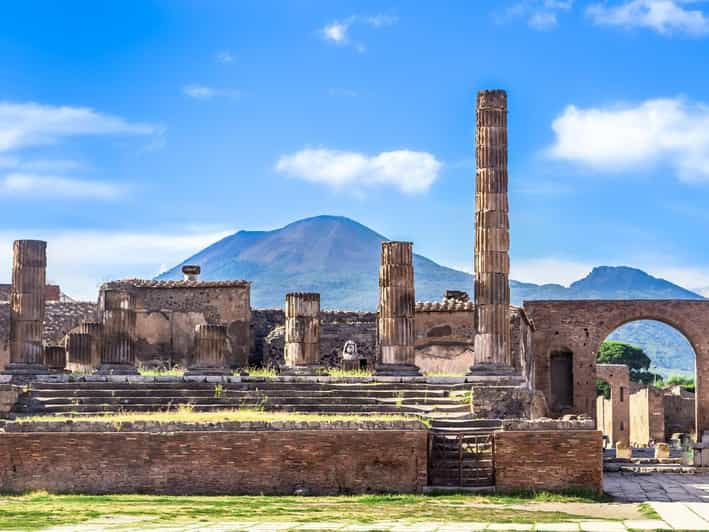
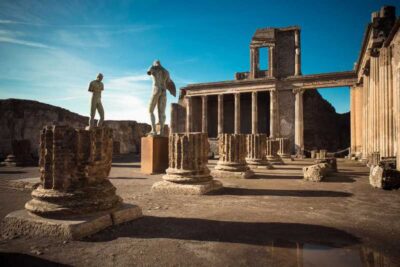
Once inside, the scale of Pompeii becomes clear. This is not a compact monument where you can see everything in an hour. The excavated area covers about 66 hectares, and the streets lead through homes, public buildings, commercial spaces, religious sites, and entertainment venues.
The updated map is important because the site can feel confusing without a plan. You might otherwise wander past major buildings or spend too much time in one area before realizing how far you still have to go. I would use the map first to choose a broad route, then let the audio guide add context at the stops that interest you most.
The freedom is a real advantage. You can pause, go back, or spend extra time looking at a frescoed house without holding up a group. The tradeoff is that no guide is there to point out a detail you might miss.
Frescoed houses and Roman domestic life

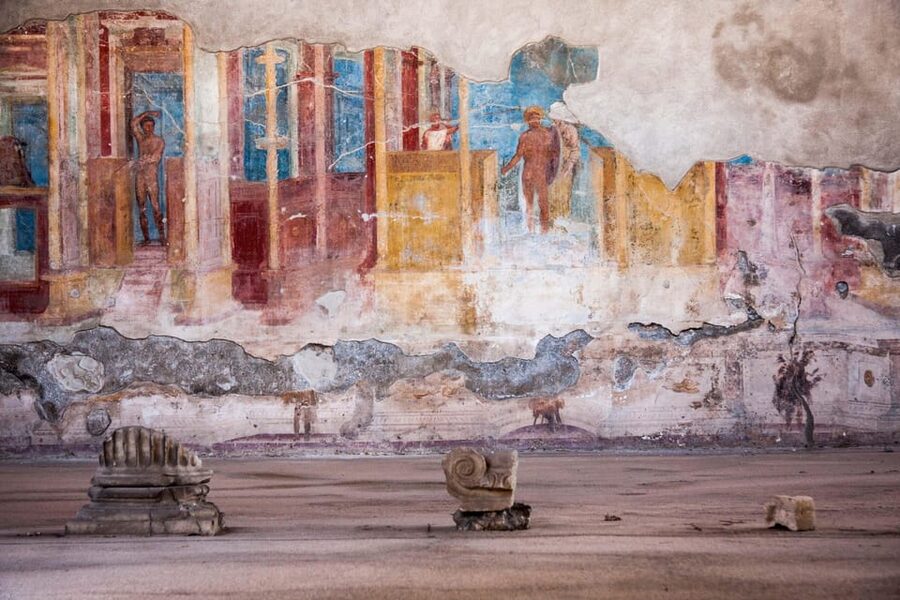
Pompeii’s domus, or wealthy Roman houses, are among the most rewarding stops. Their frescoed walls show how much attention Roman homeowners gave to decoration, display, and entertaining.
The audio guide should help you understand what you are seeing, but its quality is the main uncertainty in this experience. A verified French review from July 2025 rated the experience five stars with a simple positive comment, while another verified French review in September 2025 rated it two stars because the audio guide felt very short on information.
That mixed signal gives you a useful expectation: treat the audio guide as a basic aid, not a full lecture. If you already know some Roman history, the map and commentary may be enough. If you want detailed explanations of architecture, daily life, and the eruption, you may want to read more before arriving.
Same place, a different route to walk:
- Pompeii: Skip-the-Line Ticket with Audio Guide and Map
★ 4.0 · 117 reviews - From Pompeii: Vesuvius Entry with Transfer and Audioguide
★ 4.2 · 74 reviews - Pompeii & Herculaneum: Skip-the-line & Digital Guide App
★ 4.0 · 35 reviews - Herculaneum and Pompeii in one day: Audioguides + Tkts (art)
★ 3.7 · 22 reviews
Baths, temples, shops, and thermopolia
Pompeii becomes more interesting when you look beyond the famous casts. The site includes spas, temples, shops, and thermopolia, ancient Roman food and drink counters that functioned somewhat like quick-service cafés.
These commercial spaces help you picture Pompeii as a working city rather than a collection of empty ruins. The baths reveal public life and social routine. Temples point to religious practice. Shops and thermopolia show the practical side of the city, where people bought goods and meals during ordinary days.
I like this variety because it keeps the visit from becoming a long march past similar walls. You can shift from grand public buildings to small details of daily life. The map should help you connect these areas into a sensible route instead of treating each building as an isolated stop.
The theaters and ancient amphitheater
The theaters offer a change of scale and mood. These spaces show how entertainment fitted into city life, while the amphitheater gives you one of the clearest views of Pompeii’s public architecture.
The amphitheater is described as one of the best-preserved Roman examples. That makes it a particularly worthwhile stop, even if you are not an ancient-history expert. Its size and survival help you understand how organized public events shaped the city.
Because the tour has no set itinerary, you need to make sure you include these buildings rather than simply following the first street that looks interesting. I would mark the theaters and amphitheater on the map early in the visit, then work smaller houses and shops around them.
The casts of the eruption victims
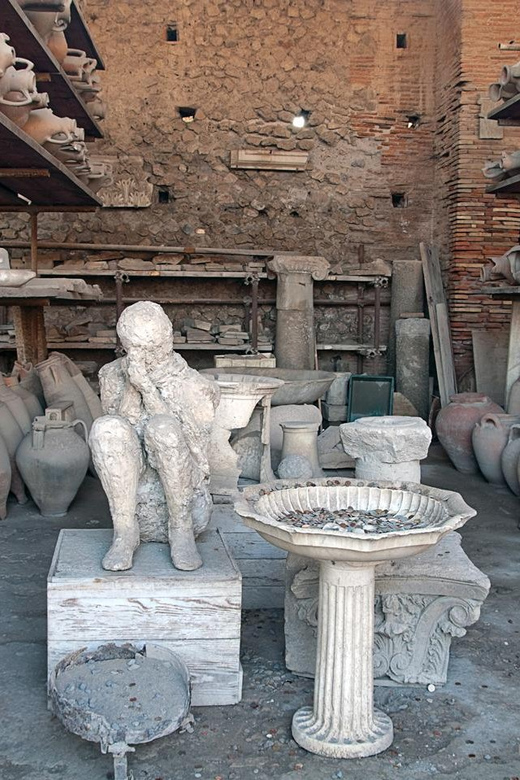
The casts of the victims are among Pompeii’s most emotionally difficult sights. They bring the eruption down from a grand historical event to the level of individual human loss.
Give these displays time. They are not just another item on a sightseeing checklist, and their presence changes the tone of the visit. The audio guide may offer some background, but the supplied information does not promise extensive interpretation, so do not expect a long explanation at every display.
The wider importance of Pompeii comes into focus here. You are seeing a Roman city preserved through catastrophe, including both its public buildings and the people caught in the eruption. That combination is what gives the site its unusual force.
How the audio guide affects the visit
The audio guide is available in English, French, German, Italian, Hebrew, Chinese, Russian, Spanish, and Portuguese. That is a strong language range for a self-guided ticket, and it lets you visit without depending on a live guide in your preferred language.
Still, I would keep expectations modest. The most specific criticism in the available feedback was that the French commentary was too brief and lacked enough information. Since the audio guide is central to the package, this is not a minor point.
The best way to use it is selectively. Listen at the houses, public buildings, and major landmarks that you want to understand, then continue at your own pace. You do not need to hear every entry if the commentary becomes repetitive or too short. The map may end up being just as useful as the audio.
One day at Pompeii
The ticket is valid for one day, with starting times available according to the booking calendar. That gives you a full day in principle, but the supplied information does not specify a fixed duration inside the ruins.
I would avoid treating one day as a challenge to see every corner. The site is too large for a relaxed visit if you rush from one end to the other. Choose the areas that matter most to you, such as frescoed houses, baths, temples, the thermopolia, theaters, amphitheater, and victim casts.
A sensible visit has three parts: first, get your bearings with the map; second, follow a route through the major buildings; third, slow down for the places that hold your attention. The independent format works best when you accept that you will not absorb every street and structure.
Who will get the most from this ticket
I would recommend this experience to independent visitors who like choosing their own pace. It suits you if you want to avoid a long ticket queue, prefer an audio guide to a live group, and are comfortable making route decisions inside a huge archaeological site.
It also works well for people who want several language choices. Families and mixed-interest groups may appreciate the freedom to split up briefly or spend different amounts of time at each building, though everyone should still carry the map and agree on meeting plans.
I would be more cautious if you want a detailed academic explanation or personal storytelling from a guide. There is no guide included, and the audio commentary may be too short for you. In that case, the ticket still gets you into Pompeii, but its educational value may not match your expectations.
Price, flexibility, and practical value
The listed price is $44 per person. That is not the cheapest way to enter Pompeii, but it combines admission, skip-the-line access, a map, and an audio guide.
The value depends on your priorities. Saving time at the entrance is worth more on a crowded day or when you have other plans in Campania. The self-guided format can also save you from paying for a longer private tour if you prefer to explore alone.
The booking terms add useful flexibility. You can cancel up to 24 hours before the visit for a full refund, and you can reserve now and pay later. The package does not include food, drinks, transportation, or a live guide, so add those costs and needs to your own plan.
Should you book the Pompeii audio guide ticket?
Book it if your main goals are faster entry, independent exploration, and a broad choice of audio languages. The map is valuable at a site this large, and the ticket gives you freedom to focus on houses, baths, shops, theaters, the amphitheater, and the casts without following a group.
Think twice if you need detailed commentary at every stop. The French audio feedback points to a real weakness, and the experience does not include a live guide. For a self-directed Pompeii visit at $44, it is a practical option, but its value rests more on access and flexibility than on deep interpretation.
FAQ
Where is the meeting point?
The meeting point is directly next to Bar De Vivo.
Is transportation included?
No. Transportation to and from the meeting point is not included.
Is a live guide included?
No. The package includes an entrance ticket, an audio guide, and an updated map, but not a live guide.
How long is the ticket valid?
The ticket is valid for one day. You should check availability for the available starting times.
Which audio guide languages are available?
The listed audio guide languages are English, French, German, Italian, Hebrew, Chinese, Russian, Spanish, and Portuguese.
What should I bring?
Bring a passport or ID card, comfortable shoes, and comfortable clothes.
Can I cancel the booking?
Yes. You can cancel up to 24 hours in advance for a full refund. You can also reserve now and pay later.
Just added around Pompei Campania
- Pompeii: Pre-reserved ticket with audio guide★ 3.2 · 15 reviews
- Pompeii: Skip-the-Line Ticket with Audio Guide and Map★ 4.0 · 14 reviews
- Pompeii: Skip-the-Line Ticket with Audio Guide and Map★ 3.9 · 5 reviews
- Pompeii: Skip the Line Ticket + Audioguide★ 3.3 · 13 reviews
- Pompeii, skip-the-line ticket with smartphone audio guide on App★ 3.0 · 4 reviews
- Pompeii & Herculaneum: Skip-the-line & Digital Guide App★ 4.0 · 35 reviews
- Pompeii Skip-the-Line Ticket and Audioguide★ 4.2 · 7 reviews
- Pompeii: Skip The Line Entrance Tickets + Audioguides★ 3.2 · 4 reviews
Pompeii Audio Tours, compared.

Skip-the-line Entry Ticket with Audio Guide & Map
Read our review →
Skip-the-Line Entry Ticket with Digital Guide App
Read our review →


Pompeii & Herculaneum: Skip-the-line & Digital Guide App
Read our review →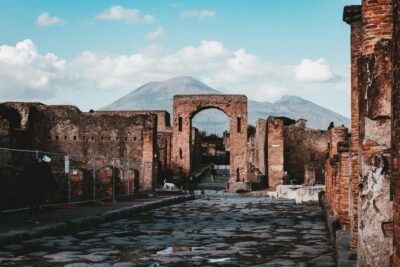
Herculaneum and Pompeii in one day: Audioguides + Tkts (art)
Read our review →Browse the lists this tour appears in