
REVIEW · ITALY AUDIO TOURS
Taranto Walking Tour with Audio and Written Guide by a Local
Taranto rewards curious walkers. This self-guided route links the city’s Greek, Roman, medieval, and modern sights through a mobile audio guide that you can follow at your own speed. I like the direct Google Maps links and the choice between audio and written explanations. I also like the low price, just $7.15 per person, which makes this an easy way to add structure to a visit.
The main tradeoff is that you guide yourself. There is no person to answer questions, adjust the route, or explain a surprise you notice along the way. You also need your own smartphone with an internet connection, and headphones are not provided.
Key points about this Taranto walking tour
- A smart route through two sides of Taranto: Begin near the National Archaeological Museum and finish at the Church of San Domenico in the Old Town.
- Six major stops with free admission listed: The route includes the Monument to the Sailor, Aragonese Castle, Doric columns, Spartan Museum, Cathedral, and San Domenico.
- Audio and written guidance: Listen through your phone speaker or use your own headphones, with audio available in English, Spanish, Italian, German, and French.
- Strong value at $7.15: The price is modest for a two to three hour route with history, directions, food advice, and links to useful information.
- Built for independent sightseeing: You choose the pace, pause when you like, and skip or revisit sections without keeping up with a group.
- Plan your phone setup first: The digital guide must be activated through the booking voucher, and an internet connection is required.
Why Taranto works well as a self-guided walk
Taranto is not a city that explains itself in one quick glance. Its story stretches from Spartan foundations and Greek temples to medieval churches, military fortifications, and the grand civic buildings of the modern city. A route like this helps you connect those pieces instead of seeing them as unrelated sights.
The walk begins at the National Archaeological Museum of Taranto on Via Cavour. Founded in 1887, the museum was created during the urban growth east of the Taranto Navigable Canal, when the Borgo Umbertino area was being built up. It is one of Italy’s most important archaeological museums, so its position at the start gives the route a useful historical frame.
The museum itself is listed as the starting point, but the supplied tour details do not say that museum admission is included. If you want to visit inside, check the current ticket arrangements separately. The main route then moves through the city’s public squares, fortifications, archaeological remains, underground spaces, and churches.
You should allow about two to three hours for the walking route. That estimate includes roughly twenty minutes at the Monument to the Sailor, thirty minutes at Aragonese Castle, ten minutes by the Doric columns, thirty minutes in the Spartan Museum, thirty minutes at the cathedral, and twenty-five minutes at San Domenico. Walking time between stops comes on top of that, so your total may run longer if you linger.
More Audio Walking Tours in Italy
- Florence: 2.5 hour Audio Guided Walking Tour led by Host
★ 4.6 · 293 reviews - Verona Walking Tour with Audio and Written Guide by a Local
★ 4.5 · 157 reviews - Bologna Walking Tour with Audio and Written Guide
★ 4.5 · 132 reviews
Starting at the National Archaeological Museum
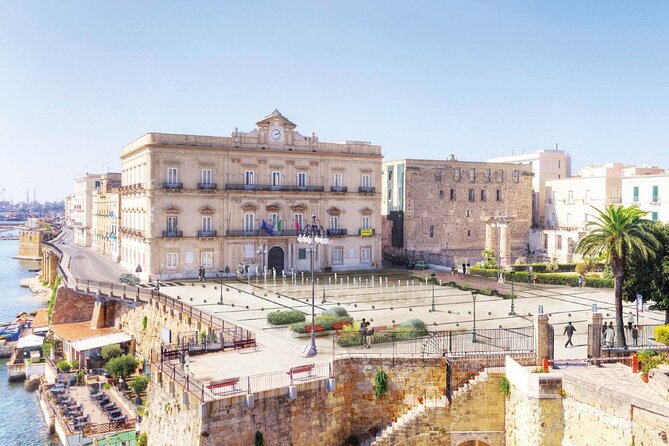
The starting point on Via Cavour places you in the Borgo area, east of the navigable canal. This is a sensible beginning because the museum represents the city’s serious archaeological side before the route shifts toward the Old Town.
The museum’s story is tied to Taranto’s nineteenth-century urban expansion. As new streets and buildings grew around the canal, the need to collect and protect archaeological finds became more important. Even if you only use the museum as your meeting point, knowing that background helps explain why Taranto has such a strong connection to its ancient past.
The digital guide is designed to work alongside a map. Direct links to Google Maps pins are especially useful here, since self-guided walks are only as good as their directions. You can listen to the explanation, read the text instead, or switch between both. The written material is described as detailed, while the audio keeps you from staring at your screen every few minutes.
Twenty minutes at the Monument to the Sailor
The first named stop is the Monumento al Marinaio d’Italia, or Monument to the Sailor of Taranto. It was inaugurated in 1974 and created by artist Vittorio Di Cobertaldo. The monument is one of Taranto’s recognizable modern symbols, and its setting reflects the city’s close relationship with the sea.
You get about twenty minutes here, which should be enough to look at the sculpture, hear its story, and take in the surrounding setting without turning this into a long stop. The guide adds meaning to what could otherwise be a quick photograph and a few seconds of inspection.
This is a good example of the route’s broad time span. Taranto is not presented only as an ancient Greek settlement. The modern monument reminds you that the city remains tied to naval life and its position between two bodies of water.
Aragonese Castle and Taranto’s sea defenses

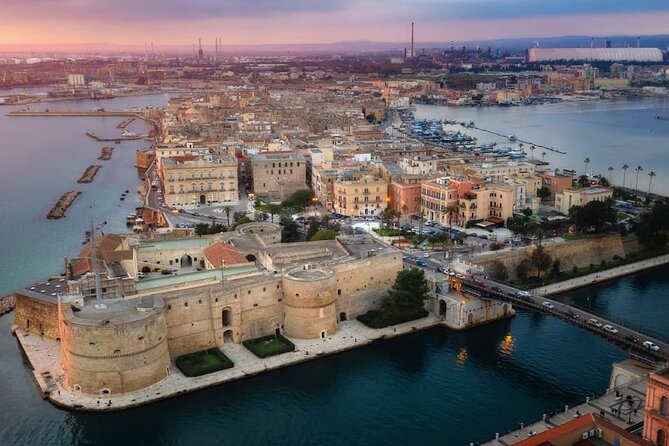
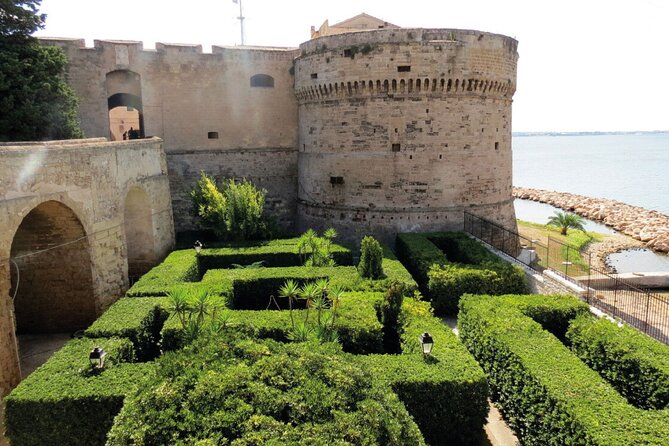
From the sailor monument, the route continues to Castello Aragonese, also called Castel Sant’Angelo. The castle sits at the end of the island that contains the ancient village, with the sea around its fortified position. Its quadrangular design and large central courtyard give it a solid, military character.
The suggested visit lasts thirty minutes. That is long enough for the audio guide to explain the castle’s role and for you to pay attention to its shape, walls, courtyard, and relationship to the water. The listing marks admission as free for this stop, though access arrangements can always change, so it is sensible to follow any current instructions at the site.
I like this stop because it changes your view of Taranto. The city’s past is not only found in museum cases or broken columns. It is also written into defensive architecture. The castle shows how control of the island and harbor mattered long after the Greek period.
Because this is a self-guided experience, you can take more time if the castle catches your interest. You can also keep moving if you prefer archaeology to military history. That freedom is one of the route’s clearest advantages over a fixed group schedule.
Same place, a different route to walk:
- Rome: Pantheon Fast-Track Ticket and Official Audioguide
★ 4.5 · 27,353 reviews - Rome: Colosseum & Forum with Audio Guide App -Optional Arena
★ 4.2 · 24,770 reviews - Florence: Timed Entry to Michelangelo’s David + Audio App
★ 4.6 · 19,496 reviews - Rome: City Sightseeing Hop-on Hop-off Bus with Audioguide
★ 4.0 · 16,045 reviews
Ten minutes with the Doric columns

In Piazza Castello, behind a fence, stand the remaining columns of the Doric Temple of Poseidon, dating from the sixth century BC. They are the only surviving trace of the temple described in the tour material, which makes this a small stop with real weight.
The planned visit is only ten minutes. That sounds brief, but the remains are limited, and the guide supplies the context you need to understand what you are seeing. Without an explanation, two ancient columns can be easy to overlook. With the story of the temple and its place in Taranto’s Greek past, the stop becomes more meaningful.
Do not expect a large archaeological site here. This is a compact urban remnant, viewed from behind a fence. Its value lies in the connection to the city’s earliest major period, not in the number of ruins on display.
Underground Taranto at the Spartan Museum
The Museo Ipogeo Spartano di Taranto is housed in the Bellacicco Hypogeum, previously known as the Hypogeum of Palazzo de Beaumont Bonelli. This underground space covers the history of Taranto from the Spartan era in the eighth century BC through the seventeenth century, when the noble palace above it was built.
The route gives this stop thirty minutes. That is enough time for the audio and written guide to explain how the underground setting relates to the buildings and periods above it. The site offers a useful bridge between ancient Taranto and the later city, rather than treating them as separate worlds.
I would pay close attention here to the change in setting. The castle and columns are open urban landmarks, while the hypogeum asks you to think below street level. The guide’s written text may be especially helpful if the underground rooms are difficult to interpret on sight.
Admission is listed as free for the stop, but the supplied information does not provide a separate opening schedule or explain whether access depends on a staff member being present. Since underground sites can have specific entry arrangements, check the conditions when you arrive.
San Cataldo, the oldest cathedral in Puglia

The Cathedral of San Cataldo sits in Taranto’s historic center. It was first dedicated to Mary Magdalene and later to San Cataldo, the holy bishop and patron saint of the city. It is identified as the oldest cathedral in Puglia.
The suggested time here is thirty minutes. That gives you room to consider the building’s long religious history and the way it belongs to the Old Town. The guide’s audio can be useful inside a church, where a few details may otherwise pass unnoticed. The written version is a good backup if the surroundings are quiet or if you prefer reading at your own pace.
This stop also gives the walk a slower, more reflective section. After the military character of the castle and the exposed remains of the Doric temple, the cathedral shifts attention to worship and civic identity.
The tour does not provide a detailed interior description or a current service schedule. Treat San Cataldo as a place of worship as well as a sightseeing stop, and follow any notices about access when you visit.
Finishing at the San Domenico cloister

The final stop is the Church of San Domenico, also known as San Pietro Imperiale, in the Old Town. Built in Romanesque-Gothic style and completed in 1360, the church is described as one of the architectural highlights of historic Taranto.
You get about twenty-five minutes here. The tour finishes at the Chiostro di San Domenico on Via Duomo, 33, so this is not just a passing point on the map. It is the place where the route ends and where you can pause before deciding what to do next.
The finish works well because the walk moves from the museum and modern Borgo area into the older island district, then ends with medieval architecture. You are left in the historic center rather than being taken back to the starting point. That is convenient if you plan to continue exploring on your own.
The stated operating window for the experience runs from March 10, 2024, through March 22, 2027, with hours shown from midnight to 11:30 p.m. daily. Those broad hours describe when the digital activity is available, not necessarily the opening hours of every church, museum, or underground site.
What the digital guide does well
The guide’s strongest feature is control. You can stop the audio, replay a section, read instead of listen, and move at your own speed. If you are interested in the castle but less interested in a short civic-building explanation, you can adjust your attention without holding up anyone else.
The route also includes advice on local restaurants serving authentic food, along with tips about monuments, history, and curiosities. That restaurant guidance adds value because the experience does not end with the final church. You get help deciding where to eat after the walk, although the supplied details do not name specific restaurants.
The app is described as easy to use, with direct links to possible tickets. That can save time when you want to check an attraction before walking there. Still, you should read the voucher carefully before arriving. The activation instructions are provided there, and you need an internet-connected smartphone.
Audio is available in English, Spanish, Italian, German, and French. The tour itself is offered in English, while the audio option gives multilingual flexibility. You can listen through your phone speaker, but your own headphones will make the experience more private and easier to hear in busy streets or public spaces.
Price, pace, and practical value
At $7.15 per person, this is a low-cost sightseeing tool rather than a full guided tour. The value is strongest if you want historical context, clear map links, and a planned route without paying for a private guide.
The price also makes sense for short visits. If you have only a few hours in Taranto, the route helps you cover several major sights without spending much time planning. Group discounts are available, though the exact reduction is not provided.
The maximum group size is listed as 104 people, but this is not a conventional escorted group experience. You use the guide independently, so the large maximum matters less than it would on a bus or walking tour with a live guide.
There are limits. You will not have a local person beside you to answer follow-up questions or point out something outside the planned route. The city’s condition may also feel uneven in places, and the guide cannot change what you see around the monuments. One assessment described Taranto as being in poor condition, so keep expectations realistic: the historical interest is strong, but not every street or building will look polished.
Most people can take part, and service animals are allowed. The route is near public transportation, which helps with reaching the starting point. No special physical requirements are listed, but this remains a city walking experience, so check the route for yourself if mobility is a concern.
Who should book this Taranto walk?
I would choose this experience if you like independent sightseeing but do not want to spend an hour building your own route. It suits visitors who enjoy history, archaeology, churches, and old urban districts, especially those who appreciate a written guide as much as spoken commentary.
It is also a good fit for budget-minded visitors. The low cost leaves room in your day for a museum ticket, lunch, or another attraction. Families and small groups may appreciate being able to pause whenever needed, though children who dislike historical explanations may find the route slow.
I would hesitate if you want a social experience or a live guide with local stories. The product is designed for self-guided exploration, not conversation. I would also hesitate if you do not have reliable phone access, since the digital guide needs an internet connection and must be activated through the voucher.
Should you book it?
Book it if you want an inexpensive, flexible introduction to Taranto that links ancient remains, a fortress, churches, an underground museum, and modern civic history. The best parts are the thoughtful route, the Google Maps links, the clear audio and written choices, and the very low price.
Skip it if you want personal guidance, guaranteed access to every interior, or a polished city setting at every stop. For the right visitor, this guide turns Taranto from a city of scattered sights into a walk with a clear shape and useful context.
Free cancellation is available if you cancel at least 24 hours before the experience start time. Changes or cancellations made later are not accepted for a refund.
FAQ
How long does the Taranto walking tour take?
The experience lasts approximately two to three hours. The listed stop times total about two hours and twenty-five minutes, before adding walking time between locations.
Where does the tour begin?
It begins at the National Archaeological Museum of Taranto, Via Cavour, 10, 74123 Taranto TA, Italy.
Where does the tour finish?
The route finishes at the Chiostro di San Domenico, Via Duomo, 33, 74123 Taranto TA, Italy.
Is the tour guided by a person?
No live guide is described. You explore independently using the digital written guide and audio guide.
What languages are available for the audio guide?
The audio guide is available in English, Spanish, Italian, German, and French.
Do I need a smartphone and internet connection?
Yes. You need a smartphone with an internet connection to use the digital guide. Activation details are provided in your booking voucher.
Are headphones included?
No. You can listen through your smartphone speaker or use your own headphones.
Can I cancel for a full refund?
Yes, if you cancel at least 24 hours before the experience start time. Cancellations made less than 24 hours before the start time are not refunded.
Just added around Italy
- Torino Walking Tour with Audio and Written Guide by a Local★ 4.5 · 35 reviews
- Medieval Canals and Fountains: A Treviso Self-Guided Audio Tour★ 4.5 · 4 reviews
- Trapani Walking Tour with Audio and Written Guide by a Local★ 4.0 · 8 reviews
- Trento Walking Tour with Audio and Written Guide★ 4.5 · 11 reviews
- Sicily: Selinunte Park Entry Ticket & Sicily Digital Audio Guide★ 4.5 · 4 reviews
- Taormina Walking Tour with Audio and Written Guide by a Local★ 4.5 · 41 reviews
- Siracusa Walking Tour with Audio and Written Guide by a Local★ 5.0 · 59 reviews
- Syracuse Scavenger Hunt & Highlights Self Guided Audio Tour★ 4.5 · 4 reviews
Walking Tours, compared.

City Monuments Guided Walking Tour with Audio Guide
Read our review →

Self Guided Classic Freedom Trail Location Aware (GPS) Walking Audio Tour
Read our review →
Self-Guided Historical Walking Tour (Audio Guide)
Read our review →
Cape Cod & Provincetown Self-Guided Driving & Walking Audio Tour
Read our review →
Verona Walking Tour with Audio and Written Guide by a Local
Read our review →
Royal Walking Tour and Buckingham Palace Audio Tour
Read our review →
Bologna Walking Tour with Audio and Written Guide
Read our review →Browse the lists this tour appears in