

REVIEW · ITALY AUDIO TOURS
Syracuse Scavenger Hunt & Highlights Self Guided Audio Tour
Ortigia turns history into a walking game. I like the freedom to start at any hour and the way the route links the Temple of Apollo, Diana Fountain, Syracuse Cathedral, and Arethusa Spring. I also like the low price of $9.46, which gives you a structured introduction to Syracuse without paying for a private guide. The main catch is that some puzzles may feel confusing, and the stated duration varies between about two and three hours.
This works best if you enjoy exploring at your own pace rather than following a guide with a flag. You use your phone, solve observation-based riddles, listen to short historical accounts, and stop whenever you wish. You should also note one practical inconsistency: the details describe a custom finish, while the meeting information says the activity ends back at the starting point. Check the app route before setting off.
Key points at a glance

- A 2.6-kilometre route through Ortigia: The walk connects major sights in Syracuse’s historic center without requiring entry tickets.
- Start any time, day or night: Your access is available 24 hours a day, and you can pause or resume as needed.
- Puzzles bring the sights into focus: You study monuments, fountains, statues, and streets to answer the next question.
- Audio and text information are included: Historical notes cover places such as Syracuse Cathedral and the mythical Arethusa Spring.
- A bargain for independent explorers: At $9.46 per person, the tour costs less than most guided city walks.
- Some questions need patience: The puzzles are meant to make you look closely, but unclear wording may frustrate you.
What kind of Syracuse experience is this?
This is not a traditional walking tour. No guide meets you at Chiesa di San Tommaso al Pantheon, and there is no fixed departure time. You download the World City Trail app, enter your 10-digit booking reference, select Create, and follow the route through your phone.
I see this as a useful middle ground between wandering alone and joining a scheduled group. You get GPS navigation, an audio guide, short pieces of historical information, and local suggestions for restaurants and shops. At the same time, you can linger at a fountain, stop for seafood, or take a break in the shade without holding up anyone else.
The advertised route covers about 2.6 kilometres. The basic walking time is roughly two hours, but the instructions also say the activity takes about three hours on average. That longer estimate makes sense if you pause for photos, food, shopping, or extra time at the sights.
The route is private to your group. That matters if you are traveling with family or friends and want to move at your own speed. You will not be joining a larger party or listening to a guide manage several different interests.
More Self-Guided Audio Tours in Italy
- Naples: Pompeii Self Guided Audio Tour
★ 3.9 · 211 reviews - Matera: Sassi di Matera Historical Self-Guided Audio Tour
★ 3.6 · 183 reviews - Self Guided Audio Tour-Coliseum & the Gladiator’s Legends
★ 3.5 · 49 reviews
Starting at Chiesa di San Tommaso al Pantheon

The suggested starting point is Chiesa di San Tommaso Apostolo, at Via Vincenzo Mirabella. The route information calls it the best place to begin, but you can technically start and finish elsewhere.
I recommend using the suggested starting point if this is your first time with the app. A planned beginning gives the walk a clear shape and reduces the chance that you will miss one of the stops. Since the tour is self-guided, your first task is not sightseeing. It is making sure the app is working before you leave.
Charge your phone fully and bring an active mobile data connection. The app requires internet access, and you are specifically advised to avoid city Wi-Fi and disable any VPN, since either can cause connection problems. You can listen through your phone speaker or use headphones.
The meeting information says the activity runs daily from midnight to 11:30 p.m. That gives you unusual freedom, though a daytime start will make it easier to see details used in the puzzles. You should also wear comfortable walking shoes and dress for the weather.
Temple of Apollo and the first puzzles
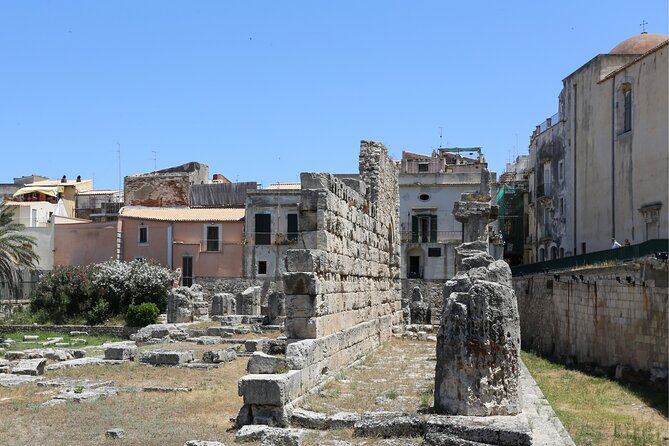
The Temple of Apollo is an excellent early stop because its remains immediately show how much older Syracuse is than the surrounding streets. The activity keeps you outdoors, so you do not need to buy an admission ticket or enter the attraction.
Here the puzzle format asks you to use observation and imagination. That means you are not simply standing in front of ruins while an audio track talks at you. You are looking for details that help answer the question and move on to the next stop.
This approach is appealing if you like a little purpose in your sightseeing. It can also slow you down in a good way. Without a question to answer, ancient stones can blur together. With one, you pay closer attention.
The tradeoff is clarity. One piece of feedback rated the experience three out of five because some questions were confusing. The provider’s response made clear that the puzzles are intended to be challenging, but there is still a difference between a clever riddle and a question that feels poorly worded. If you want direct explanations and quick answers, this format may test your patience.
Diana Fountain and Ortigia’s public spaces

The route continues to the Fontana di Diana, a central landmark associated with Ortigia’s public life. A fountain is also a good setting for this kind of activity because you can pause, look at the sculpture and surrounding buildings, and solve the clue without needing to enter a museum.
The app mixes navigation with short stories and facts. Its information is designed to be neither too long nor too thin, which is one of the strongest features of the experience. You get enough context to understand why a place matters, but you are not trapped listening to a lecture at every stop.
I like this balance for a first look at Syracuse. You can learn the basic story of the city while keeping your eyes on the streets. If a particular site catches your interest, you are free to spend more time there and continue later.
More Scavenger Hunts in Italy:
- Bolzano Scavenger Hunt and Highlights Self Guided Audio Tour
★ 4.5 · 12 reviews - Rimini Scavenger Hunt and Highlights Self Guided Audio Tour
★ 4.5 · 9 reviews - Siena Scavenger Hunt and Highlights Self Guided Audio Tour
★ 5.0 · 8 reviews - Bari Scavenger Hunt and Highlights Self Guided Audio Tour
★ 4.0 · 8 reviews
Castello Maniace and the freedom to pause

Castello Maniace gives the walk a change of mood. The route brings you toward one of Syracuse’s major defensive landmarks and the edge of Ortigia, where the setting opens up around the castle.
The tour does not require you to enter the castle. Its puzzles relate to outdoor areas, so there are no extra entrance costs built into the route. That keeps the price simple, but it also means this is an introduction to the site rather than a full castle visit.
This is where the flexible format becomes especially useful. You can stop to admire the views, take a break, and resume when you are ready. Access lasts for a full year, so you do not have to squeeze the activity into one afternoon. If rain, illness, or a change of plans gets in the way, you can use it on another day. The provider also says you can ask to switch the tour to a different city.
Foro Siracusano and the Archimedes statue

The Foro Siracusano and the Statua di Archimede add a different layer to the route. Instead of focusing only on ancient ruins and grand religious buildings, the walk also points you toward public spaces and a figure connected with Syracuse’s scientific past.
These stops help break up the route. The experience is not nine versions of the same archaeological explanation. You move between different types of sights, with puzzles encouraging you to notice what is around you.
I would not book this expecting a specialist lesson on Archimedes or a detailed archaeological study of the forum. The app provides short audio and text material, so the level is more suitable for orientation. That is also why the experience works well early in a stay. It helps you identify places you may want to revisit later.
Ortigia Market: the best place for a real break
The Mercato di Ortigia is one of the most practical stops because it gives you a natural chance to pause. The route suggests stopping for fresh seafood at the Old Market, along with exploring local shops and food stalls.
This is where the tour feels less like a checklist. You can use the activity to guide you through the old center, then take time for lunch or a snack instead of rushing from clue to clue. The app also includes hand-picked restaurant and shop suggestions, which may help if you want ideas beyond the most obvious places.
Keep in mind that food is not included. The market is an optional break, not part of the $9.46 price. I would budget extra time here if you enjoy local food, since the advertised walking duration does not account for a long meal.
Syracuse Cathedral and the Arethusa Spring
Syracuse Cathedral is one of the main highlights on the route. The building carries the layered character that makes Ortigia rewarding: the experience gives you historical context through the app while you examine the exterior and surrounding square.
The tour does not require you to pay to enter the cathedral. Its activity takes place outdoors, so you can complete the puzzle without adding an admission fee. If you want to go inside, that would be separate from the scavenger hunt.
The final stop, Fonte Aretusa, brings you to one of Syracuse’s most famous mythological places. The app connects the spring with the story of Arethusa and provides audio or text information to explain the legend.
This pairing of cathedral and spring shows the range of the route. You get architecture, mythology, public spaces, ancient remains, and local life in one compact walk. I find that mix more useful than a tour focused only on monuments.
What $9.46 buys you
At $9.46 per person, this is inexpensive for a city activity. The value comes from combining several services in one phone-based package: navigation, puzzles, audio commentary, historical notes, and local food and shopping tips.
A guided walking tour normally gives you a person who can answer questions and adapt the story to your interests. This tour does not. You are paying for flexibility and structure, not conversation or expert interpretation on the spot.
The price is strongest for couples, families, or small groups who want something more engaging than a map. Group discounts are also available, which can make the cost even more appealing for a larger party.
The low price should not lead you to expect museum-quality detail. The content is designed for a general introduction, and the appeal rests as much on the route and game as on the audio material. If you want a deep historical explanation of Syracuse, pair this with a museum visit or a live guide.
Languages, access, and support
The experience is offered in English, with the app also available in German, French, Dutch, Italian, and Spanish. That makes it practical for mixed-language groups, provided everyone is comfortable using the same app setup.
Most people can participate, and service animals are allowed. The route is near public transportation, though no specific transport directions are supplied. You should plan around your own arrival point and use the app’s GPS once you are in the area.
Support is available through the official World City Trail chat 24 hours a day. There is no phone support, so you need internet access to contact the provider. This is worth remembering before starting, especially if you are relying on a weak connection or an unfamiliar phone.
There is free cancellation if you cancel at least 24 hours before the scheduled start time. Cancellations or changes made within 24 hours are not accepted for a refund. Since the activity can be used at any time and remains valid for a year, booking early is less risky than with a fixed departure, but the deadline still matters.
The main strengths and weaknesses
The most praised part of the experience is its simple usefulness. It gives you a pleasant way to see several important sights while learning a manageable amount about each one. The information is short enough to keep the walk moving, and the puzzle format gives children and adults a reason to look closely.
I also value the lack of pressure. You can start early, late, or at any point in between. You can pause for food, skip a stop, change the order of places, and resume later. That is a much better fit for a relaxed visit than a tour that runs by the clock.
The weak point is the puzzle wording. You need to accept that some questions may require trial and error. The provider treats confusion as part of the game, but if you prefer precise clues, this may be the least enjoyable part.
There is also a small planning issue in the supplied details. One section says you can choose where to finish and that the activity does not finish at the starting location. Another says it ends back at the meeting point. I would check the route shown in the app before beginning, especially if you have a dinner reservation or train to catch.
Who should book this Syracuse walk?
I would recommend it to independent visitors who want a low-cost introduction to Ortigia and do not need a live guide. It suits couples, families, and friends who enjoy solving clues together and prefer to set their own pace.
It is also useful if you have limited time but want to cover several major sights. The 2.6-kilometre route is manageable, and the option to pause means you can fit in a market stop or a meal.
I would look elsewhere if you want detailed expert commentary, guaranteed clear questions, or a guide who can answer follow-up questions in person. This is a flexible sightseeing game with historical content, not a formal lecture or private archaeological tour.
Should you book it?
At $9.46, I think this is a good-value choice for a self-guided first look at Syracuse. The Temple of Apollo, Diana Fountain, Castello Maniace, Ortigia Market, cathedral, and Arethusa Spring give you a well-rounded route, while year-long access removes much of the usual time pressure.
Book it if you like independent exploring, phone-based navigation, and puzzles that make you study the sights. Skip it if confusing clues will spoil the day or if you want a human guide. Before starting, charge your phone, use mobile data, wear good shoes, and confirm the finish point in the app.
FAQ
Is the Syracuse scavenger hunt self-guided?
Yes. No guide meets you at the starting point. You use the World City Trail app for navigation, puzzles, audio information, and text content.
How long does the experience take?
The walk covers about 2.6 kilometres. It is described as taking about two hours, with an average activity time of roughly three hours when breaks and a relaxed pace are included.
Where should I start the tour?
The suggested starting point is Chiesa di San Tommaso Apostolo on Via Vincenzo Mirabella in Syracuse. You can technically start elsewhere, but the suggested point is intended to provide the best route.
Can I start at any time?
Yes. The activity is available every day from 12:00 a.m. to 11:30 p.m., and there is no fixed departure time.
Do I need to pay entrance fees?
No entrance fee is needed for the activity. The puzzles relate to outdoor areas, and you do not need to enter the attractions to complete the tour.
Which languages are available?
The app is available in English, German, French, Dutch, Italian, and Spanish. The tour is specifically listed as offered in English.
Do I need an internet connection?
Yes. You need a fully charged smartphone and active mobile data. You should disable any VPN and avoid city Wi-Fi because they may cause the app to disconnect or malfunction.
Can I pause or change the route?
Yes. You can pause and resume, change the order of places, or skip stops. Access remains valid for one year.
What happens if bad weather or illness prevents me from going?
You can take the tour on another day. The provider also says you can contact them to request a change to a different city. Free cancellation is available up to 24 hours before the experience start time.
Just added around Italy
- Taormina Walking Tour with Audio and Written Guide by a Local★ 4.5 · 41 reviews
- Taranto Walking Tour with Audio and Written Guide by a Local★ 5.0 · 5 reviews
- Siracusa Walking Tour with Audio and Written Guide by a Local★ 5.0 · 59 reviews
- Self driven private audioguided Amalfi Coast Vespa Tour★ 5.0 · 7 reviews
- Siena Scavenger Hunt and Highlights Self Guided Audio Tour★ 5.0 · 8 reviews
- Siena Walking Tour with Audio and Written Guide by a local★ 4.0 · 30 reviews
- Taormina: A Self-Guided Audio Tour of Sicily’s Hilltop Town★ 4.5 · 6 reviews
- Orgosolo Multilingual Audioguide★ 4.5 · 42 reviews
Scavenger Hunts, compared.

Bruges Scavenger Hunt and Highlights Self Guided Audio Tour
Read our review →
Strasbourg Scavenger Hunt and Highlights Self-Guided Audio Tour
Read our review →
Lille Scavenger Hunt and Highlights Self Guided Audio Tour
Read our review →
Lübeck Scavenger Hunt and Highlights Self Guided Audio Tour
Read our review →
Freiburg Scavenger Hunt and Highlights Self Guided Audio Tour
Read our review →
Colmar Scavenger Hunt and Highlights Self Guided Audio Tour
Read our review →
Cologne Scavenger Hunt and Highlights Self Guided Audio Tour
Read our review →
Aachen Scavenger Hunt and Highlights Self Guided Audio Tour
Read our review →Browse the lists this tour appears in