
REVIEW · UK AUDIO TOURS
Paisley History Walking Tour with Personal Audio
Paisley packs plenty into two hours. This walking tour links its abbey, civic buildings, old mills, cottages, and kilt-making tradition in one easy route, making it a useful introduction to a town many people pass on the way to Glasgow Airport. I like the small maximum of 15 people, and I like the personal audio headsets, which help you hear the guide without crowding around.
The tour is also a smart choice if you have spare time near Glasgow Airport, as one visitor used it as a short break between airport plans. The main consideration is pace: two hours gives you a broad introduction, not enough time for long visits inside every building. Lunch is not included, and the tour ends where it starts.
Why this Paisley walk is worth your time
- Paisley Abbey begins the story: See a 12th-century monastery linked with Scottish royalty and William Wallace.
- The audio headset keeps the commentary clear: You can hear the guide even while walking through streets and back lanes.
- Industrial Paisley gets proper attention: A red-brick thread mill and former weavers’ cottages show how cloth shaped the town.
- The route includes unusual social history: An Art Deco building connects Paisley with an important child welfare story.
- The group stays small: With no more than 15 people, the walk should feel more personal than a large city tour.
- Houston Kiltmakers adds a living craft tradition: The visit brings the story into the present with a Scottish business dating from 1909.
Starting at 2 County Place and Abbey Close
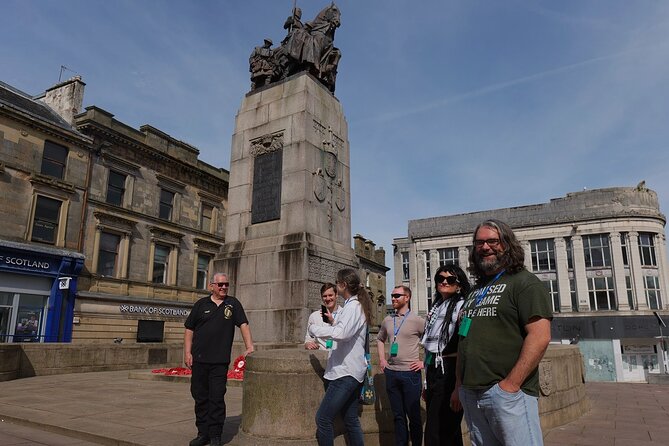
The tour begins at 2 County Pl, Paisley PA1 1BN, and returns to that same meeting point. That simple out-and-back arrangement helps if you are fitting the walk around transport, an airport connection, or another visit in town.
Paisley is close to Glasgow Airport, and the tour can work well as an outing when you have time to spare there. A short taxi or bus ride connects the airport area with Paisley, and luggage storage is available at the airport for a small fee. Since the walk itself lasts about two hours, leave extra time for transport and airport procedures rather than trying to squeeze it into a tight connection.
The tour is offered in English. Audio headsets are provided, which is a useful feature in a town walking tour. You do not need to stand directly beside the guide to catch every word, and the headset should help when the group spreads out at crossings or along wider streets.
The small group limit matters here. A maximum of 15 people gives the guide room to point out details without turning the walk into a procession. It also gives you a better chance to ask a question or pause briefly when a building deserves a closer look.
More Audio Walking Tours in the UK
- London: Royal Walking Tour and Buckingham Palace Audio Tour
★ 4.8 · 154 reviews - Buckingham Palace: Walking Tour with Entry & Audio Guide
★ 5.0 · 91 reviews - Stratford-Upon-Avon Audio Walking Tour: Shakespeare’s Life
★ 3.5 · 33 reviews
Paisley Abbey and the town’s medieval beginning
Paisley Abbey is the strongest opening point. This 12th-century monastery has links with Scottish royalty and William Wallace, giving the tour an immediate connection to national history rather than only local architecture.
You get about 15 minutes at the abbey, with free admission. That timing suggests a focused introduction rather than an extended architectural study. I would treat this part as a chance to understand why Paisley developed around this site and to take in the scale and age of the building before moving into the town streets.
The abbey also gives the walk a useful chronological shape. You begin with medieval Scotland, then move through civic, industrial, social, and cultural chapters. That is more satisfying than a route that simply points out attractive buildings without explaining how they fit together.
Do not expect the abbey stop alone to fill an afternoon. The value comes from the way it anchors the rest of the route. The later mills, cottages, and civic buildings make more sense after you have seen the older institution that helped define the town.
Victorian civic pride around Abbey Close
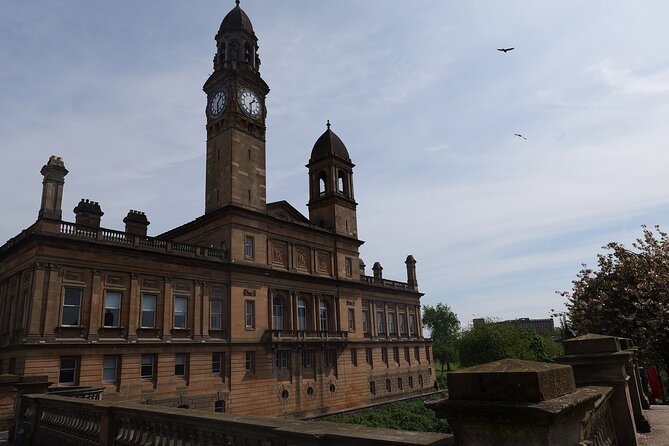
From the abbey, the route takes in a grand Victorian civic building overlooking Abbey Close. The supplied details do not identify the building by name, so the appeal here is the setting and the contrast with the medieval abbey.
This is a useful stop for understanding how Paisley presented itself in the Victorian period. The building’s scale should be read alongside the abbey’s older stonework: one reflects religious and medieval roots, while the other points to municipal confidence and the town’s later prosperity.
The stop is likely more about the guide’s explanation and the exterior than a long interior visit. That is typical of a compact walking tour, where the aim is to help you read the town rather than spend half the available time inside one attraction.
The audio system should be particularly useful here. Abbey Close is the kind of place where people may want to look up, take photographs, and listen at the same time. You can keep your attention on the building instead of pressing close to the guide.
Red brick, thread mills, and Paisley’s working past
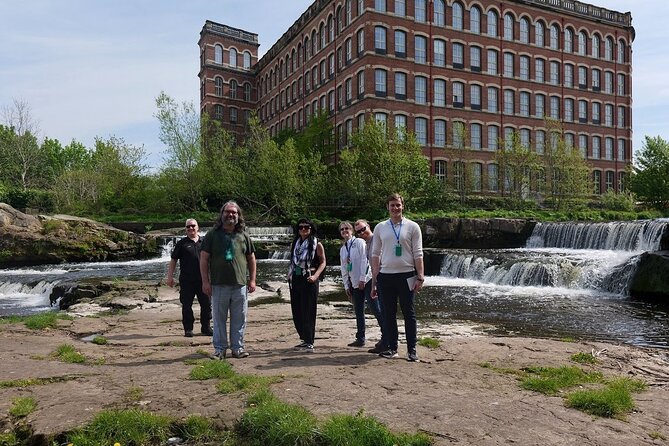
A striking red-brick former thread mill brings the industrial chapter into view. Paisley’s identity was shaped by textile production, and this stop gives the tour a physical reminder of the people and work behind that reputation.
The building’s color and scale make it easy to notice, but the important point is what it represents. A former mill turns the town’s textile story from an abstract fact into something you can see in the streets. The route is not limited to grand monuments. It includes the places connected with manufacturing and employment.
This is one of the reasons I find the tour more useful than a simple highlights walk. You get both the postcard subjects and the less polished structures that explain how the town functioned. The mill is not presented as a detached architectural curiosity. It is part of a larger story about thread, weaving, and Paisley’s working communities.
The drawback is that the experience does not promise a full mill tour or a detailed industrial museum visit. You see the building and hear its story while continuing through town. If your main interest is machinery or textile production, you may want a separate museum visit, but this walk gives you a strong starting point.
More History Audio Tours in the UK
- London: Natural History Museum Express Guided Tour & Audio Guide
★ 4.0 · 100 reviews - London: Natural History Museum Express Tour & Audio App
★ 3.6 · 60 reviews - Cirencester’s Tall Tales and Hidden History: A Self-Guided Audio Tour
★ 4.0 · 5 reviews - London’s Alternative History: A Self-Guided Audio Tour
★ 5.0 · 4 reviews
An Art Deco building with a serious story
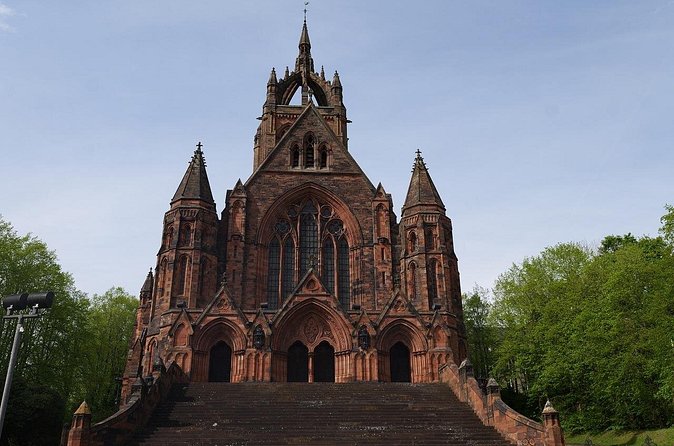
The route also pauses at a striking Art Deco building connected with child welfare. This is an unexpected change of mood after the abbey, civic architecture, and mill.
The building’s design may catch your eye first, but its backstory gives the stop real weight. Art Deco is often discussed through decoration, geometry, and style. Here, the building also carries a social history linked to the care and welfare of children.
That combination is valuable because it widens your picture of Paisley. The town is not only medieval religion and industrial success. Its streets also record changing ideas about public service, family life, and social responsibility.
You should expect a short explanation rather than a visit built around entering the building. The tour’s strength is the connection between visible architecture and stories you could easily miss while walking alone. Without the guide, this may simply look like an interesting facade.
Gothic lines and the town skyline
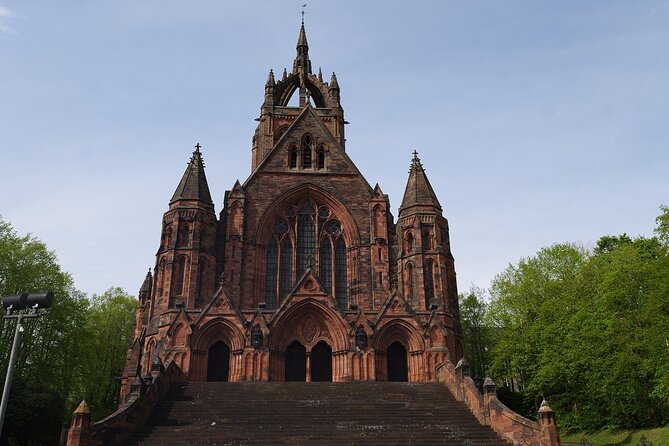
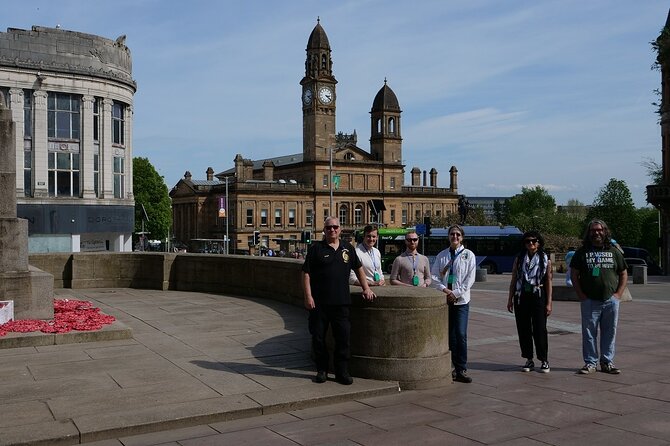
One stop focuses on Paisley’s Gothic-style skyline icon. The details provided do not name the building, but its role is clear: it is one of the town’s most recognizable vertical markers.
Gothic architecture can look familiar at first glance, especially in Scotland, so the guide’s context is important. You will get more from the stop if you listen for why this particular building matters to Paisley and how it contributes to the town’s profile.
This is another place where a headset earns its keep. You can look at the upper sections of the building while still following the explanation. A large group often creates a choice between seeing the architecture and hearing the guide. The small format should make that less of a problem.
The route’s repeated attention to exteriors means you should dress for an ordinary walking tour, not a museum visit. The focus is on streets, facades, views, and short stops. The tour is about seeing Paisley in context, so rain or poor weather could affect how much you enjoy lingering outside.
Weavers’ cottages and the Tannahill connection
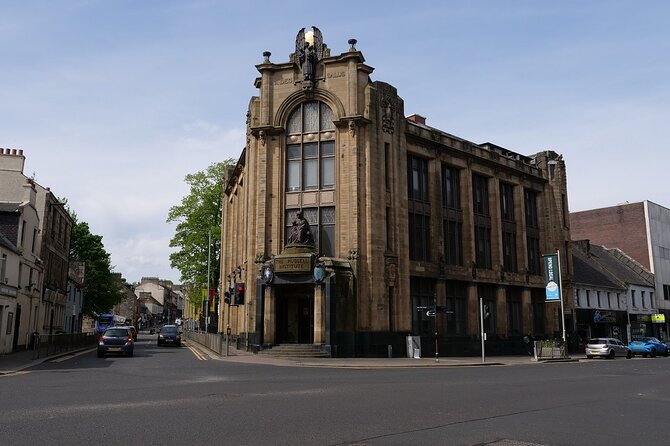
Preserved 18th-century weavers’ cottages provide one of the most human-scale moments on the route. After the large abbey, civic building, mill, and Gothic skyline, these cottages bring the story down to domestic life.
They help you picture the town as a place of homes and workshops, not only public buildings. The cottages connect directly with Paisley’s textile tradition, showing how weaving was tied to everyday neighborhoods as well as major industrial sites.
The walk also celebrates Robert Tannahill, Paisley’s weaver-poet. That is a pleasing local detail because it joins craft, literature, and place. Tannahill was not presented simply as a famous name from elsewhere. He belongs to the town’s own working and creative story.
I would pay close attention at this point if you enjoy personal stories more than architectural facts. The cottages and Tannahill stop give the tour a sense of individual lives behind the town’s larger history. They also help keep the walk from becoming a parade of buildings with dates attached.
Houston Kiltmakers and a living Scottish craft
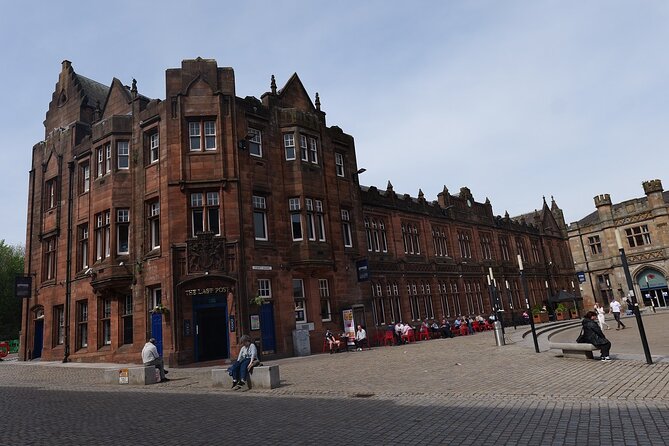
The final named stop is Houston Kiltmakers, one of Scotland’s oldest kilt makers, operating since 1909. The visit lasts about 15 minutes and admission is free.
This is a good way to finish. Instead of ending with a building from the past, the tour connects Paisley to a business and craft that are still part of Scotland’s public identity. Kilts can be treated as costume-shop souvenirs, but a long-running maker gives you a closer look at the skill and tradition behind them.
The stop also changes the rhythm of the walk. Much of the route asks you to look at architecture and imagine earlier periods. At Houston Kiltmakers, the subject becomes more immediate and practical. You can see how a traditional Scottish product fits into a modern town.
Do not expect a full workshop course or a long shopping session. The scheduled visit is about 15 minutes, so think of it as an introduction to the maker and its place in Scottish culture. It is a useful extra, particularly if you are interested in textiles, clothing, or Scottish craft.
What the $27.42 price actually buys you
At $27.42 per person, this is priced as an accessible short tour rather than a full-day attraction. The value depends on what you want from Paisley.
I think the price works well if you want a clear route and local context in two hours. You receive a guided walk, personal audio equipment, a small group setting, and free admission to the listed stops. You also avoid spending your limited time working out which streets and buildings matter.
The audio headset is not a flashy extra. It solves a real problem. A guide can speak at a normal volume instead of shouting, and you can look at the subject of the story while listening. That is especially helpful for visitors who do not know the town and might otherwise miss a detail on a side street.
The value is weaker if you already know Paisley well or prefer to explore at your own speed. The route has a fixed structure, and two hours leaves little room to stop for lunch or spend a long time inside one place. Lunch is not included, so plan to eat before or after the walk.
The excellent rating, 5 out of 5 from 30 reviews, and 100 percent recommendation rate support the idea that this is a well-received small experience. The strongest praise centers on the route through both main streets and backstreets, the amount of history packed into the walk, and the guide Hugh, who is specifically praised for making the outing worthwhile.
Who should book this Paisley walk?
I would recommend it to you if you have a few hours near Glasgow Airport and want something more substantial than waiting in a terminal. The airport connection makes Paisley practical for a short excursion, provided you allow a safe margin for transport and return.
It also suits first-time visitors who want an introduction before exploring on their own. The guide gives you a framework: medieval abbey, Victorian civic pride, textile work, child welfare, Gothic architecture, weaving, poetry, and kilt making.
History fans should enjoy the range. This is not one narrow subject tour. It moves across several centuries and includes religious, political, industrial, social, and cultural material.
The experience may be less suitable if you want a slow architectural photography walk, a meal included in the price, or long interior visits. The tour keeps moving, and some stops are brief. It is also less appealing to anyone who dislikes outdoor walking or listening through a headset.
Most people can participate, and service animals are allowed. Public transport is nearby. Confirmation is provided when you book, and the tour requires a minimum number of participants, so it can be canceled if that minimum is not reached. In that case, you are offered another date or experience, or a full refund.
Free cancellation is available up to 24 hours before the start time. If you cancel later, the amount paid is not refunded, and changes made inside that 24-hour window are not accepted.
Should you book the Paisley History Walking Tour?
Book it if you want a short, well-organized introduction to Paisley, especially during a Glasgow Airport stopover. The best reasons are the small group, clear audio, wide range of local stories, and the mix of major landmarks with less obvious places such as weavers’ cottages and the Art Deco child welfare building.
I would skip it only if you need a completely flexible schedule or want to spend most of your time inside attractions. For $27.42, this is a sensible way to turn two spare hours into a proper look at Paisley, not just a wait between buses or flights.
FAQ
How long does the Paisley History Walking Tour last?
The tour lasts approximately two hours.
Where does the tour begin?
It begins at 2 County Pl, Paisley PA1 1BN, UK.
Where does the tour end?
The walk returns to the meeting point at 2 County Place.
What language is the tour offered in?
The tour is offered in English.
Are audio headsets provided?
Yes. Personal audio headsets are included so you can hear the guide clearly.
What is the maximum group size?
The tour has a maximum of 15 participants.
Can I cancel for a full refund?
Yes. You can cancel at least 24 hours before the experience start time for a full refund. Changes or cancellations made less than 24 hours before the start time are not accepted for a refund.
Just added around the UK
- Stratford-upon-Avon: River Cruise and City Audio Tour★ 5.0 · 9 reviews
- Shakespeare’s Stratford-Upon-Avon: A Self-Guided Audio Tour★ 5.0 · 26 reviews
- Warwickshire & Stratford-Upon-Avon Self-Guided Audio Tours★ 5.0 · 6 reviews
- Rebels, Romance & Raisins St. Andrew’s Walking Audio Tour★ 5.0 · 2 reviews
- Stonehenge Private Immersive Audio Guide★ 4.5 · 15 reviews
- Oxford’s literary legends and landmarks: A Self-Guided Audio Tour★ 3.0 · 4 reviews
- A Guide to the City of Dreaming Spires: A Self-Guided Audio Tour of Oxford★ 5.0 · 2 reviews
- Discovering Cheltenham: A Self-Guided Audio Tour★ 4.5 · 23 reviews
Historical Tours, compared.

Colosseum, Roman Forum & Palatine Hill with Audioguide App
Read our review →
St. Mark Basilica Ticket, Audioguide+History Gallery
Read our review →
Colosseum, Ancient Rome Tour or AudioGuided Tour
Read our review →
Colosseum, Roman Forum & Palatine Hill Entry and Audioguide
Read our review →
Taormina: Ancient Theater Skip-the-Line Ticket & Audio Guide
Read our review →
Colosseum, Roman Forum & Palatine Hill Visit + Audio Guide
Read our review →
National Archaeological Museum Ticket & Audio Guide
Read our review →
Roman Forum Super Pass Entry with Audio Guide App
Read our review →Browse the lists this tour appears in