

REVIEW · GREECE AUDIO TOURS
Athens: National Archaeological Museum Ticket & Audio Guide
Ancient Greece feels surprisingly close here. The National Archaeological Museum ticket and smartphone audio guide give you an easy way to see major Greek works at your own pace, from the Mask of Agamemnon to bronze statues, Mycenaean gold, pottery, jewelry, and Roman portraits. I especially like the fast ticket redemption and the audio tour’s focus on major objects rather than every label in the building.
I also like that the audio content works offline and can be used before or after your visit. It is useful when you want context without joining a group. The main catch is that the guide skips some rooms, and its route can feel confusing in parts, so you should allow time to explore on your own after the narrated highlights.
The museum is large enough to fill two to four hours, yet a focused audio route can take about 90 minutes. At $31 per person, the value depends on how much you want convenience and explanation. If you already have a museum guide or prefer reading labels, the regular ticket may be enough.
Key Points Before You Book

- The Mask of Agamemnon is a headline stop: The famous gold funerary mask is one of the museum’s most recognizable objects.
- The bronze gallery is a major strength: Look for the Zeus or Poseidon figure and the celebrated horse-and-rider statue.
- The audio tour covers highlights, not every room: Plan extra time if you want to see the whole collection.
- Tickets help most when the booth queue is long: You still pass through security, but pre-purchased entry can get you to the ticket scan faster.
- Your phone does the work: Bring a charged Android or iPhone, plus your own headphones.
- The courtyard cafe is a useful pause: It offers a quiet break among greenery and art inside the museum complex.
Why This Athens Museum Deserves Time

The National Archaeological Museum is the place to go when you want more than one famous statue and a quick photo. Its collection follows Greek art across several periods, including Mycenaean, Bronze Age, Classical, Hellenistic, and Roman material. You will see objects connected to religion, burial, warfare, daily life, trade, and public art.
That range is both the museum’s strength and its challenge. A first visit can feel like too much information packed into one building. The audio guide helps by selecting major works and giving each one a story, but you should not mistake the short route for a complete museum visit.
I like the way the collection brings together small personal objects and huge sculptural works. Gold ornaments, tools, pottery, and jewelry show how people lived, while marble and bronze statues reveal how Greek artists pictured gods, athletes, rulers, and ordinary human movement.
The building itself also adds to the visit. It is described as light and airy, with broad exhibition rooms and a central courtyard cafe. On a hot day, air conditioning and a place to sit can make a real difference, especially after several rooms of statues and cases.
More History Audio Tours in Greece
- Delphi: Archaeological Site & Museum Ticket with Audio Tours
★ 4.3 · 721 reviews - Athens: National Archaeological Museum Ticket w/ Opt. Audio
★ 4.4 · 713 reviews - Athens: Ancient Agora E-Ticket and Audio Tour
★ 3.9 · 413 reviews
Getting Inside With the $31 Ticket
The ticket is sent by email, along with instructions for downloading the entry pass and audio content. You scan the ticket at the museum after passing through the required security check. The queue outside can look alarming, but some of that line is for security rather than ticket buying.
Buying ahead is most useful at busy times. Several people were able to walk directly to the entrance scan instead of waiting at the ticket booth. Still, this is not a promise of instant entry, since everyone must follow the museum’s security process.
The $31 price includes regular admission, the self-guided audio tour, offline text, narration, and maps. It does not include a live guide, transportation, food, drinks, a phone, or headphones.
There is one important price detail. The product provides a regular ticket for all ages. If you qualify for free or reduced-price admission, go directly to the museum ticket booth instead, since this ticket does not appear to apply those discounts.
The activity is non-refundable, so check your date and entry details carefully before paying. The available visit window can range from 45 minutes to four hours, depending on the option and your own pace.
The Mycenaean Galleries and the Mask of Agamemnon

Start with the earliest major displays covered by the audio route. The Mycenaean galleries contain some of the museum’s most famous objects, including gold funerary pieces and the Mask of Agamemnon.
The mask is the star for many first-time visitors, but it makes more sense when you see it alongside the other burial goods. Gold vessels, ornaments, weapons, and small crafted objects show the wealth and ceremony connected with elite burials. The audio narration gives you a reason to pause instead of simply walking past a case of gold.
The Mycenaean material can be especially satisfying if your picture of ancient Greece comes mostly from mythology. The objects connect those stories to a real Bronze Age society, though the museum cannot make every mystery disappear. Some displays require you to imagine their original setting and use.
A useful tip is to give this section more time than your first glance suggests. The most famous object may attract attention, but the surrounding pieces help explain what made the collection so important.
Bronze Statues That Still Feel Alive
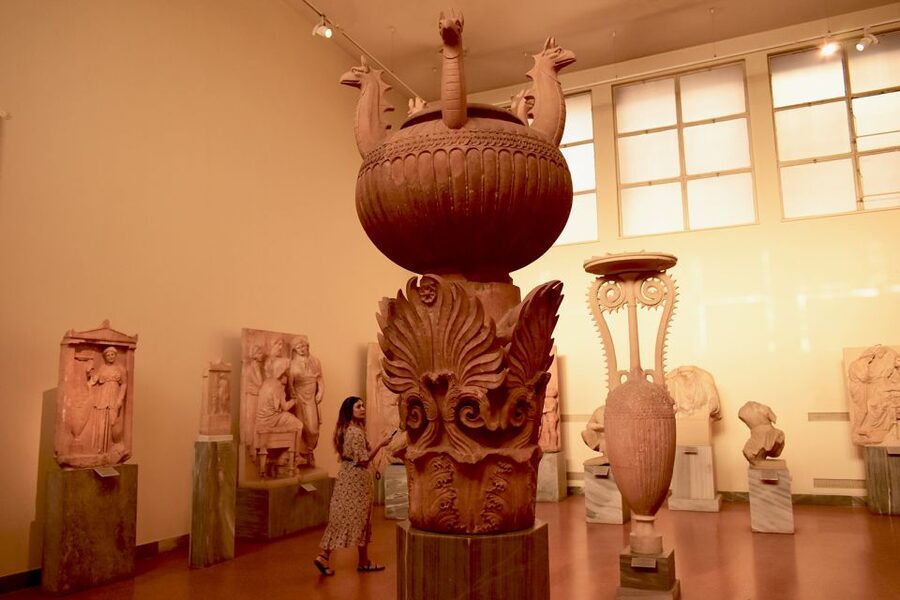
The bronze section is one of the strongest parts of the visit. Bronze was valuable and difficult to preserve, so surviving large figures are especially important. Here, the audio guide focuses on works such as the statue identified as Zeus or Poseidon and the horse rider.
The god statue is a fine example of why this museum is more than a collection of broken fragments. The figure has presence, balance, and movement. You may find yourself wondering whether the raised arm once held a thunderbolt or a trident. The audio commentary helps frame that question without turning the stop into a long lecture.
The horse-and-rider group gives the collection another kind of energy. Instead of an isolated ideal figure, you see a moment of action. Details in the horse, rider, and posture reward a slower look.
I would not rush through the bronze rooms. If you have limited time, put these works near the top of your list, along with the Mycenaean galleries and the most important marble sculptures.
More Museum Audio Tours in Greece
- Athens: Acropolis Museum Ticket with optional Audio Guide
★ 4.4 · 2,652 reviews - Parthenon & Acropolis Museum with Audio or Live Tour Option
★ 4.1 · 2,446 reviews - Athens: Acropolis Museum Ticket with Audio Guide
★ 4.1 · 835 reviews - Crete: Knossos Palace and Museum E-Tickets with Audio Guides
★ 4.0 · 828 reviews
Marble, Pottery, Jewelry, and Everyday Greece
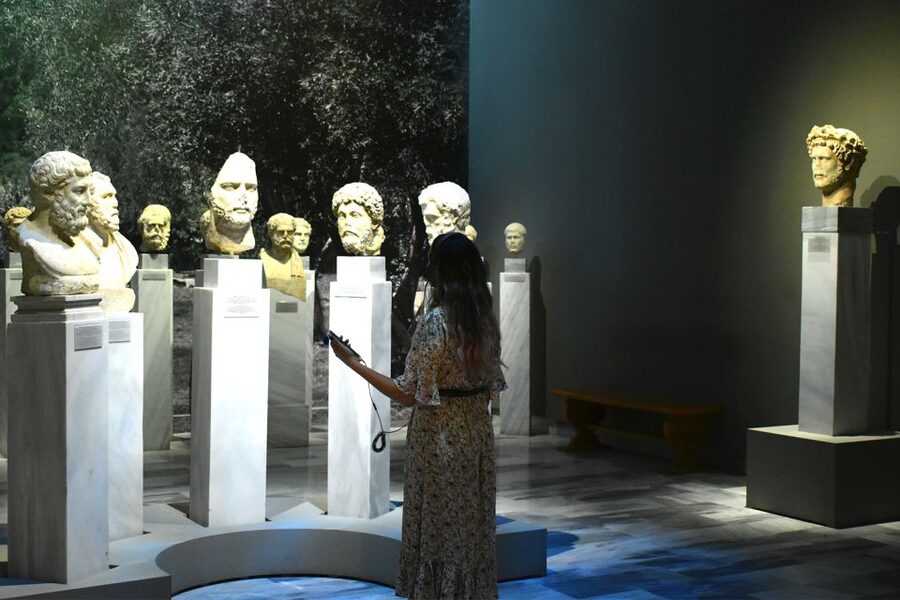
The audio tour cannot cover every room, and that is where your own wandering matters. After the main narrated stops, look for the pottery, tools, jewelry, and smaller objects that fill out the picture of Greek life.
Statues are the obvious attraction, but small objects often carry the clearest human detail. Jewelry shows taste and status. Tools suggest work and craft. Pottery can reveal scenes, habits, and beliefs through painted decoration.
The museum’s displays generally follow a historical line, though the route may not always feel obvious. Some areas can seem maze-like, especially if you are following the audio map while also stopping to read labels. Download everything before you enter, and keep the museum map available on your phone.
Written explanations appear in Greek and English in the areas described by the experience. You should still expect to use your own judgment about how much to read. Trying to read every label can turn a pleasant visit into a tiring one.
Roman Works and the Hadrian Connection

Greek art did not end with Classical Greece. Roman collections, including sculptures connected with Emperor Hadrian, show how Roman leaders admired and preserved Greek artistic models.
This section is valuable because it changes the usual story. Rome did not simply replace Greek culture. Roman patrons collected Greek works, copied Greek styles, and used Hellenic art to present their own ideals of education, power, and taste.
A temporary Hadrian exhibition has also been a highlight for some visits, but temporary displays can change. Treat it as a possible bonus rather than a guaranteed part of the ticket.
If you have a particular interest in Hadrian, allow extra time for Roman material. If your main goal is Bronze Age or Classical Greece, you can keep moving after the highlights without feeling that you have missed the core of the museum.
How the Audio Tour Works in Practice
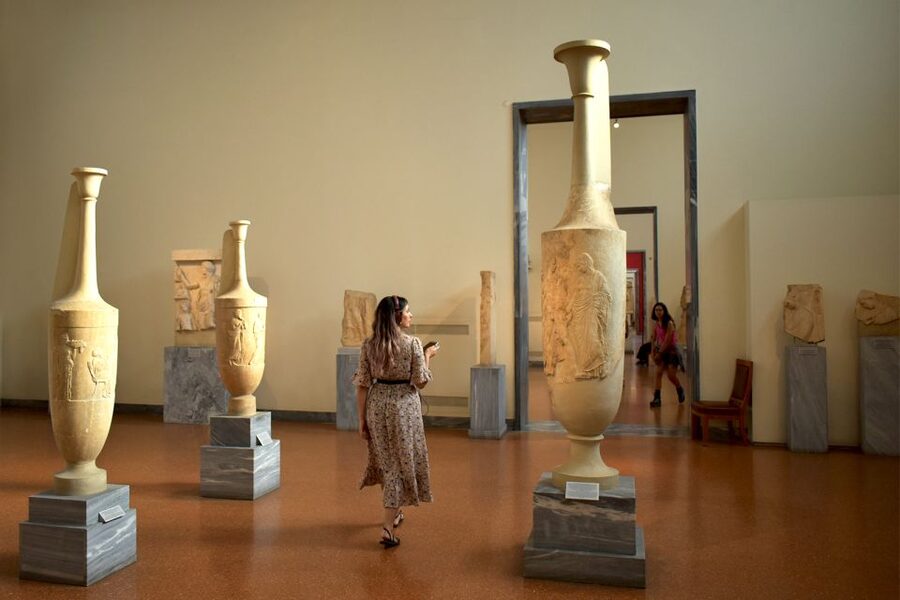
The self-guided narration is available in English, French, German, Greek, Italian, and Spanish. You download the content to an Android or iOS device, then use your own headphones while walking through the museum.
The best feature is control. You can pause, replay, stop for a closer look, or leave the audio and return later. Since the content works offline, you do not need to depend on the museum’s signal during the visit.
The narration is strongest when you want a quick explanation of a major object. It gives background, stories, and anecdotes in a format that is easier to follow than trying to absorb every wall panel.
The weakness is navigation. The audio route does not cover every exhibit, and some people have found the directions unclear in certain areas. I would treat it as a highlights tour rather than a complete guide to the building.
A practical plan is simple:
- Download the ticket, audio, text, and maps before leaving your hotel.
- Charge your phone fully.
- Bring headphones that fit comfortably.
- Follow the main audio route first.
- Return to skipped rooms afterward using the museum map.
- Pause the narration whenever an object deserves more time.
This approach gives you both structure and freedom. You get a clear starting point without allowing the phone to dictate your entire visit.
How Long Should You Stay?
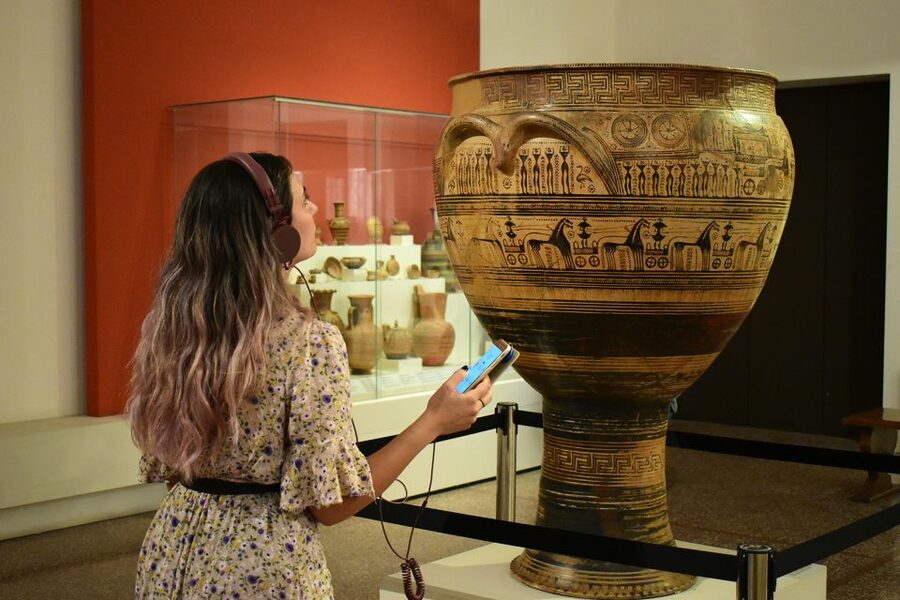
The advertised duration ranges from 45 minutes to four hours. In practice, 45 minutes is enough only for a very narrow visit. You can hear a few highlights, see the major attractions, and leave, but the museum deserves more.
Plan about 90 minutes if you want the principal audio stops at a comfortable pace. Allow two hours for a better first visit, especially if you want to read labels and pause at the bronze and Mycenaean displays.
Three hours is reasonable for anyone who enjoys archaeology or wants to cover more rooms without sprinting. A four-hour visit is possible for serious museum fans, though you may want a cafe break in the middle.
Some people find the collection less overwhelming after following the audio route, while others want to return to rooms the guide skipped. Both approaches work. The important thing is not to assume that the end of the audio track means the end of the museum.
Crowds, Security, and Comfort
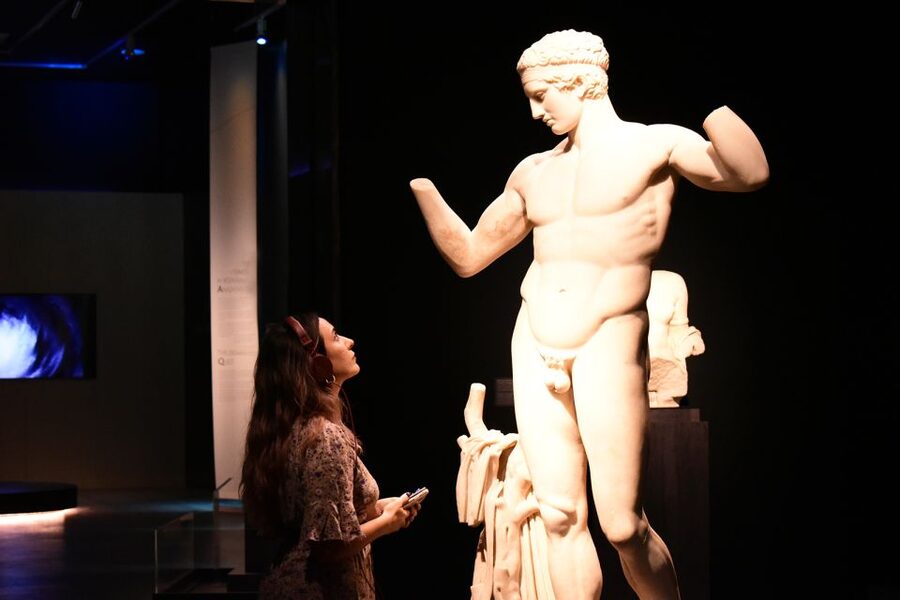
The museum can be busy, particularly around popular objects and the ticket entrance. Pre-booking is most useful when the ticket booth has a long queue, though the security line remains part of the process.
You can take photographs, but bags may need to be checked at the entrance for security purposes. Keep your visit simpler by carrying only what you need.
Wear comfortable clothes and shoes. The museum is large, and the floors and rooms can make a longer visit tiring. Air conditioning has been appreciated during hot weather, and the cafe provides a convenient place to rest.
The courtyard cafe is more than a quick coffee stop. It gives you a chance to sit among greenery and art without leaving the museum. If you are visiting with someone who needs a break before continuing, this can make a two or three hour visit much easier.
Pets are not allowed, apart from assistance dogs.
Who Should Choose This Experience?
I would recommend it to first-time Athens visitors who want structure but do not want a scheduled group. It also suits independent museum visitors who prefer to stop, replay, and move on when they choose.
It is a good match for:
- People interested in Greek mythology and archaeology
- Visitors who want the major objects explained in plain language
- Cruise passengers or short-stay visitors who need a focused route
- Anyone uncomfortable reading every museum panel
- Families or couples who want to explore at different speeds
- Repeat visitors who want a quick route through the best-known works
It is less suitable if you want a live guide who can answer questions immediately. It is also not ideal if you rely on Windows phones, an older iPhone, an older iPod Touch, or older iPad models listed in the booking information.
If you already own a trusted audio guide, compare what you have before paying. One person had already downloaded another guide and did not use this one. The museum’s own audio arrangements may also differ, so check what is included at the time of your visit.
Is the $31 Cost Worth It?
The regular ticket alone is the simplest choice for confident museum visitors who enjoy reading and finding their own route. The extra cost of this option buys convenience, offline content, and a selected narrative path.
I think it offers fair value when the ticket booth is busy and you want help identifying the important works. The audio guide can save you from spending the first hour wondering where to begin.
The value drops if you qualify for reduced admission, already have an audio guide, or plan to stay only briefly. It also drops if you expect coverage of every room, since the narration is designed around highlights.
At $31, I would choose it for a first visit with two or more hours available. For a quick stop, buy the least expensive valid admission option you can find and focus on the bronze statues, Mask of Agamemnon, and Mycenaean displays.
Should You Book It?
Book this experience if you want an easy entry ticket and a flexible audio route through Athens’ most important archaeological museum. The strongest parts are the major bronze works, Mycenaean gold, famous mask, and the freedom to explore after the narration ends.
Skip it if you need a live guide, qualify for free or reduced admission, or already have a museum audio tour you trust. For everyone else, download the material early, arrive with a full phone battery, and allow at least two hours. That gives you enough time for the famous pieces, the quieter cases, and a well-earned pause at the courtyard cafe.
FAQ
What does the National Archaeological Museum ticket include?
It includes regular museum admission, a self-guided audio tour for Android or iOS, offline text, audio narration, maps, and free time to explore.
Is there a live guide?
No. This is a self-guided smartphone audio tour and does not include a live guide.
Which languages are available for the audio tour?
The audio guide is available in English, French, German, Greek, Italian, and Spanish.
Do I need to bring my own phone?
Yes. You need a charged Android or iOS smartphone that is compatible with the audio tour.
Do I need headphones?
Yes. Headphones are listed as something to bring, and the experience does not provide them.
Does the audio tour cover the entire museum?
No. It focuses on selected highlights and skips some rooms, so you should allow extra time to explore independently.
How long should I allow for the visit?
The available duration ranges from 45 minutes to four hours. About 90 minutes works for the main audio route, while two to four hours is better if you want to explore more of the collection.
Can I use the audio tour offline?
Yes. Offline content includes the text, audio narration, and maps.
Can I buy this ticket if I qualify for free or reduced admission?
No. This product includes only a regular ticket for all ages. If you qualify for free or reduced-price entry, go directly to the museum ticket booth.
Just added around Greece
- E-Ticket to Akrotiri with Audio Tour on your Phone★ 5.0 · 2 reviews
- Authentic Santorini: A Self-Guided Audio Tour of Oia★ 4.5 · 3 reviews
- The Palace of the Grand Master E-Ticket with Audio Tour★ 4.0 · 9 reviews
- The Palace of the Grand Master. Self-guided Audio Tour★ 3.5 · 15 reviews
- Acropolis of Lindos E-Ticket with Audio Tour on your Phone★ 4.5 · 8 reviews
- Explore Lindos Acropolis in 3D & Audio★ 4.0 · 4 reviews
- Olympia Archaeological Site & Museum E-Ticket with Audio Tour★ 4.0 · 11 reviews
- Mykonos: Find your (queer) god Self-Guided Audio Tour★ 4.0 · 2 reviews
Museums, compared.

Uffizi Priority Ticket & Masterpieces Audio App
Read our review →
Louvre Museum Hosted Entry and Mona Lisa Audioguide
Read our review →
St. Mark Basilica Ticket, Audioguide+History Gallery
Read our review →
Borghese Gallery Skip-the-Line Ticket & Audioguide
Read our review →
Borghese Gallery Ticket + Audioguide or Guided Tour
Read our review →
Orsay Museum Entry Ticket and Digital Audio Guide App
Read our review →
Uffizi Gallery Timed Entry Ticket & Audio Guide
Read our review →
Acropolis Museum Ticket with optional Audio Guide
Read our review →Browse the lists this tour appears in