
REVIEW · LONDON AUDIO TOURS
London’s Alternative History: A Self-Guided Audio Tour
London gets more interesting when you look past the grand monuments. This self-guided walk turns a short route from Covent Garden to the Savoy into a string of strange stories, theatrical legends, old lawsuits, and overlooked city details. I like the GPS-guided narration, which tells you where to turn and what to look at without requiring a live guide. I also like the freedom to pause, wander, and return later with lifetime access. The main drawback is that this is an audio walk, not a full sightseeing tour, so entrance fees, food, transport, and your smartphone are all up to you.
At about one to one and a half hours, the route works well when you have a spare morning or afternoon in central London. It covers several major sights, but its real appeal is the odd detail: a church tied to London’s first recorded punch-up, a theatre ghost, a gas lamp fed by sewer gas, and a bridge built largely by women during World War II. The narration is in English only, and the tour is best for independent walkers who prefer setting their own pace.
Key points to know before you go
- Start at Covent Garden: The Piazza is the meeting point, and the walk ends near the Savoy on the Strand.
- Follow London’s stranger stories: Expect theatre ghosts, legal oddities, old postal connections, and unusual engineering facts.
- Use the GPS audio carefully: The VoiceMap app provides directions, maps, audio, and geodata for offline use.
- Plan for extra time: The advertised route takes about one hour to one and a half hours, but pauses, photos, and conversation can lengthen it.
- Pay once for repeat use: Lifetime access lets you revisit the route instead of treating it as a one-time activity.
- Bring your own phone: A smartphone is not included, and neither are meals, transport, or admission tickets.
Why this short walk has more character than a standard sightseeing route
This is not a tour built around a long list of royal residences and famous statues. It uses well-known central London sights as markers, then adds details you could easily miss while hurrying between them.
That approach gives the walk a useful balance. You still tick off Covent Garden, Somerset House, Waterloo Bridge, and the Savoy. But the commentary points you toward the less polished side of the city, including fights, ghosts, sewer gas, court cases, and the practical problems of lighting and river construction.
I especially like the format for a first visit when you want some structure but do not want to spend half a day in a group. The route is private by default because only your own group takes part. You can stop the recording when somebody wants a coffee, take a photo, or spend longer looking at a building.
The audio is one of the strongest parts. It is designed to tell you when to turn and where to look, which matters in central London, where a wrong turn can quickly put you on a busy street or send you several blocks away. One particularly useful detail from the feedback is that the narration was praised for being soothing and easy to follow. That makes a difference when you are walking and listening at the same time.
More History Audio Tours in the UK
- London: Natural History Museum Express Guided Tour & Audio Guide
★ 4.0 · 100 reviews - London: Natural History Museum Express Tour & Audio App
★ 3.6 · 60 reviews - Paisley History Walking Tour with Personal Audio
★ 5.0 · 30 reviews
Covent Garden and the church where actors are remembered
The walk begins at The Piazza, at 1 to 7 Covent Garden. This is a sensible starting point because the area gives you an immediate sense of London’s layered past. The market name comes from Convent Garden, a reference to the medieval convent garden that once occupied this part of the city.
The market itself is a major attraction, so allow a little time to get oriented before pressing play. The route is not simply about shopping or street entertainment. It uses Covent Garden to explain how a working religious space became one of central London’s best-known public areas.
The next stop is the church known as the Actors’ Church. Many famous actors have been memorialized there, and the church is tied to London’s first recorded punch-up. That small detail sets the tone for the rest of the walk. You are not only hearing about grand events. You are getting the odd, human stories that make old buildings easier to remember.
You may find this stop especially appealing if you enjoy theatre history. It also offers a quieter contrast to the market outside. Since the audio tour does not include entrance fees, check any opening arrangements yourself if you want to go inside.
Theatre ghosts and the oldest theatre site
The route then turns toward one of London’s oldest theatre sites. The location has hosted performances for generations and is linked with ghost stories, including the famous Man in Grey.
The audio commentary gives this section a different mood from the Covent Garden stops. Instead of concentrating on architecture alone, it uses performance, superstition, and backstage tradition to show how theatres become part of a city’s folklore. You do not need to be a serious theatre fan to enjoy it. The ghost story gives the stop a clear hook, while the theatre setting keeps the walk tied to London’s entertainment district.
The route also includes the Lyceum Theatre, known today for productions including The Lion King. Its connection to the early use of electricity for theatre lighting adds a practical piece of technology to the cultural story.
That pairing works well. One stop deals with apparitions and old theatre legends. Another shows how new lighting changed the way audiences saw a performance. I like that contrast because it keeps the walk from becoming a string of similar anecdotes.
Do not expect a backstage visit or a ticketed performance. You are learning from the outside and from the audio commentary, so this section is best viewed as a street-level introduction rather than a theatre tour.
London’s legal oddities and the route toward Somerset House
Another stop focuses on intriguing cases and famous trials. The point is not to provide a full legal history of London. Instead, the commentary looks at the quirky side of the courts and the unusual situations that have passed through them.
This is a good change of subject after the theatres. London’s legal buildings can look formal and severe, but their cases often involve strange details, strong personalities, and everyday behavior. The stop helps you see that the city’s past was not only shaped by kings, wars, and major political events.
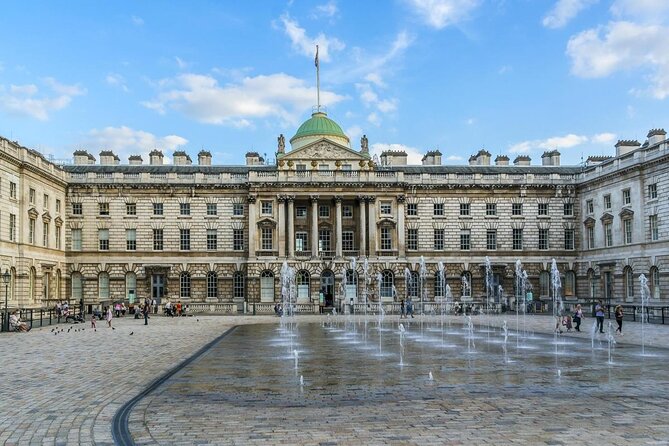
From there, the walk reaches Somerset House. This grand building has changed purpose over time, moving from a Tudor palace to a Navy office. It also connects with the development of the British postal system.
Somerset House is one of the route’s most useful sightseeing stops because it brings several centuries together in one place. You can look at the exterior and hear how a building can be reused as the city’s needs change. If you visited Somerset House on another occasion, the audio gives you a different way to read it, focusing on its former functions rather than only its present cultural role.
Admission to any attraction is not included. The route is designed to be enjoyed while walking past these places, so you do not need to buy a ticket to complete it.
More Self-Guided Audio Tours in London
- Kew Gardens, Richmond – Self-Guided Audio Tour
★ 4.5 · 30 reviews - London Walks – 12 Self-Guided Audio Walking Tours
★ 4.0 · 17 reviews - Britpop Camden: A Self-Guided Audio Tour in London
★ 5.0 · 8 reviews - Self-Guided Audio Tour – Shakespearean London
★ 3.0 · 7 reviews
Victoria Embankment and the river beneath your feet
The route continues along the riverside promenade at Victoria Embankment. The story here concerns the construction of the embankment, including the diversion of the River Thames and the hidden river secrets revealed during the work.
This is one of the places where the physical setting matters most. You are walking beside the river while hearing how the riverfront was reshaped. The promenade may look settled and permanent today, but the commentary reminds you that this stretch of London required major engineering.
The riverside section also gives you a chance to slow down. The route is short enough to finish in an hour, but you should not feel pressured to keep moving. Stop for a view, pause the audio, or take a break if the weather is pleasant.
One practical note: riverside walking can feel very different depending on the conditions, and the tour does not provide transport. You are responsible for getting to Covent Garden and away from the Savoy at the end.
Waterloo Bridge, built by women during World War II
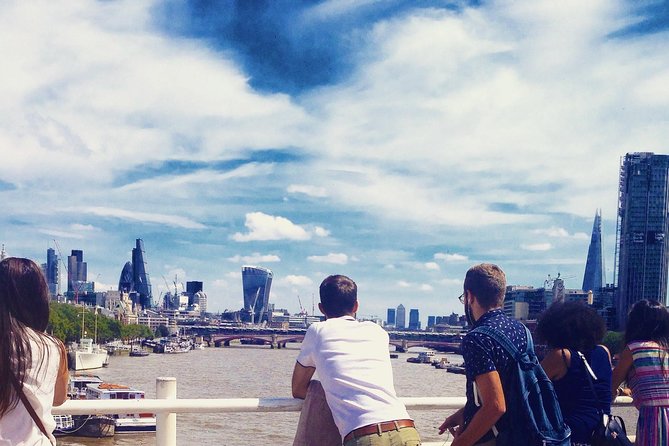
Waterloo Bridge is known as the Ladies’ Bridge because women carried out much of the construction work during World War II. The bridge also provides spectacular views of London.
This stop combines a social story with one of the route’s best viewpoints. The bridge is not just a place to cross the river. It gives you a clear sense of how wartime labor changed the workforce, while the views help you connect the route’s separate districts.
I would treat this as a natural photo stop. The audio can continue in the background, but you may want to pause while taking in the view. You can also use this point to judge how quickly you are moving. If you have already spent time at Covent Garden or Somerset House, the tour may take longer than the one-hour estimate.
The bridge section is also a reminder that the walk includes open public spaces, not only historic buildings. That makes it feel less like a museum visit and more like a guided look at the city as you move through it.
A sewer-gas lamp and London’s practical inventions
Near the end of the route, you encounter London’s last remaining Victorian gas lamp. It was powered by sewer gas, which earned it the nickname The Lamp that Lights Itself.
This is exactly the sort of detail that makes the tour different from a basic highlights walk. The lamp is small, easy to miss, and tied to the city’s old systems rather than its grand public image. The story shows the practical, sometimes odd solutions London used to light its streets.
You should not expect a major monument here. That is part of the appeal. Keep your eyes open and follow the audio closely, since the location-based commentary is doing more work at this stop than a large sign or obvious entrance would do.
The lamp also fits the tour’s larger theme of technology. Earlier, the Lyceum introduced electric theatre lighting. Here, you hear about sewer gas used for street lighting. The two stops show very different stages in London’s effort to control and use artificial light.
Finishing at the Savoy and the birth of electric luxury
The walk ends at the Savoy on the Strand. The building is known as the first public building in the world to be lit entirely by electricity. It also has a past connected with luxurious visitors and infamous parties.
That gives the tour a fitting finish. You begin with a former convent garden and end with a building linked to modern electric comfort and high society. Along the way, the route moves through theatres, legal buildings, river engineering, bridges, and street lighting.
The Savoy stop is also practical because it places you near central London transport links and other attractions. The listed endpoint is The SavoyStrand, London WC2R 0EZ. You can finish the audio there, then make your own plans instead of being tied to a group departure.
The route does not include drinks, food, or entry to the Savoy or other attractions. Think of the building as the endpoint of the story, not as part of a hotel visit.
How the VoiceMap format works in real use
The tour uses the VoiceMap application and includes offline access to the audio, maps, and geodata. Downloading the material before you set out is a wise step, particularly if you do not want to rely on a mobile signal or use data while walking.
GPS tagging means the commentary is linked to each location. The app can tell you where to go, when to turn, and what to look toward. That guidance is particularly useful for anyone who finds ordinary map directions frustrating.
You get lifetime access rather than a single-use recording. That matters because London is full of places where you may want a second look. You could complete the route quickly on one day, then return later to spend more time at Covent Garden, Somerset House, the river, or the theatres.
The experience is offered in English. You need to bring your own smartphone, and the tour does not provide transport. Service animals are allowed, and most people can take part, but you should still expect a walking route with outdoor sections and periods of standing.
Is $9.99 a fair price?
At $9.99 per person, the tour is inexpensive by London sightseeing standards. You are paying for a guided route, professionally organized audio, navigation, offline maps, and lifetime access rather than for admission to a museum or a live performance.
The value is strongest if you want a private experience. A group of friends or family members can listen together without paying for a private guide by the hour. You also avoid the fixed pace of a scheduled walking group.
The price is less attractive if you want access inside every major building. Tickets, meals, drinks, and transportation are not included, so you should treat the $9.99 as the cost of the audio walk itself.
For me, the repeat access improves the deal. You can pause freely, split the route across more than one outing, or use it again if you are showing London to somebody else.
Who should choose this self-guided walk?
I would recommend it to independent visitors who like history in small, memorable pieces. It suits people with a spare hour or two, couples who want to walk at their own speed, and families or friends who prefer private conversation over a formal group.
It is also useful for repeat visits to London. The main sights may be familiar, but the unusual facts give you a reason to see them again.
You may want a different option if you prefer a live guide, a longer historical explanation, or interior visits. The route is compact and selective. It gives you a series of strong stories, not an exhaustive account of every building along the way.
The feedback is especially positive about the pacing and ease of use. The narration was described as soothing and clear, and the directions helped someone who normally struggles with map apps. Another person took longer than the suggested time, pausing to chat and walk slowly, which is exactly how the tour is meant to work.
Should you book London’s Alternative History?
Book it if you want a low-cost, flexible walk that adds odd and memorable details to central London’s main sights. The combination of theatre ghosts, the Actors’ Church, Somerset House, Waterloo Bridge, the sewer-gas lamp, and the electric Savoy gives the route a strong sense of variety.
Skip it if you need a live historian or included admission tickets. Otherwise, the $9.99 price, private format, offline access, and lifetime use make this a practical choice for a free afternoon in London. Just download the app, bring your phone, start at Covent Garden, and leave room for pauses.
FAQ
Where does the tour start?
It starts at The Piazza, 1 to 7 Covent Garden, London WC2E 8HD, United Kingdom.
Where does the tour end?
The route ends at The SavoyStrand, London WC2R 0EZ, United Kingdom.
How long does the walk take?
The estimated duration is about one hour to one and a half hours.
What language is the audio tour offered in?
The tour is offered in English.
Is this a guided group tour?
No. It is a private self-guided activity, so only your own group participates.
What application is used for the tour?
The tour uses the VoiceMap application.
Can I use the tour offline?
Yes. Offline access to the audio, maps, and geodata is included.
Are tickets and food included?
No. Food, drinks, transportation, and tickets or entrance fees for museums and other attractions are not included.
Can I cancel for a full refund?
Yes, if you cancel at least 24 hours before the experience start time. Cancellations made less than 24 hours in advance are not refunded, and changes within 24 hours are not accepted.
More History Audio Tours in London
- Colosseum, Roman Forum & Palatine Hill with Audioguide App
★ 4.4 · 6,291 reviews - Venice: St. Mark Basilica Ticket, Audioguide+History Gallery
★ 3.9 · 4,780 reviews - Rome: Colosseum, Ancient Rome Tour or AudioGuided Tour
★ 4.4 · 2,879 reviews - Colosseum, Roman Forum & Palatine Hill Entry and Audioguide
★ 4.1 · 2,475 reviews
More Self-Guided Audio Tours in the UK
- Southbank Immersive Self-Guided Audio Walking Tour
★ 5.0 · 6 reviews - Medieval London: A Self-Guided Audio Tour from Monument to the Tower of London
★ 4.0 · 5 reviews - Westminster Famous Sites Self-Guided Audio Walking Tour
★ 3.5 · 4 reviews - Londinium’s Footprint: Explore London’s Roman wall on a self-guided audio tour
★ 5.0 · 3 reviews
Just added around London
- Westminster Famous Sites Self-Guided Audio Walking Tour★ 3.5 · 4 reviews
- Wicked Whitechapel: Where Now’s Jack The Ripper Audio Tour★ 5.0 · 2 reviews
- Southbank Immersive Self-Guided Audio Walking Tour★ 5.0 · 6 reviews
- Self-Guided Audio Tour-Behind the shadow of evil: Jack the Ripper★ 4.0 · 2 reviews
- Tower of London Ticket with Audio Guide and Unlimited Entry Time★ 5.0 · 15 reviews
- Medieval London: A Self-Guided Audio Tour from Monument to the Tower of London★ 4.0 · 5 reviews
- Harry Potter London Tour with Audioguide on Smartphone★ 5.0 · 3 reviews
- London Public Buses Audio Tour★ 4.0 · 7 reviews
Self-Guided Tours, compared.

Acropolis Ticket & Optional Self-Guided Audio Tours
Read our review →


Ultimate Acadia National Park Self-Guided Driving Audio Tour
Read our review →

Santorini: Akrotiri Ticket with Optional Self-Guided Audios
Read our review →
Browse the lists this tour appears in