

REVIEW · POMPEII AUDIO TOURS
Pompeii Archaeological Park Skip-the-line Entry and Audio Guide
Pompeii rewards a slow, curious walk. This self-guided visit gives you reserved entry and a smartphone audio guide covering more than 130 points of interest, so you can explore temples, villas, mosaics, and streets at your own pace. I like the freedom to pause whenever a site catches your eye, and I like that the commentary is available in five languages.
The main drawback is the digital navigation. The map and audio points can be hard to match up, especially when you are standing among dozens of ancient streets and buildings. You must also bring your own phone and headphones, and the ticket does not cover the suburban villas, including Villa dei Misteri.
Key points to know before you go

- More than 130 audio stops: The digital guide covers major monuments as well as smaller details across Pompeii.
- Reserved entry at Piazza Esedra: You exchange your voucher for the required entry ticket at the info point in front of Hotel Vittoria.
- A full ancient city, not a quick ruin: Pompeii covers 44 square hectares, and most people spend two to four hours inside.
- Good landmarks for a first visit: The route includes the Forum, the temples of Venus, Apollo, and Jupiter, and the House of the Faun.
- Bring your own listening kit: A mobile device and headphones are not included.
- Villa dei Misteri costs extra: Access to the suburban villas requires an additional €8.
What this Pompeii experience actually gives you

At $35.32 per person, this experience combines a reserved entrance ticket with a digital audio guide and map. There is no transportation, a live guide, or group schedule. You make your own way to Pompeii, collect the entry ticket, then explore independently.
I see the format as a useful middle ground. You get more context than you would from wandering around with no explanation, but you avoid the fixed pace of a large guided group. If you like stopping for photos, rereading a description, or skipping a building that does not interest you, the freedom matters.
The audio guide covers over 130 locations. That is a lot of material for one visit. You can focus on the major sites, or use the smaller points to build a fuller picture of daily Roman life. The commentary is offered in English, French, Spanish, German, and Italian.
The price is reasonable if you use the guide well and spend several hours in the park. It becomes less attractive if you plan only a short visit, have trouble with phone-based navigation, or expect a guide to lead you from place to place. The value comes from the combination of access and information, not from personal service.
More History Audio Tours in Italy
- Pompei Archaeological Park Skip The Line ticket With audio Guide
★ 3.0 · 10 reviews - Colosseum, Roman Forum & Palatine Hill with Audioguide App
★ 4.4 · 6,291 reviews - Venice: St. Mark Basilica Ticket, Audioguide+History Gallery
★ 3.9 · 4,780 reviews
Collecting your ticket at Piazza Esedra
Your voucher is not the final ticket needed to enter the archaeological park. You must exchange it at the Vox City information point at Piazza Esedra, 1, in front of Hotel Vittoria. This step matters, so do not walk directly to the archaeological entrance assuming the voucher alone will get you through.
Allow a little time for the exchange, particularly if you are working around a train, bus, or lunch reservation. The meeting point is near public transportation, but transportation to Pompeii is not included in the price.
Before arriving, scan the QR code on your voucher and download the audio guide. This is one of the most useful practical tips for the whole experience. A poor signal, a low battery, or a rushed download can turn an easy visit into a frustrating one.
Bring:
- Your own smartphone
- Headphones
- A fully charged battery
- The voucher with its QR code
- Comfortable walking shoes
The park covers 44 square hectares. That is far more ground than the word ruins might suggest. The ancient stone roads are part of the experience, but they can make walking tiring. The advice to wear good shoes is not decorative travel copy. You will be walking for hours over uneven surfaces.
Entering the 44-hectare archaeological park
Once you have the required entry ticket, you can begin your self-guided visit. The reserved admission is designed to make entry simpler, though you should still follow the ticket exchange instructions carefully.
Pompeii is best understood as a city rather than a single monument. You will pass through streets, public spaces, religious buildings, and private homes. The audio guide helps turn separate walls and columns into parts of a working Roman community.
I recommend starting with the broad picture before chasing small details. Notice the street plan, the raised sidewalks, the stone paving, and the scale of the urban area. Then use the audio stops to add meaning to what you are seeing.
The guide is not limited to the famous highlights. More than 130 points let you move beyond a short checklist. That can be a strength, but it also creates a navigation problem. The digital map may not always make it obvious which audio stop matches the building in front of you.
To make the system easier, check the map before walking to the next point. Pause the commentary when you need to look around. You do not have to listen in numerical order, and you do not need to complete every stop for the visit to feel worthwhile.
The Forum, where Pompeii gathered
The Pompeii Forum is one of the essential stops. It served as a trading hub and political center, making it a useful place to understand how the city functioned.
This is the spot where I would spend time with the audio guide rather than simply taking a photo and moving on. The Forum connects the city’s civic, commercial, and religious life. Once you understand that role, the nearby temples and public buildings make more sense.
The open space also gives you a sense of scale. Pompeii was not a small settlement frozen under ash. It was a functioning city with public places designed for movement, business, worship, and government.
Listen for the Forum stop before moving on to the temples. The audio commentary can help you see how the major public spaces fit together. Without that context, a visitor can easily remember the plaster casts and mosaics but miss how the city operated.
More Skip-the-Line Tickets in Pompeii:
- Pompeii: Skip-the-line Entry Ticket with Audio Guide & Map
★ 3.9 · 3,153 reviews - Pompeii: Skip-the-Line Entry Ticket with Digital Guide App
★ 4.1 · 770 reviews - Pompeii: Skip-the-Line Entry & Audioguide
★ 3.8 · 225 reviews - Pompeii: Skip the line ticket (art) + audioguide + map
★ 3.5 · 155 reviews
Temples dedicated to Venus, Apollo, and Jupiter
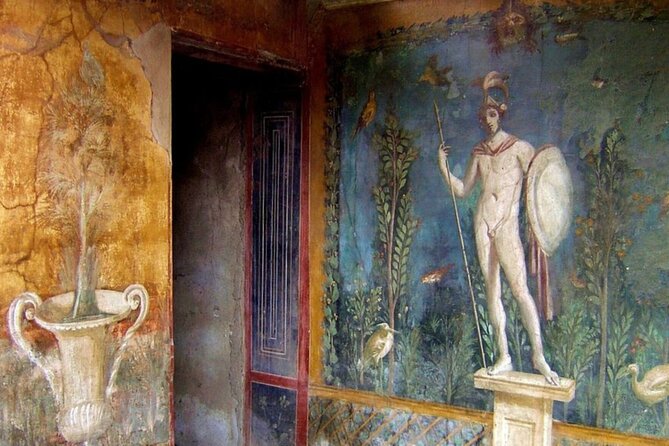
The route includes temples connected with Venus, Apollo, and Jupiter. These stops show the religious side of Pompeii and add variety after the civic focus of the Forum.
The temple areas are also a good test of the audio format. The remaining structures may not explain themselves at a glance. A digital explanation gives you a reason to pause and look at the surviving columns, platforms, and surrounding spaces.
The three temples should not be treated as identical photo stops. Use the commentary to distinguish their roles and locations. Moving between them also gives you a better feel for the city’s layout.
Because the guide contains many stops, you can choose how much detail you want. If you are visiting with children or have limited energy, listen to the main temple commentary and keep moving. If ancient religion and civic life interest you, spend longer at each site.
The House of the Faun and Pompeian homes

The House of the Faun is one of the historic residences included in the visit. It helps shift your attention from public life to domestic space and private wealth.
The name is tied to the house’s famous faun sculpture, while the residence is also known for intricate mosaics. The audio guide can help you look closely rather than treating the building as another set of walls.
Private homes are among Pompeii’s most revealing areas. They show how architecture, decoration, and status appeared in everyday surroundings. The House of the Faun is especially useful because its scale and decorative details give you a sense of the contrast between ordinary homes and grand residences.
Do not rush through the mosaics. This is where a smartphone guide earns its keep. You can pause the narration, look at the floor patterns, and return to the explanation if you missed a detail.
The same advice applies to other historic residences. The guide includes many points beyond the House of the Faun, so you can keep exploring residential areas after seeing the headline site.
Ash-covered homes and the human cost of the eruption
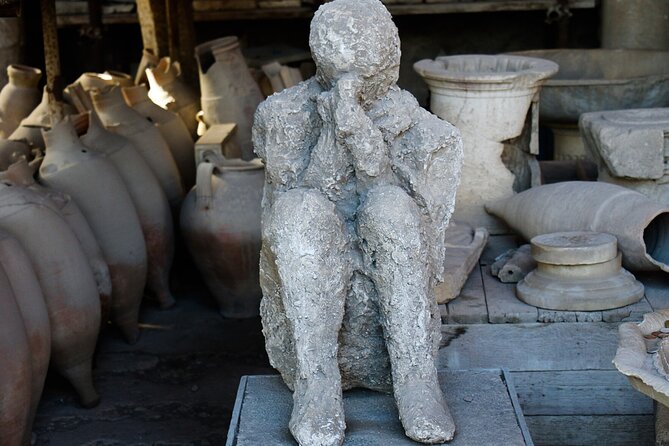
Pompeii’s most powerful moments are not always the grandest buildings. The ash-covered homes and plaster casts of victims bring the eruption into human focus.
These casts can be difficult to see, and they should be approached with respect. They are not simply dramatic objects. They show the sudden effect of the eruption on people who lived in the city.
The audio commentary gives this part of the visit a useful frame. You can connect the casts to the streets, houses, and public spaces around them. The city is not just preserved architecture. It is also evidence of lives interrupted.
This is one reason I would not try to squeeze Pompeii into a rushed hour. The major landmarks can be photographed quickly, but the meaning of the site takes time. You need a moment to look, listen, and let the scale of the disaster register.
Mount Vesuvius forms the backdrop to the entire experience. Its presence adds weight to the visit without requiring extra transport or a separate viewpoint. You are exploring the buried city with the volcano still visible in the wider setting.
How the audio guide works in practice
The audio guide is delivered through your smartphone, with a digital map and more than 130 points of interest. It is available in English, French, Spanish, German, and Italian.
The biggest benefit is control. You can stop the commentary when a group passes, repeat a section, or skip ahead. You can also build your own route rather than following a guide holding up a sign.
The main weakness is the link between the map and the narration. It can be hard to identify the correct information while standing in an open archaeological area with several nearby ruins. This is the one part of the experience I would not underestimate.
A few habits make it easier:
- Download the guide before arriving.
- Check the map before starting each section.
- Keep your phone volume or headphones at a comfortable level.
- Pause the audio when you are looking at a mosaic or building.
- Do not feel pressure to follow every point in order.
- Save battery for the full visit.
Your own headphones are required. That is a small extra detail, but it affects comfort. Sharing a phone speaker in a crowded area may be awkward, while basic headphones make the guide far easier to use.
How long you need inside Pompeii
The advertised experience takes about two to three hours, while typical time inside the park is two to four hours. I would plan for the longer end if you want to use the audio guide properly.
Two hours can work if you concentrate on the Forum, temples, House of the Faun, and the eruption-related sites. Four hours gives you more room for the residential areas, extra audio stops, mosaics, and pauses.
Pompeii is not a place where you should schedule a tight connection immediately afterward. The size of the park, the walking surface, and the number of points can make the visit longer than expected.
Your interests should guide the pace. Architecture and Roman public life may lead you toward the Forum and temples. Domestic life may keep you longer at the residences. The eruption and plaster casts may become the emotional center of your visit.
There is no required order beyond entering the park with the correct ticket. That flexibility is valuable, but it also means you need a basic plan before you begin.
What is not included, and why it matters
The ticket does not include access to the suburban villas. Villa dei Misteri, Villa of Diomedes, and Villa Regina require an additional €8.
This is an important distinction because Villa dei Misteri is often associated with Pompeii visits. If you specifically want to see the suburban villas, budget for the extra admission and allow additional time. If your priority is the central archaeological park, the included sites already provide several hours of material.
Transportation is also not included. You are responsible for reaching Pompeii and getting back afterward. The information point is near public transportation, but no transfer is part of this experience.
The package also excludes your mobile device and headphones. These are easy items to overlook because the audio guide is digital. Bring both, and charge your phone before you leave.
Service animals are allowed, and most people can take part. The park is near public transportation, which helps if you are arranging the visit independently.
Who will like this format most
I would recommend this experience to independent visitors who want context without joining a fixed group. It suits you if you enjoy choosing your own stops, listening at your own speed, and spending extra time at places such as the House of the Faun or the Forum.
It also works well for a first Pompeii visit when you want a clear list of important sites. The 130-plus audio points reduce the chance of missing major landmarks, while the map gives you a structure for covering the large area.
You may prefer a live guide if digital maps frustrate you or if you want someone to explain the ruins while you walk. The navigation issue is real, and the audio guide cannot answer a question or adjust the route for you.
Families and mixed-interest groups may appreciate the flexible timing. One person can spend longer at a mosaic while another moves on. Just keep the phone and audio setup manageable, especially if several people want to listen together.
Cancellation and booking details to remember
You receive confirmation at booking, and free cancellation is available until at least 24 hours before the scheduled start time. Cancellations or changes made within 24 hours are not accepted for a refund.
The cutoff uses local time. That matters if your plans are changing during a wider Italy trip.
Should you book Pompeii with this audio guide?
Book it if you want reserved entry, a large amount of recorded information, and the freedom to explore without a fixed group. At $35.32, the package offers fair value for a two-to-four-hour visit, especially if you use many of the audio stops.
Skip it if you want transportation, a live historian, or guaranteed help with navigation. The map can take patience, and the suburban villas cost an extra €8.
For most independent visitors, I think the strongest plan is simple: download the guide before you arrive, collect the entry ticket at Piazza Esedra, wear solid walking shoes, and give Pompeii at least three hours. Treat the audio guide as a useful tool rather than a route you must obey. That approach lets you enjoy the Forum, temples, homes, mosaics, and the sobering evidence of the eruption at your own pace.
FAQ
How much does the Pompeii audio guide experience cost?
The listed price is $35.32 per person. The price includes reserved entry to Pompeii, a digital audio guide, and a digital map.
How long should I plan for the visit?
The experience is approximately two to three hours, while visitors typically spend two to four hours inside Pompeii. The site covers 44 square hectares.
Where do I exchange the voucher for the entry ticket?
You exchange the voucher at the information point at Piazza Esedra, 1, 80045 Pompei, in front of Hotel Vittoria. Pompeii requires this entry ticket for admission.
What languages are available for the audio guide?
The digital audio commentary is available in English, French, Spanish, German, and Italian.
Do I need to bring my own phone and headphones?
Yes. A mobile device and headphones are not included. You should scan the QR code on your voucher to download the audio guide before arriving.
Does the ticket include Villa dei Misteri?
No. The ticket does not include the suburban villas, including Villa dei Misteri, Villa of Diomedes, and Villa Regina. Access to those villas costs an additional €8.
More History Audio Tours in Pompeii
- Rome: Colosseum, Ancient Rome Tour or AudioGuided Tour
★ 4.4 · 2,879 reviews - Colosseum, Roman Forum & Palatine Hill Entry and Audioguide
★ 4.1 · 2,475 reviews - Taormina: Ancient Theater Skip-the-Line Ticket & Audio Guide
★ 4.5 · 2,412 reviews - Rome: Colosseum, Roman Forum & Palatine Hill Visit + Audio Guide
★ 3.5 · 1,522 reviews
Just added around Pompeii
- Private Audio Guided Walking Tour in Pompei★ 3.0 · 2 reviews
- Pompeii Fast Track Entry with Audio Guide★ 3.0 · 2 reviews
- Pompei Archaeological Park Skip The Line ticket With audio Guide★ 3.0 · 10 reviews
- Pompeii: Pre-reserved ticket with audio guide★ 3.2 · 15 reviews
- Pompeii: Skip-the-Line Ticket with Audio Guide and Map★ 4.0 · 14 reviews
- Pompeii Tour_Skip the line ticket + audioguide★ 4.7 · 17 reviews
- Pompeii: Skip-the-Line Ticket with Audio Guide and Map★ 3.9 · 5 reviews
- Pompeii: Skip the Line Ticket + Audioguide★ 3.3 · 13 reviews
Skip the Line, compared.

Topkapi Palace and Harem Skip-the-Line-Tickets & Audio Guide
Read our review →
Pantheon Reserved Entry Ticket with Audio Guide
Read our review →
Borghese Gallery Skip-the-Line Ticket & Audioguide
Read our review →
Skip the Line: Vatican & Sistine Chapel Ticket with Audio Guide
Read our review →
Skip-the-line Entry Ticket with Audio Guide & Map
Read our review →
Mount Vesuvius: Skip-the-Line Ticket and Smart Digital Guide
Read our review →
Borghese Gallery Skip-the-Line Tickets with Audioguide
Read our review →
Taormina: Ancient Theater Skip-the-Line Ticket & Audio Guide
Read our review →Browse the lists this tour appears in