
REVIEW · POMPEII AUDIO TOURS
Private Audio Guided Walking Tour in Pompei
Pompeii rewards a slower look. This $9.66 self-guided audio tour gives you 28 audio tracks, map-based guidance, quizzes, and offline listening as you walk among temples, theatres, fountains, and grand Roman homes. I like the freedom to start at any time, and I like that the audio never expires. The main drawback is that you must use your own smartphone and app, with no guide or audio device waiting at the entrance.
The content is strongest when it connects ruins to everyday life. You hear how Pompeii’s water system worked, why theatre mattered to Roman society, and who may have lived in the House of Menander. Still, the overall experience depends on setting up the app correctly, and one serious report describes confusion at the entrance after looking for audio equipment that was never part of the tour.
Key points at a glance

- 28 audio tracks and 84 minutes of content: You get far more narration than the stated 30-minute to 1-hour-25-minute walking time requires.
- The tour uses your own phone: There is no equipment pickup, no physical guide, and no fixed departure time.
- The Temple of Apollo provides an ancient starting point: This is one of Pompeii’s oldest religious sites, with Greek and Etruscan influence.
- The Grand Theatre holds the story of Roman entertainment: The large semicircular building could seat about 5,000 people.
- The House of Menander adds a human scale: Its nearly 1,800 square meters show how large and comfortable an elite Roman home could be.
- The app works online or offline: Downloading or preparing the audio before entering is a wise step.
A $9.66 audio tour with total freedom

This experience is best understood as an audio app rather than a traditional guided walk. You do not meet a guide, collect headphones, or join a group at noon. The listed start time of 12:00 am reflects the fact that you can access the tour at any point during the day.
That flexibility is the main reason I find the price appealing. At $9.66 per person, you pay less than you would for a live private guide, yet you receive 28 pieces of audio content totaling 84 minutes. You can pause, replay, skip ahead, or stop for photographs without holding up anyone else.
The tradeoff is personal responsibility. You must have your own smartphone, find the correct app, and understand that the product is not an audio device rental. A confusing experience at the entrance resulted when a visitor searched for a pickup location and contacted a disconnected number. The important lesson is simple: there is no audio equipment to collect. The tour is designed for your phone.
The app also includes written versions of the audio tracks. That helps if the site is noisy, your phone battery is low, or you prefer reading a section before looking at the ruins. You can listen online or offline, a useful feature inside a large archaeological site where mobile service may not always be convenient.
More Audio Walking Tours in Italy
- Florence: 2.5 hour Audio Guided Walking Tour led by Host
★ 4.6 · 293 reviews - Verona Walking Tour with Audio and Written Guide by a Local
★ 4.5 · 157 reviews - Bologna Walking Tour with Audio and Written Guide
★ 4.5 · 132 reviews
Starting with the Temple of Apollo
The Temple, or Sanctuary, of Apollo is one of Pompeii’s oldest buildings. Its early form probably reflects the influence of Greek or Etruscan communities that settled in the area before Roman control became dominant.
That detail gives the first stop real value. Pompeii was not created as a purely Roman town from the beginning. Its religious buildings show layers of culture, power, and local tradition. The audio helps you see the sanctuary as part of a long story rather than as a single Roman monument.
I would give this stop time instead of treating it as a quick photo opportunity. The site introduces an important theme for the whole walk: Pompeii was shaped by different peoples before the eruption preserved it. The app’s historical explanation should help you look for those changes in the structure and its setting.
The limitation is that this stop is described in broad terms rather than with a full list of surviving details. If you want a specialist’s close reading of every column, inscription, or architectural feature, a live archaeologist would offer more depth. For a low-cost introduction, though, the Temple of Apollo is a sensible first chapter.
Reading Pompeii through its water supply
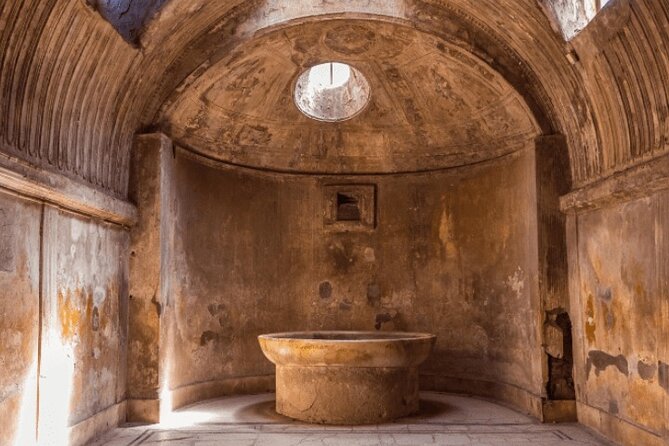
One of the most useful sections focuses on water. Before the earthquake of AD 62, Pompeii had at least 40 public fountains, placed roughly every 80 meters. Public and private bath complexes were common, and many homes and businesses received running water from the Serino Aqueduct.
I like this stop because water makes the city feel practical and lived in. Ruins can seem empty when you look only at walls and columns. Once you understand that residents could draw water from nearby fountains, visit public baths, and use indoor supplies, the streets begin to make more sense.
The audio also gives you a way to judge Pompeii’s size and planning. Forty fountains spread through the city suggest a settlement designed around regular daily needs, not just monuments. The Serino Aqueduct shows that engineering supported private homes and commercial activity as well as public facilities.
This is one of the strongest examples of the app’s value. A brief label beside a fountain may tell you what it is. A spoken explanation can connect that fountain to bathing, household work, trade, and city planning. You get a clearer picture of ordinary life, even though the tour does not promise a specialist examination of each water feature.
The Grand Theatre and Roman taste for performance
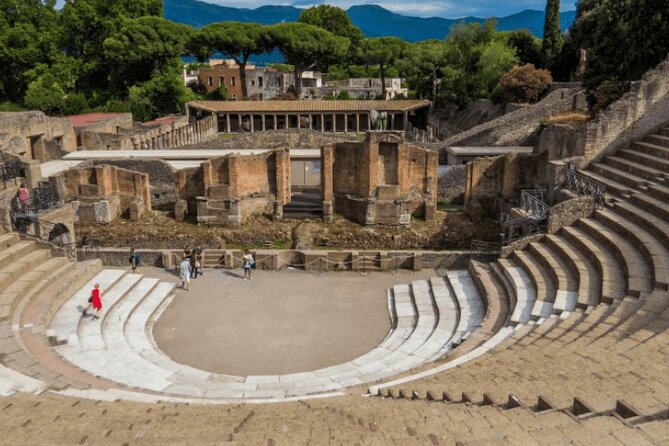
The Grand Theatre introduces another side of Pompeii: public entertainment. Roman society absorbed a strong Greek passion for theatre, especially tragedy and comedy. Pompeii’s large semicircular theatre began as early as the second century BC and was enlarged and altered over time.
At its greatest size, it could hold up to 5,000 people. That figure changes how you see the building. This was not a small local stage for a handful of residents. It was a major public venue, and its scale suggests that theatre played a serious role in community life.
I appreciate the way this stop links architecture with culture. The shape of the theatre was not random. A semicircular design helped organize the audience around the performance, while later changes reflected the city’s growing needs and changing tastes.
You should also expect a different experience here than at a quiet temple or private house. The theatre is easier to understand when you picture people arriving, finding seats, and responding to a shared performance. The audio gives you that social setting without requiring you to read a long panel.
The drawback is the same as with the other stops: the app cannot answer questions in real time. If you want to know how a particular seating section worked or how performances were staged, you may need extra information elsewhere. Still, this is a useful and memorable section for anyone interested in Roman public life.
More Audio Walking Tours in Pompeii:
- Sofia: City Monuments Guided Walking Tour with Audio Guide
★ 4.5 · 825 reviews - Self Guided Classic Freedom Trail Location Aware (GPS) Walking Audio Tour
★ 4.5 · 258 reviews - Valletta: Self-Guided Historical Walking Tour (Audio Guide)
★ 3.7 · 251 reviews - Cape Cod & Provincetown Self-Guided Driving & Walking Audio Tour
★ 4.0 · 207 reviews
Entering the House of Menander
The House of Menander is one of Pompeii’s best-preserved and largest domus, covering almost 1,800 square meters. That is a striking amount of space for a private residence, and it gives you a clearer sense of the difference between an elite home and the smaller dwellings elsewhere in the city.
The audio identifies the possible owner as Quintus Poppaeus Sabinus. Scholars believe he may have been related to Poppaea Sabina, the second wife of Emperor Nero. The same family may also have owned the Pompeian residence now called the House of the Golden Cupids.
The careful wording matters. The connection is presented as a scholarly belief, not an absolute fact. I value that restraint because Pompeii often tempts people to turn theories into certainty. You can enjoy the connection while remembering that some identities and family ties remain open to interpretation.
This stop works well as a counterpoint to the water section. The aqueduct and fountains show citywide infrastructure. The House of Menander shows how that infrastructure could support a wealthy household. Its size lets you think about domestic space, status, staff, and private life rather than only temples and public buildings.
A short walking tour cannot cover every room in a house this large. The 84 minutes of total audio content help, but you should still expect selected highlights rather than a room-by-room academic study.
How the app format changes your visit
The tour is private in the simplest sense: only your group participates, and nobody else sets the pace. You can listen to one track, pause for a break, then continue. If one person in your group wants more time at the theatre while another is ready to move on, the app does not force a compromise.
The quiz section adds short questions about Pompeii. I like this feature for families and for anyone who remembers more when asked to make a quick guess. It also gives the visit a little structure without turning it into a classroom.
The written transcripts are another practical touch. You might use them when you want to scan the main facts quickly, or when listening is awkward. Having both text and audio also makes the tour more usable for people with different preferences.
An additional section covers city services, including metro information, airports, cinemas, and events. That material is broader than the archaeological walk, but it may help if you are building a full day around Pompeii rather than visiting only the ruins.
The audio has no expiry date. That matters if your plans change or if you want to use the material again later. It also means you could listen before your visit to understand the stops, then replay key sections while standing in front of them.
Timing, access, and the need to prepare

The stated walking time ranges from 30 minutes to 1 hour 25 minutes. The app itself contains 84 minutes of audio, so these figures do not line up perfectly. In practice, the shorter time likely reflects listening to selected highlights, while the longer visit allows for more tracks, pauses, and time at the ruins.
You can access the tour at any time of day. There is no required meeting appointment beyond the general starting point in Pompei, and the end point is also in the same Pompei area. The experience is near public transportation, and most people can participate.
Confirmation is provided at booking. Service animals are allowed. The activity is offered in English only, so you should choose it only if you are comfortable following English narration and written text.
Prepare before you reach the entrance. Confirm that you have the TravelMate audio app, check that your phone is charged, and download or arrange offline access if the app allows it before entering the site. The most damaging mistake would be waiting for a staff member or booth that does not exist.
Also remember that the price does not include personal help on site. If the app fails or the voucher is unclear, you may need to solve the problem yourself. This is the natural cost of choosing a very inexpensive, self-guided product.
What the price really buys

At $9.66, this is a low-cost way to add structure to a Pompeii visit. The strongest value comes from the combination of 28 audio tracks, 84 minutes of material, offline listening, transcripts, quizzes, and unlimited access after purchase.
The price is especially fair if you already plan to explore independently. You are not paying for a live guide’s time, a fixed route, or a group experience. You can use only the sections that fit your interests and ignore the rest.
The value is weaker if you expect someone to meet you, hand over equipment, explain the app, or answer questions during the walk. That expectation caused a serious problem for one purchaser, who searched around the entrance for audio equipment and could not reach the provider by phone. The app format must be clear before you buy.
Another concern is the no-refund rule. This experience cannot be canceled, exchanged, or amended for a refund. At $9.66, the financial risk is limited, but you should still check the date, language, phone access, and app instructions before paying.
Who should choose this Pompeii tour?
I would recommend it to independent visitors who like to move at their own pace and want more context than bare signs provide. It is also a good fit for couples, families, and small groups who do not want to join a larger walking party.
The quiz and written transcripts make it useful for families, while the ability to pause and replay suits anyone who prefers a relaxed visit. The audio has enough material to give a substantial introduction without committing you to a long live tour.
I would be cautious if you dislike phone-based sightseeing. If you want a guide waiting at the gate, a headset handed to you, or immediate help when something goes wrong, spend more on a guided option with clear in-person support.
The content itself receives one particularly strong positive assessment for its quality and usefulness. That matches the best parts of the program: the water system, theatre, Temple of Apollo, and House of Menander give you memorable subjects rather than a string of disconnected facts.
Should you book it?
Book this tour if you understand that it is an app-based audio guide, not an equipment rental or live walk. At $9.66, the 28 tracks, transcripts, quizzes, offline option, and no-expiry access offer good value for a self-directed visit.
Before purchasing, make sure you can use an English-language app on your own phone and accept the no-refund policy. If you prepare properly, this is a practical way to add context to Pompeii without paying for a private guide. If you need personal assistance at the entrance, choose another format.
FAQ
How much does the Pompeii audio tour cost?
The price is $9.66 per person.
How long does the tour take?
The estimated walking time is about 30 minutes to 1 hour 25 minutes. The app contains 84 minutes of audio across 28 tracks, so your total time depends on how many sections you hear and how long you spend at each site.
Is this a guided group tour?
No. It is a private, self-guided activity for your group only. You can access the audio at any time of day.
Do I collect audio equipment at Pompeii?
No. You use your own smartphone with the TravelMate audio app. There is no audio equipment pickup.
Is the tour available offline?
Yes. You can listen online or offline.
Is the audio available in languages besides English?
The experience is offered in English.
Can I cancel the booking for a refund?
No. The experience is non-refundable and cannot be changed, canceled, or exchanged for any reason.
Just added around Pompeii
- Pompeii Fast Track Entry with Audio Guide★ 3.0 · 2 reviews
- Pompeii Archaeological Park Skip-the-line Entry and Audio Guide★ 3.5 · 4 reviews
- Pompei Archaeological Park Skip The Line ticket With audio Guide★ 3.0 · 10 reviews
- Pompeii: Pre-reserved ticket with audio guide★ 3.2 · 15 reviews
- Pompeii: Skip-the-Line Ticket with Audio Guide and Map★ 4.0 · 14 reviews
- Pompeii Tour_Skip the line ticket + audioguide★ 4.7 · 17 reviews
- Pompeii: Skip-the-Line Ticket with Audio Guide and Map★ 3.9 · 5 reviews
- Pompeii: Skip the Line Ticket + Audioguide★ 3.3 · 13 reviews
Walking Tours, compared.

City Monuments Guided Walking Tour with Audio Guide
Read our review →

Self Guided Classic Freedom Trail Location Aware (GPS) Walking Audio Tour
Read our review →
Self-Guided Historical Walking Tour (Audio Guide)
Read our review →
Cape Cod & Provincetown Self-Guided Driving & Walking Audio Tour
Read our review →
Verona Walking Tour with Audio and Written Guide by a Local
Read our review →
Royal Walking Tour and Buckingham Palace Audio Tour
Read our review →
Bologna Walking Tour with Audio and Written Guide
Read our review →Browse the lists this tour appears in