
REVIEW · OAHU AUDIO TOURS
Honolulu Historic District a Smartphone Audio Walking Tour
Royal statues, old churches, and odd sculptures await. This self-guided walk gives you a useful introduction to downtown Honolulu, linking Aliʻiolani Hale, King Kamehameha I’s statue, Iolani-era landmarks, museums, theaters, and civic buildings through your phone. I especially like the low $10.99 price and the freedom to pause, skip stops, or finish the route later.
I also like the GPS-guided format. Download the tour over Wi-Fi, then let your phone trigger commentary at each point without using mobile data. The main caution is important: this is an outdoor walking tour, not an admission ticket. You do not enter Iolani Palace or other attractions, and some audio can be quiet without earbuds.
Key points to know before you go

- Start at Aliʻiolani Hale: The route begins at 417 S King St, in front of one of Honolulu’s most important royal-era buildings.
- A royal and civic history lesson: You hear about King Kamehameha I, King Kalakaua, King Lunalilo, Queen Emma, and Hawaii’s last monarch.
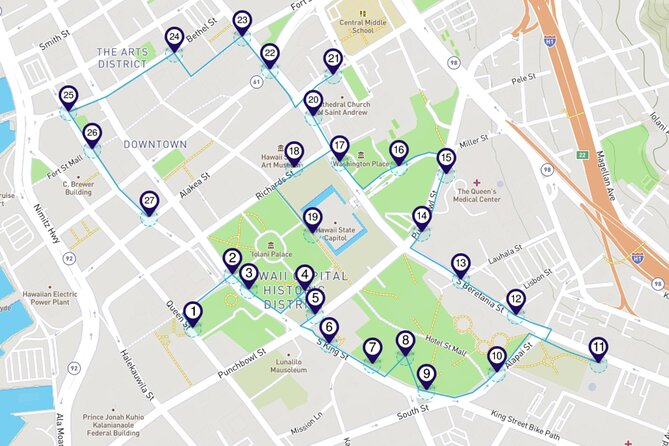
- Twenty-plus downtown stops: The route covers churches, statues, theaters, museums, government buildings, libraries, and public art.
- No signal needed after download: Save the tour on Wi-Fi before leaving, then follow the live GPS map offline.
- Bring earbuds: Audio plays through your phone speaker, but one review found some narration too quiet in ordinary street conditions.
- Plan for heat and sun: The walk can take longer than expected, so an early start makes practical sense.
What this Honolulu audio walk actually is
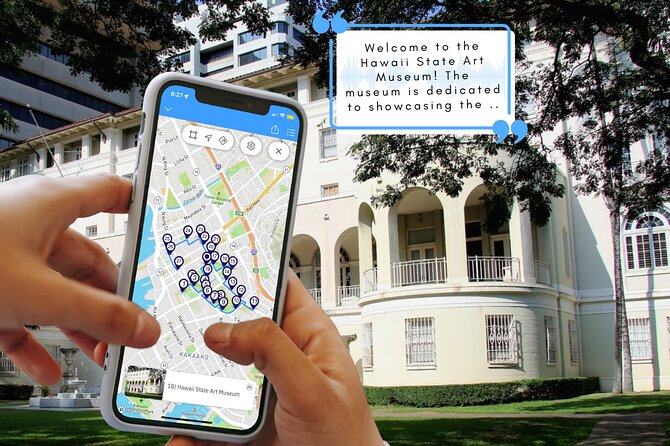
This experience is a private tour for your own group, but it is not a private guide walking beside you. You use a smartphone or tablet, follow the route on a live GPS map, and hear commentary automatically as you reach each point.
That setup suits independent visitors who dislike fixed departure times. You can begin anytime during the broad operating window, stop for food, take photos, or wander a little before returning to the route. The tour is yours to keep, so it can also be split into shorter outings.
The stated duration is about one to two hours. In practice, allow extra time if you read plaques, take photos, pause in shaded spots, or explore nearby streets. One user found the route longer than expected but enjoyed starting early to avoid the sun.
The route begins and ends at Aliʻiolani Hale, 417 S King St. Since the tour is outdoors, your experience depends partly on weather, traffic noise, and how carefully you follow the map.
More Audio Walking Tours in the USA
- Self Guided Classic Freedom Trail Location Aware (GPS) Walking Audio Tour
★ 4.5 · 258 reviews - Cape Cod & Provincetown Self-Guided Driving & Walking Audio Tour
★ 4.0 · 207 reviews - Santa Fe Historic Downtown Smart Phone Audio App Self Guided GPS Walking Tour
★ 4.5 · 112 reviews
Aliʻiolani Hale and the royal beginning
The first stop, Aliʻiolani Hale, means House of the Heavenly Kings. The building was constructed in 1879 for King Kalakaua, who ruled the Hawaiian Kingdom. That opening gives the walk a clear theme: Honolulu is not only a modern capital, but also the former center of a sovereign kingdom.
From there, the tour brings you to the statue of King Kamehameha I. The commentary includes folklore about Hawaii’s celebrated monarch, which adds a human touch to what could otherwise be a quick photo stop. This is one of the better ways to begin because the statue and government buildings help you connect names, power, and place.
The route then points out the Kanaina Building, listed on the National Register of Historic Places in 1978. It is presented as an important example of Victorian architecture in Hawaii. You will want to look up at the building details rather than treat it as a simple marker on a map.
The walk also includes a statue honoring Patsy, with attention to her accomplishments and the reason the monument was created. The supplied information does not identify her full name, so the audio itself carries the explanation. That sort of stop can be easy to miss on your own, which is one benefit of a narrated route.
Libraries, churches, and Honolulu’s royal faith

One of the most appealing stops is Hawaii’s oldest church. The walk also explains why King Lunalilo refused burial in the Royal Mausoleum and was instead buried at the church. This is a useful reminder that royal decisions were often personal and symbolic, not simply matters of ceremony.
Another stop is the library, which began in 1879 as a simple reading room. Its original purpose was to keep unruly sailors out of mischief. That small detail gives the building a memorable story and shows how public institutions often began with very practical goals.
The route then reaches the Queen’s Conference Center, described as a historic and cultural landmark. You also hear about the complex created through the vision of Queen Emma and King Kamehameha IV. These stops add more than architecture. They show how Hawaii’s rulers supported education, faith, public life, and community institutions.
A major highlight is the church envisioned by King Kamehameha and Queen Emma for Hawaii. The tour frames it as another expression of their hopes for the kingdom. For visitors interested in royal Hawaii, this section is likely more rewarding than the less impressive civic stops because the buildings connect directly to people and events.
Civic buildings, odd sculpture, and modern Honolulu

The route does not stay in the royal past. It takes you to Honolulu Hale, the city hall, and explains its construction and notable features. It also answers a practical question you might have while looking at another building: why do the dates 1820 and 1915 appear on the front if the structure was built in 1921?
That sort of detail is exactly where an audio walk earns its small fee. You can see a date or design feature, wonder about it for a moment, and receive the explanation without opening another app.
The tour also pauses at an unusual sculpture tied to a natural phenomenon. The description calls it a strange-looking work and promises the story behind it. This is a nice change of pace after formal government buildings and churches. Public art can seem random when you pass it alone, but a short explanation gives it a reason to exist.
You then reach the Frank F. Fasi Building, Honolulu’s municipal building as of 2006. Its design is described as distinctive, and the commentary explains why. The route continues to relaxed-looking stone figures on the grounds of Seagull Schools, an early childhood education center. These are not major attractions, but they help you notice the small pieces of public art and local life spread across central Honolulu.
The Honolulu Police Department also receives attention. As you look at its building, the tour explains something unique about the department. The information provided does not spell out the detail in advance, so this is another point where the audio supplies the payoff.
More History Audio Tours in the USA
- Savannah’s Historical District: A Self-Guided Audio Tour
★ 4.5 · 69 reviews - Self-Guided Walking Audio Tour of Historic Santa Fe
★ 4.5 · 43 reviews - Salida History Audio Tour l A Self-Guided Wild West Experience
★ 5.0 · 41 reviews - Historic Bar Harbor Self-Guided Walking Audio Tour Guide
★ 4.5 · 38 reviews
Peace, queens, and the state capitol

The Bell of Nagasaki is one of the most meaningful stops on the route. It represents peace and friendship between the United States and Japan. Unlike a grand royal building, this is a compact object with a wider message, and the audio gives it a place in Honolulu’s civic story.
The route then moves to the Hawaii State Capitol. The building officially became Hawaii’s state capitol in 1969, and the commentary gives you more detail about its design and role. This makes a useful contrast with the nineteenth-century royal buildings at the start. You are seeing how the city moved from kingdom to modern state government.
Another stop is a regal manor built in 1842 by a clipper ship captain for his wife and young son. The tour promises the story behind the house, which adds a domestic angle to the royal and political material.
You also hear a first-person-style passage connected to the last surviving member of the Kamehameha dynasty. That dramatic perspective helps break up the building facts and gives the royal section a more personal tone.
Museums, public spaces, and the downtown shopping route

The walk visits a museum devoted to the art and culture of Hawaii. It is described as an essential stop for anyone interested in island traditions and artistic life. The attraction itself is not included in the $10.99 price, so treat the tour as an introduction and decide separately if you want to pay for entry.
The route also includes the area originally named for Queen Emma, which since 2016 shares the honor with James and Abigail Campbell. This gives you another example of how Honolulu’s public spaces preserve several layers of local history at once.
From there, the pedestrian-only street mall offers a change in atmosphere. It was established in the 1960s to help revive downtown and remains a place for shopping, dining, and entertainment. This is a useful stop if you want to connect the historic core with the city you see today, rather than viewing downtown as a collection of old buildings only.
The route does not include Chinatown, though one practical suggestion is to add it at the end yourself. That makes sense if you want to extend the walk, but keep in mind that Chinatown is not part of the narrated route.
Hawaii Theatre and Kumu Kahua
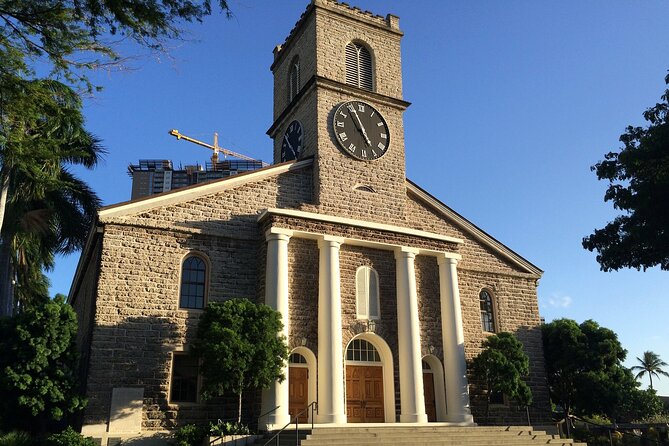
The Hawaii Theatre Center opened in 1922, when vaudeville and silent films were major forms of entertainment. Its inclusion gives the tour a welcome dose of cultural history beyond royalty and government.
Another stop focuses on a building donated to the Kumu Kahua Theatre Company. The company was formed to produce new works by Hawaii playwrights and plays reflecting the varied cultures and experiences of Hawaii’s people. This is one of the route’s strongest reminders that local identity is still being expressed, not merely preserved in old buildings.
The final stop concerns building materials. Newcomers wanted substitutes for the bricks they had used back home, and the commentary explains what they chose instead. It is a modest detail, but construction choices often tell you how people adapted to island conditions and available resources.
Because the tour returns to Aliʻiolani Hale, you finish near where you began rather than being left at a distant attraction. That is helpful for planning, especially if you arrived by public transportation.
Audio quality, phone use, and timing

Download the tour over Wi-Fi before you start. Once saved, it does not require a signal or mobile data. The app includes a live map showing both the route and your location, which is reassuring in an unfamiliar downtown grid.
You need to supply the smartphone or tablet. Headphones are optional, since the audio can play through the device speaker, but I would bring earbuds. One review specifically noted that some narration was quiet. Earbuds also let your group listen without raising the volume in public places.
Start early if you can. Honolulu sun and heat can make a one-hour walk feel much longer, and the route may run beyond the estimated time if you stop often. The tour is available every day, with opening hours listed from midnight to 11:30 p.m., so you have plenty of flexibility. Still, daylight is the sensible choice for seeing building details and statues.
The route is near public transportation, service animals are allowed, and most people can participate. No attraction tickets are included. That last point deserves special attention because the tour does not provide entry to a palace or any other indoor site.
Is $10.99 a fair price?
At $10.99 per person, this is inexpensive for a self-guided introduction to central Honolulu. You are paying for route planning, narration, GPS prompts, and the freedom to use the tour whenever you like. If you would otherwise wander downtown without context, the price is easy to justify.
The value drops if you expected a guided group, personal questions answered on the spot, or admission to Iolani Palace and other attractions. One dissatisfied customer had wanted palace access and found that an on-site audio ticket offered a better fit. That complaint points to a booking mistake rather than a flaw in this product, but it is a crucial distinction.
The overall rating is 3.8 from six reviews, so the sample is small. The strongest praise goes to the price, flexible format, historical background, and artistic audio touches, including voiced stories from historic figures. The main concerns are uneven interest among stops, quiet audio, and confusion about attraction entry.
Free cancellation is available if you cancel at least 24 hours before the start time. Cancellations inside that window are not refunded, and changes are not accepted.
Who should book this Honolulu walk?
I would choose this tour if you want a low-cost orientation to downtown and prefer setting your own pace. It works well for independent visitors, couples, families with older children, and anyone with a short free afternoon.
It is also a good fit if you enjoy architecture but do not want to read a guidebook while walking. The narration points out dates, design choices, royal connections, and odd public sculptures that could otherwise pass unnoticed.
I would skip it if your main goal is entering historic buildings, visiting a palace interior, or receiving a live guide’s personal interpretation. You should also think twice if your group dislikes phone-based tours or struggles with small audio speakers.
Should you book it?
Book this tour if you want a flexible, inexpensive walk through Honolulu’s royal, civic, religious, and cultural center. Download it on Wi-Fi, bring earbuds, start early, and keep your expectations focused on outdoor sights and narration.
Do not book it as a substitute for palace admission or a full guided city tour. For $10.99, it offers a useful framework and a surprising number of stops, but its value depends on your willingness to explore with a phone rather than a person.
FAQ
How much does the Honolulu Historic District audio tour cost?
The price is $10.99 per person.
How long does the walking tour take?
The estimated duration is one to two hours, though it may take longer if you stop often or explore along the way.
Where does the tour begin?
It starts at Aliʻiolani Hale, 417 S King St, Honolulu, Hawaii 96813.
Where does the tour end?
The tour ends back at the starting point.
Do I need mobile data during the tour?
No. You should download the tour over Wi-Fi first. After that, no signal or mobile data is required.
Are attraction admission tickets included?
No. The tour is an outdoor walking experience, and attraction tickets are not included.
Do I need headphones?
Headphones are optional because the audio can play through your phone or tablet speaker. Earbuds are recommended because some audio may be quiet.
Is cancellation free?
Yes, if you cancel at least 24 hours before the experience start time. Cancellations made less than 24 hours in advance are not refunded.
More Smartphone Audio Tours in the USA
- Self-Guided GPS Audio E-Bike Tour Hawaii Volcanoes National Park
★ 4.5 · 131 reviews - Ultimate Portland Self-Guided Driving GPS Audio Tour
★ 4.0 · 56 reviews - Birmingham Civil Rights Walk of Freedom Smartphone Audio App Tour
★ 5.0 · 40 reviews - Self Guided GPS Audio Driving Tour Acadia NP From Hulls Cove VC
★ 4.0 · 25 reviews
Just added around the USA
- Self Guided Driving Audio Tour of Saguaro National Park★ 3.0 · 4 reviews
- Self-Guided Audio Driving Tour of Mount Lemmon★ 5.0 · 4 reviews
- Saguaro National Park Self-Guided Audio Tour★ 3.5 · 11 reviews
- A Self Guided Audio Tour in Tombstone★ 4.0 · 11 reviews
- Catskills Scenic Byway Self-Guided Driving Audio Tour★ 4.0 · 9 reviews
- Big Bend National Park Self Guided Audio Tour Guide★ 5.0 · 12 reviews
- Self-Guided Audio Driving Tour in Catskills Scenic Byway★ 4.5 · 7 reviews
- Shiloh Battlefield Self-Guided Driving Audio Tour★ 4.0 · 9 reviews
Smartphone Audio Tours, compared.

Colosseum & Forum with Audio Guide App -Optional Arena
Read our review →
Timed Entry to Michelangelo’s David + Audio App
Read our review →
Cathedral & Brunelleschi’s Dome Ticket & Audio App
Read our review →
Michelangelo’s David Priority Ticket & Audio App
Read our review →
Uffizi Priority Ticket & Masterpieces Audio App
Read our review →
Castel Sant’Angelo Entry Ticket & Digital Audioguide
Read our review →
Pantheon Priority Entry Ticket & Audio Guide App
Read our review →Browse the lists this tour appears in