

REVIEW · MOAB AUDIO TOURS
Arches and Canyonlands NP Self-Guided Driving Audio Bundle Tour
Red rock is better with a narrator. This self-guided driving tour links Arches and Canyonlands with location-triggered stories, route advice, geology, Native history, and practical hiking notes. For $24.99 per group of up to four people, you get a private audio guide without a fixed bus schedule.
I especially like the offline maps, which matter when cell service fades, and the way the app explains upcoming pullouts, trail lengths, and viewpoints. The lifetime access is another strong point: you can use the tours again on a later trip. The main drawback is technical. You must download everything on reliable Wi-Fi or cellular service before entering the parks, and a few users have had audio cutouts or trouble with the app.
This is a good fit if you want guidance without surrendering control. You can stop for an hour, skip a viewpoint, repeat a story, or return another day. Just remember that park entrance fees, attraction passes, and reservations are not included.
What makes this Moab audio tour useful
- Two major parks in one purchase: You receive separate driving tours for Arches and Canyonlands, each covering more than 28 miles and offering more than 49 audio stories.
- GPS-triggered narration: Stories play as you reach points along the route, so you can keep your eyes on the road instead of constantly checking a map.
- Lifetime access: The tour has no expiry date, allowing you to split the experience across several days or use it again on another visit.
- Practical trail information: Audio segments explain turnoffs, scenic viewpoints, trail distances, and some hiking difficulty details.
- Good value for a private group: One purchase covers up to four people in the same car, making the cost far lower than a conventional guided tour.
- Offline operation: Once downloaded, the tour works without Wi-Fi or cellular service, which is essential in both parks.
How the Action Tour Guide app works

After booking, you receive setup instructions and a password by email and text. Search your messages for audio tour, then download the separate Action Tour Guide app and load the tour before you leave strong service.
That preparation is not optional. Arches and Canyonlands both include long stretches where your phone may show little or no signal. If you wait until the park entrance to download the audio, you may spend your morning watching a loading screen instead of red rock.
Once you arrive at the starting point, open the correct tour and let the GPS do its job. The first story begins at the opening point, and later stories play as you approach them. You can pause, repeat, skip sections, or stop the tour when you take a side trip.
The app works with iPhones running iOS 15 or later, Android devices running version 9 or later, and iPads or tablets with GPS and cellular connectivity. You can connect the phone to your car stereo with Bluetooth, USB, or AUX. Apple CarPlay is supported, while Android Auto support is still being developed.
The hands-free design is one of the strongest parts of the product. You get spoken guidance while driving, then can switch to headphones for a short walk if you want to hear a story away from the car.
More Self-Guided Audio Tours in the USA
- Arches National Park Self-Guided Driving Audio Tour
★ 4.5 · 288 reviews - Canyonlands National Park Self-Guided Driving Audio Tour
★ 4.5 · 54 reviews - Utah Mighty 5 National Parks Self-Guided Driving Audio Tours
★ 4.5 · 25 reviews
Arches begins with geology and big red-rock characters
The Arches route starts just before the park entrance and visitor center. That is a useful place to begin because the narration gives you a sense of what you are seeing before the road fills with formations, pullouts, and trailheads.
Early stories introduce Moab’s Fault, a six-million-year-old crack in the earth’s crust. You also hear about the forces that shaped the sandstone around Arches, giving the scenery a little more meaning than a series of attractive roadside stops.
The La Sal Mountains provide a striking contrast to the red rock. The range is Utah’s second-highest, with a central peak reaching nearly 13,000 feet. The audio also discusses Spanish settlers and their displacement of the Ute and Paiute tribes. That historical context is important, although you should treat a short driving narration as an introduction, not a full account of Indigenous history.
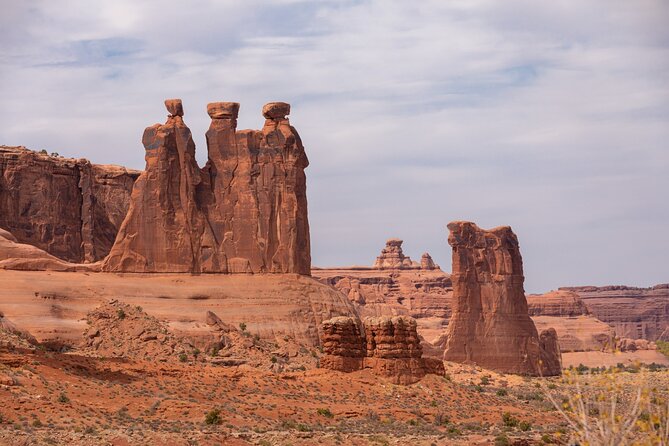
You then pass the Three Gossips, a group of upright sandstone towers that look like three figures leaning toward one another. The stop is free and takes about 10 minutes according to the suggested timing, though you can stay longer if the light is good.
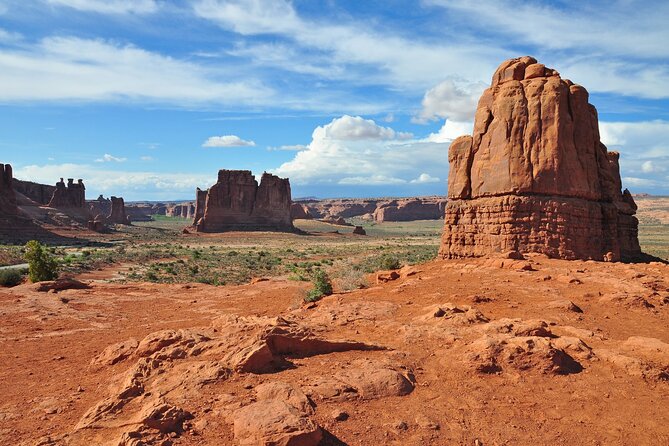
The route continues past the Organ, Courthouse, and Sheep Rock. These formations are easy to confuse when you are seeing them quickly from a moving car, so the narration helps you match names to shapes. You also pass the Petrified Dunes and Great Wall, with stories about Ute and Paiute traditions connected to the area.
The Windows, Cove of Caves, and Panorama Point

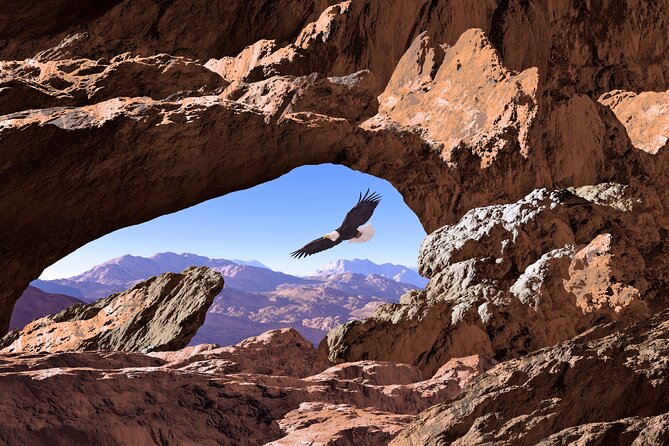
The Windows Road brings you to one of Arches’ most popular areas. The Windows are large openings created by erosion, and they are among the park’s essential stops. Plan on roughly 10 minutes at the suggested stop, but you can spend much longer if you walk farther around the formations.
Cove of Caves follows as a smaller but memorable sight. From the trail, you can see a cluster of arches and partial arches gathered together in one view. The stop is also listed at about 10 minutes, making it a useful quick break if your schedule is tight.
Panorama Point has two roles. During daylight, it gives you another broad view of the surrounding scenery. After dark, it can be a useful place to remember for stargazing, since the area has little light pollution. The narration also introduces Paiute approaches to reading the night sky.
The audio does a good job of mixing natural facts with human stories, but you still need to manage your own time. A seven to eight-hour day can cover both tours only if you drive between major stops and keep hikes short. Arches alone can easily fill a full day if you walk several trails.
Delicate Arch and the quieter Salt Valley

Delicate Arch is the headline stop. The route points you toward a short hike to the famous freestanding arch, but the product does not replace your need to judge trail conditions, water, heat, and your own ability.
If you only have time for a few major sights, this is one of the places to prioritize. The arch is not simply a roadside view, so check the tour’s hiking information before setting off and allow enough time to return to the car.
The drive then passes Salt Valley, a quieter area formed when sandstone domes collapsed. Broken rock scattered across the ground is part of that story. The stop gives the tour a welcome change of pace after the better-known arches.
You also pass the Fiery Furnace, a maze of narrow passages and tall red cliffs. The audio explains the geology and the role of the park’s advocates in preserving this area. It also returns to Ute and Paiute mythology, along with Spanish and Mormon settlement history.
At the far end of the Arches route, Devils Garden offers another major stop. The trail leads to Landscape Arch and continues beyond it. The route’s final stories tie together the park’s geology, cultural history, and conservation story.
More Driving Audio Tours in Moab:
- Full-Day Audio Driving Tour of Arches National Park
★ 4.5 · 27 reviews - Self Guided Audio Driving Tour in Arches National Park
★ 3.5 · 6 reviews - Goblin Valley Self Guided Driving Audio Tour
★ 4.0 · 4 reviews - Self Guided Audio Driving Tour of Canyonlands
★ 5.0 · 2 reviews
Canyonlands shifts from arches to huge open views
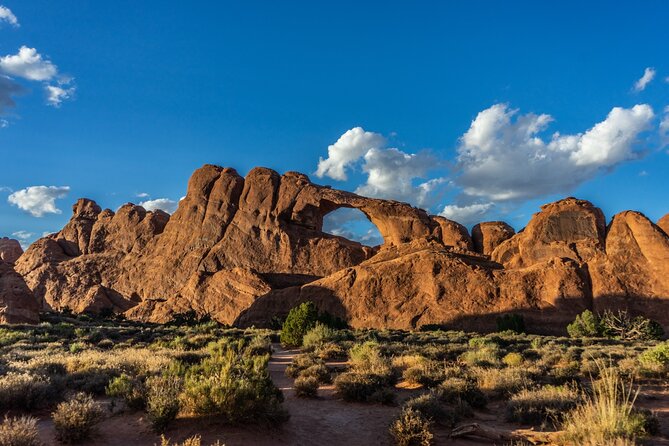
The Canyonlands portion feels different from Arches. Instead of focusing mainly on individual arches, it takes you through broad canyon views, mesas, rivers, and overlooks in the Island in the Sky area.
The road passes through Sevenmile Canyon, where tall rock walls initially block your view. As you emerge, you can look toward the Merrimac and Monitor, two distinct formations in the distance.
Big Mesa Viewpoint is a good pause for scenery. The mesa looks almost misplaced, as if someone set it down and forgot to move it. These short stops work well with the app because the audio tells you when to watch for them, rather than requiring you to study every road sign.
The route then discusses White Rim Road and biological soil crust. This living surface can look like ordinary dirt, but driving or walking across it can cause damage. You should stay on marked roads and trails, even when an unpaved shortcut seems harmless.
Dead Horse Point comes next. Local legend connects its name to wild mustangs that were corralled there and sorted by cowboys. The viewpoint is also a reminder to check exactly which park or attraction you are entering, since entrance charges and access rules can differ. The purchase does not include admission passes, tickets, or reservations.
The Canyonlands visitor center is a practical stop for water, restrooms, and supplies. Infrastructure is limited in this desert setting, so use the facilities when you can and carry enough water for every walk.
Mesa Arch, Green River Overlook, and the best viewpoints
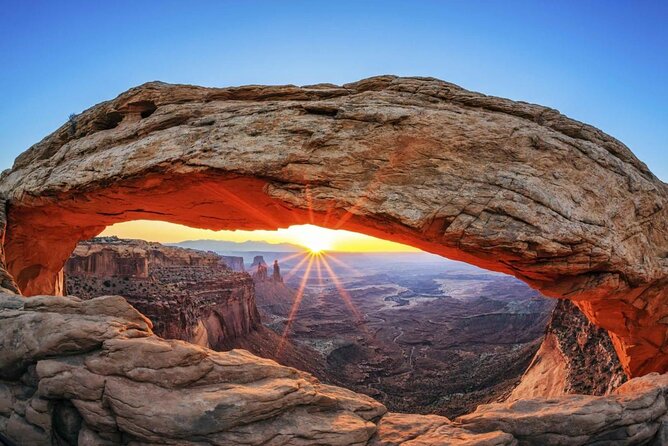
Mesa Arch is one of Canyonlands’ must-see stops. The short trail takes you through juniper and pinyon trees to the arch, with a broad view beyond it. The audio encourages you to notice these trees, which helps you read the plant life around other parts of the park.
The route also includes an overlook with views on three sides. If heights make you uneasy, this one may feel exposed because there is little between you and the canyon. The view is impressive, but the app cannot make a cliff edge feel less like a cliff edge, so take your time.
Green River Overlook offers a different kind of scene. You can trace the Green River as it cuts through the canyon system. The narration explains that the river runs about 730 miles and may have received its name from green soapstone along its banks.
Another stop leads toward old granaries built by Native peoples. You can see them from the base of the final hill, but approach carefully. These structures are hundreds of years old and should be treated as fragile cultural sites, not props for a closer photograph.
The audio also points out the park’s layered rock. Much of what you see was deposited over hundreds of millions of years and has remained relatively undisturbed. Candlestick Tower is an easy example to identify, with three broad color bands that resemble a cake topped with candles.
Murphy Point is reached by an easy trail of up to 3.5 miles round trip. The walk itself may feel plain compared with the viewpoint, but the overlook opens onto Stillwater Canyon and the Green River.
Buck Canyon Overlook is among the more accessible stops. The short trail is paved, and a rail separates you from the canyon edge. If you want a major view without an exposed rim, this is a sensible choice.
A picnic area near the end has only eight tables. If you find an empty one, it is a good place to rest and eat before finishing the route. The tour closes with a final Canyonlands message and points toward the Needles District, which is a separate option featuring Newspaper Rock, Pothole Point, and Wooden Shoe Overlook.
Price, timing, and what the $24.99 buys
At $24.99 per group of up to four, the pricing is one of the easiest reasons to choose this tour. If four people share a car, the cost is about $6.25 each. Even with two people, it remains inexpensive compared with a private guide or a scheduled bus experience.
The real value comes from control. You are not paying for a fixed departure, a set number of minutes at Delicate Arch, or a guide who must keep moving. You can use the audio for two or three hours per park, pause it for lunch, and return on another day.
The stated driving time for the overall experience is about seven to eight hours, while each individual park tour takes around two to three hours to complete. That does not include long hikes, meals, entrance lines, road delays, or extra time at viewpoints.
The lifetime access makes the price better for repeat visits. You could use Arches on one day, Canyonlands on the next, then replay sections later. The app can also help if you miss a stop, provided you return to the route.
Strengths and limitations from actual use
The strongest feature is the narration. It is clear, concise, and packed with geology, history, myths, and practical directions. You get more context than you would from trying to absorb every printed sign while keeping track of the road.
The GPS generally works even when cell service disappears. It can also adjust if you do not visit every stop in order. That flexibility is useful when a parking lot is full or you decide to skip a trail.
Still, the system is not flawless. Audio can cut off, replay on a return route, or sound strange when operating offline. Some timing appears based on older speed limits, so you may reach the next point before the story expects you to.
The best response is simple: download first, follow the suggested direction, connect the phone properly, and keep manual playback controls available. If the app becomes confused after a U-turn or side trip, pause it and relaunch the correct version from your planned starting point.
The tour is also a poor choice if you want a live guide who can answer questions in real time. It is an audio product, not a ranger talk. You will need to make your own decisions about weather, hiking, road conditions, water, and park rules.
Who should book this Moab driving tour?
I would recommend it for couples, families, and small groups sharing one car. It is especially useful when one person cannot hike, since the stories and major views can still be enjoyed from the vehicle.
It also suits first-time visitors who want help spotting formations and choosing worthwhile turnoffs. Families may appreciate the short stories and fun facts, while independent sightseers will like the ability to ignore the clock.
You should think twice if you are not comfortable downloading an app, entering a password, or troubleshooting basic audio problems. The product can be easy to use once set up, but setup is part of the experience.
Should you book it?
Book this tour if you want low-cost guidance, offline navigation, and freedom to explore Arches and Canyonlands without joining a group. The best reasons are the GPS-triggered stories, useful trail notes, and lifetime access for one carload.
Skip it if you expect a live human guide, guaranteed flawless playback, or park admission included in the price. For most independent visitors who prepare the app before leaving town, $24.99 is a sensible buy and a practical way to give two huge parks some structure.
FAQ
How much does the Arches and Canyonlands audio tour cost?
The price is $24.99 per group of up to four people. You purchase one tour for the car rather than paying separately for each person.
How long does the full experience take?
The overall experience is listed at about seven to eight hours. Each park tour covers more than 28 miles and takes roughly two to three hours to complete, not including extra hiking, meals, or extended stops.
Does the tour work without cell service?
Yes. You must download the tour while you have strong Wi-Fi or cellular service. After that, the maps and audio work offline.
Is anyone waiting at the starting point?
No. This is a self-guided activity, so no guide meets you at the start. You open the Action Tour Guide app at the starting point and follow the GPS-triggered stories.
What devices are recommended?
The tour recommends an iPhone using iOS 15 or later, an Android device using version 9 or later, or an iPad or tablet with GPS and cellular connectivity.
Are park entrance fees included?
No. Attraction passes, entry tickets, and reservations are not included. You need to arrange entrance tickets for Arches and Canyonlands through the official national park website.
Can I use the tour more than once?
Yes. The tour provides lifetime access with no expiry date. You can pause it, return to missed sections, use it over several days, and listen again on a future trip.
More Self-Guided Audio Tours in Moab
- Self Guided Audio Tour in Arches and Canyonlands
★ 4.5 · 16 reviews - Canyonlands National Park Self-Guided Audio Tour
★ 4.0 · 5 reviews - Utah Mighty 5 Adventure Bundle: 8 Self-Guided Audio Tours
★ 5.0 · 4 reviews - La Sal Mountain Loop Self-Guided Audio Tour
★ 3.5 · 4 reviews
Just added around Moab
- Utah Mighty 5 National Parks Self-Guided Driving Audio Tours★ 4.5 · 25 reviews
- Utah Mighty 5 Adventure Bundle: 8 Self-Guided Audio Tours★ 5.0 · 4 reviews
- Self Guided Audio Driving Tour in Arches National Park★ 3.5 · 6 reviews
- Goblin Valley Self Guided Driving Audio Tour★ 4.0 · 4 reviews
- Self Guided Audio Tour Bundle for Utah’s Mighty Five★ 5.0 · 3 reviews
- Delicate Arch Trail Self-Guided Audio Walking Tour★ 4.0 · 2 reviews
- Self Guided Audio Driving Tour of Canyonlands★ 5.0 · 2 reviews
- Self Guided Audio Tour in Arches and Canyonlands★ 4.5 · 16 reviews
Driving Audio Tours, compared.



Ultimate Acadia National Park Self-Guided Driving Audio Tour
Read our review →



Browse the lists this tour appears in