
REVIEW · ATHENS AUDIO TOURS
Half Day Ancient Corinth and Canal VR Audio Guided Tour
The canal is only the beginning. This small-group day trip from Athens joins the Corinth Canal, Ancient Corinth, and the old port of Kenchreai, with enough time to explore the archaeological site at your own pace. I like the comfortable air-conditioned bus and the clever VR audio system, which helps you picture ruined buildings as they once looked. I also like the unhurried three hours at Ancient Corinth. The main drawback is the confusing half-day label: the outing usually takes most of the day, and the VR device may occasionally need restarting.
The tour is especially useful if you want a simple way to reach the Peloponnese without renting a car. Guides such as Stefanos, Maria, Dido, Christopher, and Georgios have been praised for friendly explanations and good timing. Just remember that the Ancient Corinth entry ticket costs an extra €15, and the audio device provides much of the site commentary rather than a guide walking beside you.
Key points to know before booking
- The Corinth Canal is about one hour from Athens, with a 45-minute stop for photos, refreshments, and toilets.
- Ancient Corinth receives the largest share of time, about three hours, including the archaeological site and museum.
- The VR audio guide is self-paced, with visual reconstructions that show how the ruins may once have appeared.
- Kenchreai is a brief coastal photo stop, not a full archaeological visit.
- The advertised six hours can stretch longer, with some outings taking seven or nearly eight hours.
- The €38.10 price excludes the €15 Ancient Corinth admission, plus food and drinks.
Why Corinth makes a strong escape from Athens
Athens has more than enough to fill several days, but the city can become tiring. This excursion gives you a change of pace, open coastal views, ancient ruins, and a little road time without requiring you to plan connections across the Isthmus of Corinth.
The basic route is straightforward. You meet the bus at one of four central Athens points at 8:15 in the morning, ride in an air-conditioned vehicle, visit the canal, continue to Ancient Corinth, stop near Kenchreai on the return, and finish back in Athens.
The group limit is 20 people. That is large enough to keep the price reasonable but small enough for the escort to manage the day without the feel of a major coach operation. The bus matters in Greek summer. Several people specifically appreciated the strong air-conditioning and comfortable seats.
The price of $38.10 per person is good for transport, an English-speaking escort, and the VR audio system. It becomes less of a bargain once you add the €15 admission charge and lunch, but it remains a sensible choice for a full day outside Athens. A private car or taxi would cost much more, and public transport would require more planning and would not include the guided structure.
More History Audio Tours in Athens
- Athens: National Archaeological Museum Ticket w/ Opt. Audio
★ 4.4 · 713 reviews - Athens: Ancient Agora E-Ticket and Audio Tour
★ 3.9 · 413 reviews - Athens: Roman Agora & Ancient Agora E-ticket & 2 Audio Tours
★ 4.1 · 107 reviews
The Corinth Canal: an impressive 45-minute stop
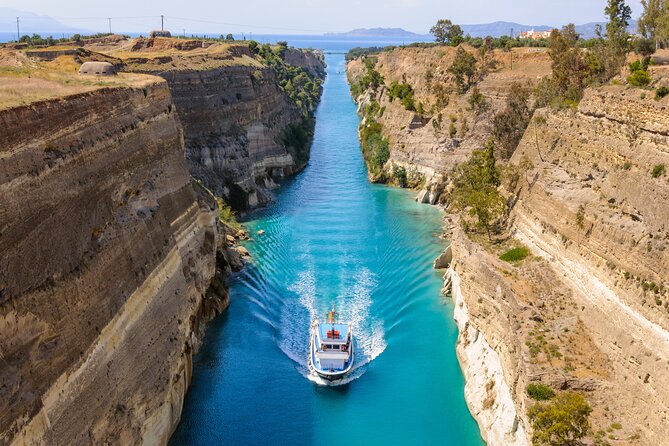
The first major sight is the Corinth Canal, roughly an hour from Athens. It cuts through the narrow Isthmus of Corinth, separating the Peloponnese from mainland Greece. In practical terms, the canal turns the Peloponnese into an island.
The numbers help explain why the view is so striking. The canal runs for more than six kilometers, is about 23 meters wide, and has near-vertical rock walls rising around 90 meters above the water. From the crossing, you look down into a narrow strip of blue water framed by pale stone.
The idea is ancient, but the finished canal is modern by Greek historical standards. A ruler of Ancient Corinth first conceived the project. Roman emperor Nero began work on it, and French engineers completed it in the 19th century. The canal also helped strengthen Piraeus as a major Mediterranean port.
You receive about 45 minutes here. That is enough for photos, a short look around, a drink, or a snack. Public toilets are available nearby. It is not enough time for a long meal, so I would save lunch for the village beside Ancient Corinth.
The canal is a quick stop, but it is not filler. It gives you a clear geographic key to the rest of the day. You can see why Corinth mattered: this narrow crossing controlled movement between central Greece and the Peloponnese, while the waterway later connected the Gulf of Corinth with the Saronic Gulf.
Ancient Corinth: three hours among Greek and Roman ruins
After about 30 minutes on the road, the bus reaches Ancient Corinth. This is the heart of the excursion, and the generous three-hour stay is one of its best features.
Ancient Corinth was a wealthy and important city in both Greek and Roman times. It was also the place where Greece made its final stand against Rome. After the defeat, the Romans destroyed the city and later rebuilt it as a Roman settlement, complete with theaters, a forum, and imperial temples.
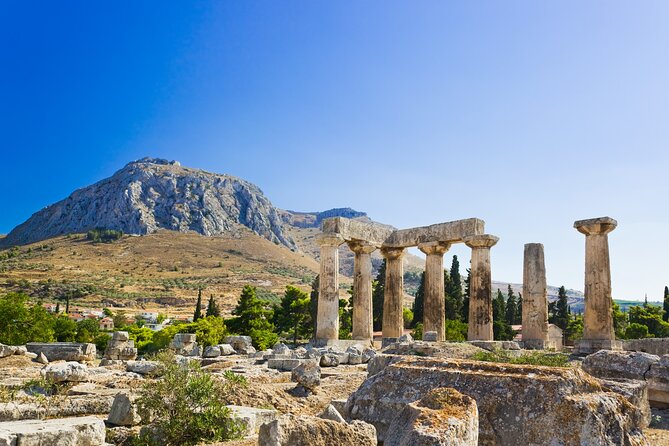
The Temple of Apollo is the great survivor. Its sturdy columns are among the most recognizable remains at the site, and they help you imagine the scale of the ancient city. You are not simply looking at one isolated monument. The ruins spread across an area that once supported public life, religion, trade, and administration.
Corinth also connects to several famous names. Jason of the Argonauts is associated with the city, as is the ancient writer Pausanias. St. Paul taught here, adding an important early Christian connection. Standing among the remains, you are walking through a place that mattered to Greek myth, Roman power, and Christian history.
The three-hour schedule lets you choose your own pace. You can move slowly, read the signs, visit the museum, and pause for photos instead of rushing from one column to the next. People who like to inspect inscriptions and stonework will appreciate this freedom. One visitor found three hours enough to see both the museum and ruins without hurrying.
The museum deserves your time. Do not treat it as an optional add-on if the doors are open. The outdoor remains can seem scattered until the displayed objects give them human scale. The museum helps explain what the buildings were for and how the city changed after Rome took control.
There is a village near the site where you can find a quick lunch or snacks. The food break fits neatly into the long stop, although you will need to watch the time if you want a full look at the museum and ruins.
How the VR audio guide works at the archaeological site
The VR system is the unusual feature here. You use a phone or provided device with earphones while walking through Ancient Corinth. It supplies maps, spoken explanations, and visual reconstructions of the ruins.
This approach solves a common problem at archaeological sites. A broken column rarely tells you what the original building looked like. The visual material gives you a better sense of the completed temples, public spaces, and Roman structures.
The audio is in English. Your escort gives background during the bus ride and helps set the scene, but the site visit itself is largely self-guided. If you expect a guide to walk from monument to monument delivering a live talk, this may disappoint you. The system is better described as a guided archaeological visit with personal pacing.
Most people find the device easy to use. Still, one practical weakness is worth noting: it can occasionally leave the tour program and require a restart. That may waste a few minutes. Bring patience, and if you have already read about Corinth, you can keep exploring while the device reconnects.
The audio quality has not pleased everyone. Some users found it useful and appreciated the reconstructed images, while another felt the written signs were more helpful. I would treat the VR program as an extra layer, not the sole reason to visit. The ruins, museum, and setting remain worthwhile even if the technology misbehaves.
More History Audio Tours in Greece
- Ancient Agora Self-Guided Tour with 3D & Audio (No Ticket)
★ 3.9 · 59 reviews - Athens National Archaeological Museum E-Ticket with Audio Guide
★ 3.0 · 57 reviews - Athens: Archaeological & Acropolis Museum Entry & Audio Tour
★ 4.3 · 21 reviews - Ancient Agora of Athens E-Ticket and Audio Tour
★ 3.5 · 5 reviews
A possible Acrocorinth view and the road back
The official route gives you the canal, Ancient Corinth, and Kenchreai. Some outings also include a photo opportunity connected with the castle or Acrocorinth, the high fortified site above the ancient city. Since the exact running order can vary, ask your escort early if that viewpoint is part of your day.
Acrocorinth is important because it overlooks the plain and the approaches to Corinth. Even from a photo stop rather than a full climb, the sight helps explain the city’s strategic position. Do not assume you will have time to tour the fortress itself. The stated plan focuses on photos, not an extended visit.
The return route follows the coast toward Kenchreai. This is a pleasant change from the inland archaeological site, and the drive gives you views of the Saronic side of Corinth’s territory.
Kenchreai: ten minutes at Corinth’s eastern port
Kenchreai was one of two ports serving the ancient city-state of Corinth. It handled eastern trade across the Saronic Gulf, while Lechaion on the Gulf of Corinth served routes heading west toward Italy and the rest of Europe.
The stop lasts about ten minutes. That means photos, a quick look, and little else. You will not have time for a detailed archaeological visit or a long walk along the shore.
Still, this short stop adds useful context. Ancient Corinth was not only a hilltop city with temples and forums. Its power depended on connections by sea. Seeing Kenchreai after the main site helps you understand how goods, people, and ideas moved through Corinth.
The final drive to Athens takes about an hour. Drop-off is available at the central meeting-point area, which is convenient if you want to continue sightseeing or return to your hotel on foot. The outing may run beyond the advertised six hours. Some schedules have taken nearly seven or even eight hours, so do not book a tight evening reservation.
Guides, timing, and the feel of the day
The escort can make a real difference because the driving time is long enough for useful commentary. Strong guides have included Stefanos, Vasilis, Yorgos, Dido, Maria, Christopher, Eleftheria, and Georgios. Their best contribution is not endless talking. It is clear orientation, practical timing, and the ability to explain what you are passing on the road.
The most praised guides are described as friendly, available, and well informed about both Corinth and the wider area. Stefanos, in particular, has been singled out for combining detailed explanations with an easy personal manner. Dido was appreciated for knowing when to give quiet time, which is a small but valuable skill on a long day.
You should expect the quality of commentary to vary slightly from one departure to another. The route is repeated often, and some guides may sound more practiced than lively. That is not necessarily a problem. You receive the most value when the escort handles pickup, timing, directions, and the bus ride well, while the VR system handles the detailed site material.
The trip begins at 8:15 a.m. and is offered in English. Confirmation arrives at booking, and service animals are allowed. Most people can participate, and the meeting points are near public transport. Free cancellation is available until 24 hours before the start time. After that, refunds and changes are not accepted.
Who will enjoy this Corinth excursion?
I would recommend it to you if you want to see Corinth without hiring a car, prefer a structured day, and like having time to explore independently. It also works well for a first visit because the route covers the canal, the main ruins, the museum, and the ancient port in one outing.
It suits history fans who enjoy Greek and Roman sites but do not want every minute filled with a live lecture. The self-paced format gives you room to stop for photographs, read inscriptions, or sit quietly among the remains.
Families and mixed-age groups may also appreciate the visual reconstructions. Children who lose interest in bare stones can better understand the original buildings through the VR images, although the three-hour archaeological stop may still feel long for very young children.
This is less suitable if you want a short four-hour outing, a fully guided walk, or a luxury vehicle with a private itinerary. It is also not ideal for anyone who dislikes devices or wants to spend the entire day at one archaeological site.
Should you book it?
Book this tour if you want a reasonably priced, well-paced route from Athens with dependable transport and a proper amount of time at Ancient Corinth. The canal is memorable, Kenchreai adds a useful coastal link, and the museum is worth protecting time for.
Go in with the right expectations. This is not strictly a half-day trip, and it is not a traditional guide-led tour inside the ruins. You will pay €15 extra for entry, may need to restart the audio device, and could return later than planned.
For me, the strongest reason to choose it is the balance: an impressive engineering site, a major ancient city, a port connection, free time, and an air-conditioned ride. If that combination sounds better than arranging Corinth on your own, the $38.10 base price is fair value.
FAQ
How long does the tour take?
The listed duration is approximately six hours, but some departures take seven or nearly eight hours. Allow most of the day, especially if you have evening plans in Athens.
What time does the tour start?
The start time is 8:15 a.m. Pickup is available from four central Athens meeting points.
Is the Ancient Corinth admission ticket included?
No. Admission to Ancient Corinth costs €15 per person and is paid separately. Food and drinks are also excluded.
Is the tour conducted in English?
Yes. The experience is offered in English and includes an English-speaking escort and an English VR audio guide.
How much time is spent at Ancient Corinth?
The planned visit lasts about three hours. This gives you time to walk through the archaeological site, visit the museum, and stop for lunch or snacks in the nearby village.
Can I cancel for a full refund?
Yes. You can cancel at least 24 hours before the local start time for a full refund. Cancellations or changes made less than 24 hours before departure are not accepted.
Just added around Athens
- Temple of Olympian Zeus: Self-Guided Audio Tour on your Phone (without ticket)★ 4.0 · 8 reviews
- Athens Ticket Pass: Acropolis & 6 Sites with 5 Audio Guides★ 3.5 · 84 reviews
- Ancient Agora of Athens: A Self-Guided Audio Tour★ 3.5 · 3 reviews
- Self Guided Tour In Athens With 100 Captivating Audio Stories★ 4.0 · 4 reviews
- Athens Hop-On Hop Off w/ Acropolis & Acr.Museum tickets & 3 audio★ 3.0 · 5 reviews
- E-ticket for Kerameikos with Audio Tour on Your Phone★ 5.0 · 4 reviews
- Athens Acropolis Museum Reserved Entry Ticket and Audio Tour★ 3.0 · 2 reviews
- Audioguided tour of Athens’ alternative neighbourhood of Exarchia★ 5.0 · 2 reviews
Historical Tours, compared.

Colosseum, Roman Forum & Palatine Hill with Audioguide App
Read our review →
St. Mark Basilica Ticket, Audioguide+History Gallery
Read our review →
Colosseum, Ancient Rome Tour or AudioGuided Tour
Read our review →
Colosseum, Roman Forum & Palatine Hill Entry and Audioguide
Read our review →
Taormina: Ancient Theater Skip-the-Line Ticket & Audio Guide
Read our review →
Colosseum, Roman Forum & Palatine Hill Visit + Audio Guide
Read our review →
National Archaeological Museum Ticket & Audio Guide
Read our review →
Roman Forum Super Pass Entry with Audio Guide App
Read our review →Browse the lists this tour appears in