REVIEW · ITALY AUDIO TOURS
Tivoli: Entrance Ticket to Villa Adriana & App Audioguide
Roman power is easiest to grasp in the ruins. Villa Adriana gives you a rare look at Emperor Hadrian’s enormous country retreat near Tivoli, where polished marble, clever engineering, baths, libraries, pools, and gardens once formed a private imperial world. I like the Maritime Theater, with its round pool and artificial island, and the chance to wander through a full square kilometer of Roman remains rather than a single restored building. The $19 price is fair for the entry and digital audioguide.
I also like the open-air setting and the surviving mosaics, especially if you enjoy ancient engineering more than polished museum displays. The main drawback is that this is a large archaeological site with no transportation or live guide included, so you need comfortable walking shoes, a printed voucher, and enough time to make sense of the ruins.
Key points to know before visiting

- Hadrian’s private escape: The villa was built as a country retreat because the emperor disliked living on Rome’s Palatine Hill.
- More than 30 ancient buildings: The grounds cover about one square kilometer, and much remains unexcavated.
- The Maritime Theater: A circular portico surrounds a pool with an artificial island and former private rooms.
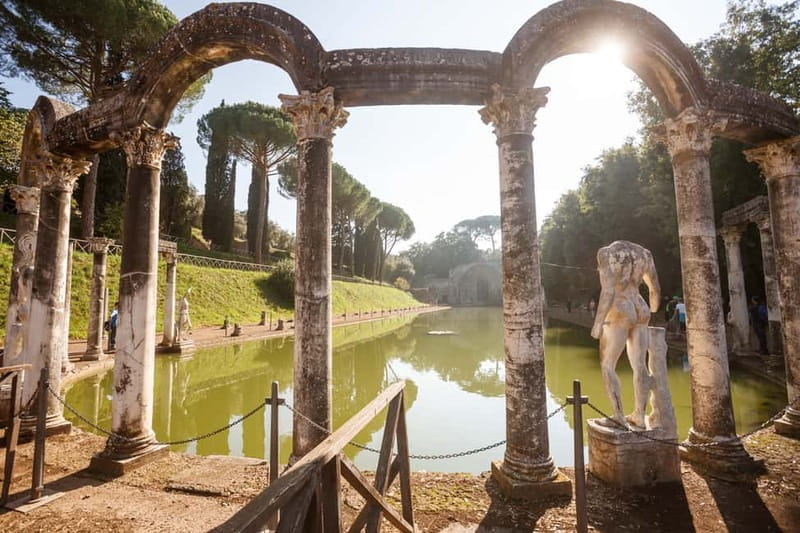
- Canopo and Serapeum: A long pool, statues, and an artificial grotto create one of the site’s most striking areas.
- Digital guidance, not a live tour: Your ticket includes an audioguide, but not a guide leading you around.
- Bring light luggage: Security checks are required, and rucksacks, suitcases, and large bags are not allowed inside.
Why Villa Adriana is worth the trip from Rome
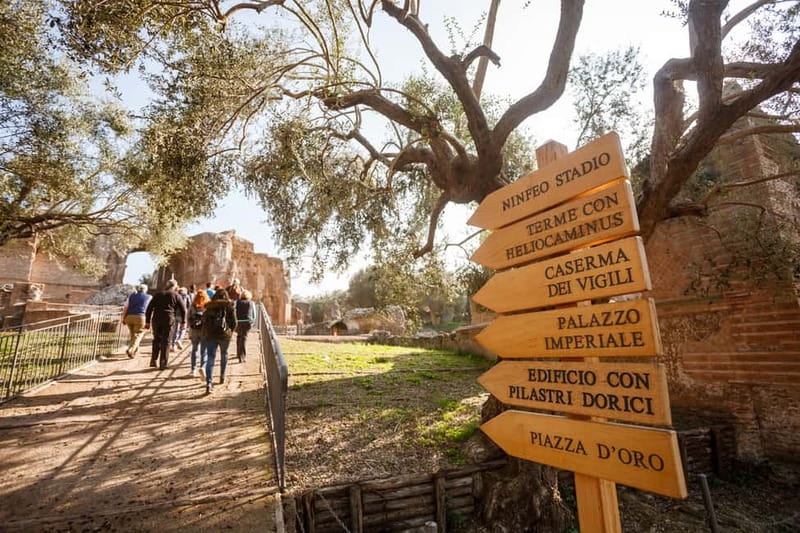
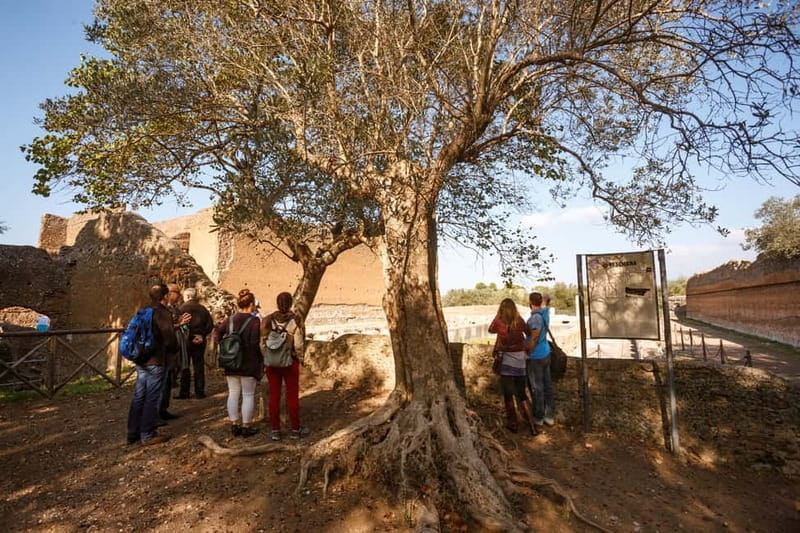
Villa Adriana is not a single villa in the modern sense. It is a huge Roman complex, built as an imperial residence and retreat in Tivoli, east of Rome. The remains spread across about one square kilometer, with more than 30 known buildings and large sections still below ground.
That scale changes the experience. At many Roman sites, you look at one temple, one forum, or one surviving house. Here, you begin to see how an emperor’s world worked as a complete system. There were baths, libraries, reception spaces, private apartments, theaters, pools, fountains, gardens, and religious areas.
I find the site especially valuable because it shows Roman architecture as an experiment. Straight walls remain remarkably precise. Curves, domes, vaults, and water channels reveal a level of planning that can be easy to forget when you are focused only on famous statues and columns.
The setting also helps. You are not walking through a modern city street with traffic pressed against every ruin. You move through extensive grounds where the remains are spread out. That gives you room to picture the villa as a working imperial retreat rather than a collection of disconnected stones.
Still, the open layout requires effort. You will not see everything in a quick half-hour visit. Plan on at least two hours if you want to cover the main areas and listen to the audioguide without rushing. Anyone who enjoys ancient sites should allow more time if possible.
A few more audio tours around Italy worth a look
- Rome: Pantheon Fast-Track Ticket and Official Audioguide
★ 4.5 · 27,353 reviews - Rome: Colosseum & Forum with Audio Guide App -Optional Arena
★ 4.2 · 24,770 reviews - Florence: Timed Entry to Michelangelo’s David + Audio App
★ 4.6 · 19,496 reviews
Start at the ticket office with your printed voucher
The practical beginning is simple, but do not overlook it. You exchange your voucher at the Villa Adriana ticket office, then pass through the security check before entering. The ticket provides skip-the-ticket-line access, which can save time at the entrance.
A printed voucher is required, so do not rely only on having the booking stored on your phone. Keep the paper easy to reach. The experience is valid for one day, with the available starting times shown when you book.
Security rules matter here. Rucksacks, suitcases, and large bags are not permitted inside the attraction. Pack lightly and avoid arriving with luggage from a hotel change or train journey. A small personal bag may be more practical, but the supplied information specifically warns against large bags and backpacks, so it is wise to keep your belongings minimal.
There is no transportation included. You arrange your own way to Tivoli and make your own way back after the visit. That makes this a good add-on for a day already planned around Tivoli, but less convenient if you want a fully managed excursion from Rome.
The Maritime Theater shows Hadrian’s private side
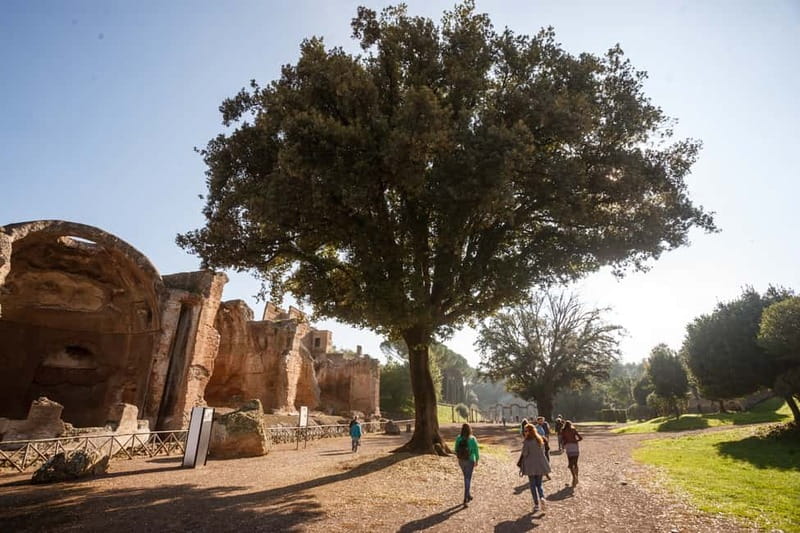
Make the Maritime Theater one of your first major stops. It is among the most memorable structures at Villa Adriana because its shape and purpose are so unusual.
The building is a round portico with a barrel vault supported by pillars. Inside, a pool surrounds an artificial island. The island was linked to a private set of rooms, including a lounge, library, heated baths, three suites with heated floors, a washbasin, an art gallery, and a large fountain.
That list tells you more than the word villa ever could. This was not simply a country house with a pleasant view. It was a private retreat designed around comfort, privacy, art, and water. Hadrian could withdraw from official life without giving up the comforts of an imperial residence.
The round design also gives the place a different feeling from the straight halls and courtyards elsewhere on the grounds. Look at how the portico frames the pool. The water was not just decoration. It helped create a calm, enclosed setting at the center of a complex built on a grand scale.
The surviving structure is incomplete, of course. You need to use the audioguide and your imagination to connect the remaining walls with the rooms that once stood there. That is one reason the digital guide is useful. It gives you a sequence and context while you walk, even though it cannot answer questions or adjust the pace like a live guide.
Canopo and Serapeum bring the grandest water features
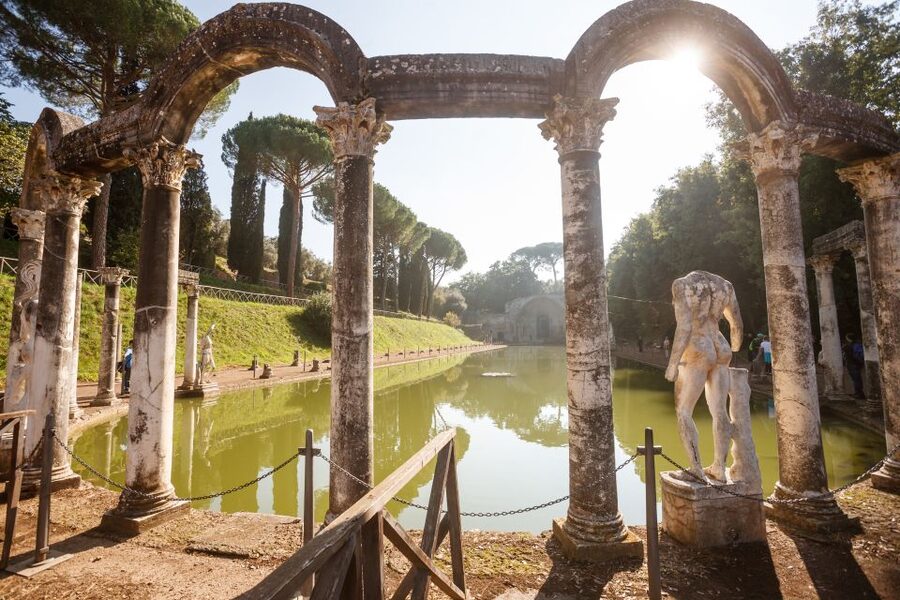
The Canopo is one of the site’s most impressive open spaces. It is a large rectangular pool surrounded by sculptures. The long water feature creates a strong sense of ceremony and scale, even in its ruined condition.
As you walk around it, notice how the pool organizes the space. The sculptures and surrounding architecture were not placed randomly. The area was made for display, movement, and controlled views. It is easy to understand why water played such a large role in Roman luxury architecture.
At one end, you find the artificial grotto of the Serapeum. This unusual structure adds another layer to the Canopo. The grotto was designed as part of the pool complex, giving the area a more theatrical finish.
You should not expect every sculpture to remain in its original place or every surface to look complete. Villa Adriana has survived as an archaeological site, not as a fully reconstructed palace. That is part of its appeal, but it also means the experience rewards patience. Let the audioguide explain what you are seeing, then spend a few minutes looking without it.
The Canopo is also a good place to understand the difference between a quick photo stop and a meaningful visit. A photograph can record the pool and statues. It cannot fully show how the water, long lines, open sky, and surrounding ruins worked together.
Same place, a different route to walk:
- Rome: City Sightseeing Hop-on Hop-off Bus with Audioguide
★ 4.0 · 16,045 reviews - Pompeii: Entry Ticket with Audio Guide
★ 4.1 · 13,491 reviews - Venice: La Fenice Opera House Entry Ticket with Audio Guide
★ 4.6 · 11,742 reviews - Rome: Colosseum, Forum, Palatine Hill Entry & Audioguide App
★ 4.4 · 10,957 reviews
Mosaics and statues add human detail
The scale of Villa Adriana can feel overwhelming. The smaller surviving details help bring it back to human size.
You can see mosaics connected with the theater and baths, as well as mosaics in the area identified with a hospital. Their value is not only decorative. They show the care that went into surfaces people walked across every day, even in service or treatment areas rather than grand reception rooms.
The mosaics are also a useful reminder that Roman buildings were not bare stone boxes. Many spaces were colorful, patterned, and carefully finished. The ruins often look stark now because paint, furnishings, roofs, and much of the marble have disappeared.
Look for references to marble statues of Antinous, Hadrian’s deified lover. Antinous was an important figure in Hadrian’s life, and his presence here adds a personal note to a site otherwise dominated by state power and architectural display.
You may find it helpful to divide your attention between major structures and small remains. Start with the large pools, theaters, and buildings to understand the plan. Then slow down near mosaics and statues to see how ordinary rooms were decorated and used.
The grounds reward a slower walking pace
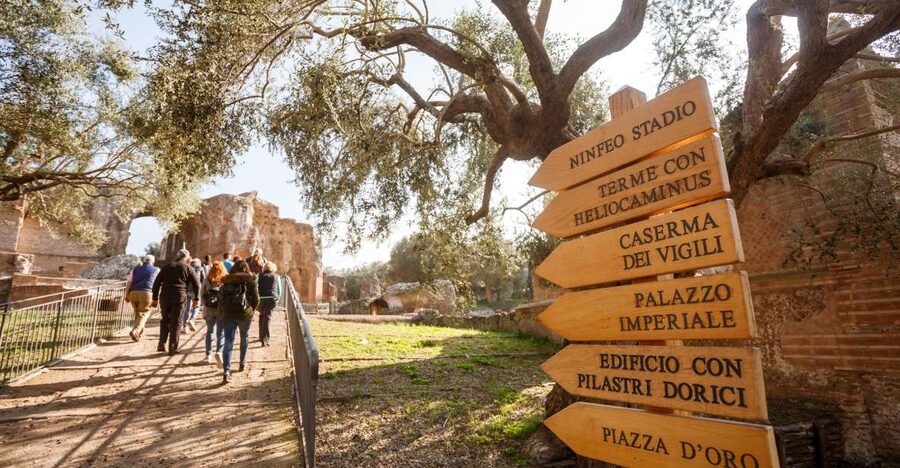
The main challenge at Villa Adriana is its size. The ruins are spread across extensive grounds, and the site includes far more than the most photographed areas. You will walk between buildings, courtyards, water features, and open areas where only fragments remain visible.
I would wear comfortable shoes and avoid planning another tightly scheduled activity immediately afterward. The site is valid for one day, but that does not mean you should treat it as a quick timed attraction. A rushed visit can turn a remarkable complex into a blur of walls and names.
The unexcavated sections are part of the story. Much of the area has not been explored, so the visible remains represent only part of what lies beneath the ground. That can be frustrating if you want a complete picture, but it also gives the site a sense of unfinished discovery.
Use the digital audioguide as a thread through the grounds. Without some structure, you may see the largest ruins but miss why they mattered. The guide can help separate a private suite from a public hall, a bath from a decorative pool, and a religious feature from a garden element.
There is no live guide included, so the experience suits people who like to set their own pace. If you want constant explanation, questions answered on the spot, and a fixed route, you may prefer a guided tour purchased separately.
How the $19 price works for you
At about $19 per person, this is a good-value entry ticket for anyone interested in Roman architecture, engineering, or archaeology. You receive admission to a UNESCO World Heritage Site and a digital audioguide, which is enough for an independent visit without paying for a private guide.
The value improves if you stay for at least two hours. A very short visit would make the ticket feel less worthwhile because the site’s strongest quality is its breadth. You are paying to see a whole imperial complex, not just one famous object.
The price does not include transportation, so factor that into your day. It also does not include a guided tour. For some people, that keeps the cost pleasantly low. For others, the lack of transport and personal explanation may make a more organized excursion a better choice.
A useful bonus is the Pemcard option. You can create a digital photo and send it as a real postcard to an address anywhere in the world. It is a small extra rather than a reason to book, but it gives you a more personal souvenir than another image buried on your phone.
Who will enjoy this experience most
I would recommend Villa Adriana to you if you like ruins that require some imagination. The site is best for people who enjoy connecting fragments, comparing architectural forms, and thinking about how a large complex once functioned.
It is also a strong choice for anyone who has already seen Rome’s central monuments and wants a quieter change of setting. The villa shows a different side of the Roman world: not the crowded political center, but the private retreat of the man who ruled it.
Families with older children may find the pools, tunnels, domes, and unusual buildings more engaging than a long museum visit. The grounds give young visitors room to move, though the size means adults should plan the route and pace carefully.
You may want another option if you dislike walking through broad archaeological grounds, need a live guide, or are carrying substantial luggage. The site is also not ideal as a casual stop between tightly timed activities. Give it room in your schedule.
Small details that can make the visit better
Keep your printed voucher ready at the ticket office. The skip-the-line benefit is useful only if you can complete the exchange quickly and follow the entry process.
Bring as little as possible. Large bags, rucksacks, and suitcases are not allowed, and the required security check adds another step before you enter.
Start with the main landmarks, especially the Maritime Theater and Canopo, then use the audioguide to fill in the less obvious buildings. This gives you a clear framework before you spend time among smaller ruins and mosaics.
Allow at least two hours. If you want to listen carefully, photograph the main areas, and pause at the engineering details, three hours may feel more comfortable than two.
Finally, do not judge the site only by its most intact walls. Some of the best evidence of Roman skill is in the geometry, vaults, baths, water systems, and surviving floor decoration. The grandeur is spread across the grounds.
Should you book Villa Adriana?
Book this experience if you want a self-guided look at one of the Roman world’s largest and most inventive imperial residences. The combination of a low entry price, digital audioguide, Maritime Theater, Canopo, mosaics, statues, and open grounds offers strong value for a half-day visit.
I would skip it only if you have limited time, cannot manage a large walking site, or need transportation and a guide bundled into the price. For everyone else, Villa Adriana is one of the best ways to see Roman luxury and engineering away from Rome’s crowded center. Bring the printed voucher, travel light, and give the ruins enough time to make sense.
FAQ
How much does the Villa Adriana ticket cost?
The ticket costs $19 per person.
How long is the ticket valid?
The ticket is valid for one day. You should check availability for the starting times offered when booking.
What does the ticket include?
It includes entry to Villa Adriana and a digital audioguide.
Is transportation to Villa Adriana included?
No. Transportation is not included, so you must arrange your own way to and from Tivoli.
Is a guided tour included?
No. The ticket provides a digital audioguide, but it does not include a live guided tour.
Where do I begin the experience?
You begin by exchanging your voucher at the ticket office of Villa Adriana.
Do I need a printed voucher?
Yes. A printed voucher is required for the visit.
Can I bring a suitcase or large backpack?
No. Rucksacks, suitcases, and large bags are not permitted, and you must pass through a security check before entering.
Just added around Italy
- Torino Walking Tour with Audio and Written Guide by a Local★ 4.5 · 35 reviews
- Medieval Canals and Fountains: A Treviso Self-Guided Audio Tour★ 4.5 · 4 reviews
- Trapani Walking Tour with Audio and Written Guide by a Local★ 4.0 · 8 reviews
- Trento Walking Tour with Audio and Written Guide★ 4.5 · 11 reviews
- Sicily: Selinunte Park Entry Ticket & Sicily Digital Audio Guide★ 4.5 · 4 reviews
- Taormina Walking Tour with Audio and Written Guide by a Local★ 4.5 · 41 reviews
- Taranto Walking Tour with Audio and Written Guide by a Local★ 5.0 · 5 reviews
- Siracusa Walking Tour with Audio and Written Guide by a Local★ 5.0 · 59 reviews
Italy Audio Tours, compared.

Pantheon Fast-Track Ticket and Official Audioguide
Read our review →
Colosseum & Forum with Audio Guide App -Optional Arena
Read our review →
Timed Entry to Michelangelo’s David + Audio App
Read our review →
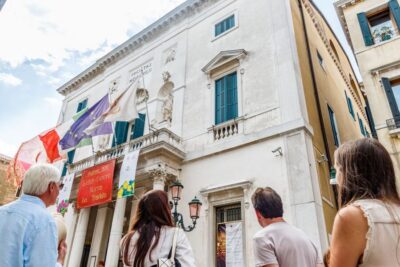
La Fenice Opera House Entry Ticket with Audio Guide
Read our review →
Colosseum, Forum, Palatine Hill Entry & Audioguide App
Read our review →
St. Peter’s Basilica & Dome Entry Ticket & Audio Tour
Read our review →