
REVIEW · CROATIA AUDIO TOURS
Split: City Walk with Audio Guide in 7 Languages on your Phone
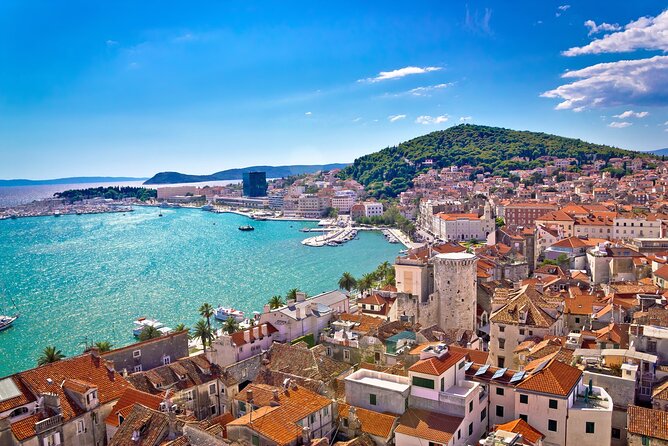
Split rewards curious walkers. This phone-based audio tour covers 2.5 kilometers and 24 stops, linking Roman ruins, waterfront views, and busy city squares in about two to three hours. I like the low price and the freedom to pause, take a drink break, or visit a museum before finishing by the end of the next day.
I also like that the app offers audio in seven languages and uses GPS guidance instead of tying you to a group schedule. The main caution is navigation. One detailed assessment found the narration informative and enjoyable but said directions sometimes left the listener wandering, so bring headphones, keep your phone charged, and be ready to check the route yourself.
Key points to know before you walk

- Twenty-four stops over 2.5 kilometers: A compact route gives you a useful first look at central Split without taking a full day.
- Diocletian’s Palace is the core attraction: You pass through the palace area and hear about its Roman origins, but entrance fees are not included.
- The tour starts and ends on the Riva: That makes it easy to connect with a waterfront meal, a harbor stroll, or another Split activity.
- GPS audio on your own phone: You walk privately, at your own pace, with no guide or group to follow.
- Flexible finishing window: The usual walk takes two to three hours, but you have until the end of the next day to complete it.
- Navigation needs attention: The audio is useful for context, but it may not provide perfect turn-by-turn directions.
A self-guided way to meet Split
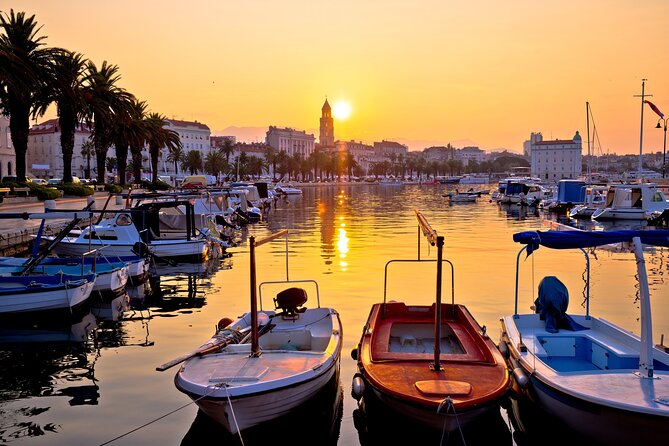
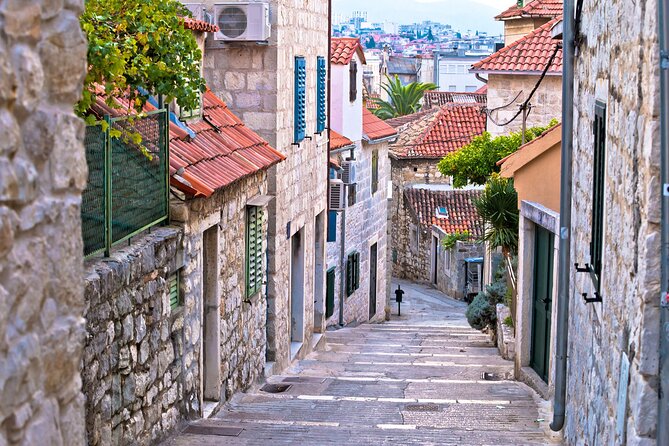
Split is a city where ancient stone and ordinary daily life share the same narrow streets. Roman walls can frame a café, a market lane can lead toward a palace courtyard, and a waterfront promenade can become the evening meeting place for the whole city.
This walking tour gives you a simple route through that mix. You start at Splitska Riva, the palm-lined waterfront, then move through the central sights before returning to the same meeting point. That makes the route easy to fit into a day of sightseeing, especially if you are staying near the old center or arriving with limited time.
The tour costs $9.07 per person, which is a modest fee for a private audio walk. You are not paying for a live guide, attraction admission, or transport. You are paying for the app, recorded commentary, and GPS assistance. For a first orientation, that is good value. If you want detailed conversation, local recommendations, or help finding every turn, a live guide would offer more.
The experience is private in the basic sense that only your own group takes part. You do not wait for other participants, and you can pause the audio when you want. That freedom matters in Split, where a short walk can easily turn into a stop for coffee, photographs, or a look inside a church or museum.
More Multilingual Audio Guides in the world:
- Athens: Acropolis Ticket with Multilingual Audio Guide
★ 3.9 · 926 reviews - Geiranger: Bus Tour with Multilingual Audio Guide
★ 4.0 · 317 reviews - Sightseeing Cruise on the Danube with Audio Guide in Budapest
★ 3.5 · 229 reviews
Starting on the Riva waterfront
The Riva is a strong place to begin. This waterfront promenade runs beside Split’s harbor, with palm trees, cafés, shops, and views across the Adriatic. It is also one of the city’s main social spaces, so you begin with a sense of how Split functions today, not just how it looked in Roman times.
The route both starts and ends here. That is practical because you do not need to find a separate return point or arrange transport at the end. You can finish the walk and remain on the Riva for a meal or a slow look at the harbor.
The promenade also gives you a useful reference point before entering the older streets. Listen for the first instructions here, and make sure the app has access to your phone’s internet connection and GPS. The audio tour depends on both.
Your phone is not included, and neither are headphones. You need to bring both. Headphones are especially helpful near cafés and waterfront traffic, where outside noise can make recorded narration harder to hear.
Walking through Diocletian’s Palace

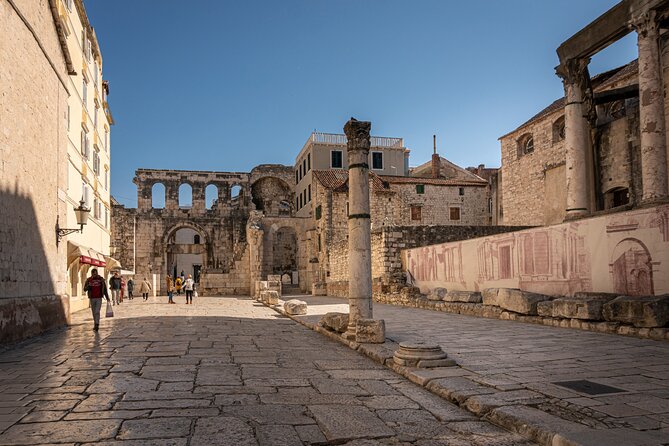
The main historical focus is Diocletian’s Palace, a Roman complex built in the early fourth century as the retirement residence of Emperor Diocletian. It is not an isolated monument behind a gate. Much of the palace area forms the living center of Split, with streets, restaurants, shops, homes, and cultural sites built into and around the old structure.
That is what makes this stop valuable. You are not simply looking at Roman walls from a distance. You get to understand how an ancient imperial residence became part of a modern Croatian city. The maze-like plan can be confusing, but it also gives the walk its character.
The audio commentary should help you place the palace within Split’s story, while GPS prompts guide you from one point to the next. Still, keep your eyes on the phone map. The most important practical weakness of this experience is that the navigation may not always feel like exact turn-by-turn guidance.
You pass the palace landmarks rather than entering them as part of the tour. Admission fees are not included, and the route does not promise entry to museums or other paid attractions. That keeps the price low, but you should budget separately if you want to go inside anything you discover.
If you plan to add a museum stop, the flexible format helps. The normal route takes two to three hours, but you have until the end of the next day to finish it. You can pause the tour, explore an attraction on your own, and return to the audio route afterward.
Meeting Grgur Ninski

One of the most recognizable stops is the Statue of Grgur Ninski, a large bronze work by Croatian sculptor Ivan Meštrović. It honors Grgur Ninski, a tenth-century bishop associated with the use of the Croatian language in religious services.
The statue is also a small piece of local ritual. People rub its big toe for good luck, leaving that part of the bronze noticeably polished. It is the sort of detail an audio walk can explain well because it connects the monument to a custom you might otherwise miss.
This stop gives the route more than Roman background. Split’s story includes Croatian religious and cultural figures as well as imperial architecture. The statue helps shift your attention from the palace as a relic to the city as a place with its own national identity.
Because the route has 24 stops, the statue is one piece of a larger sequence rather than a long standalone visit. You can pause for a photograph, listen to the commentary, and continue when ready. If you are walking with children, the toe-rubbing tradition may give them a simple activity during a history-focused section.
More Smartphone Audio Tours in the world:
- Rome: Colosseum & Forum with Audio Guide App -Optional Arena
★ 4.2 · 24,770 reviews - Florence: Timed Entry to Michelangelo’s David + Audio App
★ 4.6 · 19,496 reviews - Florence: Cathedral & Brunelleschi’s Dome Ticket & Audio App
★ 4.4 · 6,973 reviews - Florence: Michelangelo’s David Priority Ticket & Audio App
★ 4.4 · 6,812 reviews
Returning to the Riva and seeing Republic Square
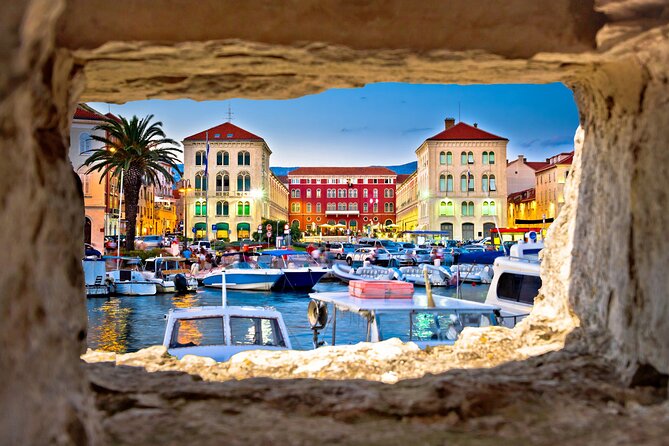
After the palace area, the route brings you back toward the public spaces that shape modern Split. The Riva Promenade is more than a scenic harbor path. It is a gathering place lined with cafés and shops, framed by historic buildings, and used by both residents and visitors.
The audio tour lets you see the Riva in relation to the old center. That connection matters. You begin with the sea and harbor, move inland through Roman streets, and then return to the waterfront. The walk has a clear physical shape rather than feeling like a string of unrelated stops.
Republic Square, known locally as Trg Republike, adds another layer. The square is associated with Split’s cultural and social life, and its Prokurative buildings give it a formal architectural setting. Nearby, you can find the Renaissance-style City Hall, the Croatian National Theatre, and Marmont Street.
This section should appeal to you if you want more than ancient monuments. Republic Square shows how Split uses open civic spaces for events, performances, and celebrations. It also provides a good contrast with the tight lanes around Diocletian’s Palace.
As with the other stops, the experience takes you past the sights rather than providing admission. You can admire the buildings, listen to the explanation, and decide later if you want to return for a performance or an indoor visit. The app provides orientation, not a ticket package.
How the GPS audio format works
The tour is designed for your own smartphone. After booking, you receive separate instructions for activating the self-guided walk. You need an internet connection and GPS enabled on your phone, so check those settings before starting at the Riva.
The audio is available in seven languages. At the same time, the experience information lists English as the offered language, so I would confirm your preferred language during booking and activation. That small check can prevent frustration once you are standing at the starting point.
The GPS feature should trigger or support the commentary as you reach different places. It is useful for keeping the route moving, but it should not be treated as a perfect walking navigator. The most useful approach is to combine the narration with your phone’s map and nearby street signs.
A good routine is simple:
- Download or activate the app before you reach the Riva.
- Bring headphones and make sure your phone has enough battery.
- Listen for the next stop before walking away from the current one.
- Pause the audio when you need to check the map.
- Leave extra time if you plan to enter a museum or stop for a drink.
The walk covers only 2.5 kilometers, so the physical distance is manageable for most people. The bigger challenge is attention. Split’s old center has irregular streets and many distractions, and the route may require more active navigation than a guided group tour.
Who gets the best value for $9.07
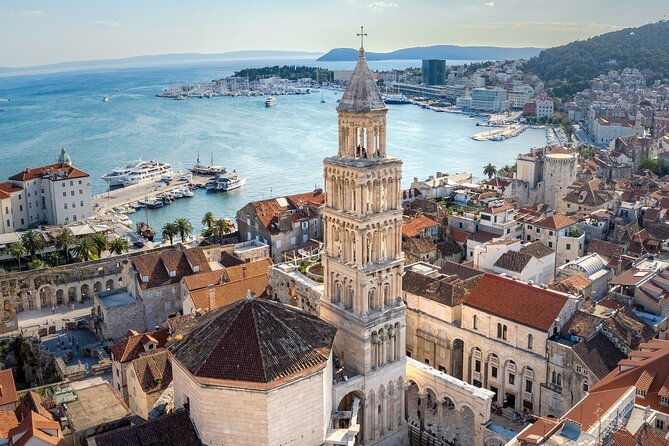
At $9.07 per person, this is priced for travelers who want structure without paying for a private guide. I think it works best as a first introduction to Split, especially if you have two or three hours and want the main sights explained in a sensible order.
It is also useful for couples, families, or small private groups who dislike fixed departure times. Group discounts may make it even better for several people traveling together. You can stop when someone needs a break and continue without holding up another group.
The tour is less suitable if you want expert conversation or detailed help inside monuments. There is no live guide to answer questions, adjust the route, or explain a confusing corner in person. The narration is informative, but the format depends on you managing the technology and directions.
The low price also reflects what is not included. You provide the smartphone and headphones, and you pay separately for any attraction admission. If you already plan to visit several museums, you may find that a live walking tour with included entry offers better value, though that would be a different kind of experience.
Timing, breaks, and practical planning
The average walking time is two to three hours. That estimate is realistic for the route itself, but your day can last longer if you pause for photographs, food, shopping, or a museum visit.
The generous completion window is one of the strongest features. You have until the end of the next day, so you do not need to rush through every stop. For example, you can begin in the afternoon, stop for dinner, and continue later, provided you finish within the stated period.
That flexibility is especially useful in warm weather. Split has a Mediterranean climate, and a pause in a café can make the walk more pleasant. The route’s short distance means you can break it into sections without losing too much ground.
Book at least a day ahead if your plans are firm, since the experience is commonly reserved several days before the chosen date. Confirmation arrives at booking, and activation instructions come in a separate email. Save those instructions before you leave your accommodation.
Free cancellation is available when you cancel at least 24 hours before the scheduled start time. Changes or cancellations inside that window are not accepted for a refund, so pay attention to local time when adjusting your plans.
The main drawback: navigation is not always exact
The audio content receives the clearest praise. One assessment described the tour as fun and informative, while also pointing out that the directions could be much better. The listener wanted more turn-by-turn guidance and sometimes ended up unsure where to go.
That is not a minor point in Split’s old center. Narrow lanes, courtyards, and intersecting passages can make a route less obvious than it looks on paper. GPS can help, but phone positioning is not always precise among dense buildings.
I would treat the experience as an audio guide with route support, not as a hands-free navigation system. If you enjoy a little independence and do not mind checking a map, this is manageable. If getting lost would spoil your afternoon, choose a live walking guide or prepare to use your phone’s standard map alongside the app.
Should you book this Split audio walk?
Book it if you want an inexpensive, flexible introduction to Split’s central sights. The route covers the Riva, Diocletian’s Palace, Grgur Ninski’s statue, and Republic Square, while the seven-language audio and private format let you set your own pace.
Skip it if you want entry to the palace attractions, a live person answering questions, or flawless turn-by-turn directions. For most independent visitors, the best way to use it is as a well-priced orientation walk, with headphones, a charged phone, and a little patience when the route needs help.
FAQ
Where does the Split audio tour start and finish?
It starts at Splitska Riva in Split and ends back at the same meeting point.
How long does the walking tour take?
The usual walking time is about two to three hours. You have until the end of the next day to complete it, allowing time for breaks, a museum visit, or a drink.
How far do you walk?
The route covers approximately 2.5 kilometers and includes 24 stories or stops.
Is a smartphone included?
No. You must bring your own smartphone. The tour also requires an internet connection and GPS access on your phone.
Are headphones provided?
No. You should bring your own headphones.
Are attraction entrance fees included?
No. You pass by the landmarks, but admission fees for attractions are not included.
More Audio Walking Tours in the world
- Sofia: City Monuments Guided Walking Tour with Audio Guide
★ 4.5 · 825 reviews - Florence: 2.5 hour Audio Guided Walking Tour led by Host
★ 4.6 · 293 reviews - Self Guided Classic Freedom Trail Location Aware (GPS) Walking Audio Tour
★ 4.5 · 258 reviews - Valletta: Self-Guided Historical Walking Tour (Audio Guide)
★ 3.7 · 251 reviews
Just added around the world
- Coba Ruins: Self-Guided Walking Audio Tour in Mexico★ 3.5 · 2 reviews
- Self Guided Driving Audio Tour of Saguaro National Park★ 3.0 · 4 reviews
- Torino Walking Tour with Audio and Written Guide by a Local★ 4.5 · 35 reviews
- Self-Guided Audio Driving Tour of Mount Lemmon★ 5.0 · 4 reviews
- Trondheim’s Inner Circle: A Self-Guided Audio Tour★ 4.0 · 15 reviews
- A Tromsø Introduction: A Self-Guided Audio Tour★ 3.5 · 19 reviews
- Panorama Bus Tour with Audio Guide★ 4.0 · 3 reviews
- Saguaro National Park Self-Guided Audio Tour★ 3.5 · 11 reviews
Multilingual Audio Guides, compared.

Geiranger: Bus Tour with Multilingual Audio Guide
Read our review →
Sightseeing Cruise on the Danube with Audio Guide in Budapest
Read our review →

Castel Sant’Angelo E-Ticket & Multilingual Audio Guide
Read our review →
Best Of – with Tour Leader & Multilingual Audio Guide
Read our review →
Chiva Private Cultural Tour with Audio Guide in Buga
Read our review →
Acropolis Museum E-Ticket and Multilingual Audio Guide
Read our review →Browse the lists this tour appears in