
REVIEW · ROME AUDIO TOURS
Rome:Ostia Antica Skip-the-line Ticket & Audioguide
Ancient Rome feels different at its old harbor. Ostia Antica gives you wide-open ruins, mosaics, baths, homes, and theaters without the crush of central Rome. I like the chance to see Roman life beyond emperors and monuments, and I like that the downloadable audio guide comes with an interactive map to help you find your way around the large site.
The main drawback is value. The ticket costs $31, while the stated official admission is €18, and the skip-the-line benefit may be small on a quiet day. The advertised two-hour visit also feels short if you want to see the major buildings at a sensible pace.
Key points to know before you go
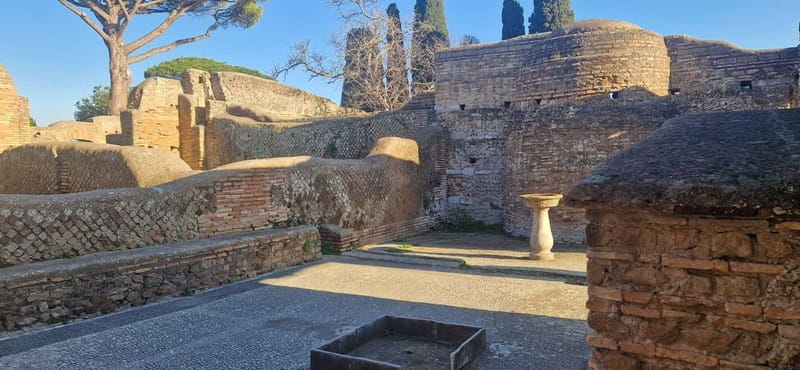
- Ostia Antica is much larger than a quick museum visit: Plan on walking across an extensive outdoor archaeological park.
- The audio guide uses your own phone: Download the app ahead of time, bring headphones, and arrive with a charged phone and internet access.
- Two hours is a tight schedule: Seeing the main sights is possible, but three to four hours is more comfortable if you want the full site and the new museum.
- The skip-the-line ticket is not always a bargain: It can save time during busy periods, but a Saturday afternoon visit may have little or no queue.
- The site shows ordinary Roman life: Homes, shops, baths, temples, markets, and the theater make this more than a parade of grand monuments.
- Bring water and sun protection: On-site food and drink options may be limited, and much of the visit takes place outdoors.
Why Ostia Antica is worth leaving central Rome
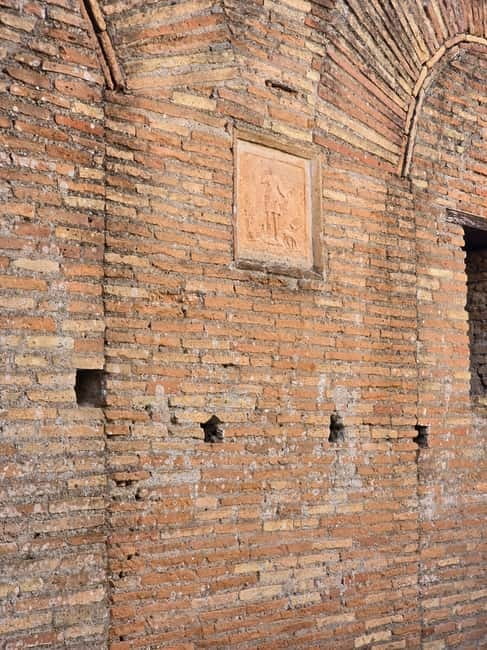
Rome can make ancient history feel like a contest between the Colosseum, the Forum, and the Pantheon. Ostia Antica offers something quieter and more grounded. This was Rome’s port, a working city tied to trade, shipping, storage, religion, housing, and daily business.
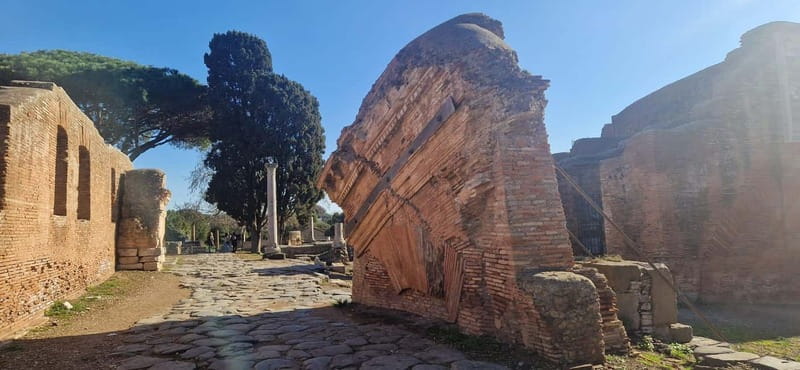
That difference matters. At many famous Roman sites, you mainly see fragments of monumental buildings. Here, you can follow streets through a former city and picture how people lived around them. The remains include homes, temples, baths, marketplaces, the theater, and public spaces.
I especially like the way Ostia Antica connects big imperial power with small daily routines. Grain, goods, sailors, merchants, workers, and officials all passed through the port. The site helps explain how Rome’s economy functioned, not just how its rulers were honored.
The setting also gives you breathing room. You are still within reach of Rome, but the visit does not feel like another stop in a packed city-center sightseeing circuit. The tradeoff is that the site is spread out, and you must be ready for a lot of walking.
More Skip-the-Line Tickets in Rome:
- Rome: Borghese Gallery Skip-the-Line Ticket & Audioguide
★ 4.3 · 4,318 reviews - Rome: Borghese Gallery Skip-the-Line Tickets with Audioguide
★ 4.6 · 2,562 reviews - Rome: Borghese Gallery Skip the line ticket and Audioguide
★ 4.3 · 1,535 reviews
Entering with the $31 skip-the-line ticket
This is a self-guided entry product, not a guided tour. You go directly to the attraction entrance, show the ticket sent to the email address or WhatsApp number used during booking, and present a valid passport or ID if requested.
There is no person waiting to meet you and escort you inside. That is important. You should not expect an agent at the gate, a group welcome, or help finding the first stop. Arrive early, keep your ticket easy to access, and make sure the contact details in your booking are correct.
The ticket is supposed to arrive within 24 hours before the activity. Since late arrivals and no-shows are not accommodated or refunded, I would not cut the timing close. The practical advantage is a separate entrance intended to avoid the regular ticket line.
But the price deserves a close look. You pay about $31 for a product whose stated official ticket price is €18, with children under 18 admitted free. The difference pays for the booking service, the audio guide, and the possible time savings.
That can be reasonable during a busy period when a line forms. It is less convincing when the entrance is quiet. One Saturday afternoon during a peak period reportedly had no visible queue, making the regular ticket a much better deal. If saving money matters more than convenience, compare the official admission option before committing.
The Roman Forum and the first look at city life
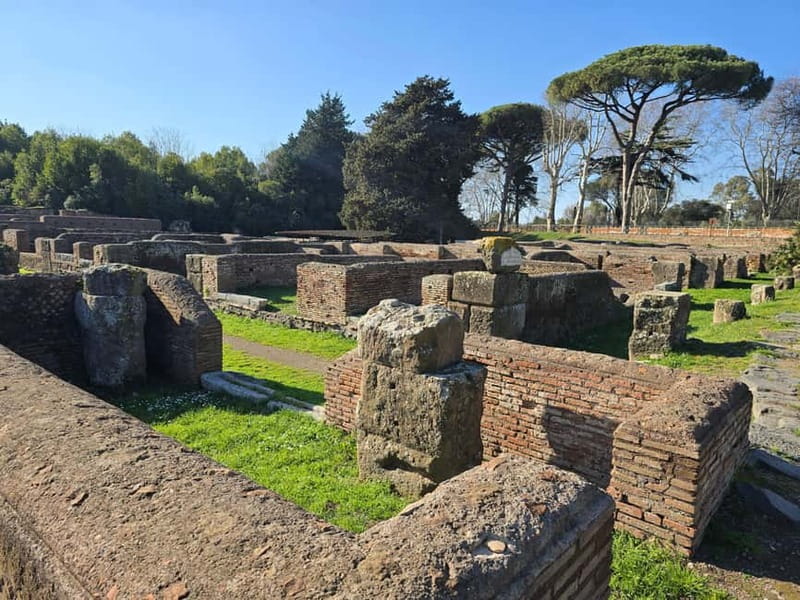
Once inside, the Roman Forum gives you a useful starting point. This is not the same Forum as the famous one in central Rome. At Ostia Antica, the forum belonged to the port city and helped organize its civic and public life.
It is a good place to begin because it gives scale to the settlement. From here, the ruins stop looking like scattered stones and start reading as parts of a planned town. The audio guide can help explain what you are seeing, though its coverage is not equally strong at every point.
You will find temples and public buildings around the site, along with streets leading toward residential and commercial areas. Look closely at the ground as you walk. The remains of roads, foundations, thresholds, and decorative floors often tell you as much about the city as the larger structures do.
The site signage is also useful. You are not entirely dependent on the app to find your way. Clear signs help point you toward the main buildings and make it possible to create your own route if a particular audio stop is missing or too brief.
The theater shows Ostia’s public side
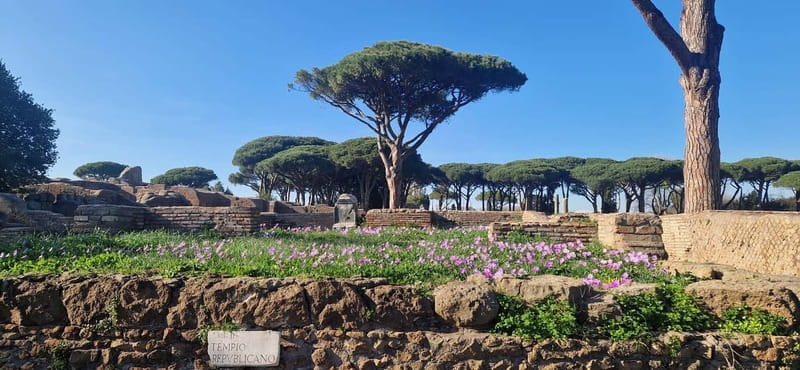
The theater is one of the clearest highlights. It gives the ruins a strong sense of public life and offers a change from the low walls and foundations found across much of the park.
This is where the city’s social life becomes easier to imagine. The theater was built for shared entertainment, and its presence shows that Ostia was not just a warehouse district or a place where ships unloaded cargo. It had public spaces where residents gathered.
I would give the theater more than a quick photograph. Use it as a pause in your route and listen to the related audio stop if available. The structure helps you understand how public buildings fit into the wider city, especially when you have already walked through quieter residential sections.
The drawback is that the audio guide may not explain every feature you pass. One visitor found that the app left out many parts of the site. That means you should treat it as a useful companion, not a complete replacement for signs, maps, or your own careful look around.
A few more audio tours around Rome worth a look
- Rome: Colosseum & Forum with Audio Guide App -Optional Arena
★ 4.2 · 24,770 reviews - Rome: City Sightseeing Hop-on Hop-off Bus with Audioguide
★ 4.0 · 16,045 reviews - Rome: St. Peter’s Basilica & Dome Entry Ticket & Audio Tour
★ 4.2 · 7,537 reviews - Colosseum, Roman Forum & Palatine Hill with Audioguide App
★ 4.4 · 6,291 reviews
Homes, mosaics, baths, and marketplaces
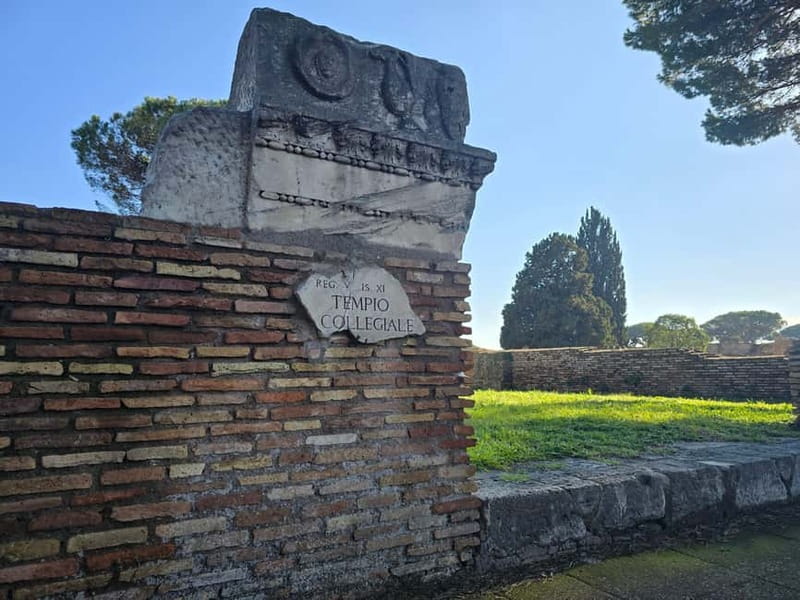
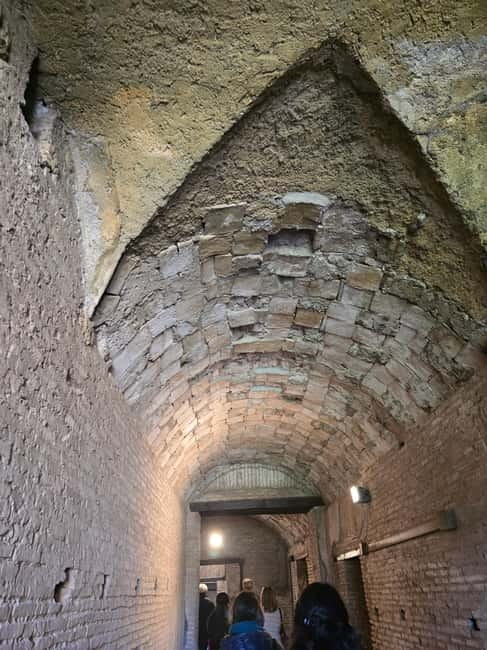
The residential and commercial areas are where Ostia Antica becomes most rewarding for many people. You can see how Roman architecture worked at street level, with homes, shops, public baths, and business spaces arranged through the city.
The Domus buildings are especially worth your time. Their mosaics and architectural details give you a sense of wealth, taste, and household life. Some floors are strikingly well preserved, and they reward a slower look. Instead of rushing from monument to monument, I would spend time noticing patterns, room layouts, entrances, and the relationship between private and public space.
The baths show another side of Roman routine. They were not simply places to wash. They were important public buildings and part of the city’s shared social life. The remains help you see how Roman communities invested in spaces used by many people.
Marketplaces and commercial structures bring the port’s economic role into focus. Ostia supported Rome’s wider power through trade and maritime connections. You can better understand that system by seeing the places where goods were stored, sold, managed, and moved.
This is the part of the visit where the audio guide can add real value. Historical context helps turn a wall or mosaic into evidence of a larger system. Still, download the app before arrival if possible. The interactive map shows your position and the next audio station, which makes the large grounds easier to manage.
Why two hours may not be enough
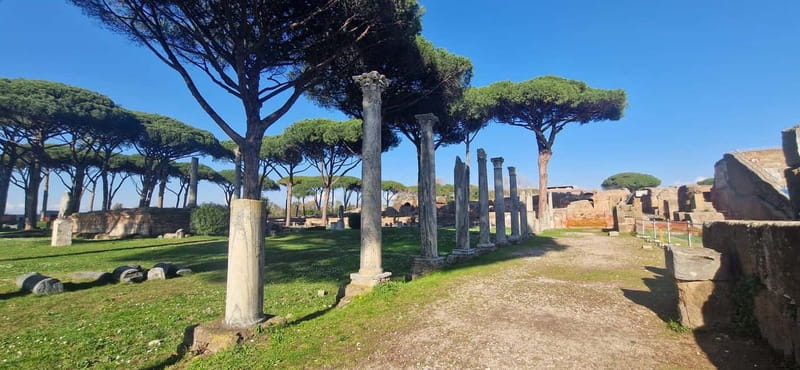
The listed duration is two hours, but that is best treated as a brisk visit. You can see major highlights in that time if you walk steadily and do not stop at every building.
For a fuller visit, plan on three to four hours. That gives you time to explore the forum, theater, homes, baths, marketplaces, and Domus buildings without turning the visit into a race. It also leaves room for the new museum, which is considered a worthwhile addition.
The length matters because Ostia Antica is not compact. You will walk outdoors over uneven archaeological ground, and the site can feel tiring in hot weather. Comfortable shoes are essential. Water, a hat, sunscreen, and weather-appropriate clothing will make a real difference.
Food and drink may be limited. The café was reported to be closed on a weekday and open only on weekends at one point, so bring water and a snack rather than counting on buying refreshments on site.
A two-hour booking can still work well for a visitor with limited time. I would choose a short route focused on the forum, theater, Domus buildings, and the best-preserved commercial areas. If ancient history is a major reason for your Rome trip, give yourself the longer window.
Making the audio guide work for you
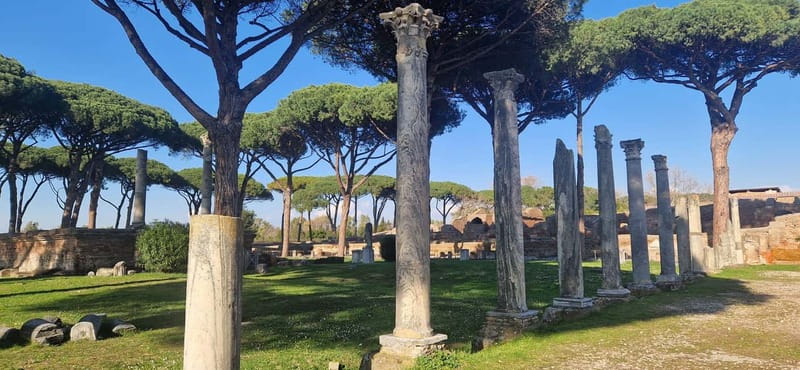
The included audio guide is downloadable and available in English, Italian, French, Spanish, and German. You use your own smartphone, so bring headphones and check that your battery is well charged.
Download the app before you reach the entrance. This avoids wasting time with setup and gives you a chance to see how the map and audio stations work. Internet access is also listed as necessary, so do not assume that every part of the visit will function offline.
The interactive map is one of the better practical features. It can show where you are and which station comes next, which is useful in a site with many paths and ruins. It helps you get your bearings fast instead of wandering past the buildings you most want to see.
The guide is not perfect. It may leave gaps, and some parts of the archaeological park may receive little or no explanation. If you want a full account of every building, this product may frustrate you.
I would use the audio guide selectively. Listen at the forum, theater, Domus areas, and major public buildings. Then use the site signs and the map to explore beyond the listed stations. That approach gives you structure without forcing you to wait for an explanation at every turn.
Who will enjoy this visit most
I recommend Ostia Antica to anyone who wants more than Rome’s famous central monuments. It suits people who enjoy archaeology, Roman daily life, architecture, trade, and self-guided sightseeing.
Families with older children may find the open setting easier than a crowded museum, though the walking and uneven ground require stamina. Children under 18 are admitted free according to the stated official price, but a child must be accompanied by at least one adult.
This is less suitable if you have mobility limitations. The experience is not recommended for wheelchair users or people with mobility impairments, and the amount of walking can be demanding even for fit visitors.
It also suits independent visitors who like setting their own pace. You are not tied to a group or a live guide. If you prefer a historian explaining every stop in person, this is not that kind of outing.
Practical details that affect your decision
You need a passport or valid ID, a charged smartphone, headphones, and internet access. Bring comfortable shoes, water, snacks, and clothing suited to the forecast.
Pets, large bags, bikes, drones, weapons, smoking, alcohol, drugs, and littering are not allowed. Unaccompanied minors are also not permitted.
The activity offers free cancellation up to 24 hours before the scheduled visit, and you can reserve now while paying later. Check the available starting times before booking, since the visit is listed as two hours even though a longer stay may suit you better.
Bad weather can affect entry because Ostia Antica is an outdoor archaeological park. Check the forecast and look for any closure updates before setting out.
Should you book the Ostia Antica ticket?
Book it if you value convenience, want the audio guide, and expect a busy visit when the separate entrance may save time. The app’s map is useful, and Ostia Antica itself is one of the best places near Rome to see ordinary Roman spaces at a large scale.
Think twice if you are focused on price. The $31 cost is notably higher than the stated €18 official admission, and the skip-the-line benefit may disappear when there is no queue. In that case, buying directly may offer better value.
My practical choice would be to book this option when your schedule is tight or when you are visiting during a busy period. If you have several hours, do not rush. Download the app early, bring water, and treat the two-hour duration as a minimum rather than a complete tour.
FAQ
How long does the Ostia Antica visit last?
The activity is listed as two hours. Allow three to four hours if you want to see the site at a relaxed pace and include the new museum.
Is a live guide included?
No. The ticket includes entry and a downloadable audio guide, but there is no live guide or guided tour.
Which languages are available for the audio guide?
The audio guide is available in English, Italian, French, Spanish, and German.
What should I bring?
Bring your passport or ID, comfortable shoes, headphones, weather-appropriate clothing, a charged smartphone, and internet access. Water and snacks are also recommended.
Are children admitted free?
The stated official price lists admission under 18 as free. A child must be accompanied by at least one adult to complete the booking.
Is Ostia Antica suitable for wheelchair users?
No. The activity is not considered suitable for wheelchair users or people with mobility impairments.
Just added around Rome
- Pantheon Skip the Line Entry Tickets with Digital Audio Guide★ 3.5 · 52 reviews
- Audio guide in Vatican Museums and Sistine Chapel★ 4.5 · 12 reviews
- Trastevere: A Self-guided Audio Tour of Rome’s Medieval Village★ 4.5 · 3 reviews
- St. Peter’s Basilica: Dome Climb with Lift & Audioguide★ 4.5 · 13 reviews
- Navova square underground with audioguide★ 4.5 · 17 reviews
- The Roman Jewish Ghetto: A Self-Guided Audio Tour★ 4.0 · 8 reviews
- Experience: The Pantheon Audio Tour★ 4.5 · 4 reviews
- St. Mary’s Basilica, Pope Francis Tomb Audio Tour with Crypt★ 4.0 · 3 reviews
Skip the Line, compared.

Topkapi Palace and Harem Skip-the-Line-Tickets & Audio Guide
Read our review →
Pantheon Reserved Entry Ticket with Audio Guide
Read our review →
Borghese Gallery Skip-the-Line Ticket & Audioguide
Read our review →
Skip the Line: Vatican & Sistine Chapel Ticket with Audio Guide
Read our review →
Skip-the-line Entry Ticket with Audio Guide & Map
Read our review →
Mount Vesuvius: Skip-the-Line Ticket and Smart Digital Guide
Read our review →
Borghese Gallery Skip-the-Line Tickets with Audioguide
Read our review →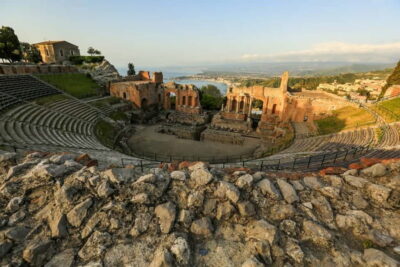
Taormina: Ancient Theater Skip-the-Line Ticket & Audio Guide
Read our review →Browse the lists this tour appears in