
REVIEW · COLOGNE AUDIO TOURS
Roman Cologne: A Self-Guided Audio Tour
Roman Cologne is hiding in plain sight. This one-hour to 90-minute walking tour uses the VoiceMap app to connect cathedral views, old streets, Roman ruins, and clues tucked into modern buildings. It is a smart choice if you want history without joining a group or keeping to a guide’s schedule.
I especially like the lifetime access and the fact that you can pause, restart, or skip stops. I also like the way the tour links major sights, such as the Roman Praetorium and Cologne Cathedral, with smaller details most people would walk past. The main drawback is that the tour works best when you begin at its designated starting point and follow the route in order. It is not designed to be walked backward.
The price is $11.99 per person, which is reasonable for a private, self-paced introduction to Roman Cologne. Just prepare your phone before setting out, download the audio and map files, and bring headphones. The tour is offered in English only.
Key points to know before you walk
- Roman Cologne beneath the modern city: The route explains how ancient streets, warehouses, temples, and government buildings still shape the center today.
- A phone-based walking tour: VoiceMap uses GPS to trigger the audio as you reach each location, so you can keep your phone in your pocket while listening.
- About 60 to 90 minutes: The distance is presented as a short city walk, but stops, photos, and pauses can make it take longer.
- Major sights and small details: You pass Cologne Cathedral, the Northern Gate, the Roman Harbour road, the Praetorium, and several less obvious historical markers.
- Offline access after download: Audio, maps, and geodata are stored on your device, so the tour is intended to work without mobile data or roaming.
- A private experience for $11.99: You walk alone or with your own group, with no scheduled departure and no guide beside you.
What this Roman Cologne walk is really about
This is not a museum tour with long explanations at every stop. It is a narrated walk through Cologne’s center, using visible buildings and street corners to explain what once occupied the ground beneath your feet.
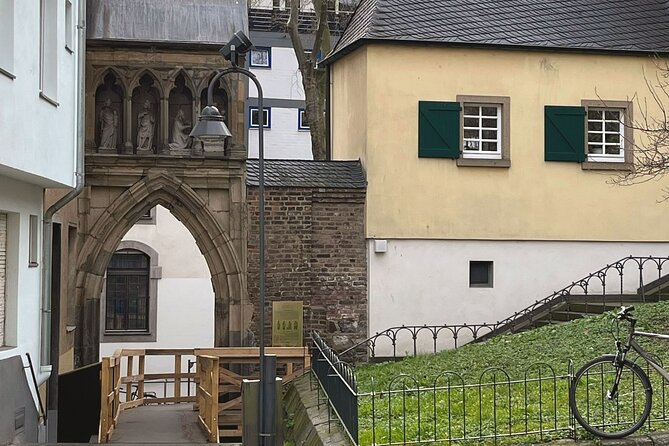
That approach works well in Cologne. The modern city has been rebuilt and altered many times, so Roman remains do not always announce themselves. A church may sit on an older Roman foundation. A pavement pattern may suggest an ancient road. A museum window may offer a glimpse of an important mosaic without requiring you to enter.
The audio gives these fragments a useful connection. Instead of looking at the cathedral as an isolated monument, you begin to see it within a much older urban story. The route also adds curious side notes, including a link between a Cologne column and the 1969 moon landing.
The tour has a published rating of 3.9 out of 5 from 15 ratings. That points to a generally useful experience with some clear limitations. The strongest praise centers on the context, the easy pace, and the ability to notice things even long-time Cologne residents had missed. The main criticism concerns the storytelling pace and the need to follow the route from its proper beginning.
More Self-Guided Audio Tours in Germany
- Lübeck Scavenger Hunt and Highlights Self Guided Audio Tour
★ 4.0 · 30 reviews - Freiburg Scavenger Hunt and Highlights Self Guided Audio Tour
★ 4.0 · 29 reviews - Heidelberg’s Altstadt: A Self-Guided Audio Tour
★ 4.0 · 26 reviews
Starting at Cologne Cathedral and the Kreuzblume
The walk begins in the area of Cologne Cathedral, at Domkloster 4, near the Kreuzblume. The Kreuzblume is a useful meeting landmark in front of the cathedral, but check the exact app pin before you begin. The tour’s instructions identify the Kreuzblume as the starting location, while the meeting information gives the cathedral address.
This is a practical place to start because the cathedral is easy to find and gives you an immediate sense of Cologne’s scale. The audio introduces the city’s Roman past before leading you into streets where ancient remains are less obvious.
Give yourself a few minutes to open the app, confirm the route, and make sure the first audio section has loaded. The tour’s GPS system is meant to start the correct recording when you reach the proper area. Starting somewhere else can make the route confusing, especially if you try to walk in reverse.
Cologne Cathedral and the Roman Northern Gate
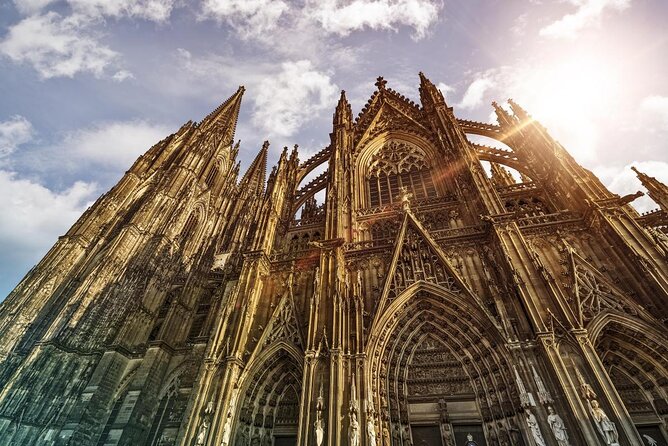
You pass Cologne Cathedral early in the walk. The cathedral itself is a medieval and modern landmark, but the audio uses it as a bridge to older Cologne. You hear about the site while taking in the building’s dramatic exterior.
This is one of the tour’s better choices. The cathedral is likely already on your sightseeing list, so the tour adds historical context without asking you to spend more time inside. It also gives you a clear beginning before moving toward Roman Cologne.
The route then passes the Roman Northern Gate. This was part of the ancient city’s defensive system, and the stop helps you picture Cologne as a Roman settlement rather than simply a cathedral city.
You should expect a mix of visible remains and spoken reconstruction. Not every Roman feature is complete or easy to see. The audio is doing important work by explaining what stood here and how the area connected to the wider city.
The Roman mosaic at the Roman-Germanic Museum
One of the most appealing stops comes at the Roman-Germanic Museum. You look through a window to see one of the world’s largest and best-preserved Roman mosaics.
This is a good example of how the tour keeps costs down. You do not receive museum admission, and no entrance tickets are included, but you can still see an important piece of Roman Cologne from outside. If the museum or other attractions are open and you want a fuller visit, you will need to buy admission separately.
The window viewing also makes this stop flexible. You can listen, look closely, and continue without building your day around museum hours. Still, the viewing experience is naturally limited compared with entering the museum. I would treat it as an introduction, not a replacement for a museum visit.
Same place, a different route to walk:
- Neuschwanstein Castle Skip-the-Line Ticket with Audio Guide
★ 4.4 · 1,388 reviews - Berlin: Solar Powered Sunset Catamaran Cruise & Audio Guide
★ 4.6 · 1,043 reviews - Berlin: Boat Sightseeing Cruise with Audioguide
★ 4.6 · 947 reviews - Füssen: Neuschwanstein Castle Express Ticket and Audio Guide
★ 3.9 · 788 reviews
Die Römische Hafenstraße and an imperfect reconstruction
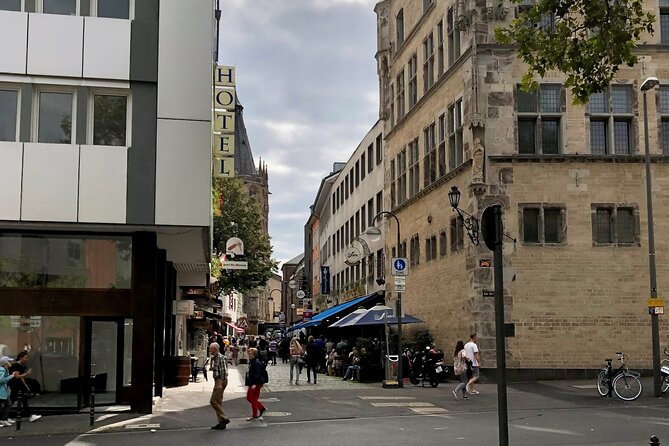
The route continues down Die Römische Hafenstraße in Köln, the Roman Harbour road. This section explains why the ancient road was imperfectly rebuilt in Kurt Hackenberg Platz.
That detail gives the walk an honest edge. Historic reconstruction is not always neat, exact, or complete. A rebuilt road can suggest the original layout while still reflecting modern choices and gaps in evidence.
This is the sort of information that makes the audio worthwhile. You are not simply told that something is Roman. You are encouraged to think about how archaeologists and city planners decided to present the past in a working modern center.
Kurt Hackenberg Platz also shows how quickly Cologne’s appearance can change from one street to the next. The tour asks you to look down and around, not only straight ahead at famous buildings.
The Roman Praetorium, once the Rhineland’s largest palace
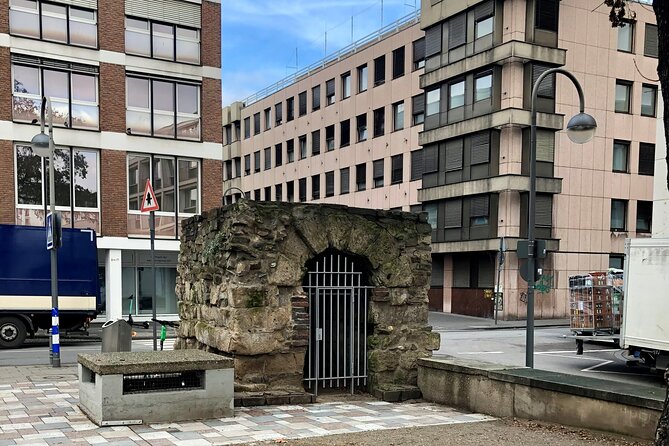
The Roman Praetorium is one of the route’s central stops. It was the largest Roman palace in the Rhineland, making it one of the most important reminders of Cologne’s political role in the Roman period.
The audio helps explain the scale and purpose of the site. You get a sense of Roman administration, power, and public life rather than hearing only about walls and foundations.
This is an important stop for anyone who wants more than a list of dates. The Praetorium shows that ancient Cologne was not a minor outpost. It was a major center with officials, public buildings, trade, and regional influence.
The drawback is that Roman remains can require imagination. If you expect a complete palace standing above ground, you may find the experience less dramatic than the name suggests. The value comes from the explanation and the location, not from a fully preserved building.
Alter Markt and Great St Martin Church
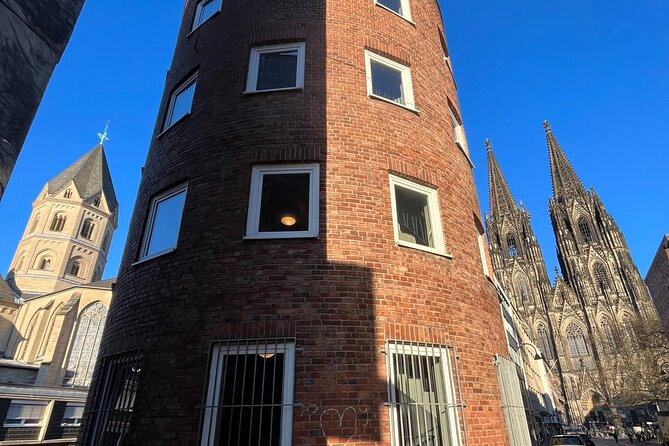
The walk passes through Alter Markt, Cologne’s old market. This brings the Roman story into a lively central setting, where modern city life sits on top of centuries of earlier activity.
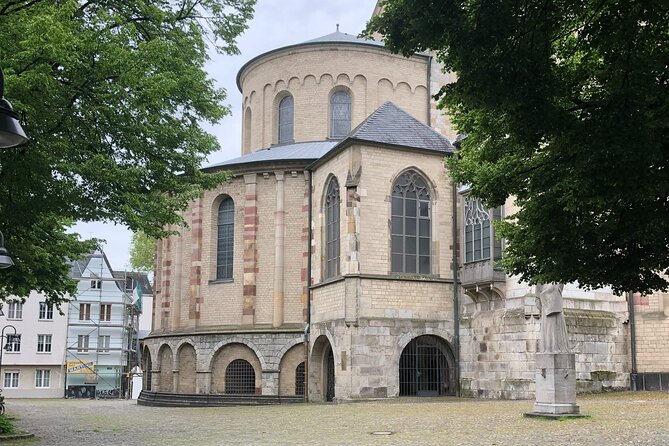
The route then passes Great St Martin Church. The church was built in the Middle Ages on the foundations of a Roman warehouse. That one fact neatly shows how the city was repeatedly reused. Roman commercial buildings did not simply vanish from the city’s story. Their locations and foundations could shape later construction.
I like this part of the route because it makes history easier to see. You do not need a large archaeological site to understand continuity. A church, market, and street can each carry traces of earlier use.
This section may feel less focused if you want only visible Roman ruins. The tour is strongest when you accept that much of Roman Cologne survives through foundations, alignment, and explanation.
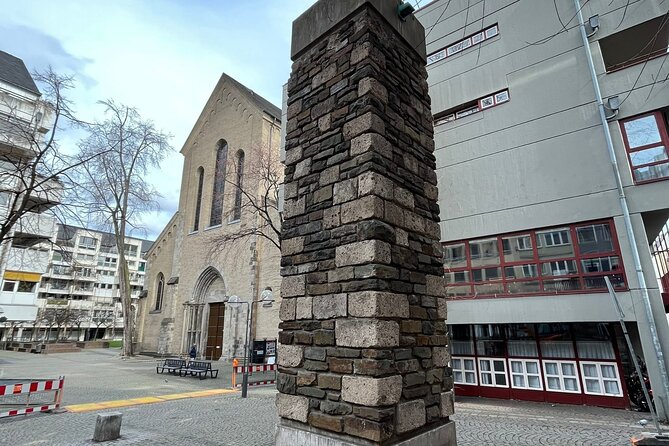
Schmitz Säule and the moon landing connection
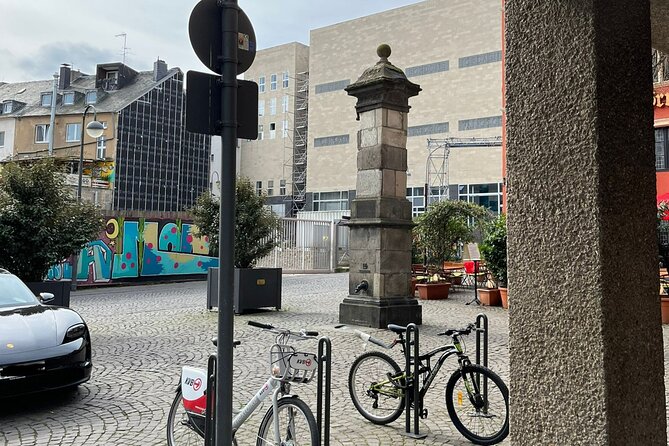
At Schmitz Säule, the audio explains what the 1969 moon landing has to do with the ancient Romans in Cologne. This is one of the more unusual stories on the route, and it breaks up the heavier architectural material.
Specific details like this help the tour avoid becoming a parade of dates and building names. You are given a memorable connection that links modern history with the Roman past.
The stop also shows the value of an audio format. A small column or marker may not tell you much on its own. With the narration, it becomes part of a larger story about how Cologne remembers its past and presents it in public spaces.
Gürzenich Köln and Roman figures on a Gothic facade
At the imposing Gothic facade of Gürzenich Köln, you learn how to spot the Roman soldiers Marsilius and Agrippa. This is another stop where looking closely matters.
The figures are not presented as isolated Roman ruins. Instead, they appear on a later building, showing how Roman names and characters were carried into Cologne’s medieval and civic identity.
You may need to pause and study the facade to identify the figures. That is not a bad thing. This tour rewards a slower pace and a willingness to look above street level.
The narration also adds a sense of play. Ancient Roman figures appearing on a Gothic building is exactly the kind of layered detail you might miss while hurrying between the cathedral and the river.
The former temple district and St Maria im Kapitol
The route continues through the former Roman temple district and passes St Maria im Kapitol. This is one of the places where the tour’s main idea comes through clearly: modern Cologne is built over older religious and civic spaces.
The stop links the Roman temple area with the medieval church, allowing you to consider how sacred locations can be reused across different periods. You are not simply moving from one monument to another. You are following a change in religion, architecture, and urban identity.
St Maria im Kapitol gives the route another major church, but the focus remains on the Roman layer below and around it. If you enjoy seeing how cities change over time, this should be one of the more rewarding parts of the walk.
Ending near the Ubii Monument
The tour ends near the Ubii Monument at Mühlenbach 35, 50676 Köln. The monument is described as the oldest stone tower in Germany, giving the walk a strong final point.
Ending here makes sense. After hearing about roads, temples, warehouses, government buildings, and city defenses, you finish with a substantial Roman-era structure rather than returning to the cathedral.
The end point is also useful for planning the rest of your day. You are not left back at the starting point, so check your map and decide what you want to do next. The tour does not include transportation, food, drinks, museum tickets, or other entrance fees.
How the VoiceMap app works in practice
VoiceMap uses GPS to trigger sections of the narration as you reach each location. This means you can put your phone away and listen instead of constantly checking a screen.
The app is available for Android and iOS. After downloading the tour, the audio, map, and geodata are stored on your device for offline use. That is particularly helpful if you are avoiding roaming charges or do not have mobile data in Germany.
The offline feature needs preparation. Download everything before you leave Wi-Fi, and check that the files are available on your phone. One poor experience came from expecting the tour to work after downloading without understanding how the GPS and offline files worked. The supplied instructions say constant internet access is not required, but setting up carefully is still wise.
Bring headphones and a charged smartphone. Headphones are not provided, and you cannot take the tour without a phone. The automatic audio triggers are convenient, but GPS can be less forgiving if you begin away from the assigned point or try to reverse the route.
Pace, group size, and value at $11.99
At $11.99 per person, this is a good-value option for a short history walk. A traditional private guide would normally cost far more, while a free map would not provide the same level of narration or route structure.
The strongest value comes from flexibility. You can stop for photos, pause the audio, take a break, or return to the route later because access does not expire. That makes the tour useful on a day when you have other plans or when museums are closed. It was also used successfully as a New Year’s Day activity, when many Cologne attractions were not open.
The tour is private in the simple sense that only your group takes part. You are not joining a scheduled group, waiting for other people, or keeping pace with a guide.
The tradeoff is that you do not have a person beside you to answer questions or adjust the route. The storytelling may also feel slow or less engaging if you prefer energetic guides. The experience received a five-star rating from a long-time Cologne resident who still learned new details, but another rating called it boring. That difference likely comes down to how much you enjoy audio narration and self-guided walking.
Who should choose this tour?
I would recommend it to you if you enjoy history, prefer independent sightseeing, and want to connect Cologne’s famous center with its Roman past. It is especially useful for a first visit when you want an organized introduction without giving up control of your schedule.
It also suits repeat visitors. A long-time resident found unfamiliar details about places such as Höherstraße and Gürzenich, which suggests that the route offers more than the standard cathedral stop.
Families with older children may like the moon landing story, the Roman soldiers on the Gothic facade, and the idea of finding ancient traces in ordinary streets. The app format also avoids the pressure of keeping young walkers quiet during a formal guided tour.
I would be more cautious if you dislike listening through a phone, want extensive archaeological remains, or expect a fully guided experience. The tour is also a poor fit if you cannot begin at the marked starting point, since the route is not designed to run backward.
Book it if you want a low-cost, flexible way to make sense of Cologne’s Roman layer. Skip it if you want museum entry, a live guide, or a walk built around dramatic ruins rather than explanations and scattered remains.
FAQ
How long does the Roman Cologne audio tour take?
The tour takes approximately one hour to one hour and 30 minutes. Stops, photos, and pauses may affect your total time.
What language is the tour offered in?
The tour is offered in English.
Where does the tour begin?
It begins in front of the Kreuzblume near Cologne Cathedral. The meeting information gives the cathedral address as Domkloster 4, 50667 Köln, Germany.
Where does the tour end?
It ends near the Ubii Monument at Mühlenbach 35, 50676 Köln, Germany.
Does the tour work offline?
Yes. After you download the tour, its audio, map, and geodata are stored on your device for offline access.
Do I need to bring my own phone and headphones?
Yes. A smartphone and headphones are not included.
Are museum tickets included?
No. Entrance fees for museums and other attractions along the route are not included.
Can I take the tour in reverse?
The tour is designed to follow its dedicated starting point and narrative order. It is not set up for walking backward, although the app allows you to skip a location if needed.
Is the tour refundable if I cancel?
No. The experience is non-refundable and cannot be changed after booking.
Just added around Germany
- Explore Trier a Beautiful City Walk with Audio and GPS Guide★ 3.5 · 2 reviews
- Private audio book city rally around Stuttgart’s old town★ 3.5 · 3 reviews
- Stuttgart Scavenger Hunt and Highlights Self Guided Audio Tour★ 5.0 · 2 reviews
- Private audio book city rally around the Jahrhunderthalle in Bochum★ 5.0 · 12 reviews
- Private audio book city rally around the old town of Essen Kettwig★ 4.0 · 6 reviews
- Beautiful Baroque Potsdam: A Self-Guided Audio Tour★ 4.5 · 4 reviews
- Sanssouci Park: A Self-Guide Audio Tour of the Garden’s Landmarks★ 3.0 · 2 reviews
- Nuremberg Walking Tour with Audioguide on your Smartphone★ 5.0 · 3 reviews
Self-Guided Tours, compared.

Acropolis Ticket & Optional Self-Guided Audio Tours
Read our review →


Ultimate Acadia National Park Self-Guided Driving Audio Tour
Read our review →

Santorini: Akrotiri Ticket with Optional Self-Guided Audios
Read our review →
Browse the lists this tour appears in