
REVIEW · GERMANY AUDIO TOURS
Explore Trier a Beautiful City Walk with Audio and GPS Guide
Trier rewards slow looking. This self-guided audio and GPS walk brings together Roman monuments, medieval churches, market squares, and Karl Marx’s birthplace in about two hours. I like the freedom to begin at your own pace, and I like the low price of $8.41 per person for a private experience with no group to keep up with.
The main tradeoff is that you are walking with an app rather than a live guide. That means no one is there to answer a question or adjust the route, but it also gives you control over pauses, photos, and time inside the sights. The route is offered in English and begins and ends at Porta Nigra.
Key points about this Trier walking tour
- Roman Trier in one compact route: See Porta Nigra, the Cathedral, the Liebfrauenkirche, and the Imperial Baths.
- A self-guided Niki audio walk: GPS directions and recorded commentary let you explore without joining a group.
- A remarkable price: At $8.41, it costs less than many guided city walks and covers several of Trier’s main sights.
- A strong historical range: The route moves from Roman Trier to medieval market life, Gothic architecture, and the modern legacy of Karl Marx.
- Easy central starting point: Meet at Porta-Nigra-Platz 9, with the route returning to the same place.
- Good for independent sightseeing: You can pause, take photographs, and set your own walking rhythm.
Starting at Porta Nigra, Trier’s giant Roman gateway
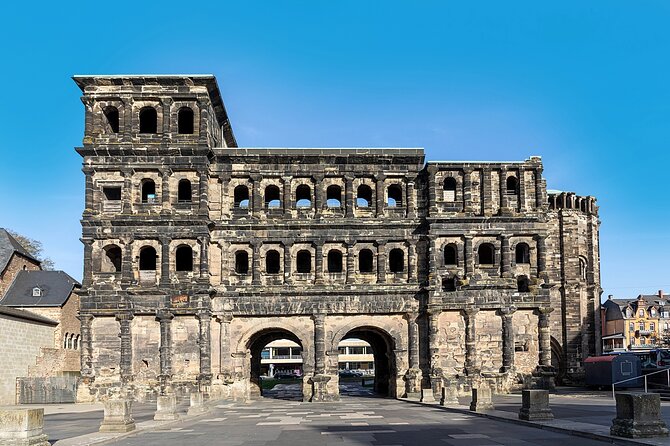
The walk begins at Porta Nigra, the dark sandstone gate that has become Trier’s most famous landmark. It was part of a Roman city wall more than six kilometers long, so this was not a small neighborhood entrance. It was a major defensive structure in one of northern Europe’s most important Roman cities.
The gate survived for an unusual reason. During the Middle Ages, a hermit named Simeon lived inside it. After Simeon was canonized, the site became a pilgrimage destination. That religious use helped protect the Roman structure from being dismantled for building stone, which happened to many ancient buildings elsewhere.
Porta Nigra was even converted into a double church. A staircase from the city led to the second floor, while another staircase reached the third. A floor was added above the open central section, changing the Roman gate into a medieval religious building.
The audio commentary is especially useful here because the gate can look like a straightforward military ruin at first glance. Once you know that it was a church, a hermit’s home, and a pilgrimage site, the building becomes much easier to read.
Give yourself time to look at the stonework. The route is only about two hours, but you should not feel pressured to hurry past the starting point. If you want to enter the monument or spend longer examining it, the self-guided format lets you pause the walk.
More Audio Walking Tours in Germany
- Berlin Cathedral Ticket & Audio Tour with a City Walk
★ 4.1 · 28 reviews - Trier: City Walk with Audio Guide in 7 Languages on your Phone
★ 4.0 · 19 reviews - Cologne Walking Tour with Audioguide: City and Cathedral
★ 4.5 · 14 reviews
Simeonstift and the old market cross
Just beside Porta Nigra is the Simeonstift, the former monastery connected with Simeon. Today it houses a museum in a building that combines modern exhibition rooms with an older historic core.
The museum collection covers the early modern period through the twentieth century. One of its most interesting pieces is the original market cross from 958. You will see a copy of that cross later at the Hauptmarkt, so this stop helps you understand why the central square looks the way it does.
The museum also preserves the original medieval figures from Trier’s main market. That makes the Simeonstift more than a quick architectural stop. It offers a chance to see original objects connected to places you encounter along the walk.
Admission to the museum is not included in the stated tour price, and the experience is designed as an audio walk rather than a museum tour. If you want to enter, allow extra time and check the current opening details before setting out. The route itself can still be enjoyed from the outside.
The Hauptmarkt and Trier’s medieval center
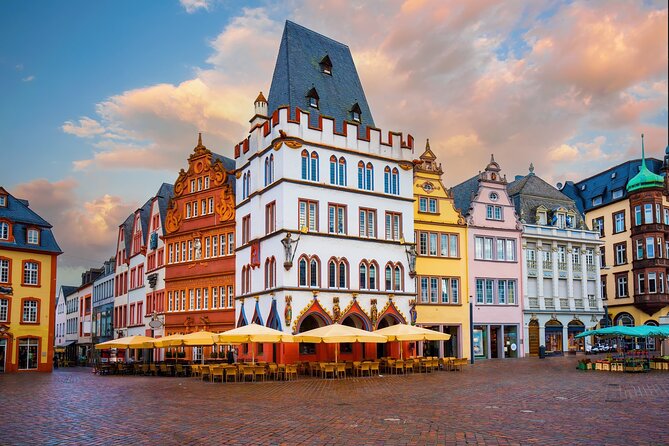
The walk continues to the Hauptmarkt, Trier’s central market square. The square’s location has a dramatic backstory. In 882, Norman raiders attacked Trier, and the archbishop moved the market away from the river to its present position.
At the center is the market cross, set on a Roman granite column. The column originally came from the Cathedral, while the cross itself is a copy. The original is held in the Simeonstift museum.
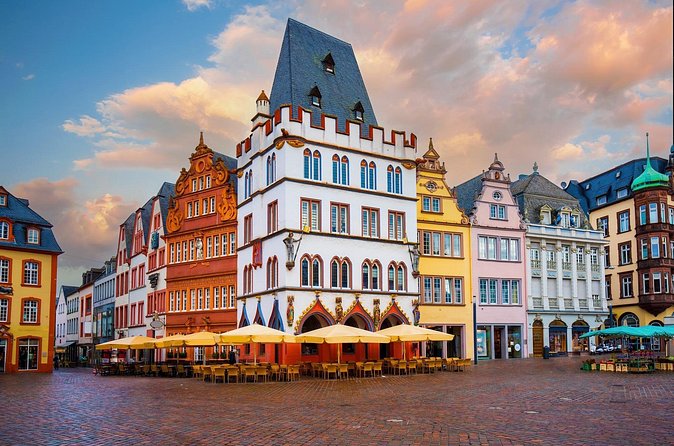
Look closely at the buildings around the square. Many use half-timbered construction, with wooden beams forming the supporting frame of the walls. The mixture of colored façades, timber framing, and the old market cross gives the square a more intimate feel than the huge Roman monuments earlier in the route.
I like this part of the walk because it connects several layers of Trier in one place. The column is Roman, the cross dates from the tenth century, and the surrounding buildings reflect later German town architecture. You are not simply looking at a pretty square. You are seeing how the city reused earlier materials and adapted its center over time.
The Hauptmarkt is also a practical place to pause. The route is self-guided, so you can stop the audio, sit for a while, and continue when you are ready.
Trier Cathedral and the remains of a Roman basilica
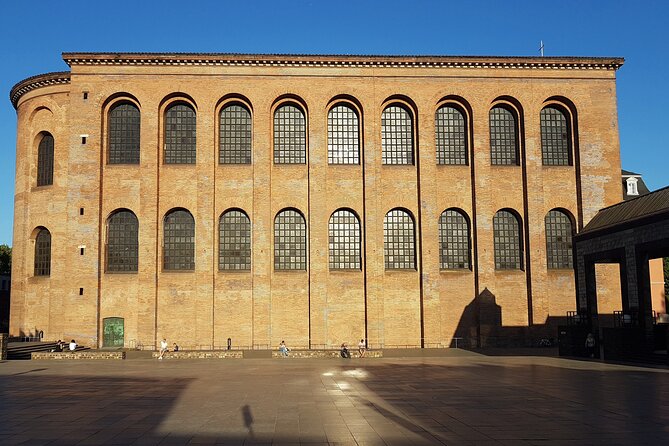
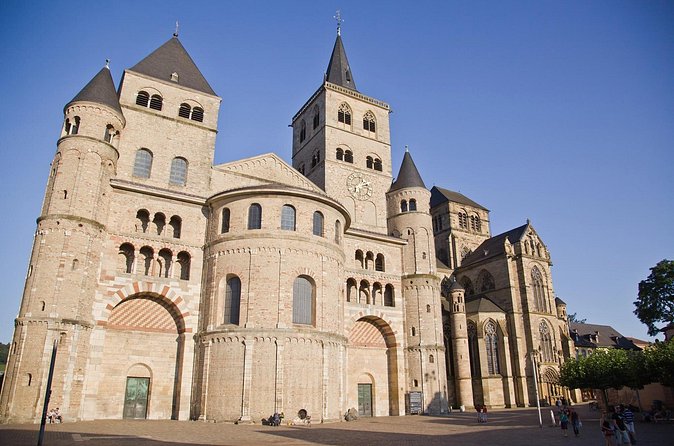
The Trier Cathedral is enormous. For many years, it was the largest church north of the Alps. Its importance is not only religious or architectural. The building preserves part of the Roman foundation of the city.
The Cathedral began as a Roman basilica from the fourth century. In this context, basilica means an administrative building rather than a church. The original structure may have been built on the site of a palace belonging to Helena, the mother of Emperor Constantine.
The exterior still reveals the Roman brickwork of the original rectangular basilica. That detail is easy to miss if you are focused only on the later church façade, so listen carefully when the audio points out the older material.
Trier Cathedral was originally part of a double church. The northern section became the present Cathedral, while the southern section became the Liebfrauenkirche. That arrangement helps explain why two major churches sit side by side.
The Cathedral is a good example of why an audio guide can add value to a city walk. Without context, you may see a large church with many building phases. With the historical explanation, the site becomes a record of Roman administration, early Christianity, and later religious architecture.
Same place, a different route to walk:
- Neuschwanstein Castle Skip-the-Line Ticket with Audio Guide
★ 4.4 · 1,388 reviews - Berlin: Solar Powered Sunset Catamaran Cruise & Audio Guide
★ 4.6 · 1,043 reviews - Berlin: Boat Sightseeing Cruise with Audioguide
★ 4.6 · 947 reviews - Füssen: Neuschwanstein Castle Express Ticket and Audio Guide
★ 3.9 · 788 reviews
Liebfrauenkirche and its Gothic details
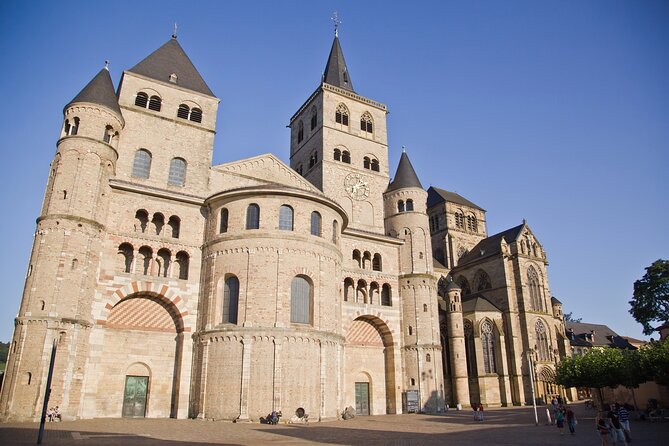
Next comes the Liebfrauenkirche, one of Germany’s oldest Gothic churches. It was built in the thirteenth century on the foundations of the earlier double church.
The exterior is heavily decorated, particularly around the west façade and its portal. Many of the sculptures are copies, but the weathered sculpture in the tympanum above the door is original. It shows scenes from the youth of Christ.
That distinction matters. The church is not a perfectly untouched medieval object, and the copied sculptures should not be mistaken for original work. At the same time, the surviving tympanum gives you a genuine medieval detail to seek out.
The Liebfrauenkirche is smaller in feel than the Cathedral, and the two buildings make a useful comparison. The Cathedral carries the weight of Roman foundations and imperial scale. The Liebfrauenkirche gives you the lighter, more decorative forms of Gothic design.
The audio commentary should help you notice the connection between the two churches rather than treating them as unrelated stops. If you are interested in architecture, take a little time to compare their façades before moving on.
The Imperial Baths and Roman public life
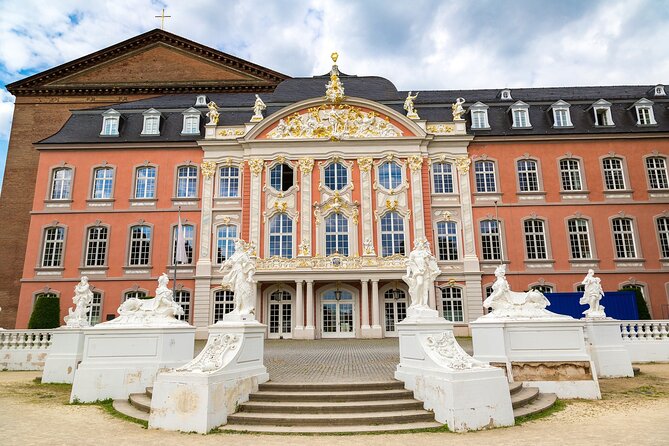
The route then reaches the Imperial Baths, known in Latin as thermae. Trier has three Roman bath complexes: the Imperial Baths, the Barbara Baths, and the baths at the Cattle Market. The Imperial Baths are the largest of the three.
Built in the fourth century, the complex was much more than a place to wash. Roman bathhouses could include areas for exercise, massage, and social activity. In Rome, there were reportedly 856 bathhouses around the year 300, which gives you an idea of how important this type of building was to Roman urban life.
The Imperial Baths were robbed for materials during the Middle Ages. That history is worth remembering as you look at the remains. Ancient ruins often survived not because later generations carefully protected them, but because they were reused, neglected, or gradually buried.
This stop adds variety to the route. Porta Nigra shows Roman military engineering, and the Cathedral shows Roman civic foundations adapted for Christian use. The baths reveal everyday public life and the scale of Roman leisure facilities.
The site is also a reminder that Trier was not merely a frontier settlement. It had the civic buildings, public services, and monumental construction expected of a major Roman city.
Karl Marx’s birthplace and Trier’s modern legacy

The walk continues to the house where Karl Marx was born. It is now a permanent museum dedicated to his life and work.
Marx lived in the nineteenth century and became a major German thinker, a founder of the labor movement, and a central figure in the history of socialism and communism. His best-known works include Das Kapital and The Communist Manifesto.
This stop shifts the focus from ancient and medieval Trier to the modern era. That change is useful. A city walk that only covers Roman ruins can give you a narrow picture of Trier. Karl Marx’s birthplace shows how the city also connects to major political and economic debates of the nineteenth and twentieth centuries.
The museum is not included in the $8.41 audio walk price. If you want to visit the interior, plan extra time and check current admission arrangements. If you only follow the route outside, the stop still provides an important piece of Trier’s identity.
I would especially recommend this section for anyone who wants the walk to cover more than architecture. It gives the route a wider historical range without requiring a separate trip across the city.
Frankenturm, a medieval residential tower
The final listed stop is Frankenturm, a Romanesque residential tower built around 1100. Its name does not refer to the Frankish tribe. Instead, it comes from an inhabitant named Franco von Senheim.
The building technique deliberately copied Roman construction methods. Trier still had many Roman examples available when the tower was built, so medieval builders could draw directly from the city’s ancient structures.
Later, the tower served as a residence for servants of the archbishop. That later use gives the building a practical social history. It was not simply a defensive monument. It was also part of the daily organization of religious power in medieval Trier.
Frankenturm is a fitting late stop because it brings several themes together: Roman influence, medieval construction, and the power of the archbishop. The tower may be less instantly famous than Porta Nigra or the Cathedral, but the explanation makes it worthwhile.
The activity returns to the meeting point, making the route easy to combine with other plans in central Trier.
What the $8.41 price really gives you
At $8.41 per person, this is a low-cost introduction to Trier’s main historic center. You receive an English audio and GPS guide, a planned route, and commentary covering major monuments from the Roman period through the nineteenth century.
The value is strongest if you want orientation and basic historical context without paying for a private live guide. A live guide could answer questions and adjust the pace, but this option keeps the cost low and gives you control over stops.
You should also understand what the price does not cover. The information provided does not include admission to Porta Nigra, the Simeonstift museum, the Cathedral, the Liebfrauenkirche, the Imperial Baths, or Karl Marx’s birthplace. Treat the $8.41 as the price for the self-guided route and commentary, not as a ticket covering every attraction.
The experience is private in the sense that only your group participates. You are not joining a scheduled walking group, and the app format means your timing is your own.
Timing, access, and who will enjoy it most
The stated duration is about two hours, with travel time already included. The experience is available daily from 7:00 AM to 7:00 PM during the listed operating period, from May 21, 2024, through February 8, 2027.
The meeting point is Porta-Nigra-Platz 9, 54290 Trier, Germany. The route ends back at the meeting point. It is near public transportation, service animals are allowed, and most people can participate.
I would choose this walk if you like exploring independently, want a compact introduction to Trier, or have limited time in the city. It also suits you if you prefer stopping for photographs instead of keeping pace with a guide.
You may want another option if you need detailed personal guidance, frequent conversation, or help adapting the route to special interests. The information provided does not promise a live guide, wheelchair-specific route details, or entry to the monuments.
Confirmation is provided when you book. Free cancellation is available up to 24 hours before the start time, with no refund for cancellations or changes made within 24 hours.
Should you book this Trier audio walk?
Book it if you want a cheap, flexible way to see Trier’s historic center and you are comfortable using an audio and GPS app. The route covers an impressive range: a Roman gate, a medieval monastery, a historic market, two major churches, Roman baths, Karl Marx’s birthplace, and a medieval tower.
The strongest reason to choose it is the combination of low price and broad coverage. The main limitation is the lack of a live guide. For many independent visitors, that is a fair trade. You get the freedom to walk at your own speed, pause when you like, and return to the center without managing a group.
If you have only a short time in Trier, this is a sensible first look. Add entrance tickets and extra time only for the sights that interest you most.
FAQ
Where does the Trier audio walk begin?
It begins at Porta-Nigra-Platz 9, 54290 Trier, Germany.
Where does the activity end?
The activity ends back at the meeting point.
How long does the walk take?
The walk takes approximately two hours, and travel time is already included in the total duration.
What language is the guide offered in?
The audio and GPS guide is offered in English.
How much does the experience cost?
The listed price is $8.41 per person.
Is this a group tour?
No. It is a private activity, and only your group participates.
Is a live guide included?
The experience is an audio and GPS guide. The provided information does not state that a live guide is included.
What sights are included along the route?
The route includes Porta Nigra, Simeonstift, the Hauptmarkt, Trier Cathedral, Liebfrauenkirche, the Imperial Baths, Karl Marx’s birthplace, and Frankenturm.
Is the walk available every day?
Yes. It is listed as available Monday through Sunday, from 7:00 AM to 7:00 PM.
Can I cancel for a refund?
Yes. You can cancel at least 24 hours before the start time for a full refund. Cancellations or changes made less than 24 hours before the start time are not refunded.
Just added around Germany
- Private audio book city rally around Stuttgart’s old town★ 3.5 · 3 reviews
- Stuttgart Scavenger Hunt and Highlights Self Guided Audio Tour★ 5.0 · 2 reviews
- Private audio book city rally around the Jahrhunderthalle in Bochum★ 5.0 · 12 reviews
- Private audio book city rally around the old town of Essen Kettwig★ 4.0 · 6 reviews
- Beautiful Baroque Potsdam: A Self-Guided Audio Tour★ 4.5 · 4 reviews
- Sanssouci Park: A Self-Guide Audio Tour of the Garden’s Landmarks★ 3.0 · 2 reviews
- Nuremberg Walking Tour with Audioguide on your Smartphone★ 5.0 · 3 reviews
- Nuremberg Scavenger Hunt and Highlights Self Guided Audio Tour★ 4.5 · 7 reviews
Walking Tours, compared.

City Monuments Guided Walking Tour with Audio Guide
Read our review →
Self Guided Classic Freedom Trail Location Aware (GPS) Walking Audio Tour
Read our review →
Self-Guided Historical Walking Tour (Audio Guide)
Read our review →
Cape Cod & Provincetown Self-Guided Driving & Walking Audio Tour
Read our review →
Verona Walking Tour with Audio and Written Guide by a Local
Read our review →
Royal Walking Tour and Buckingham Palace Audio Tour
Read our review →
Bologna Walking Tour with Audio and Written Guide
Read our review →Browse the lists this tour appears in