
REVIEW · ITALY AUDIO TOURS
Ravenna Walking Tour with Audio and Written Guide by a Local
Ravenna rewards slow looking. This self-guided walk brings you to eight major sights, from the glowing mosaics of San Vitale to Theodoric’s unusual stone mausoleum, while keeping the price low at $7.21. I like the mix of audio, written explanations, and local restaurant advice. I also like that you can move at your own pace instead of following a guide’s flag through town.
The main catch is that this is a digital guide, not a live walking tour. You need a smartphone, an internet connection, and enough comfort with Google Maps to move between stops. One user found the directions confusing and walked in circles, although the provider says each attraction includes a large Google Maps button.
For a first look at Ravenna, this is a smart, inexpensive introduction to the city’s Byzantine art. Just budget extra time and money for admission tickets, and read the voucher carefully before setting out.
Key points to know before you book
- Eight important stops in about three to four hours: The route includes Ravenna’s famous mosaics, Dante’s tomb, an archaeological site, a central piazza, and Theodoric’s mausoleum.
- The $7.21 price covers the digital guide, not most admissions: Expect separate entrance costs for the shared Ravenna monument tickets, the Domus dei Tappeti di Pietra, and the Mausoleum of Theodoric.
- Audio and text come in five languages: English, Spanish, Italian, German, and French are available.
- You walk independently: There is no live guide leading the group, so your phone becomes the map, museum companion, and narrator.
- The finish is outside the historic center: The route ends at the Mausoleum of Theodoric, on Via delle Industrie, rather than returning to the starting point.
- The format suits flexible sightseers: It works well for couples, families, and small groups who want structure without a fixed pace.
Why Ravenna is worth a dedicated walking day

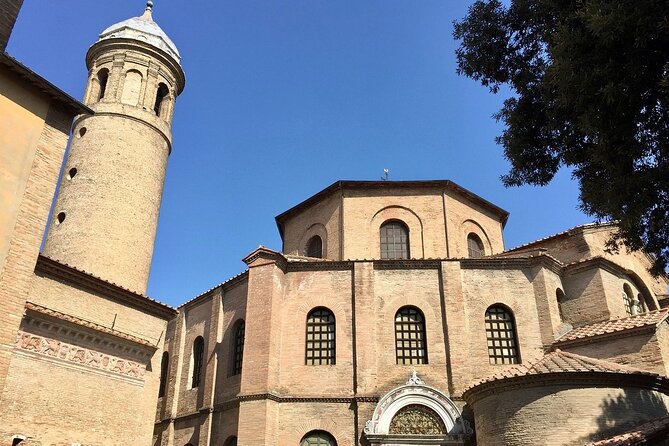
Ravenna is easy to underestimate. It is not Italy’s loudest or most famous city, but it holds an extraordinary collection of early Christian and Byzantine monuments. Several are UNESCO World Heritage sites, and their interiors are far more dramatic than their plain exteriors suggest.
I like this walking route because it puts the city’s sights into a sensible story. You begin with baptism and early Christianity, pass through Ravenna’s medieval and civic center, then reach the major mosaic churches before finishing with Theodoric’s large stone mausoleum.
The tour takes about three to four hours, though your real time will depend on how long you spend inside each monument. The listed stops total roughly three hours, before accounting for walking and ticket lines. If you want to study every mosaic panel, plan on more time.
The route is self-guided, so you can pause whenever a detail catches your eye. That matters in Ravenna. The mosaics are not a quick photo stop. They reward a few quiet minutes, especially when you begin to notice the tiny faces, repeated patterns, gold backgrounds, and carefully arranged processions.
More Audio Walking Tours in Italy
- Florence: 2.5 hour Audio Guided Walking Tour led by Host
★ 4.6 · 293 reviews - Verona Walking Tour with Audio and Written Guide by a Local
★ 4.5 · 157 reviews - Bologna Walking Tour with Audio and Written Guide
★ 4.5 · 132 reviews
Starting at the octagonal Baptistery of Neon
The walk begins at the Battistero Neoniano, also called the Baptistery of the Orthodox, at Piazza Arcivescovado 1. Allow about 20 minutes here.
The building’s octagonal shape is not simply an architectural choice. Its eight sides refer to the seven days of creation and an eighth day linked with resurrection and eternal life. That symbolism gives the baptismal building a clear purpose before you even step inside.
At the center is an octagonal baptismal font dating from the Renaissance period. The guide can help you connect the building’s shape, the font, and the meaning of baptism, rather than treating the stop as another old church.
Admission is not included. The listed €10.50 ticket also covers other monuments, including Sant’Apollinare Nuovo, San Vitale, and the Mausoleum of Galla Placidia. Because the ticket arrangement matters to the overall value, check the current terms when you arrive.
San Francesco and Dante’s Ravenna
Next comes the Basilica di San Francesco, about 20 minutes into the route. The church began in the mid-5th century and was first dedicated to the Holy Apostles, later becoming associated with Saint Peter. Renovations have changed much of the original structure, so this stop is less about seeing one perfectly preserved early Christian interior.
The special reason to visit is Dante Alighieri’s tomb. Ravenna became the poet’s final home, and his tomb adds a literary layer to a route otherwise dominated by mosaics and religious architecture.
Admission to the basilica is free. That makes it an easy stop even if you are carefully managing your budget for the paid monuments.
I would use this section of the walk to adjust to the audio format. Keep your phone ready, and use headphones if you have them. The audio can also play through your phone’s speakers, but headphones may make it easier to hear explanations near busy streets or inside large spaces.
Sant’Apollinare Nuovo and Theodoric’s royal chapel
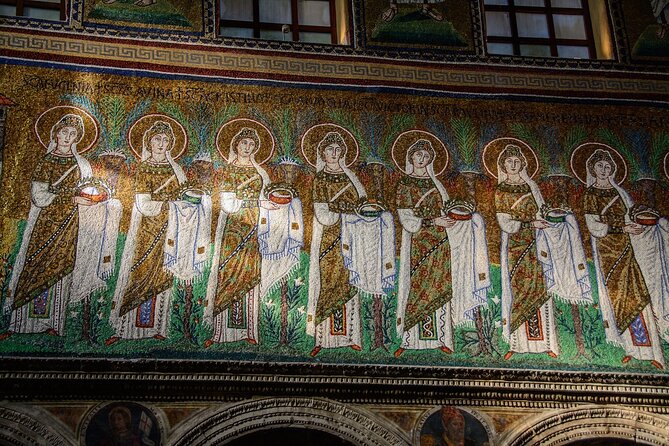
The Basilica di Sant’Apollinare Nuovo receives about 25 minutes on the route. Theodoric, king of the Ostrogoths, commissioned it at the end of the 5th century after defeating the Roman officer Odoacer in 493. It first served as a Palatine Chapel, used for the religious life of the ruler.
That background helps you read the building as both a church and a political statement. The church reflects the complicated period when Roman, Gothic, and Byzantine worlds met in Ravenna.
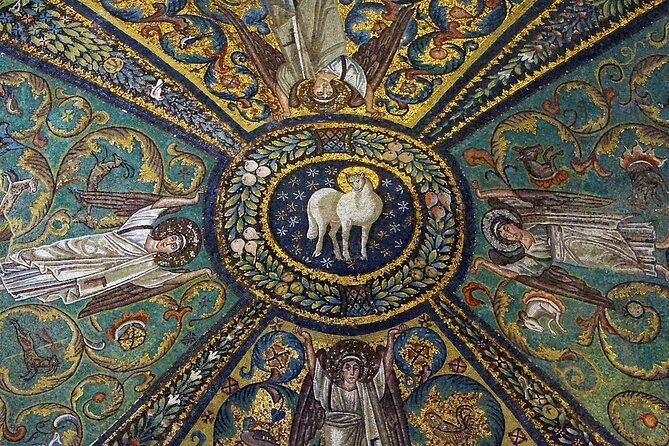
The mosaics are the main reason to slow down here. Your audio and written guide can point out what to look for instead of leaving you to face a long decorated nave without context. I appreciate that combination because written notes let you reread a point, while audio keeps your eyes free for the walls and ceiling.
Admission is separate from the $7.21 guide. The stated €10.50 ticket includes several Ravenna monuments, so the value improves if you plan to enter the included sites rather than viewing them only from outside.
Same place, a different route to walk:
- Rome: Pantheon Fast-Track Ticket and Official Audioguide
★ 4.5 · 27,353 reviews - Rome: Colosseum & Forum with Audio Guide App -Optional Arena
★ 4.2 · 24,770 reviews - Florence: Timed Entry to Michelangelo’s David + Audio App
★ 4.6 · 19,496 reviews - Rome: City Sightseeing Hop-on Hop-off Bus with Audioguide
★ 4.0 · 16,045 reviews
Piazza del Popolo and the city’s everyday center
Piazza del Popolo is a shorter 15-minute stop, but it gives the walk a useful change of mood. This is Ravenna’s central civic square, where historic streets meet and public events take place.
The Venetians built the piazza between 1470 and 1480. That date places it well after the early Christian monuments, so you get a glimpse of another chapter in the city’s story.
This is also where a local-style digital guide can add value through small details and stories. The stop is free, and you do not need to enter a building. Take a moment to look around rather than rushing directly to the next church.
If you are hungry, the included restaurant advice is useful here in principle, since you are already near the city center. The information promises suggestions for authentic local food, but it does not specify particular restaurants in advance. Read the guide on your phone before choosing where to eat.
The Domus dei Tappeti di Pietra
The Domus dei Tappeti di Pietra takes about 30 minutes. It is an archaeological site discovered in recent decades and is one of the route’s most different stops.
Instead of entering a church built for public worship, you see the remains of a Roman-era house decorated with elaborate stone and mosaic floors. The central image is the Dance of the Geniuses of the Seasons. The seasons move in a circle to the sound of a syrinx, an ancient reed instrument.
This stop helps you see that Ravenna’s artistic story is not limited to grand basilicas. Domestic spaces could also carry careful design and symbolic images. The mosaics here are viewed from above, which makes the layout easier to understand than wall mosaics viewed from across a nave.
Admission costs €6 and is not included. At this point, the extra charges begin to matter. The guide itself is inexpensive, but if you enter every paid stop listed, the monument budget is much larger than the booking price.
San Vitale, Ravenna’s great Byzantine interior
The Basilica di San Vitale receives about 20 minutes, though I would consider spending longer if the building is open and you want to study the decoration.
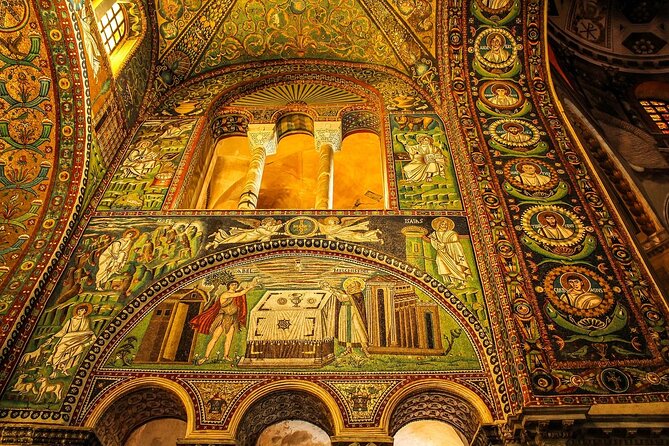
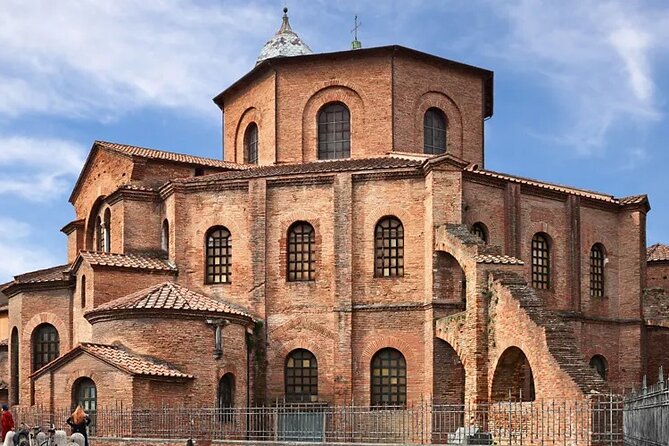
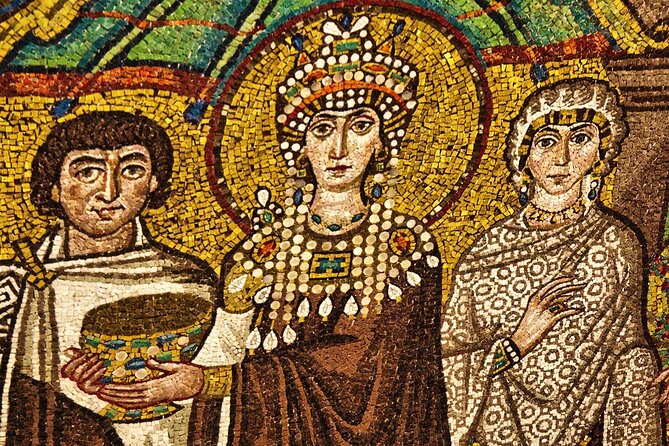
The exterior is relatively simple. Inside, the design changes completely. San Vitale has an octagonal plan and a central structure unlike the long basilicas many people expect from Italy. Curves and turning surfaces give the interior a sense of movement.
The church was designed to express Byzantine grandeur. The guide’s historical notes are most useful here because the building can feel visually overwhelming at first. You will get more from the mosaics if you know what the architecture is trying to do.
The stated €10.50 ticket also covers San Vitale and the Mausoleum of Galla Placidia, along with other monuments in Ravenna. These two sites are close in both theme and location, making the shared ticket a practical purchase if you want the full experience.
The star-filled Mausoleum of Galla Placidia
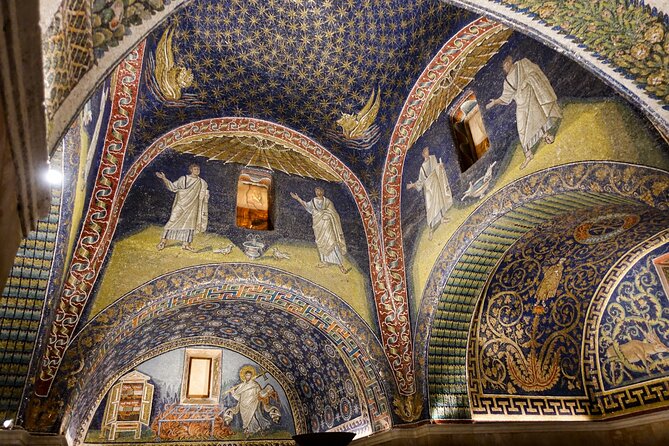
The Mausoleum of Galla Placidia is scheduled for another 20 minutes. Its plain exterior gives little warning of the interior decoration.
The contrast is the point. The outside suggests solid matter, while the inside uses color, gold, and light to suggest the soul and spiritual life. The dome is covered with stars and includes a large golden cross, creating an image associated with Paradise.
This is one of the places where a self-guided audio explanation can prevent you from missing the central idea. Without context, you might simply see a small building with beautiful surfaces. With the symbolism in mind, the dark, starry interior becomes much more meaningful.
The site is included in the €10.50 group of monument admissions listed for San Vitale and Galla Placidia. Admission is not covered by the digital tour price, and entry is described as not mandatory. You can therefore choose how much of Ravenna’s paid heritage program fits your schedule and budget.
Finishing at Theodoric’s massive mausoleum
The final stop is the Mausoleum of Theodoric, with about 20 minutes planned for the visit. The route ends here, on Via delle Industrie 14, so do not assume you will finish back in the center.
The building was commissioned by Theodoric around 520 AD. Its importance comes partly from the unusual meeting of styles. Roman influence combines with elements linked to the Gothic tradition, creating a structure unlike the colorful churches earlier in the walk.
The mausoleum is made especially memorable by its scale and stone construction. After spending much of the day looking at delicate mosaic surfaces, you finish with a building that feels heavier and more severe.
Admission costs €4. This is separate from the digital guide and from the other monument tickets. The end point is described as another UNESCO World Heritage monument, which gives the route a strong finish, but you should plan your onward transport from this location because the tour does not include a return transfer.
What the $7.21 price really gives you
At $7.21 per person, the guide is inexpensive for a route covering eight significant stops. You are paying for a digital city guide, audio and written material, historical notes, curiosities, restaurant advice, and directions that connect the sites.
The price does not cover entry to most of the monuments. Based on the listed costs, you may need:
- €10.50 for the shared ticket covering several major monuments
- €6 for the Domus dei Tappeti di Pietra
- €4 for the Mausoleum of Theodoric
That brings the listed extra admission costs to about €20.50 if you enter all the paid sites described. The shared €10.50 ticket details should be checked at the time of your visit, since the description also notes that some entries are optional.
I see the guide as a low-cost planning and interpretation tool, not as a complete admission package. It gives you a route and helps you understand what you see. You still need to manage opening hours, tickets, and your own walking pace.
Using the phone-based guide without frustration
Your voucher includes instructions for activating the digital guide. Read those instructions carefully before arriving at the first stop. You need a smartphone with an internet connection, and the audio plays through the phone’s speakers or your headphones.
The guide includes a Google Maps button before each monument. Use it every time rather than relying on memory or a printed city map. One person had trouble finding the next stop and ended up walking in circles, so navigation is the main area where a little preparation pays off.
I would also start with a charged phone and bring headphones if you own them. The group limit is listed as 104 people, but this is not a conventional live group moving as one unit. You follow the route independently, so you are responsible for starting, pausing, and moving on.
The experience is offered in English, with audio and text also available in Spanish, Italian, German, and French. That makes the format useful for mixed-language groups who want to visit together but listen or read in different languages.
Who will enjoy this Ravenna walk
I would recommend it most strongly to:
- First-time visitors who want a clear route through Ravenna’s major sights
- Independent sightseers who do not want a fixed live guide
- Couples and small groups who prefer setting their own pace
- Budget-conscious visitors who want interpretation without paying for a private tour
- People interested in mosaics, Byzantine architecture, early Christian art, and Roman archaeology
- Visitors comfortable using Google Maps and a phone-based guide
I would be more cautious if you want lively conversation, detailed questions answered on the spot, or help with every turn. A live local guide would offer more personal interaction. This digital option gives you freedom, but that freedom comes with responsibility.
The route is also less suitable if you need a fully included experience. The $7.21 price is attractive, yet the main monuments require additional admission fees. Check your schedule, too. The listed duration is three to four hours, but entering every site and spending time with the mosaics can stretch the day.
Should you book the Ravenna Walking Tour?
Book it if you want an affordable, structured introduction to Ravenna and you are happy to guide yourself with a phone. The strongest features are the carefully chosen route, the audio and written material, the five language options, and the chance to see both famous basilicas and less familiar sites such as the Domus dei Tappeti di Pietra.
Skip it if you want a human guide, effortless navigation, or one price covering all admissions. In that case, the digital format may feel too hands-off.
For most independent visitors, I see it as good value, especially if you use the Google Maps buttons, read the activation instructions, and budget for the extra €20.50 in listed admissions. Ravenna’s mosaics deserve more than a rushed look. This guide gives you a practical way to slow down and see them in context.
FAQ
How long does the Ravenna walking tour take?
The experience takes approximately three to four hours. The listed time at the eight stops adds up to about three hours, with additional time needed for walking between sites and possible admission lines.
Where does the tour start?
It starts at the Battistero Neoniano, also called the Battistero degli Ortodossi, at Piazza Arcivescovado 1 in Ravenna.
Where does the tour finish?
The route ends at the Mausoleum of Theodoric on Via delle Industrie 14, Ravenna. It does not finish at the starting point.
Are entrance tickets included?
No. The digital guide price does not include most monument admissions. The listed extra costs are €10.50 for the shared ticket covering several monuments, €6 for the Domus dei Tappeti di Pietra, and €4 for the Mausoleum of Theodoric.
What languages are available?
The audio guide and written guide are available in English, Spanish, Italian, German, and French.
Do I need a smartphone and internet access?
Yes. You need a smartphone with an internet connection to activate and use the digital guide. The activation details are provided in your booking voucher.
Can I cancel for a full refund?
Yes, if you cancel at least 24 hours before the experience start time. Cancellations or changes made less than 24 hours before the start time are not refunded.
Just added around Italy
- Torino Walking Tour with Audio and Written Guide by a Local★ 4.5 · 35 reviews
- Medieval Canals and Fountains: A Treviso Self-Guided Audio Tour★ 4.5 · 4 reviews
- Trapani Walking Tour with Audio and Written Guide by a Local★ 4.0 · 8 reviews
- Trento Walking Tour with Audio and Written Guide★ 4.5 · 11 reviews
- Sicily: Selinunte Park Entry Ticket & Sicily Digital Audio Guide★ 4.5 · 4 reviews
- Taormina Walking Tour with Audio and Written Guide by a Local★ 4.5 · 41 reviews
- Taranto Walking Tour with Audio and Written Guide by a Local★ 5.0 · 5 reviews
- Siracusa Walking Tour with Audio and Written Guide by a Local★ 5.0 · 59 reviews
Walking Tours, compared.
City Monuments Guided Walking Tour with Audio Guide
Read our review →

Self Guided Classic Freedom Trail Location Aware (GPS) Walking Audio Tour
Read our review →
Self-Guided Historical Walking Tour (Audio Guide)
Read our review →
Cape Cod & Provincetown Self-Guided Driving & Walking Audio Tour
Read our review →
Verona Walking Tour with Audio and Written Guide by a Local
Read our review →
Royal Walking Tour and Buckingham Palace Audio Tour
Read our review →
Bologna Walking Tour with Audio and Written Guide
Read our review →Browse the lists this tour appears in