
REVIEW · MALLORCA AUDIO TOURS
Palma’s Alternative History: A Self-Guided Audio Walk
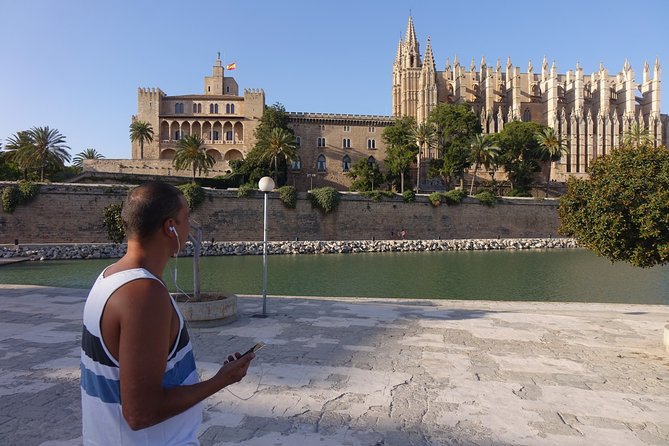
Palma’s old town rewards a slow walk. This self-guided audio tour makes the city easy to approach, linking the cathedral, palace, churches, courtyards, and central squares in about an hour. I like the freedom to start, pause, and continue whenever you choose, and I like that the route begins at Parc de la Mar, where Palma’s grandest sights appear together.
The tour also gives you Sandra’s local voice and plenty of useful history without placing you in a group. At $9.99, it is a good-value introduction to Palma, especially if your time is short. The main concern is the VoiceMap app, which can use a lot of battery and has reportedly frozen for some users, so download everything first and bring headphones with a full phone.
Key points to know before you walk
- Start beside Palma’s postcard view: Parc de la Mar faces La Seu Cathedral and the Almudaina Palace across a small saltwater lake.
- Follow Palma’s story through several eras: The route touches Talayotic culture, Moorish rule, the medieval kingdom, the Spanish Inquisition, and modern tourism.
- Hear Sandra’s personal take: Her narration adds stories and small details to major sights, churches, bars, and old courtyards.
- Finish at Plaça de Cort: The walk ends near Palma’s town hall, at the city’s traditional center point.
- Bring a charged phone: The audio, map, and location features work offline, but the app may drain your battery.
- Expect a walk, not admissions: Entry tickets, food, drinks, transport, a smartphone, and headphones are not included.
Why this short Palma walk works well
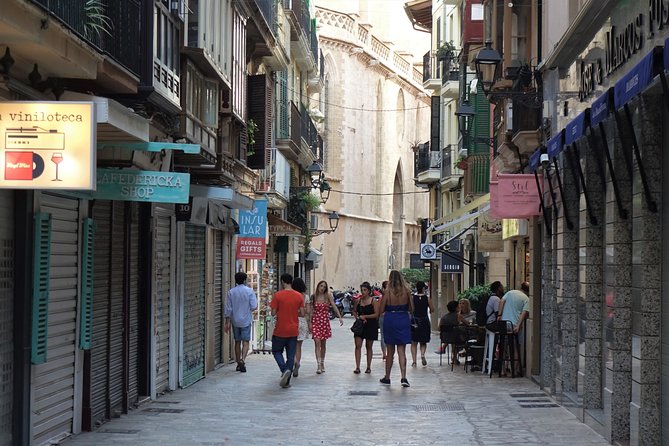
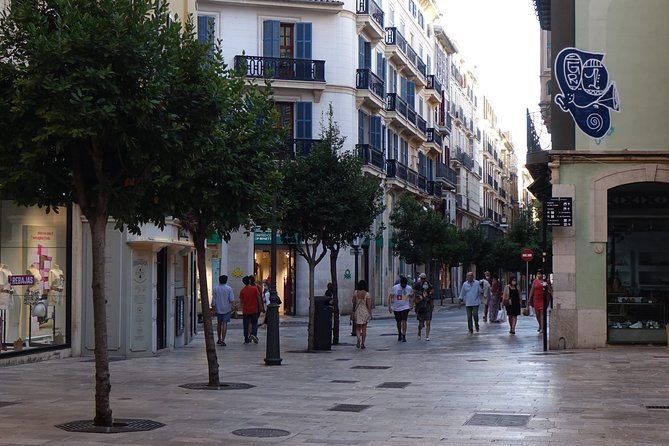
Palma can feel confusing at first. The cathedral sits beside the palace, narrow lanes twist through the old center, and grand squares appear suddenly between ordinary streets. This walk gives you a clear line through the city, from the seafront to Plaça de Cort.
The route lasts roughly one to one and a half hours, though the exact time depends on how often you pause. That matters because this is not a tightly timed group tour. You can stop for a photograph, step into Santa Eulalia Church, sit at a bar, or replay a section before moving on.
You will use the VoiceMap app on an Android or iOS phone. Audio, maps, and geodata can be downloaded for offline use, which is helpful if you do not want to depend on mobile service while walking. The location feature is intended to guide the narration as you move, but you should not treat it as failproof navigation.
One person found the app repeatedly froze and required a full restart and manual repositioning. Another liked the concept but found it very demanding on the phone battery. I would download the tour before setting out, close other apps, lower screen brightness, and carry a portable charger if you have one. Also save the route’s start and end points in your map app before leaving.
More History Audio Tours in Spain
- Madrid: Archaeological Museum E-Ticket and Audio Guide
★ 4.3 · 115 reviews - Historic Ciutadella: A Self-Guided Audio Tour
★ 4.5 · 29 reviews - Ronda Old Town Walking Tour with Audioguide on Your Smartphone
★ 4.0 · 20 reviews
Starting at Parc de la Mar with Palma’s grandest view
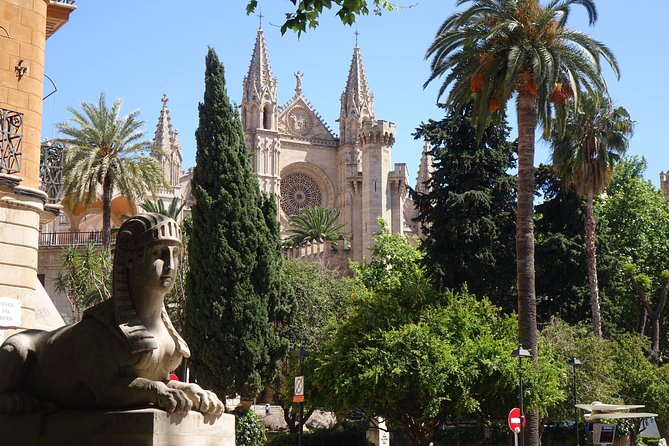
The walk begins at Parc de la Mar, a square built over the sea during the tourism boom of the 1960s. Its small salt lake reflects the Cathedral of Palma and the Almudaina Palace, giving you an immediate lesson in how old and new Palma sit side by side.
This is a smart starting point. You do not begin in an anonymous street or beside a transport stop. You begin with the two buildings that define the city skyline. The audio sets up their importance before leading you into the older streets.
Take a moment here before pressing play. The opening view helps you understand Palma’s layout. The cathedral rises beside the palace, while the park and lake belong to a much later period. That contrast is one of the walk’s useful themes: Palma has been altered repeatedly, but its main landmarks still anchor the city.
The park is also a practical meeting point. The official start is Parque del Mar in Palma, and the walk is available every day at any hour according to the stated operating schedule. Still, daylight will make it easier to read the map, notice building details, and find your way if the app needs help.
The Art Nouveau stop and a glimpse of modern Palma
One stop brings you to a striking Art Nouveau monument built in the early 1900s. The building represents a later period in Palma’s story, when the city was changing in appearance and public life.
The stop is useful because the walk does not treat Palma as a medieval museum. You get older religious and royal buildings, but also a look at the architectural style that arrived in the early twentieth century. This variety keeps the route from becoming a single repeated lesson about stone walls and Gothic arches.
The description does not identify the monument by name, so you should let the audio provide the full explanation when you reach it. Pay attention to its exterior forms and decorative details. If you enjoy architecture, this may be one of the stops you want to linger over rather than simply pass while listening.
Can Marcel, an old house with a modern pause
The route then reaches a typical noble Majorcan house, once called Can Marcel. Built in the seventeenth century, it now contains a lounge bar with a rustic, authentic design.
This is one of the walk’s more human stops. A historic house is not presented only as a facade. It has a current use, and you can make a break there if you want one. That makes the audio walk feel less like a checklist and more like a loose framework for an afternoon in Palma.
The bar is not included in the $9.99 price, so plan to pay separately for anything you order. You may also choose to continue without stopping. The value here is the option: you can keep the walk close to its one-hour length, or stretch it with a drink and a closer look at the building.
More Self-Guided Audio Tours in Spain
- Madrid: El Retiro Park Self-Guided Audio Tour
★ 3.8 · 134 reviews - Ronda Self-Guided Audio Tour with Andalucia Travel Expert
★ 4.5 · 26 reviews - Gaudi and La Sagrada Familia Exterior Self-Guided Audio Tour
★ 3.5 · 25 reviews - Valencia: Self-guided Audio Tour on Your Smartphone
★ 4.0 · 21 reviews
Santa Eulalia Church and Palma before the cathedral was finished
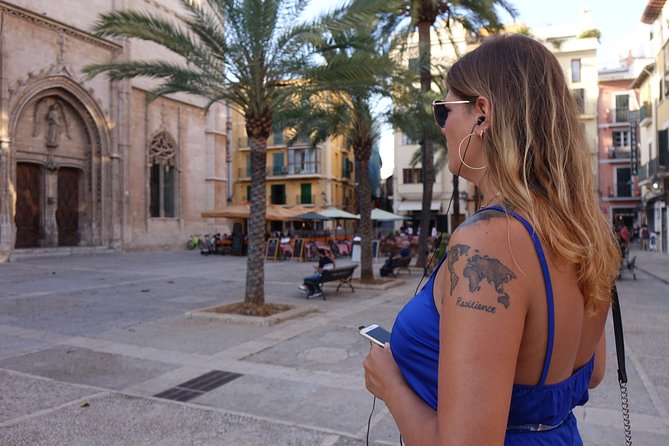
Santa Eulalia Church is one of Mallorca’s oldest churches. Built in the thirteenth century, it played an important role before the Cathedral of Palma was completed in 1601. The first kings of Mallorca were crowned here, giving the church a direct link to the early kingdom.
Inside, the decoration is Baroque, and entry is free. That makes this a particularly worthwhile pause. You are not asked to buy another ticket to see an interior that helps explain Palma’s religious and royal past.
The church also gives you a useful comparison with La Seu. The cathedral may be the city’s grandest religious building, but Santa Eulalia helps show what came before it. If the doors are open, step inside quietly and allow extra time beyond the stated walking estimate.
The audio can tell you why the church matters, but it cannot replace looking up at the decoration or noticing the scale of the space. This is a good example of how to use the tour: listen while approaching, pause the narration at the entrance, then explore at your own speed.
The street where Sa Riera once divided the city
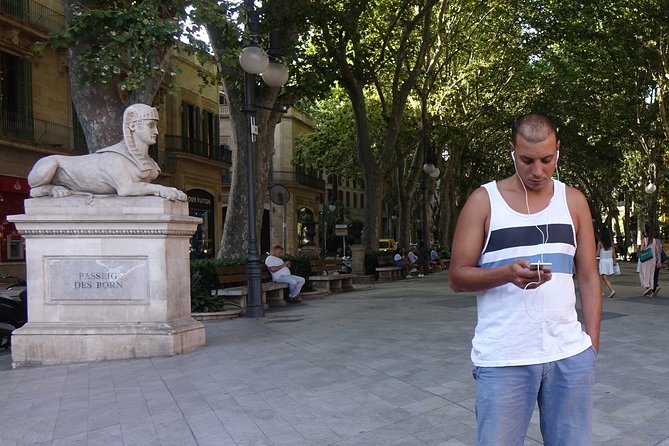
Another stop follows a street that once carried the torrent of Sa Riera. The watercourse divided Palma into two parts, and knights’ tournaments were held along it in earlier times.
Details like this give ordinary streets a second life. Without the audio, you might see a route between major monuments. With the story, you can picture the street as part of a very different city, shaped by water, ceremony, and public spectacle.
This is also where the self-guided format has an advantage. You can stand still and imagine the former torrent without holding up a group. If the location feels less obvious than the cathedral or palace, listen carefully for the app’s cue and keep the map open.
The walk is designed to connect big landmarks with these smaller historical settings. That balance is one of its stronger features. You get the famous sights, but you also hear why a normal-looking street deserves attention.
Plaça de Cort, Palma’s traditional center
The audio walk ends near Palma’s town hall at Plaça de Cort. This central square is described as the city’s Mile Zero, making it a fitting finish for a route through Palma’s old core.
Ending here is practical. You are no longer beside the water, and you have worked your way into the middle of the historic center. From this point, you can continue exploring on your own, stop for food, or simply use the square as a place to get your bearings.
The finish also gives the route a clear shape. You start with the cathedral and palace in front of you, then move through churches, houses, former waterways, and public squares before reaching Palma’s civic center.
Because the walk ends around an hour later, you should not expect a full-day tour. It is a focused introduction. If you want detailed access to every building, museum, or palace, you will need separate visits and tickets.
Plaça de Sant Francesc and Palma’s annual celebration
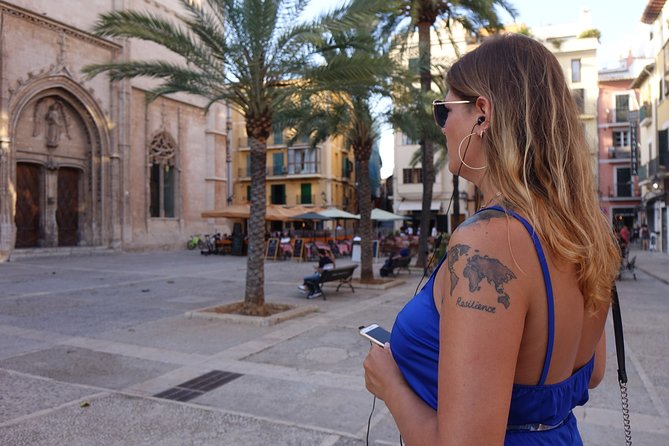
The route includes a beautiful square built in the middle of the nineteenth century, Plaça de Sant Francesc. Each year, the square hosts the feast of Saint Sebastian on January 19, the patron saint of Palma.
This stop adds a living calendar to the city’s history. You are not only looking at buildings from past centuries. You are also hearing how Palma continues to use its public spaces for celebration.
The square can be a pleasant place to pause, though the tour does not include food or drinks. You may want to make this stop part of a longer wandering route after the audio ends, especially if you prefer seeing the city at a slower pace.
La Seu, the Cathedral of Light
The Cathedral of Palma, known as La Seu and the Cathedral of Light, is the route’s major landmark. Construction began in 1230 and took 371 years, with completion in 1601. Its long building period reflects the changing history of Mallorca itself.
The cathedral is the kind of sight that deserves more than a quick photograph. Use the narration for context, but give yourself time to look at the Gothic exterior, the scale of the building, and its position beside the water and palace.
The tour does not include cathedral admission. That is important when calculating your day’s budget. The $9.99 buys the audio experience, not entry to the attractions along the route.
Even if you do not go inside, the exterior stop is worthwhile. La Seu dominates the opening view from Parc de la Mar, then appears again as part of the city’s wider story. The walk helps you see it not as an isolated monument, but as the result of centuries of religious and political change.
Almudaina Palace and the layers of Palma’s power
Beside the cathedral is the Almudaina Palace, described as an Arab king’s palace built in the tenth century. It is Palma’s oldest monument and now serves as a royal residence, museum, and military building.
The palace brings together several roles in one place. Its origins reach back to the period of Islamic rule, while its current use connects it to Spain’s monarchy. The stated information notes that King Felipe VI receives official visitors there, so this is not simply a preserved ruin.
This stop is especially useful if you want to understand Palma’s position as a city shaped by different rulers. The audio connects the palace to the broader movement from Moorish Mallorca to the Christian kingdom and later Spain.
Admission is not included. If you decide to enter, allow more time than the basic audio estimate. The walk itself only gives you the outside context and the route onward.
La Llotja, a Gothic building with free entry
The final major architectural highlight is La Llotja, a Gothic building completed in 1428. It once served as Palma’s maritime stock exchange and is open to the public without an admission charge.
This is an excellent value stop within the route because you can go inside without adding another ticket cost. Its former purpose also widens the tour beyond churches and royal buildings. Palma was a port city with commercial links, and La Llotja shows the importance of trade to its development.
You may want to pause the audio while entering and resume it once you are ready to continue. As with Santa Eulalia Church, the building is best understood through both the spoken explanation and your own look at the interior.
What the $9.99 price really buys you
At $9.99 per person, this is inexpensive for a private experience. Only your group takes part, and you are not paying for a guide’s time by the hour or waiting for other people to arrive. The value is strongest if you want a structured introduction but dislike fixed schedules.
You also receive lifetime access in English or French, along with the VoiceMap app and offline audio, maps, and geodata. That means you can return to a section later rather than trying to absorb every detail in one pass.
The price is less attractive if you already know Palma well or want entry into its major buildings. You will need to budget separately for attractions, food, drinks, and transport. You also provide the phone and headphones.
I see this as a good first-day orientation. It gives you a route and enough context to decide where you want to spend more time. It is not a replacement for a full museum visit or a private historian.
Who should choose this audio walk?
I would recommend it to you if you:
- Have about one to one and a half hours for Palma’s old center
- Prefer setting your own pace
- Want history without joining a scheduled group
- Like combining major sights with smaller streets and old houses
- Are comfortable using a smartphone map and audio app
- Need English or French narration
- Want a low-cost introduction before choosing paid attractions
It may not suit you if you want a live guide, dislike phone-based navigation, or need a perfectly smooth app experience. The route depends on your device, battery, headphones, and ability to recover if the location feature loses track.
The walk is also not designed around extended access to every stop. You can pause and explore, but the basic route remains short. Think of it as a guided thread through Palma, not a complete sightseeing day.
Should you book Palma’s Alternative History?
Book it if you want flexible city orientation at a low price. The route has a clear beginning and end, the history covers several important periods, and Sandra’s narration adds personality to places you might otherwise pass without noticing.
Before starting, download the content offline, charge your phone fully, bring headphones, and note the route from Parc de la Mar to Plaça de Cort. If you prepare for the app’s battery demands, this can be a useful and affordable way to meet Palma on your own terms.
FAQ
How long does Palma’s Alternative History take?
The audio walk takes about one hour to one and a half hours, depending on how often you pause or stop at sights along the way.
Where does the audio walk begin?
It begins at Parc de la Mar in Palma, near the small saltwater lake facing the Cathedral of Palma and the Almudaina Palace.
Where does the tour end?
It ends at Plaça de Cort, near Palma’s town hall in the center of the city.
What language is the audio tour offered in?
The tour is offered in English. Lifetime access is also listed in English or French.
Are admission fees included?
No. Tickets or entrance fees for museums and other attractions along the route are not included. Santa Eulalia Church and La Llotja are described as free to enter.
Do I need internet access during the walk?
The audio, maps, and geodata can be used offline through the VoiceMap app. You need an Android or iOS smartphone and headphones, which are not included.
Just added around Spain
- Tenerife Scavenger Hunt and Highlights Self Guided Audio Tour★ 3.5 · 3 reviews
- Tarragona Scavenger Hunt and Highlights Self Guided Audio Tour★ 4.5 · 15 reviews
- Tarragona Cathedral Entrance + Audio Guide (WebApp)★ 4.5 · 36 reviews
- Seville Maestranza Bullring Tour with Audio Guide★ 3.5 · 6 reviews
- Sevilla Centre: City Walk Audioguide in 7 Languages on your Phone★ 3.0 · 2 reviews
- Seville Cathedral and La Giralda Entry Ticket with Audio Guide★ 3.0 · 9 reviews
- Royal Alcazar of Seville Entry Ticket with Audio Guide★ 4.0 · 42 reviews
- Essential Seville’s Ancient History: An Audio Tour★ 5.0 · 9 reviews
Self-Guided Tours, compared.
Acropolis Ticket & Optional Self-Guided Audio Tours
Read our review →


Ultimate Acadia National Park Self-Guided Driving Audio Tour
Read our review →

Santorini: Akrotiri Ticket with Optional Self-Guided Audios
Read our review →
Browse the lists this tour appears in