
REVIEW · GREECE AUDIO TOURS
Olympia: Archaeological Site & Museum E-Ticket & Audio Guide
Picture the Olympic Games before stadium lights. This Olympia ticket combines entry to the archaeological site, the Archaeological Museum, and the Ancient Olympic Games Museum with a self-guided audio tour for your phone. I like the freedom to visit the ruins at my own speed, and I like that the ticket covers three important parts of Olympia rather than only the main site. The main drawback is that the audio guide covers the archaeological site only, not the Archaeological Museum, and you must download everything yourself before arriving.
The $41 price can be good value if you plan to see all three attractions. You get flexibility for the ruins, but the museum ticket uses a selected time slot, so you still need to watch the clock. This is not a guided group visit. It is a practical phone-based option for independent visitors who want direction and context without following a guide with a flag.
Key points to know before you book
- Three admissions in one ticket: Enter the archaeological site, Archaeological Museum, and Ancient Olympic Games Museum on the same date.
- The audio route follows a clear path: It begins at the Gymnasium and finishes near the workshop of Pheidias.
- The museum time matters: The Archaeological Museum entry is tied to the date and selected time slot, while the two other admissions can be used anytime that day.
- You need your own equipment: Bring a charged Android or iOS phone, headphones, and about 100 to 150 MB of storage.
- The most praised feature is ease of use: The app gives directions as you walk, helping you follow a sensible order through the ruins.
- Plan for sun and uneven ground: Comfortable shoes, a hat, and sunscreen are not optional luxuries here.
What the $41 Olympia ticket actually includes
This is best understood as a combination ticket with a digital guide, not as a traditional tour. Your package includes admission to the Archaeological Site of Ancient Olympia, entry to the Archaeological Museum at your selected date and time, and entry to the Ancient Olympic Games Museum on that same date.
The audio guide is for the archaeological site. It uses offline text, narration, and maps, so you do not need a constant data connection once the content is downloaded. That is useful in a large outdoor site, where phone reception and battery life may not always cooperate.
You receive instructions by email. Before setting out, download the app, open the audio tour, and confirm that the files work. Do this before you reach Olympia, rather than while standing at the entrance with the sun overhead and a queue behind you.
The tour is offered in English, German, Italian, French, and Spanish. There is no live guide, transportation, food, drink, smartphone, or headphones included. The $41 cost therefore pays for admission to the three attractions and the digital audio content, not a full-day escorted excursion.
More History Audio Tours in Greece
- Athens: National Archaeological Museum Ticket & Audio Guide
★ 4.3 · 1,330 reviews - Delphi: Archaeological Site & Museum Ticket with Audio Tours
★ 4.3 · 721 reviews - Athens: National Archaeological Museum Ticket w/ Opt. Audio
★ 4.4 · 713 reviews
Starting at the Gymnasium
The audio route is designed to begin at the Gymnasium inside the archaeological site. This gives you a useful starting point because the route then moves through the main remains in a planned sequence instead of sending you randomly between scattered foundations.
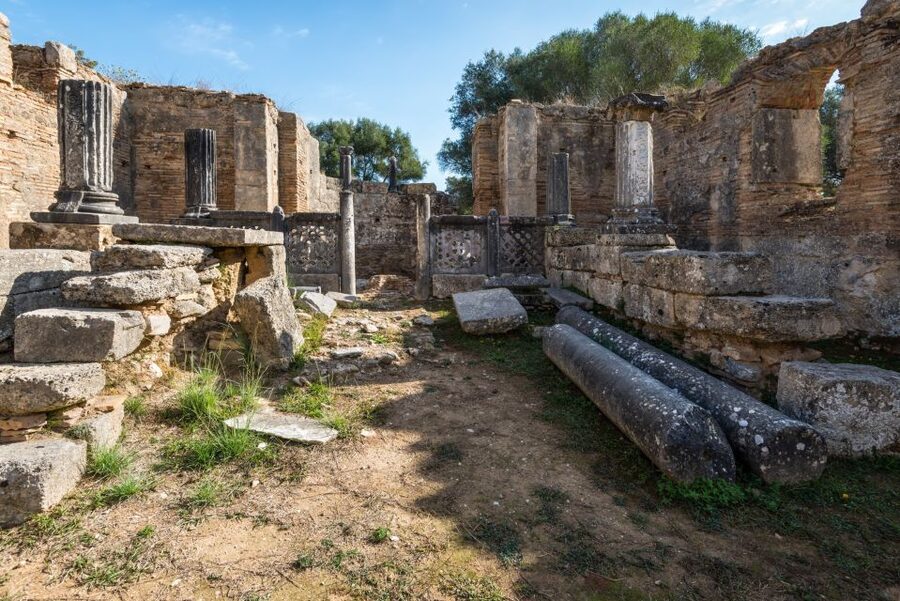
Olympia is not a compact building with a single dramatic viewpoint. It is an open archaeological area, and many structures appear as partial walls, columns, paving, or stone outlines. The audio narration helps explain what each area was used for, which makes a major difference when the ruins themselves do not immediately tell the full story.
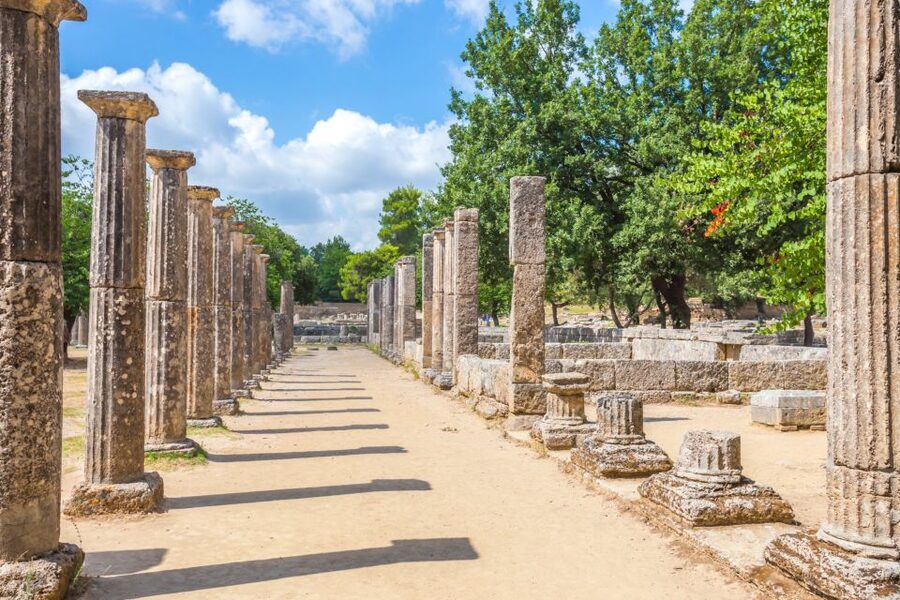
From the Gymnasium, you continue toward the Palaestra. These buildings help introduce the athletic side of Olympia, where physical training was central to the ancient games. The audio guide also points you toward the Prytaneion, the Philippeion, and the Temple of Hera.
The route is reported to take about an hour at a normal pace, though your own visit can be longer. You may stop for photographs, pause to study the remains, or replay sections. The audio can be used again before or after your visit, which is handy if you want to refresh the story later at your hotel.
The Palaestra, Prytaneion, and Temple of Hera
The Palaestra is one of the route’s worthwhile stops because it gives you a clearer sense of how training fit into daily life at Olympia. You are not simply looking at isolated stones. You are following the layout of a place built around preparation, discipline, and athletic performance.
The Prytaneion adds another side of Olympia. The site was not only a stadium and a collection of temples. It also needed administrative and ceremonial spaces, and the audio guide helps connect those less obvious remains to the wider religious center.
The Temple of Hera is among the essential stops. It is older than the famous Temple of Zeus and offers a useful contrast in scale and style. The route’s storytelling is aimed at short sections, so you can keep walking without listening to a long lecture at every stop.
That format works well if you prefer travel information in small portions. You get historical details, stories, and anecdotes, then move on. The tradeoff is that a phone narration cannot answer questions or adjust its explanation to your interests. If you want a conversation about ancient religion, archaeology, or the Olympic tradition, you would need a live guide instead.
The Philippeion, Nymphaion, and Temple of Zeus
The Philippeion is another stop where the audio matters. A circular monument can be easy to miss in a broad field of ruins, yet its purpose and political meaning are clearer when you have a short explanation in your ear.
The Nymphaion adds a different visual note, with its monumental water feature and architectural setting. It is a good reminder that Olympia was a functioning sanctuary with practical needs, not merely a sports venue.
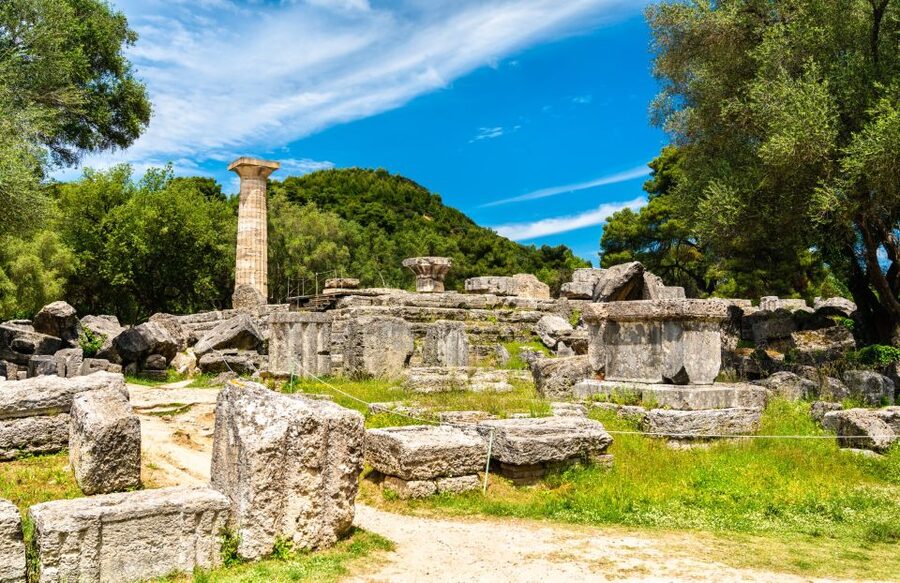
The Temple of Zeus is the headline ruin, even in its damaged condition. The scale of the fallen columns and the footprint of the building help you understand why this was one of the ancient sanctuary’s great monuments. The audio guide gives you a story to carry with the view, which is more useful than simply reading a sign and moving on.
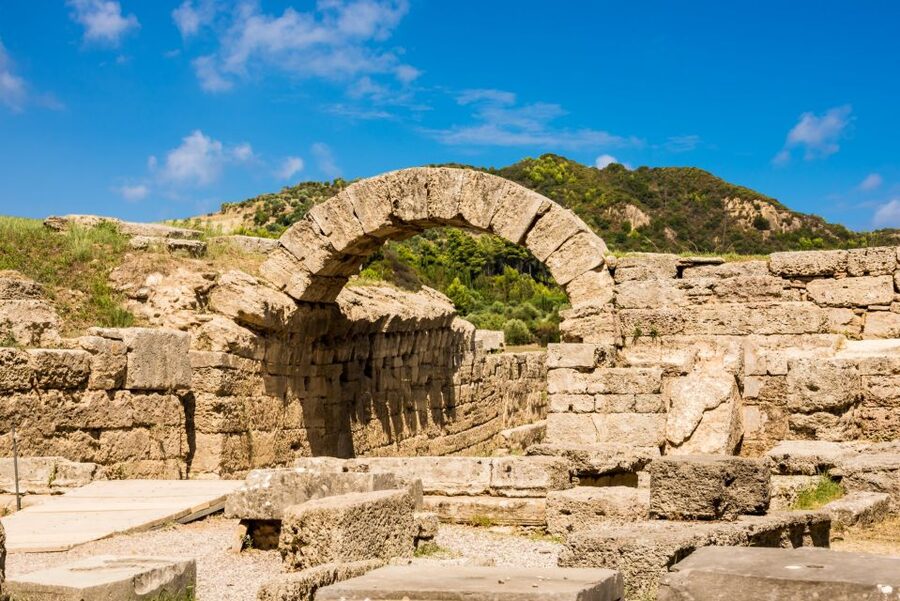
The ancient stadium is equally important. This is where the Olympic connection becomes physical. You can see the long running area and picture the athletic contests in their original setting. The site is open and exposed, so shade is limited. A hat, water, and sunscreen will make a real difference, especially in summer.
More Museum Audio Tours in Greece
- Athens: Acropolis Museum Ticket with optional Audio Guide
★ 4.4 · 2,652 reviews - Parthenon & Acropolis Museum with Audio or Live Tour Option
★ 4.1 · 2,446 reviews - Athens: Acropolis Museum Ticket with Audio Guide
★ 4.1 · 835 reviews - Crete: Knossos Palace and Museum E-Tickets with Audio Guides
★ 4.0 · 828 reviews
Pheidias’s workshop, where the audio route ends
The route finishes at the entrance to the workshop of Pheidias. That ending is especially useful because the workshop connects the archaeological site with one of its most famous artistic achievements.
Pheidias is associated with the colossal statue of Zeus that once stood in the Temple of Zeus. The workshop remains help you think about how a major ancient artwork was planned and produced, rather than treating the temple as an empty shell.
Ending here also leaves you close to a strong transition point for the rest of your visit. You can continue to the museums, revisit an area that caught your eye, or stop the audio and explore independently.
The route has a defined beginning and end, but you are not locked into it. You can pause the narration, go back, or listen again. One useful feature is that the app gives you instructions about where to go next. That reduces the chance of missing a major stop or walking in circles among similar-looking foundations.
The Archaeological Museum: included, but not audio guided
The Archaeological Museum of Ancient Olympia is included, and it is one of the most important parts of the day. Your museum admission is tied to the selected date and time slot, unlike the archaeological site and Ancient Olympic Games Museum, which can be visited anytime on that date.
You should treat the museum time as the fixed point in your schedule. Build the ruins around it, rather than arriving at Olympia with no plan and hoping the timing will work.
The museum gives you the objects and sculpture that help complete what you see outdoors. After looking at temple foundations and scattered architectural pieces, it is valuable to see surviving works in a controlled setting. The audio guide supplied with this package does not cover the museum, so you will need to use the museum’s own information panels or explore at your own pace.
That distinction is easy to miss when booking. If you want spoken commentary for every museum gallery, this package does not provide it. The included narration is specifically for the archaeological site.
The Ancient Olympic Games Museum
The Ancient Olympic Games Museum is also included and can be visited anytime on your selected date. It focuses on the games and their sporting tradition, making it a natural companion to the stadium and athletic buildings outdoors.
I would plan to visit it after seeing the site, when the buildings and running track are fresh in your mind. The museum then has more meaning because you have already stood in the setting where the games took place.
You do not have to use the attractions in a strict order, but the combination works best as a full day rather than a hurried stop. The outdoor ruins need time, and the two museums add indoor relief from the sun.
How the phone audio performs in practice
The strongest part of this product is its simple route guidance. The narration tells you where to go next, and the sequence is clear enough that you can follow it without constantly checking a map.
The app is designed for Android version 5.0 or later and iOS devices. It does not work with Windows Phones, iPhone 5 or 5C, older iPod Touch models, iPad 4th generation or older, or the first iPad Mini. You also need around 100 to 150 MB of free storage.
Download the content before you arrive. Check your phone’s battery, turn on the audio, and bring headphones. One person was happy using the phone speaker, but headphones are the better choice if the site is busy or you want to hear the narration clearly.
The audio can take a little practice. You may need to learn how to move forward or back if you walk faster or slower than the suggested pace. The ability to replay sections helps, but you should not expect the app to behave exactly like a live person walking beside you.
The upside is privacy and control. You can pause for photographs, skip a subject, or repeat an explanation. The downside is that you are responsible for managing the technology. A flat battery or failed download can turn a helpful guide into an expensive file you never hear.
Timing, transport, and a realistic day plan
There is no meeting point and no transportation included. The easiest way to reach the site is by car. If you arrive independently, leave enough time to locate the correct entrance and get through any bag check before your museum slot.
A practical order is:
- Visit the Archaeological Museum at your reserved time.
- Explore the archaeological site with the audio route.
- See the Ancient Olympic Games Museum anytime before leaving.
You can reverse the first two steps if your museum reservation makes that easier. The important point is to protect the museum appointment and leave the outdoor site flexible.
The package is valid for one day, not for multiple visits across several dates. The audio itself can be used again before or after your visit, but the admissions are for the selected date.
A full day is a sensible allowance if you want all three attractions. The audio portion may take roughly an hour, yet the ruins reward a slower pace. You will likely stop to look, photograph, listen again, and orient yourself between areas.
Comfort, access, and small details that matter
Wear comfortable shoes. The site includes uneven ground and broad outdoor paths, and you will be on your feet for much of the visit. A hat and sunscreen are especially important because shade can be limited. One useful practical suggestion is to bring your own umbrella if you prefer extra cover.
Oversize luggage and large bags are not allowed. Keep your belongings compact and bring only what you need for the site, including your phone, headphones, water, sunscreen, and ticket instructions.
Accessibility requires some planning. Parts of Olympia are not wheelchair accessible. The main entrance near the museum has steps that can create a barrier, while visitors with limited mobility are advised to use the other entrance.
The ticket supplier does not provide reduced or free tickets. However, the site rules state that people under 18 and visitors with disabilities accompanied by one family member or helper are eligible for free admission, while European Union citizens aged 18 to 25 receive a 50 percent discount. Since those reduced or free tickets are not supplied through this booking, check carefully before paying full price if you qualify.
The activity is non-refundable. That makes it important to confirm your date, museum time, phone compatibility, and transport plan before purchase.
Who will get the most from this experience
I would choose this for independent visitors who like to set their own pace and do not need a live guide. Families can find it useful because each person can follow the narration on a separate phone, and the clear directions help younger visitors understand where to go next.
It also suits people arriving by car who want a straightforward day at Olympia without arranging a private guide. The three admissions make the package more useful than a site-only ticket if you plan to visit both museums.
You may prefer a live guided tour if you want questions answered, deeper discussion, or help with transport. You may also want a different arrangement if you need audio commentary inside the Archaeological Museum.
At $41 per person, the value depends on using the full package. It is easier to justify if you visit the ruins and both museums, download the audio successfully, and appreciate the independence of a self-guided route. It is less attractive if you only want a quick look at the stadium or already have a guide arranged.
Should you book the Olympia audio guide and ticket?
Book it if you want three admissions, a clear outdoor route, and flexible pacing in one purchase. The audio guide is easy to follow, the route covers the site’s major monuments, and the chance to replay the content is useful.
Think twice if you want a live guide, museum narration, transport, or a flexible cancellation policy. Also check your museum time, phone model, storage, battery, and entrance needs before paying.
For an independent day at Olympia, this is a practical choice with a good balance of structure and freedom. Just remember that the phone is part of your equipment, not a minor extra.
FAQ
Is the audio guide included for the Archaeological Museum?
No. The included self-guided audio tour is for the archaeological site only. The Archaeological Museum entry is included, but museum audio commentary is not.
What attractions are included in the ticket?
The ticket includes the archaeological site of Ancient Olympia, the Archaeological Museum of Ancient Olympia, and the Ancient Olympic Games Museum.
Do I have to visit the archaeological site at a set time?
No. You can enter the archaeological site anytime on your selected date. The Archaeological Museum entry uses the date and time slot chosen during booking.
Is there a live guide?
No. This is a self-guided audio tour on your smartphone, with no live guide provided.
What phone do I need?
You need an Android phone running version 5.0 or later or a compatible iPhone. The audio is not compatible with Windows Phones, iPhone 5 or 5C, older iPod Touch models, iPad 4th generation or older, or the first iPad Mini.
Do I need internet during the visit?
The tour includes offline text, audio narration, and maps. You should download the app and tour before arriving, and you need around 100 to 150 MB of storage.
Is the site accessible for visitors with limited mobility?
Parts of the site are not wheelchair accessible. The main entrance near the museum has steps, and visitors with lesser mobility are advised to use the other entrance.
More Smartphone Audio Tours in Greece
- Crete: Palace of Knossos E-Ticket and Audio Guide
★ 3.8 · 1,540 reviews - Athens: Ancient Agora E-Ticket and Audio Tour
★ 3.9 · 413 reviews - Rhodes: Palace of the Grand Master E-Ticket & Audio Tour
★ 4.2 · 216 reviews - Archaeological Site of Mycenae: E-Ticket with Audio Guide
★ 4.2 · 144 reviews
Just added around Greece
- E-Ticket to Akrotiri with Audio Tour on your Phone★ 5.0 · 2 reviews
- Authentic Santorini: A Self-Guided Audio Tour of Oia★ 4.5 · 3 reviews
- The Palace of the Grand Master E-Ticket with Audio Tour★ 4.0 · 9 reviews
- The Palace of the Grand Master. Self-guided Audio Tour★ 3.5 · 15 reviews
- Acropolis of Lindos E-Ticket with Audio Tour on your Phone★ 4.5 · 8 reviews
- Explore Lindos Acropolis in 3D & Audio★ 4.0 · 4 reviews
- Olympia Archaeological Site & Museum E-Ticket with Audio Tour★ 4.0 · 11 reviews
- Mykonos: Find your (queer) god Self-Guided Audio Tour★ 4.0 · 2 reviews
Museums, compared.
Uffizi Priority Ticket & Masterpieces Audio App
Read our review →
Louvre Museum Hosted Entry and Mona Lisa Audioguide
Read our review →
St. Mark Basilica Ticket, Audioguide+History Gallery
Read our review →
Borghese Gallery Skip-the-Line Ticket & Audioguide
Read our review →
Borghese Gallery Ticket + Audioguide or Guided Tour
Read our review →
Orsay Museum Entry Ticket and Digital Audio Guide App
Read our review →
Uffizi Gallery Timed Entry Ticket & Audio Guide
Read our review →
Acropolis Museum Ticket with optional Audio Guide
Read our review →Browse the lists this tour appears in