
REVIEW · GERMANY AUDIO TOURS
Leipzig’s Communist Past: A Self-Guided Audio Tour
The past is underfoot in Leipzig. This compact audio walk connects major city sights with stories about daily life under the East German regime, then brings the 1989 Monday protests into sharper focus. I like the offline maps and audio, which let you explore without mobile data, and I like the freedom to pause at a café, church, or shopping arcade without losing your place.
The route also gives you a useful first look at central Leipzig, from Hauptbahnhof to Moritzbastei. Its stories come from a former local, and the sections about the Monday protests take place near the actual sites connected with those events. The main drawback is simple: this is not a live guided tour, so you will need your own smartphone and headphones, and you cannot ask questions along the way.
Key points to know before you go
- A 60 to 75 minute route: The tour begins at Hauptbahnhof and ends at Moritzbastei, covering a broad section of central Leipzig.
- Stories tied to real city locations: You pass Nikolaikirche, Thomaskirche, Augustusplatz, and other places linked to Leipzig’s public life.
- Useful for first-time orientation: The route includes the Brühl, Naschmarkt, Mädler Passage, Speck’s Hof, and several major squares.
- Offline access matters: Download the VoiceMap app, audio, maps, and geodata before setting out.
- Flexible timing: You can start, pause, and finish at your own pace rather than keeping up with a group.
- Good value at $9.99: The price is modest for a private, self-guided tour with lifetime English access, especially if you want context without booking a longer excursion.
What this Leipzig audio walk is really about
This tour is less about entering museums or seeing grand interiors and more about connecting Leipzig’s streets with its recent political past. You move through the center while hearing about life under East Germany’s Communist government and the Monday protests that helped make Leipzig internationally known.
That combination gives the walk its purpose. A standard city stroll might show you churches, arcades, squares, and concert halls. This tour asks you to look at those same places through the experience of people who lived under the East German regime.
I especially like that the route does not isolate the Communist period in one museum stop. Instead, the subject follows you through ordinary central Leipzig. A railway station, shopping street, church, and public square all become part of the story.
The tour is offered in English and runs for about one hour to one hour and 15 minutes. That is long enough to provide substance, but short enough to fit into a busy day. You can also pause the recording, which is useful if you want to stop for photographs, look inside a church, or spend time in one of the covered passages.
More Self-Guided Audio Tours in Germany
- Lübeck Scavenger Hunt and Highlights Self Guided Audio Tour
★ 4.0 · 30 reviews - Freiburg Scavenger Hunt and Highlights Self Guided Audio Tour
★ 4.0 · 29 reviews - Heidelberg’s Altstadt: A Self-Guided Audio Tour
★ 4.0 · 26 reviews
Starting at Hauptbahnhof and heading along the Brühl
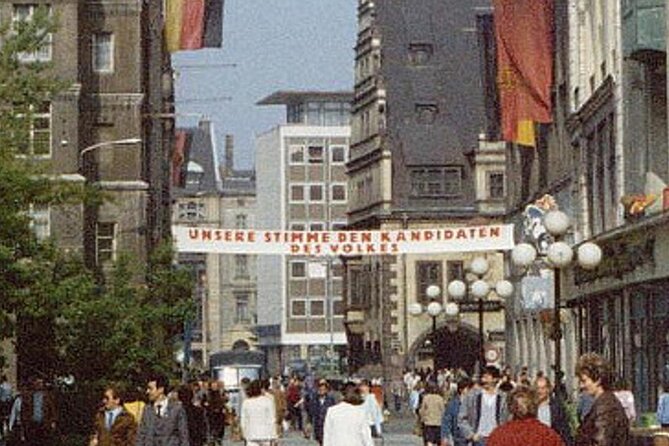
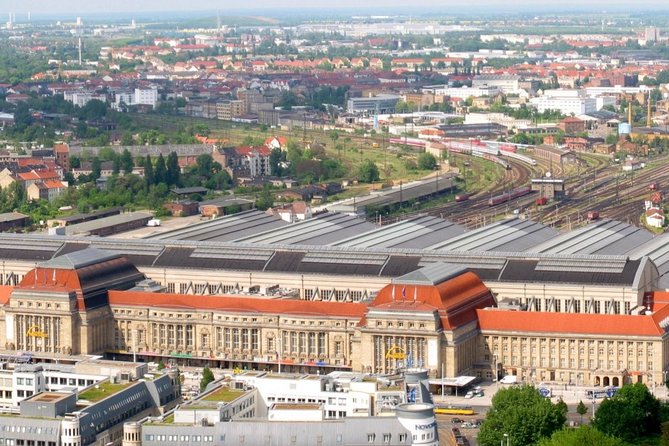
The tour starts outside Leipzig Hauptbahnhof, one of the easiest points in the city to reach by public transportation. This is a practical meeting point, especially if you are arriving by train or using the station as your base for exploring central Leipzig.
From there, the route heads along the Brühl. Starting at the station helps you get your bearings quickly, since the walk begins at a clear, central landmark rather than an obscure side street.
The opening section sets up the tour’s theme: Leipzig as a city where public space mattered. As you move away from the station, the audio begins placing modern streets within the wider story of East German life.
The Brühl also gives you an early sense of the city center’s changing face. You will see commercial areas and newer developments alongside older buildings and passages. That contrast is useful because the tour is not presenting Leipzig as a preserved historical set. It is a living city, and its past sits beside present-day shops and public spaces.
Höfe am Brühl and the Museum der Bildenden Künste
The route passes through Höfe am Brühl, a modern shopping complex. On a tour about Communist Leipzig, this may seem like an unexpected stop, but it helps show how much the center has changed.
You are not being asked to treat the shopping center as a historic sight. Instead, it works as a marker of modern Leipzig and a reminder that the city’s commercial center has been repeatedly reshaped.
Next comes the Museum der Bildenden Künste, Leipzig’s fine arts museum. The tour passes by rather than including admission, so you should not expect a museum visit to be part of the $9.99 price.
That distinction matters. The audio tour uses the museum as part of its route and orientation, but personal expenses and admission fees are not included. If you want to enter any attraction along the way, plan that separately and allow extra time.
Reformierte Kirche and Richard Wagner Platz
The walk continues past the Reformierte Kirche and Richard Wagner Platz. These stops help break up the route with smaller points of interest rather than relying only on Leipzig’s most famous landmarks.
Richard Wagner Platz is particularly useful as a reference point because it keeps you moving through the central urban area while the narration develops its account of Leipzig under East Germany. You can pause here if you need a short break, though the exact length of each stop depends on how quickly you listen and walk.
One benefit of a self-guided format is that you do not have to stand in a fixed group while listening. You can find a comfortable spot, lower the volume, or replay a section if a name or detail passes too quickly.
The tradeoff is that the experience depends on your own attention and phone setup. A live guide would notice when people look confused or want more detail. With this tour, you control the pace, but you also need to manage it.
Same place, a different route to walk:
- Neuschwanstein Castle Skip-the-Line Ticket with Audio Guide
★ 4.4 · 1,388 reviews - Berlin: Solar Powered Sunset Catamaran Cruise & Audio Guide
★ 4.6 · 1,043 reviews - Berlin: Boat Sightseeing Cruise with Audioguide
★ 4.6 · 947 reviews - Füssen: Neuschwanstein Castle Express Ticket and Audio Guide
★ 3.9 · 788 reviews
Thomaskirche and the city’s public memory
The route passes by Thomaskirche, one of Leipzig’s best-known churches. Even if your main interest is the Communist period, this is a valuable orientation stop because it places the modern political story inside a much older city center.
The church is also a good place to pause. The audio may be telling you about political life, public gatherings, or local memory, while the building itself reminds you that Leipzig’s identity reaches far beyond the twentieth century.
I like this sort of contrast. The tour does not require you to choose between old Leipzig and Communist Leipzig. You see how different layers of the city occupy the same streets.
Because the tour only passes by Thomaskirche, admission is not included. If you hope to visit the interior, check the church’s current opening arrangements separately. The supplied tour details do not promise entry or a special church visit.
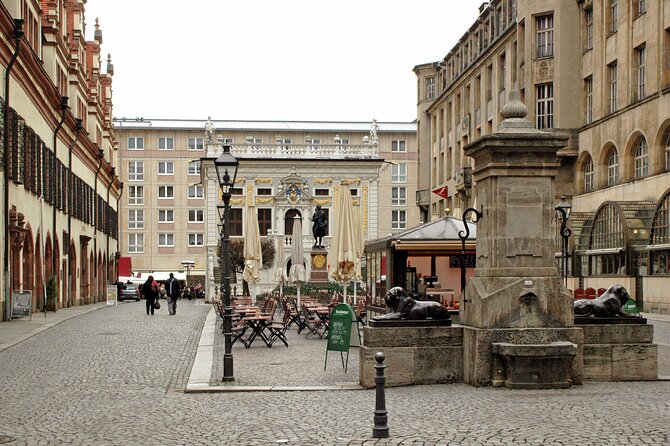
Naschmarkt, Mädler Passage, and Speck’s Hof
From Thomaskirche, the route continues toward Naschmarkt and then along the Mädler Passage. These stops give you some of the most attractive urban scenery on the walk, with historic commercial spaces and sheltered passageways forming a useful link between major streets.
The Mädler Passage is also practical in poor weather. Much of the route is outdoors, but a passage gives you a place to slow down and listen without standing in the middle of a busy street.
Speck’s Hof follows as another notable passageway. These arcades are not simply decorative stops. They help you understand how Leipzig’s center is organized, with connected courtyards and shopping routes tucked behind the main streets.
Here, the tour’s historical focus works alongside a simple city walk. You are hearing about political life while moving through places that have long served everyday commerce and social activity.
Keep your phone charged. Offline access solves the mobile-data problem, but it does not solve a low battery. Since the tour uses GPS, maps, and audio, a full charge is a sensible precaution.
Nikolaikirche and the Monday protest story
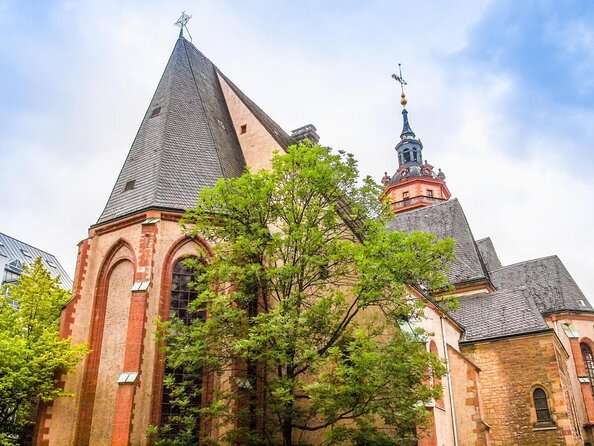
Nikolaikirche is the emotional center of the tour. The audio includes stories about the Monday protests, and this part of the route takes place near locations directly connected with them.
The account of those protests is the detail most likely to stay with you. It is not presented as a distant political lesson detached from the city. You are standing near the places where the story unfolded, which gives the narration a stronger sense of place.
The tour’s former-local perspective is helpful here. It adds a personal tone to the explanation of life under East Germany and the events surrounding the protests. The available feedback describes the stories about the Monday protests as especially moving, in part because the route passes through the actual locations.
That praise points to the tour’s strongest feature: place-based storytelling. You are not only hearing what happened. You are being directed through the streets where Leipzig’s public opposition became visible.
Nikolaikirche is also a point where you may want extra time. Pause the audio if you want to look around, reflect on the narration, or visit the church separately. The tour itself does not include admission or a guided interior visit.
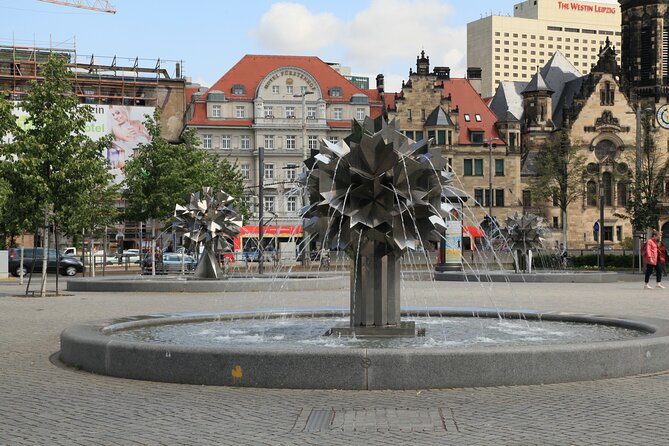
Augustusplatz and the Gewandhaus
The route then reaches Augustusplatz, one of Leipzig’s main open squares, before passing the Gewandhaus. This portion gives the walk more breathing room after the tighter streets and covered passages.
Augustusplatz is a good place to understand the scale of central Leipzig. It brings together major cultural and civic buildings, making it a natural setting for a tour concerned with public life and political expression.
The nearby Gewandhaus adds another cultural reference point. Again, the tour passes by rather than including a performance or admission. If you want to attend a concert or enter a building, that requires a separate ticket and additional planning.
I would treat this section as the final major stretch of the walk. The route has moved from the station through commercial streets, churches, passages, and protest-related sites. By the time you reach the Gewandhaus, you have seen how varied the center is within a relatively short distance.
Finishing at Moritzbastei
The tour ends by Moritzbastei at Kurt-Masur-Platz 1. Ending there is convenient because you finish near another recognizable central location rather than being returned to the starting point.
The end point also gives you flexibility. You can continue exploring Leipzig, stop for food or a drink, or use public transportation afterward. Since this is not a loop, remember that you will need to make your own way back to Hauptbahnhof if your plans require it.
That one-way design is both useful and limiting. It lets the route cover more of central Leipzig without repeating streets, but it means you should think about where you want to go after Moritzbastei.
The listed operating period runs from July 21, 2020, through February 16, 2027, with availability shown for every day of the week. The tour can be started at any time within its self-guided format, and you are not tied to a scheduled departure.
How much value do you get for $9.99?
At $9.99 per person, this is a low-cost way to add historical context to a central Leipzig walk. You receive lifetime access in English, the VoiceMap app for Android and iOS, offline audio, offline maps, and geodata.
The value is strongest if you want independence. A private live tour usually involves arranging a time and following someone else’s pace. Here, your group can start when convenient, pause whenever needed, and take breaks without affecting anyone else.
The price is less attractive if you want a conversation, personal recommendations, or access to historic interiors. Transportation, food, drinks, personal expenses, and admission fees are not included. You also provide the smartphone and headphones.
Still, the modest cost makes this a reasonable addition to a Leipzig visit. A 4.8 rating from 16 reviews and a 94 percent recommendation rate suggest that the format is working well for its intended purpose, especially the clear timing and location-based stories.
Who should book this audio tour?
I would choose this tour if you have an interest in the East German period, the Monday protests, or the way political events are remembered through city streets. It also suits first-time visitors who want a quick introduction to central Leipzig without committing to a half-day group tour.
It works well for solo visitors, couples, and private groups because no one outside your party joins the walk. Families with older children may also find the one-hour length manageable, though the political subject may suit adults and teenagers better than young children.
You should look elsewhere if you want a live guide, a set of museum admissions, or a tour built around detailed architecture. The audio format gives you independence, but it cannot answer follow-up questions.
Download everything before you leave. Bring headphones, charge your phone, and allow more than 75 minutes if you plan to pause at churches, passages, or squares. The tour is designed to be flexible, so there is no reason to rush through it.
Should you book it?
Book it if you want an inexpensive, self-paced way to understand Leipzig’s Communist past while seeing the city center. The strongest sections are around Nikolaikirche and the Monday protest story, where the narration connects directly with the places around you.
Skip it if you need a human guide or want entrance tickets included. For most independent visitors, though, the $9.99 price, offline access, private format, and compact route make this a practical choice for an afternoon or morning in Leipzig.
FAQ
How long does Leipzig’s Communist Past audio tour take?
The tour takes approximately one hour to one hour and 15 minutes.
Where does the tour start?
It starts outside Hauptbahnhof in Leipzig at 04109 Leipzig, Germany.
Where does the tour end?
It ends by Moritzbastei at Kurt-Masur-Platz 1, 04109 Leipzig, Germany.
What language is the tour offered in?
The tour is offered in English.
Can I use the tour without mobile data?
Yes. You can download the audio, maps, and geodata for offline use through the VoiceMap app.
Is this a private tour?
Yes. Only your group participates, and you can explore at your own pace.
What is included in the $9.99 price?
The price includes lifetime access to the English tour, the VoiceMap app for Android and iOS, offline audio, offline maps, geodata, and directions to the starting point. It does not include a smartphone, headphones, transportation, food, drinks, or admission fees.
What is the cancellation policy?
You can cancel at least 24 hours before the experience start time for a full refund. Cancellations or changes made within 24 hours are not accepted for a refund.
Just added around Germany
- Explore Trier a Beautiful City Walk with Audio and GPS Guide★ 3.5 · 2 reviews
- Private audio book city rally around Stuttgart’s old town★ 3.5 · 3 reviews
- Stuttgart Scavenger Hunt and Highlights Self Guided Audio Tour★ 5.0 · 2 reviews
- Private audio book city rally around the Jahrhunderthalle in Bochum★ 5.0 · 12 reviews
- Private audio book city rally around the old town of Essen Kettwig★ 4.0 · 6 reviews
- Beautiful Baroque Potsdam: A Self-Guided Audio Tour★ 4.5 · 4 reviews
- Sanssouci Park: A Self-Guide Audio Tour of the Garden’s Landmarks★ 3.0 · 2 reviews
- Nuremberg Walking Tour with Audioguide on your Smartphone★ 5.0 · 3 reviews
Self-Guided Tours, compared.

Acropolis Ticket & Optional Self-Guided Audio Tours
Read our review →


Ultimate Acadia National Park Self-Guided Driving Audio Tour
Read our review →

Santorini: Akrotiri Ticket with Optional Self-Guided Audios
Read our review →
Browse the lists this tour appears in