
REVIEW · ITALY AUDIO TOURS
Florence: Uffizi Entry Ticket & Audio Guided Tour with Host
The Uffizi rewards a little planning. This two-hour visit combines a reserved entry time, a multilingual audio guide, and an on-site host who helps you get inside without spending hours in line. I especially like the access to masterpieces by Botticelli, Leonardo, Michelangelo, Titian, and Caravaggio, along with the freedom to listen at your own pace. The host is also useful when a painting raises a question the recording does not answer.
The main drawback is price. At $69 per person, this costs far more than the official adult museum ticket of €29, so you are paying for convenience, audio content, and assistance rather than just admission. You will also still need to pass through security, and busy periods can cause delays.
Key points at a glance

- Reserved entry saves time: You meet staff outside the Uffizi and use a separate entrance for your timed admission, though security remains mandatory.
- Four-person groups are possible: A small group gives the host more room to answer questions and explain details beyond the recording.
- Twenty major works receive commentary: The audio guide covers key paintings with content prepared by art historians.
- The meeting point is easy to identify: Look for the bright yellow ACCORD vest near the Benvenuto Cellini statue.
- The audio guide covers 18 languages: Options include English, Italian, Spanish, French, Japanese, Chinese, German, Portuguese, Greek, and more.
- The Vasari Corridor is an exterior follow-up: Afterward, you can walk outside along the historic route linking the Uffizi and Pitti Palace.
Why the Uffizi is worth your time
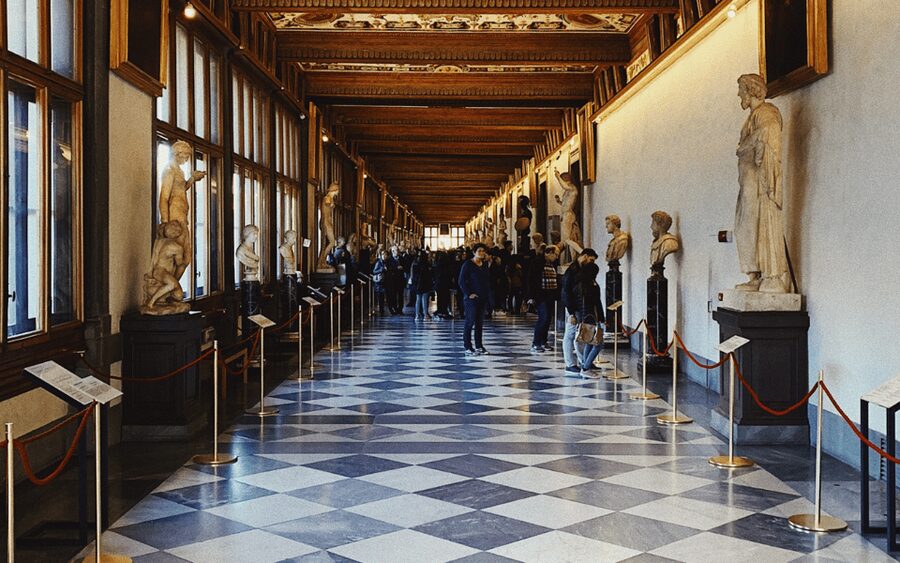
The Uffizi is not simply a room full of famous pictures. It is one of Europe’s oldest museums, and its collection lets you watch Western painting change from medieval religious images toward the more human, dramatic art of the Renaissance and Baroque periods.
That change is easier to understand when you move through the museum in sequence. Giotto’s work carries the weight of earlier religious painting, while Botticelli brings a new elegance and mythological subject matter. Leonardo gives you mystery and careful observation. Michelangelo adds force and sculptural presence. Titian and Caravaggio push color, shadow, and emotion in different directions.
You will not see every work in the building in two hours. That is not a flaw. The purpose of this visit is to reach the main rooms, understand the most important pieces, and leave with enough energy to enjoy Florence afterward.
The audio guide helps by giving you a path through the collection. Instead of reading every label or wandering without a plan, you can focus on more than twenty major works. For a first visit, that structure is useful.
More Museum Audio Tours in Italy
- Florence: Uffizi Priority Ticket & Masterpieces Audio App
★ 4.2 · 6,402 reviews - Venice: St. Mark Basilica Ticket, Audioguide+History Gallery
★ 3.9 · 4,780 reviews - Rome: Borghese Gallery Skip-the-Line Ticket & Audioguide
★ 4.3 · 4,318 reviews
Meeting the ACCORD host near the Cellini statue
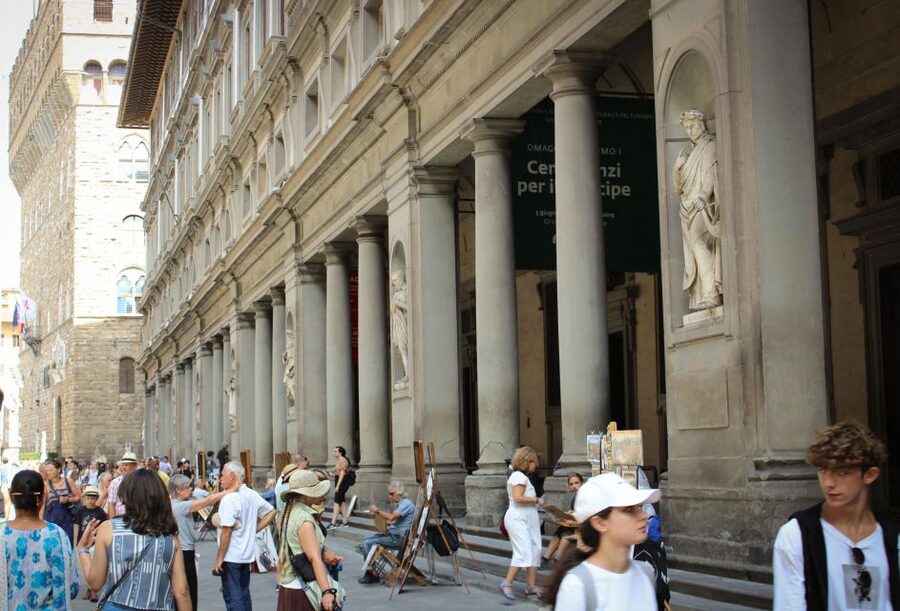
Plan to arrive 15 minutes before your scheduled time. The meeting point is at the corner between the Uffizi ticket office and Via Lambertesca, directly in front of the Benvenuto Cellini statue.
The staff wear bright yellow vests marked ACCORD. That detail matters in Florence, where several tour companies gather around major sights and the Uffizi entrance area can become confusing. Do not walk straight to the museum doors and assume your ticket will sort itself out. Find the check-in assistants first.
You must show a valid passport, identity card, or driver’s license at the meeting point. Bring the original document, not just a photograph on your phone. The instructions specifically require identification, and a small delay here can create a large problem if you miss your admission time.
The English and Italian speaking host remains available during the visit. This is not the same as having a guide deliver a long lecture in every room. Instead, you receive recorded commentary for the main works and can ask the host additional questions.
That format suits independent museum visitors. I like being able to pause, replay, or skip an explanation rather than stay attached to a guide’s pace. The tradeoff is that the experience may feel less personal than a fully guided art tour.
Getting through the entrance
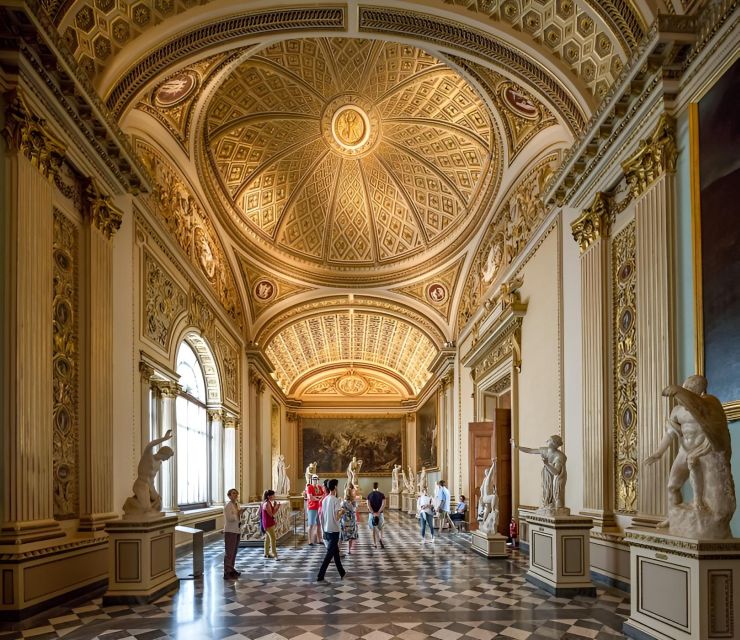
The reserved time ticket is the main practical benefit. Florence’s Uffizi can develop long lines, especially during periods of heavy visitor traffic. A timed ticket lets you use a separate entry process rather than joining the standard admission queue.
Skip-the-line does not mean skip-everything. Every person must pass through a security check, and the museum controls the number of people inside. If the galleries are full, your admission may be delayed slightly even with a reserved time.
That distinction is worth understanding before you book. You are buying a better chance of getting in quickly, not a promise that you will walk directly from the meeting point into the galleries. Arrive early, allow time for the security check, and avoid scheduling another fixed activity immediately afterward.
Large bags and luggage are not allowed. Pets are also prohibited, and video recording is not permitted. You may bring one bottle of water per person, with a maximum size of 500 milliliters.
The museum is wheelchair accessible, which makes this option workable for visitors who need step-free access. The activity is not suitable for people with hearing impairments because the main commentary is delivered through the audio guide.
Botticelli, Leonardo, and Michelangelo
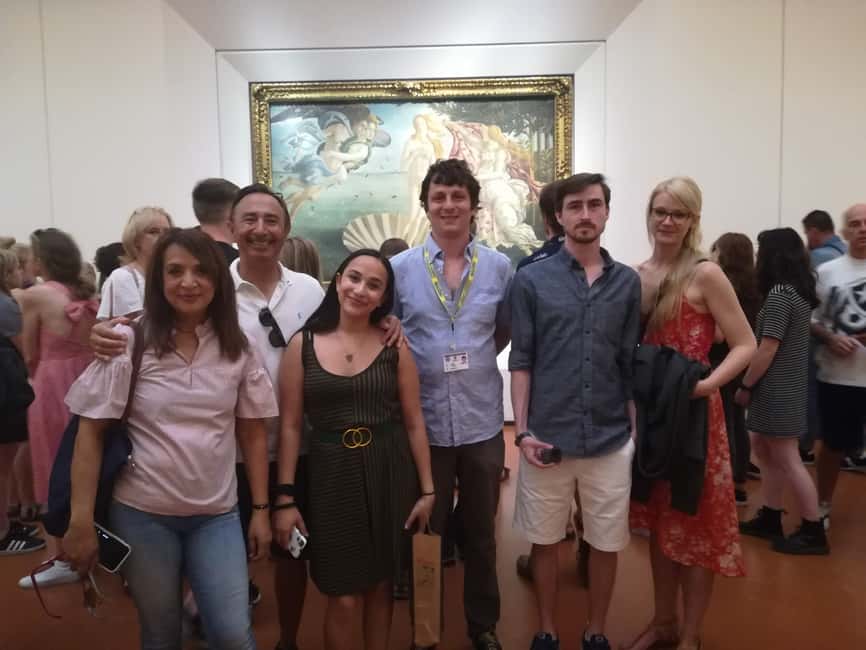
For many people, Botticelli’s Birth of Venus is the emotional center of the visit. It is famous for good reason, but the painting becomes more interesting when you look beyond the central figure. The flowing hair, pale colors, and open sea setting create a dreamlike scene that feels unlike the heavier religious works nearby.
Botticelli’s paintings reward time. You may want to pause the audio and look at the faces, gestures, and decorative lines before moving on. The recording gives you a useful starting point, while the host can help if you want to ask about the subject or the artist.
Leonardo’s Adoration of the Magi offers a different experience. It is unfinished, which makes it especially valuable for seeing how Leonardo organized a complex scene. The central religious subject is surrounded by movement and uncertainty, with figures and architectural forms drawing your eye in several directions.
The audio commentary is helpful here because unfinished works can confuse visitors. You may wonder why a painting that looks incomplete is treated as a masterpiece. The answer lies partly in Leonardo’s experiments with composition, gesture, and psychological tension.
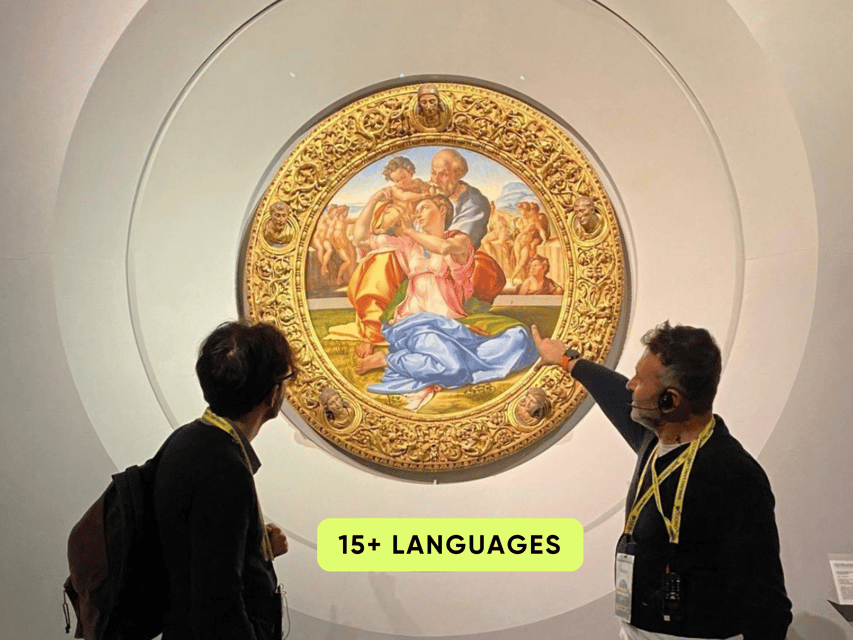
Michelangelo’s Tondo Doni is a reminder that the artist was not only a sculptor. Its circular format, strong figures, and muscular poses show the power of his visual style. The work also feels different from the softer elegance of Botticelli, which makes the comparison worthwhile.
These three stops alone give you a clear reason to use the audio guide. Each work needs a little context, but none requires an hour-long lecture. A concise explanation can help you see why these paintings matter instead of simply recognizing them from a guidebook.
Same place, a different route to walk:
- Rome: Pantheon Fast-Track Ticket and Official Audioguide
★ 4.5 · 27,353 reviews - Rome: Colosseum & Forum with Audio Guide App -Optional Arena
★ 4.2 · 24,770 reviews - Florence: Timed Entry to Michelangelo’s David + Audio App
★ 4.6 · 19,496 reviews - Rome: City Sightseeing Hop-on Hop-off Bus with Audioguide
★ 4.0 · 16,045 reviews
Titian, Caravaggio, Giotto, and the wider collection
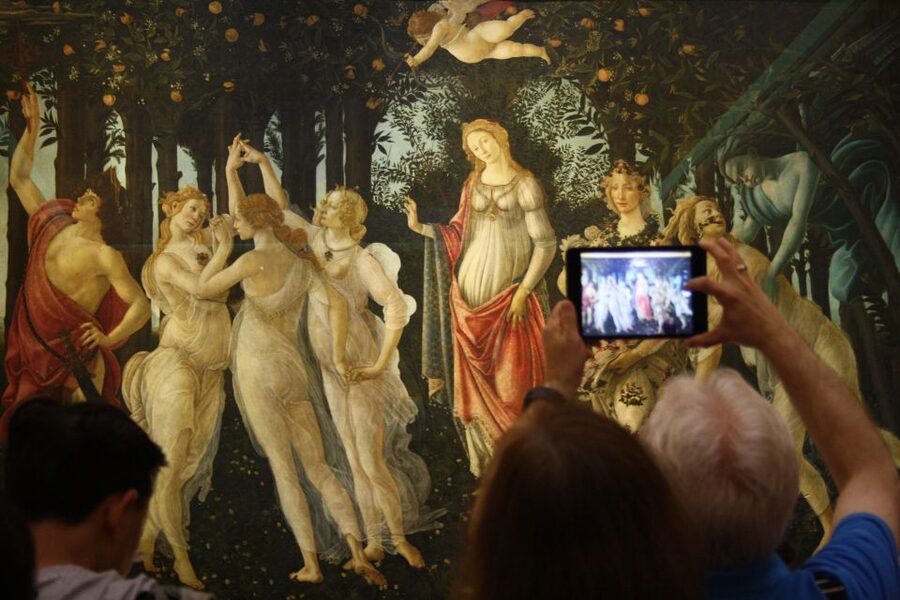
The visit also brings you into contact with Titian and Caravaggio, two artists who use color and light in very different ways.
Titian’s work is associated with rich color and a sensuous handling of paint. Caravaggio uses sharp contrast, intense shadows, and forceful human drama. Seeing both within the same museum helps you notice how European painting moved toward greater emotional and theatrical power.
Giotto takes you further back. His work shows an early step away from flat, symbolic figures toward bodies and faces that feel more present in space. You may not connect with every medieval painting immediately, but the audio guide can make the progression easier to follow.
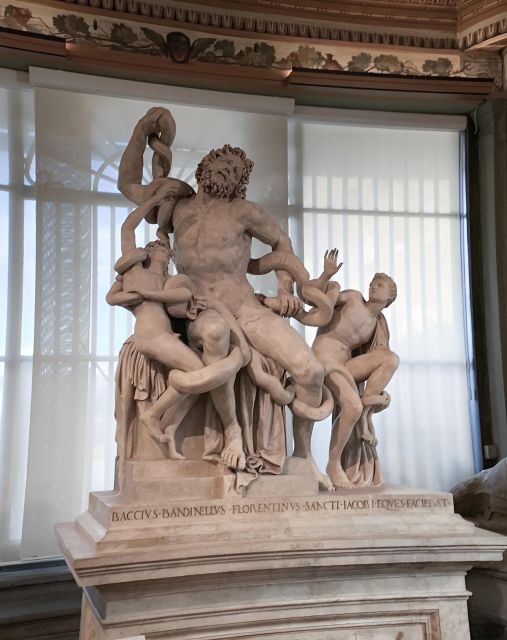
The museum also contains famous statues. These offer a break from looking at framed paintings and remind you that Florence’s artistic achievement is not limited to canvas. Sculpture, architecture, and painting overlap throughout the collection.
Do not try to memorize every artist. Pick a few contrasts: Giotto and Leonardo, Botticelli and Michelangelo, Titian and Caravaggio. That simple method gives you a clearer experience than rushing from name to name.
How the two-hour format works
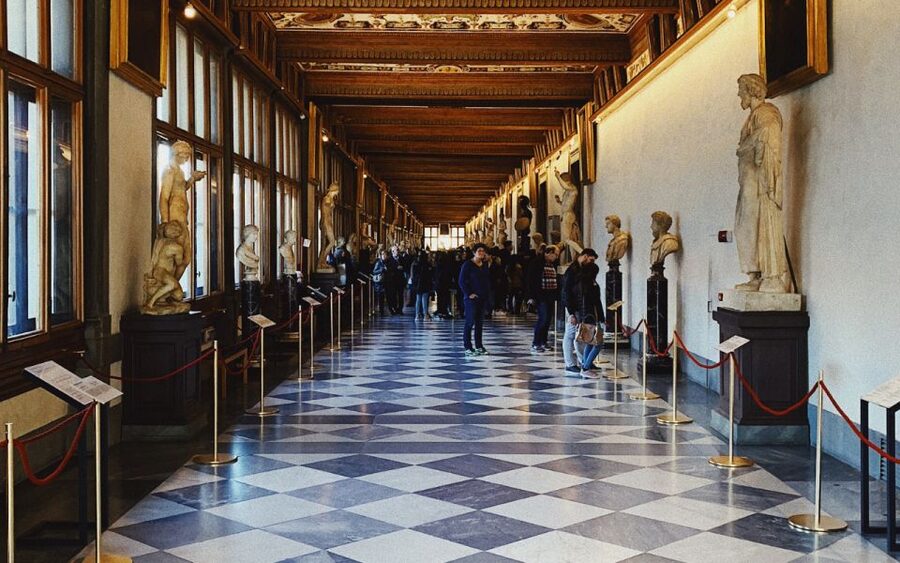
Two hours is enough for a focused first visit, not a complete study of the Uffizi. You can expect to meet the host, complete the entry process, collect or activate the audio guide, and follow the main route through selected rooms.
The time will pass quickly around the best-known paintings. If you stop for every label, photograph every room, and listen to every available explanation, you may feel rushed. I suggest deciding in advance which works matter most to you.
A useful plan is:
- Spend the first part of the visit getting oriented and following the main audio stops.
- Give extra time to the Birth of Venus, Adoration of the Magi, and Tondo Doni.
- Use the host for questions rather than asking for a full lecture on every room.
- Leave a few minutes for statues and less famous works that catch your eye.
The small group format can improve this arrangement. A group of only four allows more direct contact with the host, and one strong point of the experience is the guide’s ability to explain details that appear in the audio content. Larger groups may offer less room for questions, though the supplied format is designed as a small group tour.
The experience is listed as two hours, so do not expect unlimited time inside the museum. If you want to study the collection at length, a standard admission ticket may suit you better, provided you are willing to arrange your own timing and guidance.
What the $69 price really buys
The official adult Uffizi admission price is €29. Reduced admission for European Union visitors aged 18 to 25 is €2, and entry is free for visitors aged 17 and younger. Against those figures, $69 is a sizable premium.
The price makes more sense for a visitor who values a ready-made plan. You are paying for a reserved time, assistance at the meeting point, a separate entry process, multilingual audio commentary, and access to an English or Italian speaking host.
The value is strongest during busy periods. If avoiding a long queue protects a limited day in Florence, the extra cost may be reasonable. It can also help first-time visitors who want context but do not want to commit to a private guide.
The value is weaker if you qualify for reduced or free admission, already have a good guidebook, speak Italian or English comfortably, and do not mind handling the museum entrance yourself. In that case, the additional services may not justify the premium.
The booking is non-refundable, so check your schedule carefully. Rain will not cancel the visit, and the museum experience takes place indoors, but you still need to arrive at the outdoor meeting point on time.
The Vasari Corridor walk afterward

After leaving the Uffizi, you can walk along the outside of the Vasari Corridor. This historic passage connects the Uffizi with the Pitti Palace and gives you a chance to see Florence from street level after the museum’s interiors.
The corridor itself is not presented as an included interior visit. Think of this as a free continuation of your sightseeing, not an additional guided museum section. It is a good way to extend the experience without adding another ticket or formal activity.
This short walk also helps place the Uffizi within Florence. The museum is not an isolated box of art. It connects to the city’s streets, bridges, palaces, and political history. Even a simple exterior look can make the building feel more connected to the rest of your day.
Who should book this Uffizi experience?
I would recommend it most strongly to a first-time Florence visitor with limited time. You get a clear route, major works, language choices, and practical help at the entrance.
It also suits you if you want art context without committing to a long private tour. The audio guide lets you move at your own speed, while the host can deal with questions and basic problems.
Families and mixed-interest groups may appreciate the flexibility. One person can listen closely, another can look around, and nobody has to follow a guide’s speech every second. The two-hour length is also easier to fit into a busy Florence schedule.
I would be more cautious if you are a serious museum visitor who wants to explore every room. The selected commentary will not replace a full day with the collection. People with hearing impairments should choose a different format, since the audio guide is central to the experience.
At 3.9 out of 5 from 342 ratings, the experience looks useful but not flawless. The strongest positive points are the prepared guiding, the helpful host, and the possibility of a very small group. Those benefits matter most when the entrance area is crowded and you want someone to keep the visit moving.
Should you book it?
Book this tour if saving time and having a clear art route matter more to you than getting the lowest admission price. The reserved entry and host remove much of the confusion from a first Uffizi visit, while the audio guide gives you useful commentary in your own language.
Skip it if you are comfortable arranging entry yourself, qualify for discounted admission, or want to spend many hours studying the full collection. For everyone else, $69 is a convenience fee, not a bargain, but it can be a fair trade for a well-organized first look at Florence’s greatest museum.
FAQ
How long does the Uffizi audio guided tour last?
The activity lasts two hours. Starting times vary, so you need to check availability when booking.
Where do I meet the tour staff?
Meet at the corner between the Uffizi Gallery ticket office and Via Lambertesca, directly in front of the Benvenuto Cellini statue. Look for staff wearing bright yellow ACCORD vests.
How early should I arrive?
Arrive 15 minutes before your scheduled Uffizi visit.
Is the Uffizi ticket skip-the-line?
The ticket provides access through a separate entrance with a reserved time. You must still complete the security check, and admission can be delayed during periods of high visitor traffic.
Which languages are available for the audio guide?
The audio guide is available in English, Italian, Spanish, French, Dutch, Japanese, Chinese, Polish, Turkish, Russian, German, Hungarian, Korean, Portuguese, Greek, Croatian, Romanian, and Ukrainian.
Does the tour include a live guide?
An English and Italian speaking tour leader is available during the visit. The main commentary is provided through the multilingual audio guide.
What identification should I bring?
Bring a valid passport, identity card, or driver’s license to the meeting point.
Can I bring luggage or a pet?
No. Large bags, luggage, and pets are not allowed. You may bring one water bottle per person, with a maximum capacity of 500 milliliters.
Just added around Italy
- Torino Walking Tour with Audio and Written Guide by a Local★ 4.5 · 35 reviews
- Medieval Canals and Fountains: A Treviso Self-Guided Audio Tour★ 4.5 · 4 reviews
- Trento Walking Tour with Audio and Written Guide★ 4.5 · 11 reviews
- Trapani Walking Tour with Audio and Written Guide by a Local★ 4.0 · 8 reviews
- Sicily: Selinunte Park Entry Ticket & Sicily Digital Audio Guide★ 4.5 · 4 reviews
- Taormina Walking Tour with Audio and Written Guide by a Local★ 4.5 · 41 reviews
- Taranto Walking Tour with Audio and Written Guide by a Local★ 5.0 · 5 reviews
- Siracusa Walking Tour with Audio and Written Guide by a Local★ 5.0 · 59 reviews
Museums, compared.
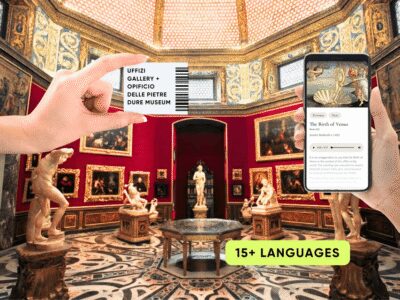
Uffizi Priority Ticket & Masterpieces Audio App
Read our review →
Louvre Museum Hosted Entry and Mona Lisa Audioguide
Read our review →
St. Mark Basilica Ticket, Audioguide+History Gallery
Read our review →
Borghese Gallery Skip-the-Line Ticket & Audioguide
Read our review →
Borghese Gallery Ticket + Audioguide or Guided Tour
Read our review →
Orsay Museum Entry Ticket and Digital Audio Guide App
Read our review →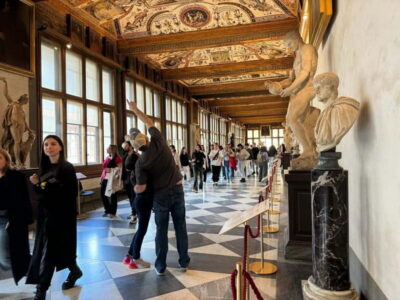
Uffizi Gallery Timed Entry Ticket & Audio Guide
Read our review →
Acropolis Museum Ticket with optional Audio Guide
Read our review →Browse the lists this tour appears in