
REVIEW · GREECE AUDIO TOURS
Delphi: Archaeological Site & Museum Ticket with Audio Tour
Ancient Greece feels close at Delphi. This self-guided visit combines timed entry to the Delphi Archaeological Museum with access to the hilltop ruins, including the Treasury of the Athenians, Temple of Apollo, and theater. I like the freedom to stop when I want, and I like having maps, written notes, and audio stories on my own phone instead of being tied to a large group.
The main drawback is the price. At $41 per person, this is not a cheap admission ticket, especially since transport, a smartphone, headphones, and a live guide are not included. You are paying for convenience, the audio content, and a pre-booked visit, so the value is best for independent sightseers who want context without joining a guided group.
The audio tour is offered in English, Italian, French, German, and Spanish. It works offline after you download it, which matters in a remote mountain setting where a reliable connection should not be assumed. One practical warning: the audio stops and starts through an app, and one Italian-speaking visitor found the sequence difficult to follow at times, so download everything and test it before entering.
Key points to know before visiting Delphi
- Visit the museum first: Your selected time slot is for the Delphi Archaeological Museum, followed by the outdoor archaeological site.
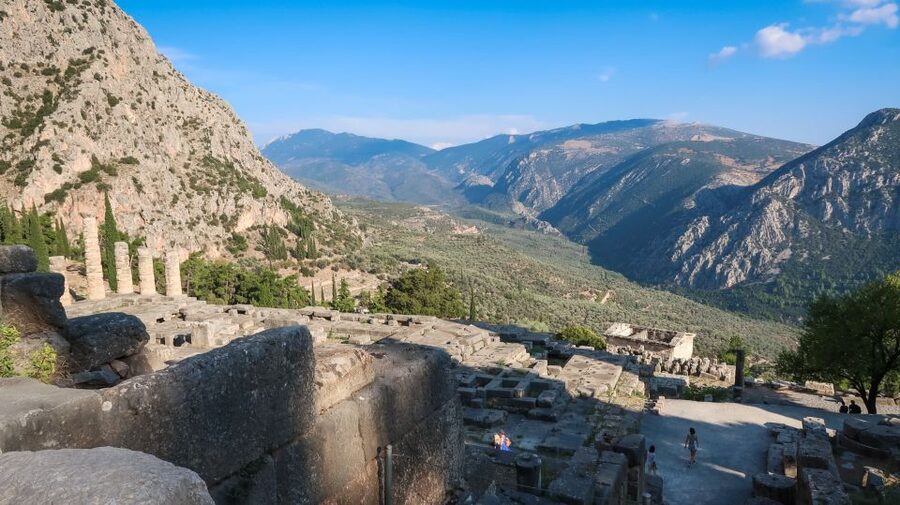
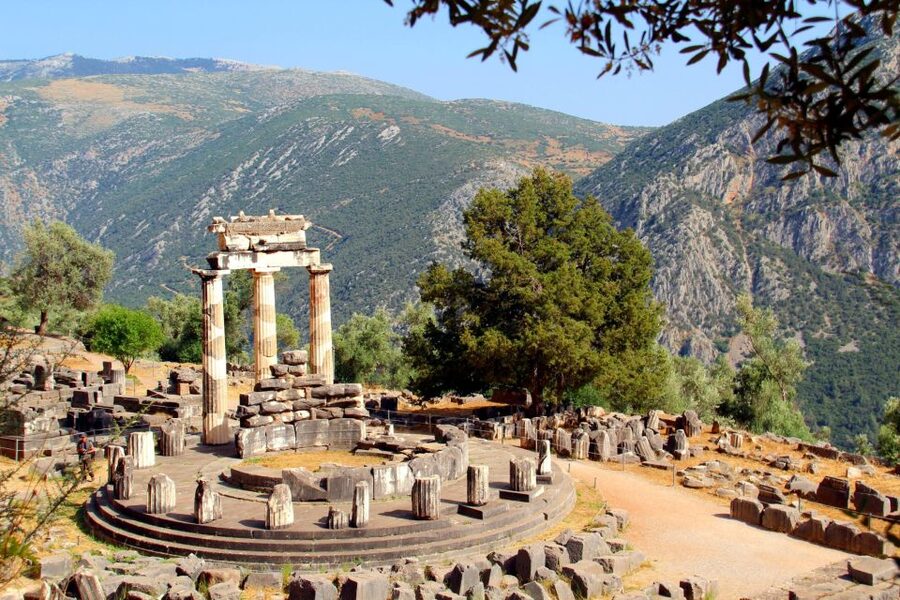
- Follow the ancient route: The audio guide leads you through the Roman Agora, Treasury of the Athenians, Temple of Apollo, and theater.
- Bring your own equipment: You need a charged Android or iOS phone, headphones, and 100 to 150 MB of free storage.
- Expect a steep walk: The ruins spread up the side of Mount Parnassus on rough tracks, while the museum has wheelchair access.
- Enjoy a flexible visit: You can pause, replay, and continue the audio at your own speed, even after leaving the site.
- Allow for the price: The $41 cost includes the ticket and audio tour, but not transport, a live guide, or personal devices.
Start with the Delphi Archaeological Museum
Your visit begins at the museum, not at the famous Temple of Apollo. That order is useful. The museum gives you a visual introduction to the sanctuary before you walk through the remains outside, so the stones on the mountain have more meaning when you reach them.
The audio tour combines narration, text, and maps. That mix helps because Delphi is not a simple line of ruins with signs at every turn. You will be moving between buildings, terraces, and viewpoints, and a map can help you understand where each structure once fit into the sanctuary.
The museum visit also gives you a calmer start before the uphill walking begins. You can listen to the explanations, look at the objects, and get oriented without trying to manage uneven ground at the same time. I find that especially helpful at archaeological sites where the remains are spread over a large area.
Your selected time slot applies to the museum. Read the supplier’s email carefully, since it contains the ticket and audio instructions. Have the ticket ready before you arrive rather than trying to sort out the app at the entrance.
More History Audio Tours in Greece
- Athens: National Archaeological Museum Ticket & Audio Guide
★ 4.3 · 1,330 reviews - Delphi: Archaeological Site & Museum Ticket with Audio Tours
★ 4.3 · 721 reviews - Athens: National Archaeological Museum Ticket w/ Opt. Audio
★ 4.4 · 713 reviews
Walk through the Roman Agora
After the museum, you continue to the archaeological site. The Roman Agora is one of the early points of interest, and it helps set the scene for Delphi as a busy religious center used across many centuries.
The audio guide’s value is strongest here because the remaining structures may not immediately explain themselves. Instead of seeing only worn foundations, you get historical facts and anecdotes that help you picture how the area functioned. The written text and map let you check the route if you miss an audio prompt.
This is also where the self-guided format feels sensible. You do not need to keep pace with a group while looking at stones or taking photographs. Pause the narration, look around, then continue when you are ready.
Still, self-guided freedom brings a small responsibility. You must keep track of the sequence yourself. The Italian feedback about audio sections being hard to hear in the correct order is a useful warning for every language. Keep the map open, follow the route carefully, and use the pause and replay functions instead of rushing from one track to the next.
See the Treasury of the Athenians
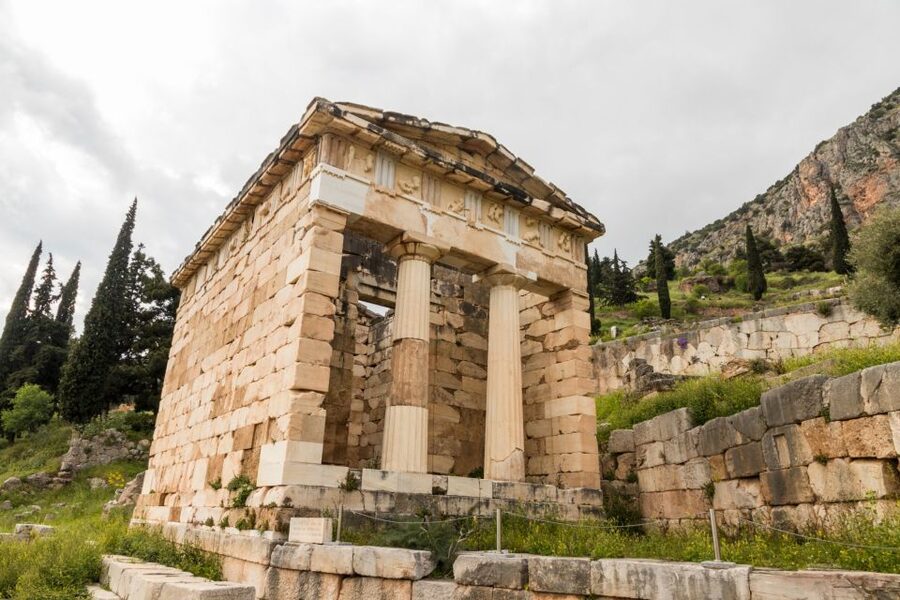
The Treasury of the Athenians is one of the most rewarding stops on the route. Its recognizable form helps you connect the surviving building with the political and religious importance of Delphi.
The audio narration gives this stop a clear purpose rather than treating it as another pile of ancient stone. The explanation is designed to be easy to follow, and a Spanish-speaking visitor praised the professional, entertaining tone and the ability to go at a personal pace. That is a good match for the site, where you may want to spend extra time looking closely at architectural details.
I would not expect the audio to replace a live specialist guide. You cannot ask follow-up questions, and the experience depends on the supplied narration. But if your main goal is a clear introduction with enough context to make the ruins meaningful, the format does the job without adding a group schedule.
Bring headphones that are comfortable for outdoor use. Your own phone and headphones are not supplied, and the instructions specifically ask you to bring both. A charged battery matters too, since the audio, maps, and ticket information all depend on your device.
Stand before the Temple of Apollo
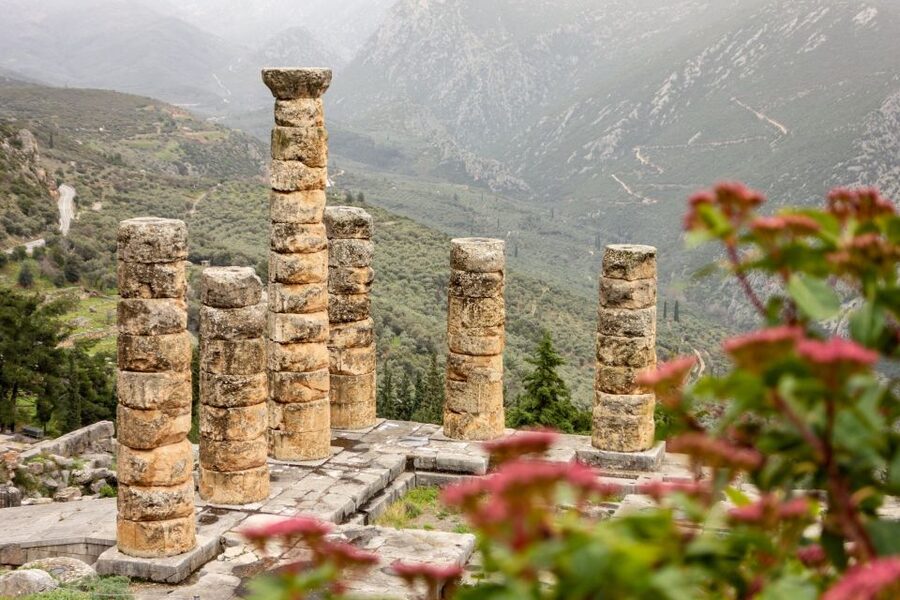
The Temple of Apollo is the emotional center of the visit. Delphi’s reputation is tied closely to Apollo’s sanctuary and the oracle, and this is where the ancient story becomes easiest to imagine.
The surviving remains are incomplete, so the narration matters. It explains the site through storytelling, facts, and anecdotes rather than asking you to guess what each column or foundation meant. You can listen while standing at the temple, then replay the section after you have moved on.
This is also a good place to slow down. The audio guide does not force you to keep moving, and the ticket is valid for one day. You have room to take a break, check the map, and return to a section if the first explanation did not land.
Do not expect a modern walkway through every part of the sanctuary. The ruins are spread up the mountain on rough tracks. Comfortable shoes are essential, and the site can be tiring for anyone who has difficulty with slopes or uneven ground. The instructions also advise a hat and sunscreen, sensible protection for a largely exposed archaeological area.
More Museum Audio Tours in Greece
- Athens: Acropolis Museum Ticket with optional Audio Guide
★ 4.4 · 2,652 reviews - Parthenon & Acropolis Museum with Audio or Live Tour Option
★ 4.1 · 2,446 reviews - Athens: Acropolis Museum Ticket with Audio Guide
★ 4.1 · 835 reviews - Crete: Knossos Palace and Museum E-Tickets with Audio Guides
★ 4.0 · 828 reviews
Watch the theater and the mountain views
The theater is another major stop, and its position helps explain why Delphi is more than a collection of isolated buildings. From here, you can look across the sanctuary and out toward the surrounding mountains.
The views are a major reward. The site sits high on Mount Parnassus, and the position gives you broad mountain scenery from the upper parts of the route. I like that the audio experience does not treat the setting as decoration. The geography is part of why Delphi feels so memorable.
The theater is also a natural pause point. You may want to put the phone away for a few minutes and simply look. Then return to the audio when you are ready. That flexibility is one of the clearest advantages over a tightly timed group tour.
The route is not ideal for visitors who need smooth, level access. The museum is wheelchair accessible, but the outdoor ruins cannot be reached throughout by pushing a wheelchair up the rough mountain tracks. If access is a major concern, treat the museum and archaeological site as two very different experiences.
How the smartphone audio tour works
You receive the ticket and instructions by email. Before you go, download the app, install the Delphi content, and make sure the audio works. The offline content uses about 100 to 150 MB of storage, so check your phone before leaving.
The audio is available in English, Italian, French, German, and Spanish. It combines several useful tools:
- Audio narration for the main stops
- Written information for reading at your own speed
- Maps to help you locate each monument
- Offline access after downloading
- The option to replay material after leaving the site
That last feature is easy to overlook. If you are tired at the end of the walk, you can revisit the explanations later instead of trying to absorb everything on the mountain. The content remains useful after your visit as a recap.
The app does require a compatible device. It works with Android version 5.0 and later and with iOS, but it is not compatible with Windows Phones, iPhone 5 or 5C, older iPhones, certain older iPads, or older iPod Touch models. You cannot borrow a phone or headphones through this experience.
The best setup is simple: charge your phone fully, download the content on Wi-Fi, bring headphones, and open the map before entering. This removes most of the avoidable technical stress.
Is $41 a fair price for Delphi?
The $41 price makes sense only if you value independent access and the audio material. It includes the museum and archaeological site ticket, selected-time admission to the museum, and the multilingual audio tour. You also get offline maps and written content, which can make the visit more coherent than walking around with no explanation.
It does not include transport to Delphi. That matters because this is an activity in Central Greece, not a pickup tour from another city. You must arrange your own way there, and you need to reach the entrance at the stated location in Delphi.
It also does not include a live guide. If you want conversation, personal recommendations, or answers tailored to your interests, a live tour may offer better value. If you prefer privacy and the ability to stop often, this format may be worth the extra cost.
The non-refundable policy raises the stakes. Check your plans, transport, phone compatibility, and weather needs before paying. This is not a ticket to buy casually and sort out later.
Who will enjoy this format most?

I would recommend it to independent visitors who want more than bare entry but less structure than a group tour. It suits couples, families with older children, and solo sightseers who like to read and listen at their own speed.
It is also a good fit if you already have transport and want to focus your budget on the site itself. The audio gives you enough guidance to understand the principal monuments without hiring a private guide.
You may want another option if you dislike phone-based tours, have an older device, or want constant personal explanation. The experience also calls for some physical effort. The museum is easier to manage, but the ruins involve an uphill route on rough tracks.
The audio quality appears to be a strong point overall. An English-speaking visitor described it as excellent, while another praised the clear organization and useful map. The Italian sequencing problem shows that the experience is not flawless, but it is more a matter of using the app carefully than a reason to dismiss the format.
Practical tips for a smoother visit
Read the supplier’s email before leaving. It contains the ticket and audio instructions you need at the entrance.
Download the app and tour content in advance. Do not count on arranging the whole setup at the site. The offline feature is helpful, but only after the content is stored on your phone.
Wear sturdy, comfortable shoes. A hat and sunscreen are also listed as essentials, and the mountain setting makes both sensible.
Pack lightly. Oversize luggage and large bags are not allowed, so bring only what you need for the walk, water, phone, headphones, and sun protection.
Plan to see the museum first, then the ruins. That order is part of how the experience is arranged and gives you useful context before the uphill route.
Keep the map handy. If the audio sequence feels unclear, use the map and replay the relevant section rather than moving on with half the story.
Should you book the Delphi audio tour?
Book it if you want a flexible visit to Delphi with clear explanations, offline content, and no group to chase. The museum-first order works well, the audio is generally praised for being organized and easy to follow, and the mountain views add plenty beyond the monuments themselves.
Skip it if you need transport, a live guide, or a low-cost admission-only ticket. The $41 price is fair for the ticket plus self-guided tools, but less appealing if you already have another source of information or dislike using your phone during a visit.
For most independent sightseers, I see this as a practical middle choice: more useful than entering without guidance, less restrictive than joining a scheduled group. Just prepare your phone, wear proper shoes, and remember that Delphi is a steep archaeological site, not a flat museum park.
FAQ
What does the Delphi ticket include?
It includes entry to the Delphi Archaeological Museum and the Delphi archaeological site, plus a multilingual audio tour with offline content.
Which languages are available for the audio guide?
The audio guide is available in English, Italian, French, German, and Spanish.
Do I need my own phone and headphones?
Yes. You need a compatible, charged Android or iOS smartphone and your own headphones. The activity does not provide either item.
Does the ticket include transportation to Delphi?
No. Transportation is not included, so you must arrange your own way to the archaeological site entrance in Delphi.
Is the archaeological site wheelchair accessible?
The museum has wheelchair access. The outdoor ruins extend up the mountain on rough tracks, so wheelchair access through the ruins is not possible.
Can I use the audio guide offline?
Yes. You need to download the app and audio content before your visit. The content requires about 100 to 150 MB of storage and can be replayed after you leave.
Just added around Greece
- E-Ticket to Akrotiri with Audio Tour on your Phone★ 5.0 · 2 reviews
- Authentic Santorini: A Self-Guided Audio Tour of Oia★ 4.5 · 3 reviews
- The Palace of the Grand Master E-Ticket with Audio Tour★ 4.0 · 9 reviews
- The Palace of the Grand Master. Self-guided Audio Tour★ 3.5 · 15 reviews
- Acropolis of Lindos E-Ticket with Audio Tour on your Phone★ 4.5 · 8 reviews
- Explore Lindos Acropolis in 3D & Audio★ 4.0 · 4 reviews
- Olympia Archaeological Site & Museum E-Ticket with Audio Tour★ 4.0 · 11 reviews
- Mykonos: Find your (queer) god Self-Guided Audio Tour★ 4.0 · 2 reviews
Museums, compared.
Uffizi Priority Ticket & Masterpieces Audio App
Read our review →
Louvre Museum Hosted Entry and Mona Lisa Audioguide
Read our review →
St. Mark Basilica Ticket, Audioguide+History Gallery
Read our review →
Borghese Gallery Skip-the-Line Ticket & Audioguide
Read our review →
Borghese Gallery Ticket + Audioguide or Guided Tour
Read our review →
Orsay Museum Entry Ticket and Digital Audio Guide App
Read our review →
Uffizi Gallery Timed Entry Ticket & Audio Guide
Read our review →
Acropolis Museum Ticket with optional Audio Guide
Read our review →Browse the lists this tour appears in