
REVIEW · USA AUDIO TOURS
Bryce Canyon National Park Self-Guided Driving Audio Tour
Hoodoos tell better stories with context. This Bryce Canyon audio tour turns a solo drive into an informal lesson in geology, Paiute traditions, Mormon settlement, wildlife, and dark skies. I like the private, flexible format and the way the narration leads you to major overlooks without joining a bus group. At $16.99 per carload of up to four people, it is also a sensible bargain.
You get lifetime access, offline maps, and location-triggered stories, so you can pause for photos, lunch, or a hike. I especially like the route beyond the busy Bryce Amphitheater, including Farview Point, Agua Canyon, Rainbow Point, and the Red Canyon arches. The catch is the app: you must download it and the tour over strong internet before entering the park, and a few users have struggled with starting, pausing, or stopping playback.
Quick take: the details that matter most
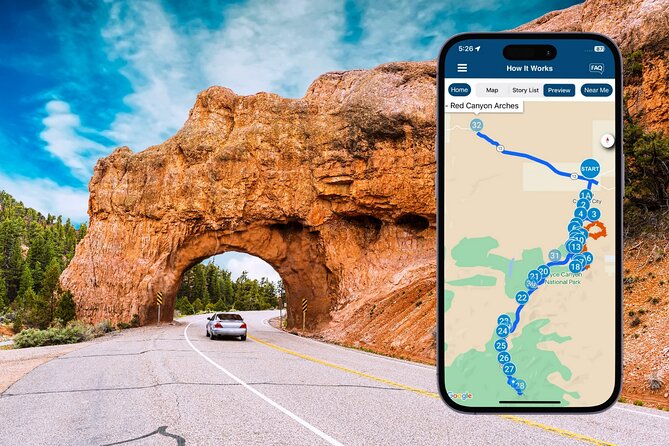
- More than 30 audio stories across a 60-mile route: The tour covers the main Bryce viewpoints and the quieter southern road toward Rainbow Point.
- $16.99 per group of up to four: One purchase covers the car, making it far cheaper than hiring a private guide.
- Lifetime access with no expiry: Use it on a later visit, replay sections at home, or spread the route over several days.
- Offline operation: Download everything before entering the park, where mobile reception may be weak.
- GPS-triggered narration: Stories begin as you reach each point, allowing hands-free listening while you drive.
- No park admission included: You still need a Bryce Canyon National Park entry pass.
How this Bryce Canyon drive works

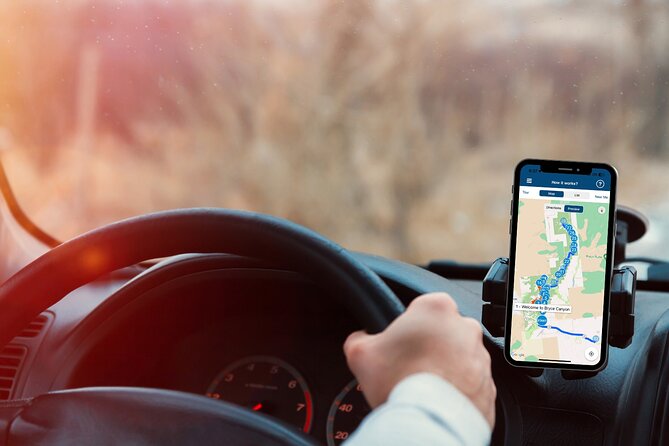
This is not a tour with a person waiting at the visitor center. You drive your own car, open Action’s separate Tour Guide app, and follow the route using your phone’s GPS. Once the tour is installed, the audio should play as you reach each story point.
The practical routine is simple, but you need to prepare. After booking, look for the setup instructions and password in both your email and text messages. Search for audio tour if the message is hard to find. Download the app and the Bryce tour while you still have strong Wi-Fi or cellular service.
Connect your phone to the car by Bluetooth, USB, or AUX. Apple CarPlay works with audio playback, while Android Auto support is still being developed. An iPhone with iOS 15 or later, an Android device with version 9 or later, or an iPad or tablet with GPS and cellular service is recommended.
The route begins near the Bryce Canyon Visitor Center area and finishes at Rainbow Point, with the Red Canyon arches included near the route’s gateway. The supplied details describe a drive of more than 60 miles and about one to two hours, but that timing is best understood as the audio and driving time. Add time for overlooks, photos, traffic, and any walking.
Use the app at your own pace. You can pause, skip a story, stop for a snack, or continue on another day. The access does not expire, which is useful if snow, road closures, or a packed schedule prevent you from finishing the whole route.
More Self-Guided Audio Tours in the USA
- Gettysburg Battlefield Self-Guided Driving Audio Tour
★ 4.5 · 910 reviews - Joshua Tree National Park Self-Guided Driving Audio Tour
★ 4.5 · 762 reviews - Ultimate Acadia National Park Self-Guided Driving Audio Tour
★ 4.0 · 521 reviews
The first stories: Paiute roots and Bryce’s strange rock towers
The opening near the visitor center gives you the basic story of the park. You learn how Bryce Canyon got its name from Mormon pioneer Ebenezer Bryce and how the area became a national park in 1924.
The narration also introduces the Paiute people, who lived in this region before Mormon settlers arrived. That cultural context matters because Bryce is easy to treat as a collection of pretty viewpoints. The audio gives the scenery a human story, including Paiute explanations for the hoodoos.
The geology lesson explains that the amphitheaters were carved into the eastern edge of the Paunsaugunt Plateau. Erosion shaped the Claron Formation limestone into fins, windows, slot canyons, and spires. Those spires are the hoodoos that make Bryce look unlike the other parks in southern Utah.
This is a good opening for first-time visitors because you learn what to look for before reaching the best viewpoints. It also helps children connect the colors and shapes to long periods of freezing, thawing, and erosion rather than seeing only a wall of orange rock.
Fairyland Point and the first taste of Bryce
Fairyland Point is the first detour. It offers a broad introduction to Bryce’s formula: cliffs, amphitheaters, and ranks of hoodoos stretching across the view.
The stop is brief in the audio itinerary, but you should not treat that as a command to rush. The tour gives you a prompt to stop, then leaves the length of the visit to you. Fairyland is especially useful if you want an early preview before concentrating on the more famous central viewpoints.
The route then reaches Sunrise Point. From here, the rock formations spread across the amphitheater, with trails dropping into the strange maze below. The narration helps you understand how the trails and formations relate to one another, which can be useful when planning a hike for later in the day or the next morning.
Sunrise, Bryce Amphitheater, and Sunset Point
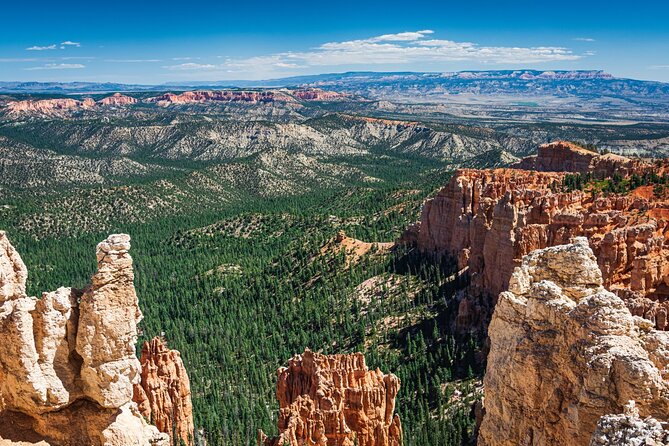
The Bryce Amphitheater is the heart of the park. It is not a canyon in the usual narrow sense, but a huge, horseshoe-shaped bowl filled with hoodoos. The audio points out the scale and shape of this central area as you drive between the major overlooks.
Sunset Point follows, with another strong view into the amphitheater. This is where the geology discussion becomes more specific. You learn what makes a hoodoo, how erosion works over long periods, and why the formations have their odd, almost carved appearance.
The narration is useful here because the main viewpoints can feel visually overwhelming. You see hundreds of pillars at once, and a short explanation gives your eyes something to organize. The commentary is designed for a driver, so it offers a steady stream of facts rather than a long lecture.
One limitation is depth. Some people will find the stories just right for a driving tour. If you want a detailed geology class, you may find the spoken material too brief. The app includes a Learn More section, which can provide extra information, but the main route is built for listening while moving.
More Driving Audio Tours in the USA:
- Ultimate Lake Tahoe Self-Guided Driving Audio Tour
★ 4.5 · 435 reviews - Scenic Newport, RI Self-Guided Driving Audio Tour
★ 4.5 · 325 reviews - Arches National Park Self-Guided Driving Audio Tour
★ 4.5 · 288 reviews - Yellowstone National Park Self-Guided Driving Audio Tour
★ 4.5 · 249 reviews
Inspiration Point and Bryce Point: stories of people and sunrise
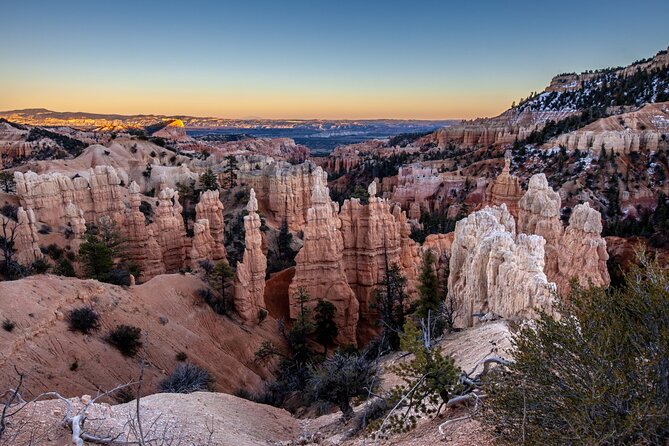
At Inspiration Point, the audio returns to Paiute traditions and their stories about the unusual stone figures. This is a welcome change from a purely scientific explanation. You get two ways to think about the same formations: one based on geology and one based on cultural tradition.
Bryce Point gives you one of the broadest views across the full amphitheater. The narration also explains why the point is famous for sunrise. The first light catches the tops of the hoodoos, then spreads down as shadows retreat into the lower recesses.
This section adds the story of Mormon settlers who followed the Paiute people and tried to live in a difficult climate. The human history is not overwhelming, but it gives the drive a sense of time and place. You are not only looking at stone. You are hearing about the people who named, used, explained, and struggled with this high desert setting.
If sunrise is part of your plan, the audio access gives you flexibility, but you still need to check park access and road conditions for your visit. The tour itself does not reserve a viewing spot or provide transportation.
Paria View and the work of ancient ice
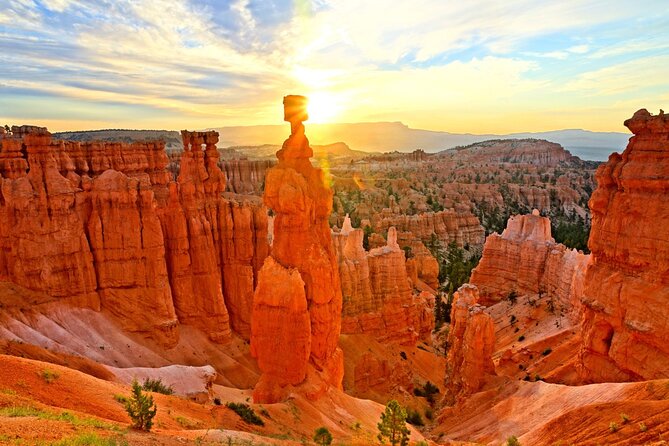
Paria View takes the route farther from the central amphitheater. Here, the narration turns to the last ice age and the effects of glaciers and melting water around 12,000 years ago.
The point of this stop is not just the view. It is the chance to connect present-day formations with changes in climate and water flow. The story gives you a clearer sense of how much time is behind the scenery.
This part of the route may appeal to you if the central overlooks feel crowded or repetitive. It continues the geology theme while moving into a less concentrated part of the park.
Swamp Canyon and the Butch Cassidy story
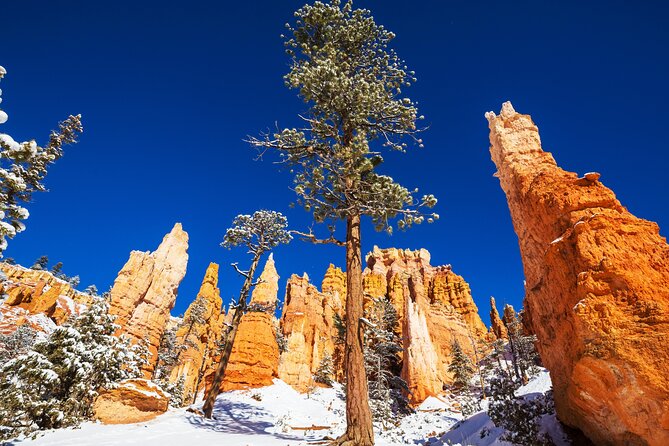
Swamp Canyon Overlook takes you into a quieter section. The subject shifts from rocks to the American West, with stories about Butch Cassidy and the Sundance Kid.
The narration separates fact from legend, which is useful because western outlaw stories often grow in the telling. This stop gives the drive a bit of human drama without turning the entire experience into a history tour.
The farther you go, the more the audio serves as company between viewpoints. One user found the final miles toward Rainbow Point especially helpful because the stories kept the long drive interesting. That is a real strength of an audio route: less famous stretches do not feel like empty time between the headline stops.
Farview Point and the value of clean air
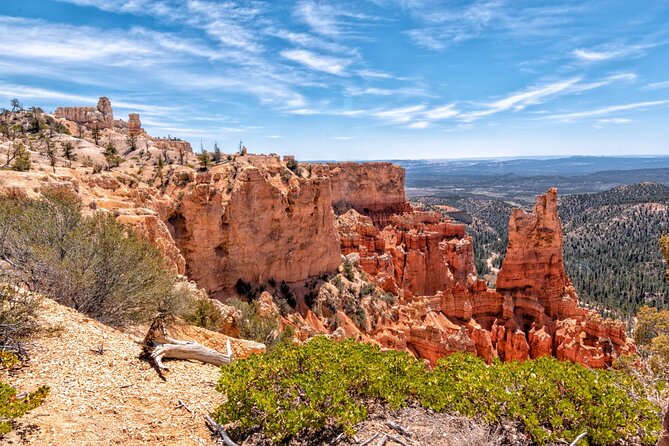
Farview Point brings a different kind of natural history. The commentary highlights the clear air and the bristlecone pines, among the oldest trees on Earth.
The clean-air point is easy to overlook, but it adds meaning to the view. At Bryce, you are seeing far across open country, and the quality of the air helps explain why the sightlines can feel so broad.
This is also a reminder that Bryce is not only about hoodoos. The park includes trees, wildlife, changing weather, and a night sky that deserves attention. The audio begins setting you up for the park’s astronomy opportunities later in the route.
Natural Bridge and Agua Canyon
Natural Bridge offers a change from the vertical towers of the amphitheater. The formations here include arches and openings, giving you another example of what erosion can make from the same general rock layers.
At Agua Canyon, two named hoodoos draw the eye: the Hunter and the Rabbit. The names are part of the fun, although the shapes may not immediately resemble either animal.
The audio uses this stop to discuss wildlife, including rabbits and deer, and the ways animals cope with very hot summers and bitter winters. That makes the stop more than a quick photo break. You begin to notice that Bryce is a demanding place for living things, not simply a dramatic backdrop.
Ponderosa Canyon and Black Birch Canyon
The route continues to Ponderosa Point, where junipers spread across the distance and the drive reaches the park’s more remote southern stretches. The scenery shifts again, with more emphasis on forest and open views around the hoodoo country.
Black Birch Canyon brings the focus to the night sky. Bryce offers excellent conditions for stargazing, and the audio points you toward amateur astronomy opportunities. If you are staying nearby after dark, this part of the commentary may shape how you plan your evening.
The route is at its best when you let the subject change naturally. Geology, Indigenous traditions, settlers, wildlife, trees, outlaws, glaciers, and stars all have a place. The stories are not equally deep, but together they help you see more than the orange rock.
Rainbow Point and Yovimpa: the far end of the route
Rainbow Point and Yovimpa are the final major overlooks. From here, you can see hoodoos, cliffs, forest, and the broad basin below.
The narration explains that Bryce sits at the top step of the Grand Staircase, a huge series of rock layers that descends toward the Grand Canyon in Arizona. This gives the final stop a useful regional connection. Bryce is not an isolated oddity. It is one part of a much larger geological story across southern Utah and northern Arizona.
Rainbow Point also gives the drive a clear finish. You have moved from the visitor center through the famous amphitheater and out along the park road to the farthest viewpoints. You can end here, turn the audio off, and spend time at the overlook without feeling that you have missed the route’s main point.
Red Canyon’s man-made arches
The Red Canyon arches provide a memorable bookend near the road into Bryce. They look like natural arches, but workers tunneled through solid rock in 1914 to make room for the road.
That detail is exactly the sort of thing you might miss while driving past. It also fits the tour’s larger purpose: explain the view in front of you, including the parts made by people rather than wind, water, or ice.
Price, value, and the app’s weak spots
At $16.99 for up to four people, this is inexpensive if your car is full. Even for one or two people, it costs much less than a private guide, while still giving you a planned route and narration at the overlooks.
The lifetime access improves the value. You can use it on a later Bryce visit, replay it from home, or pause when weather and road conditions disrupt your schedule. It also works across multiple days.
The main risk is technical. The visitor center staff will not be managing this tour, and no guide meets you at the start. Downloading from the booking platform alone is not enough. You need Action’s separate app, the password, and the tour file.
A few practical habits can prevent most trouble:
- Download the app and tour before entering the park.
- Test the first story while you still have a reliable signal.
- Save the setup email and text.
- Connect the phone to the car before driving.
- Follow the route and speed limit rather than trying to manipulate the phone while moving.
- Clear the app from your recent apps when finished, since it may continue running.
- If the GPS sends you in a large circle or the audio starts over, contact support.
Some users found the app easy and accurate. Others had trouble starting, pausing, or controlling the route. That mixed record means the tour is a good value only if you prepare for the technology.
Who should book this Bryce Canyon audio tour?
I would choose it if you want to drive independently but still want background information at the right moments. It suits couples, families, and small groups who prefer their own car, their own stops, and no fixed departure time.
It is particularly useful for a first visit. The route helps you find the major viewpoints, introduces the park’s geology, and gives you ideas for hikes and later stops. Families may also appreciate the mix of animals, Paiute stories, outlaws, and strange rock shapes.
I would hesitate if you strongly prefer a live guide, dislike phone apps, or want a detailed scholarly explanation at every stop. A free National Park Service app is also available, so price-sensitive visitors should compare the two before buying.
Should you book it?
Book this tour if you value freedom, low cost, and a steady stream of stories while driving. The best part is the combination of major viewpoints and less familiar stops such as Swamp Canyon, Agua Canyon, Black Birch Canyon, and Rainbow Point.
Skip it if app setup sounds like a chore or if you want the personal questions and deeper interpretation that come with a live guide. For most self-driving visitors, though, $16.99 and lifetime access make this a practical way to give Bryce Canyon more meaning without surrendering control of your day.
FAQ
How much does the Bryce Canyon audio tour cost?
It costs $16.99 per group of up to four people. The price covers the audio tour, not park admission.
How long does the tour take?
The stated driving and audio time is about one to two hours. The full route is more than 60 miles, so you should allow extra time for overlooks, photos, stops, and walks.
Does the tour expire?
No. The tour has lifetime access with no expiry, so you can use it on future trips and across multiple days.
Is a guide waiting at the visitor center?
No. This is a self-guided activity. You go to the starting point, open the Action Tour Guide app, and begin the first story yourself.
Do I need cell service inside Bryce Canyon?
The tour works offline after downloading. You must download the app and tour while you have strong Wi-Fi or cellular service.
Is park admission included?
No. A separate Bryce Canyon National Park entry fee applies.
Can I connect the audio to my car?
Yes. You can connect your phone using Bluetooth, USB, or AUX. Apple CarPlay is compatible with audio playback.
Can I cancel for a refund?
Yes, if you cancel at least 24 hours before the scheduled start time. Cancellations made within 24 hours are not refunded.
More National Park Audio Tours in the USA
- Self-Guided GPS Audio E-Bike Tour Hawaii Volcanoes National Park
★ 4.5 · 131 reviews - Shenandoah National Park Self-Guided Driving Audio Tour
★ 4.5 · 109 reviews - Self-Guided Audio Driving Tour in Glacier National Park
★ 4.5 · 101 reviews - Rocky Mountain National Park Self-Guided Driving Audio Tour
★ 4.5 · 92 reviews
Just added around the USA
- Self Guided Driving Audio Tour of Saguaro National Park★ 3.0 · 4 reviews
- Self-Guided Audio Driving Tour of Mount Lemmon★ 5.0 · 4 reviews
- Saguaro National Park Self-Guided Audio Tour★ 3.5 · 11 reviews
- A Self Guided Audio Tour in Tombstone★ 4.0 · 11 reviews
- Catskills Scenic Byway Self-Guided Driving Audio Tour★ 4.0 · 9 reviews
- Big Bend National Park Self Guided Audio Tour Guide★ 5.0 · 12 reviews
- Self-Guided Audio Driving Tour in Catskills Scenic Byway★ 4.5 · 7 reviews
- Shiloh Battlefield Self-Guided Driving Audio Tour★ 4.0 · 9 reviews
Driving Audio Tours, compared.


Ultimate Acadia National Park Self-Guided Driving Audio Tour
Read our review →



Browse the lists this tour appears in