
REVIEW · ITALY AUDIO TOURS
Brindisi Walking Tour with Audio and Written Guide by a Local
Brindisi rewards curious walkers. This self-guided audio tour links Roman monuments, medieval churches, port views, and local food advice in a route you can take at your own pace. I like the low price and the freedom to pause whenever you wish.
I also like the way the walk ends along the waterfront, where you can listen to the final stops while strolling beside the port. The main drawback is clear: you need internet access and a smartphone, and some audio pronunciations of Italian names may sound awkward.
The route takes about two to three hours, though you can stretch it longer with museum time, photos, lunch, or a drink by the water. It is a practical introduction to Brindisi, not a substitute for a live guide.
Key points about the Brindisi audio walk
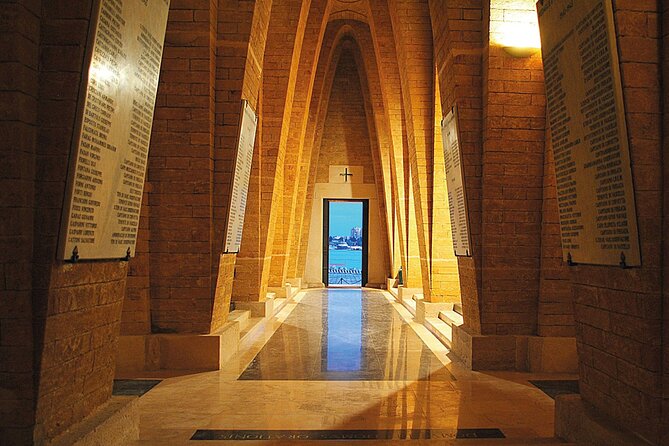
- Eight main sights connect the old town to the port, including San Giovanni al Sepolcro, the cathedral, Roman columns, and the Monument to the Italian Sailor.
- The price is just $7.21 per person, making it a low-cost choice for independent sightseeing.
- Audio and written information come in five languages: English, Spanish, Italian, German, and French.
- The route uses Google Maps, which helps you move between stops, but you must keep your phone connected to the internet.
- Food advice is part of the experience, including suggestions for authentic restaurants such as Antica Osteria La Sciabica.
- The final monument costs €3 to enter, while most other stops are free.
What this Brindisi self-guided tour actually offers
This is not a walking tour with a person waiting at the starting point. You begin on your own, open the digital guide on your phone, and follow the route from Bastione San Giacomo to the Monument to the Italian Sailor.
That distinction matters. If you want conversation, questions answered on the spot, and a local person steering the group, choose a live tour instead. If you prefer stopping for photographs, taking a coffee break, or wandering down a side street, this format gives you much more control.
The guide combines spoken commentary with written text. You can listen through your phone’s speaker or use your own headphones. The written material is useful when the surroundings are noisy, your connection drops briefly, or you want to check a name again.
The route is offered in English, Spanish, Italian, German, and French. The English audio has received some criticism for American-style pronunciation of Italian place names. That will not prevent you from using the map or understanding the main points, but travelers who care about precise Italian pronunciation should keep the written names visible on their screen.
More Audio Walking Tours in Italy
- Florence: 2.5 hour Audio Guided Walking Tour led by Host
★ 4.6 · 293 reviews - Verona Walking Tour with Audio and Written Guide by a Local
★ 4.5 · 157 reviews - Bologna Walking Tour with Audio and Written Guide
★ 4.5 · 132 reviews
Starting at Bastione San Giacomo
The walk begins at Bastione San Giacomo on Via Nazario Sauro. This defensive work is dedicated to Saint James, the patron saint of Spain, and its later uses tell you something about Brindisi after its military purpose faded.
The bastion became a public slaughterhouse, an oil depot, and a customs house. Those changes are more interesting than a simple military label because they show how an old defensive structure was absorbed into everyday city life.
Give yourself a few minutes here before moving on. The digital guide uses the site to introduce Brindisi as a port city shaped by trade, defense, administration, and movement across the Adriatic and Mediterranean.
The opening location is also practical. You do not need to find a group or identify a guide. Read the activation instructions in your voucher before you arrive, then start when you are ready.
The earth castle and Brindisi’s defensive past
The next early stop concerns the castle ordered by Emperor Frederick II. It created the original core of what is also called the earth castle, known in Italian as Castello di Terra.
Brindisi has four historic castles, and this one is second in chronological order. The audio commentary helps place the building within the wider story of imperial power and the city’s strategic role.
Do not expect a long indoor visit here based on the information provided. This is mainly a historical stop within the walking route. The value comes from understanding why Brindisi mattered to rulers who needed a secure harbor and a route toward the eastern Mediterranean.
For a first visit, this context helps the rest of the walk make sense. Brindisi is not just a port with attractive waterfront steps. Its churches, roads, castles, and monuments are tied to military control, pilgrimage, commerce, and ships.
San Giovanni al Sepolcro, a church shaped like a memory
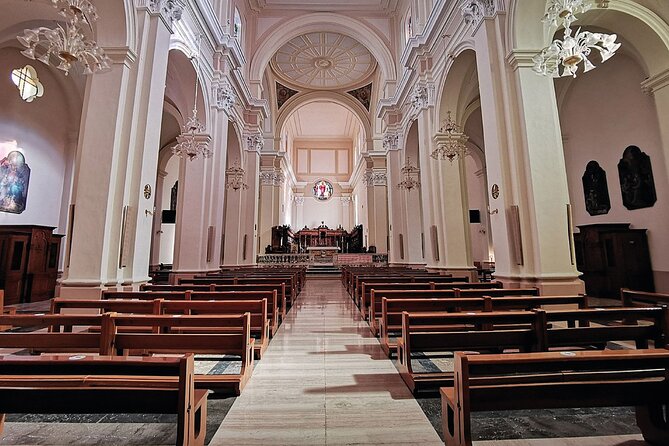
The first numbered stop is Tempio di San Giovanni al Sepolcro, or the Church of the Holy Sepulchre. The Canons Regular of the Holy Sepulchre built it before 1128, when the first document mentioning the church appears.
The name points to the church’s connection with the Holy Sepulchre tradition. That gives this modest building a strong link to pilgrimage and Jerusalem, themes that return throughout Brindisi’s history.
The suggested time here is 20 minutes. Admission is not included, so check the entrance arrangements before planning a longer interior visit. Even if you only see the exterior, the written and audio notes give you a better reason to pause than a quick photograph would.
This is one of the stops where a self-guided format works well. You can examine the church at your own speed rather than being hurried along by a group. On the other hand, if the doors are closed or you want detailed architectural discussion, a person on site would offer more help than an app.
Same place, a different route to walk:
- Rome: Pantheon Fast-Track Ticket and Official Audioguide
★ 4.5 · 27,353 reviews - Rome: Colosseum & Forum with Audio Guide App -Optional Arena
★ 4.2 · 24,770 reviews - Florence: Timed Entry to Michelangelo’s David + Audio App
★ 4.6 · 19,496 reviews - Rome: City Sightseeing Hop-on Hop-off Bus with Audioguide
★ 4.0 · 16,045 reviews
San Pietro degli Schiavoni and a vanished community
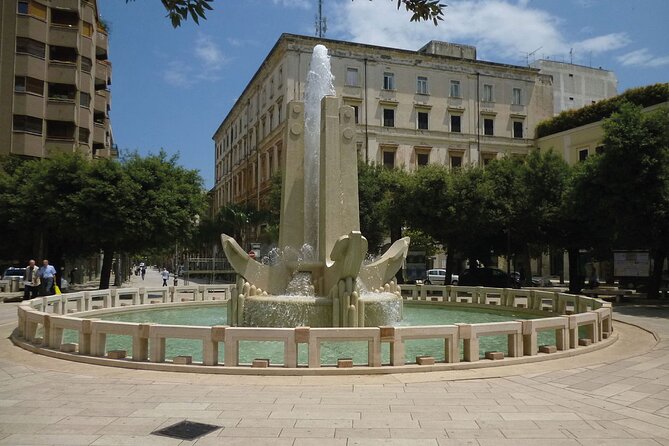
The archaeological area of San Pietro degli Schiavoni brings you to a less obvious part of Brindisi’s story. Its name recalls a community of Slavs, including Greeks and Albanians, who settled in this area from the fifteenth and sixteenth centuries.
The settlement centered on a church of San Pietro, but no material traces of that church remain today. That absence is part of the point. The stop asks you to picture a community that once shaped this neighborhood even though the main physical evidence has disappeared.
The visit is planned for about 20 minutes, and admission is free. You will get the most from this stop if you listen carefully to the explanation rather than expecting a large collection of visible ruins.
I like this kind of pause in a city walk. It moves beyond the best-known monuments and shows that Brindisi was also shaped by people who arrived from elsewhere, built homes, worshipped, and made the port their own.
Brindisi Cathedral and the return of the city

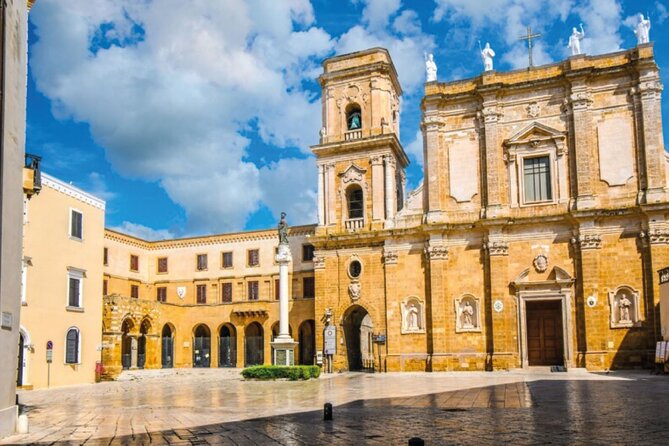
The Cathedral of San Giovanni Battista represents the city’s recovery under Norman support. Its construction marked a new phase for Brindisi as the Normans expanded eastward.
By this period, Brindisi was again an important commercial link toward the eastern Mediterranean. It also became an essential stopping point for people traveling from Rome toward Jerusalem.
The suggested stop lasts 20 minutes, and admission is free. Use the audio guide here to connect the building with the city’s changing fortunes rather than treating it as just another church on a list.
This is also a good point to pause the audio and look around quietly. The route gives you the facts, but your own time inside the cathedral helps you absorb the scale and atmosphere.
Museo Archeologico Francesco Ribezzo
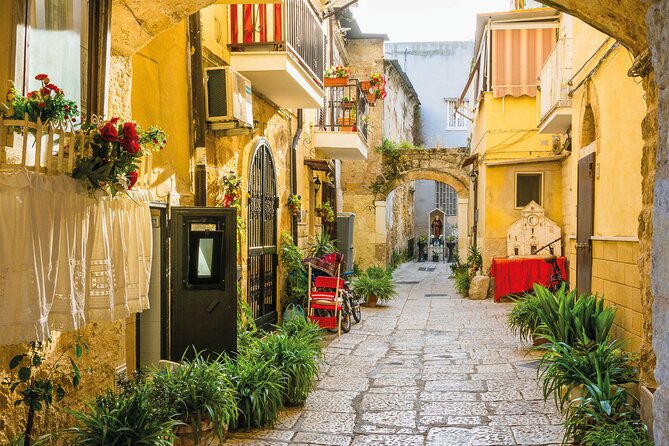
The Francesco Ribezzo Archaeological Museum deserves the longest scheduled visit, about 30 minutes. Admission is free, which makes it one of the strongest value points on the route.
The museum began in 1884 as part of Brindisi’s library and museum center. Its collections cover several periods and subjects, including prehistoric material, Messapian culture, Roman archaeology, inscriptions, statues, and finds recovered underwater.
The museum is named for Francesco Ribezzo, a scholar of the Messapian civilization of the area. That matters because the story of Brindisi did not begin with Rome, the Normans, or medieval pilgrims. The museum gives you a look at the older cultures that shaped the territory.
Thirty minutes is enough for an introduction, not a full museum study. If archaeology is a main reason for your visit, you may want to stay longer and treat the rest of the walk as flexible. Since the visit is self-guided, you can do that without holding up anyone else.
The Roman columns on Via Colonne

At Via Colonne 53, you reach one of Brindisi’s best-known symbols: the Roman columns. The accepted theory places their construction around AD 110 under Emperor Trajan, when they may have marked the end of the historic Appian Way.
The origins of the columns are not completely settled, and the guide presents three main theories. That uncertainty adds interest. You are not being handed a single neat answer and told to move on.
The planned visit is only 10 minutes, and admission is free. That is enough time to hear the explanation, look closely, and take photographs. The columns also help you understand why Brindisi was a natural endpoint for a road that connected the city to Rome.
This stop works especially well with the written guide open. Proper names and historical dates are easier to follow when you can read them rather than rely only on the audio.
Monumento a Virgilio and the port below
The Monumento a Virgilio marks a staircase connecting the historic center with the seafront. It is named for Virgil, the Roman poet of the first century BC.
The planned stop lasts 10 minutes. The main appeal is the connection between the poet and Brindisi, along with the changing view as you move toward the water.
This is a transition point in the route. The earlier stops focus heavily on buildings, archaeology, and political history. Here, the walk begins to open toward the harbor. I would not rush down the steps. The route is short, but the movement from old town to waterfront is one of the more enjoyable changes in pace.
Lungomare Regina Margherita by the harbor
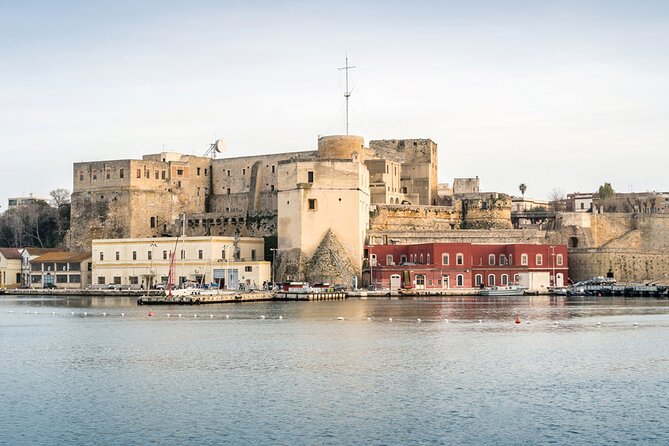
The walk continues along Lungomare Regina Margherita, one of the most attractive places in Brindisi for a waterfront stroll. The route allows about 15 minutes here, but this is a natural place to slow down.
You get broad views of the sea and port, and the final audio stops can be enjoyed while you walk. This is one of the format’s best features. You are not standing in a tight group while a guide speaks over traffic or other conversations. You can keep moving, stop for a photograph, or sit for a few minutes.
The waterfront also gives the history a physical setting. Earlier commentary about ships, trade, pilgrims, and the eastern Mediterranean becomes easier to picture when you are looking across the port.
Food advice adds practical value here. One particularly useful suggestion is Antica Osteria La Sciabica, where you might try focaccia and a spritz near the harbor. The guide also offers other restaurant recommendations, so you can use the tour as a starting point for a meal rather than ending it the moment the final monument is reached.
The Monument to the Italian Sailor
The final stop is the Monument to the Italian Sailor on Via Ammiraglio Millo. It commemorates Italian sailors who died in the First World War.
After the war, cities across Italy planned monuments for fallen soldiers. Places such as La Spezia, Trieste, and Venice sought to host the work, and Brindisi also entered the discussion. The guide uses this competition to explain why the monument belongs here and how the city’s maritime identity shaped the decision.
The planned visit is 20 minutes. Admission costs €3, unlike most of the other stops. The walk ends directly in front of the monument, which gives the route a clear finish rather than leaving you somewhere vague in the old town.
This is a useful ending for two reasons. First, it returns the story to the sea and to the people who served it. Second, you can continue along the waterfront afterward without needing to retrace the route.
Is $7.21 good value?
At $7.21 per person, this is inexpensive for a two to three hour introduction to Brindisi. The value improves if you use the restaurant advice, visit the free archaeological museum, and take advantage of the written material as well as the audio.
You should also budget €3 for the Monument to the Italian Sailor if you plan to go inside. Headphones are not provided, so bring your own if you prefer private listening. Otherwise, you can use your phone speaker.
The low cost comes with tradeoffs. There is no person to answer questions, adjust the pace, or explain an unexpected detail. The guide depends on your phone, internet connection, and ability to follow Google Maps. One technical complaint concerned the lack of an offline version, so do not assume you can use it without mobile coverage.
The digital format may suit two people better than a large group. Group discounts are available, and the maximum stated capacity is 108 people, but the guide itself is used independently rather than as one moving crowd.
Who should choose this Brindisi experience?
I would choose it if you want a low-cost overview and prefer to explore without a fixed group schedule. It is especially suitable for independent adults, couples, families with older children, and anyone who wants to combine sightseeing with a meal or a waterfront walk.
It also works for a short stop in Brindisi because the route covers many of the city’s key sights in one direction. You can shorten the walk, skip a museum, or spend longer at the port.
I would choose a live guide instead if pronunciation matters greatly to you, if you want detailed answers about architecture, or if you dislike managing maps and phone instructions. The audio can also feel less personal than a conversation with someone who knows the city.
Book only if you understand the format. You will not meet a guide at Bastione San Giacomo, and no one will be waiting when you reach the first point. Read the activation instructions carefully, check your internet connection, and download or prepare your headphones before setting out.
Free cancellation is available when you cancel at least 24 hours before the local start time. Changes or cancellations inside that window are not refunded.
Should you book it?
Book this walk if you want Brindisi’s main sights, useful historical context, and restaurant suggestions for very little money. Its strongest features are the clear route, the free museum stop, the waterfront finish, and the freedom to set your own pace.
Skip it if you need a live person, perfect Italian pronunciation, or an offline audio file. For everyone else, it is a sensible first look at Brindisi, especially when you arrive with a charged phone, mobile data, and a willingness to wander a little.
FAQ
Is this a guided walking tour with a person?
No. It is a digital self-guided experience with audio and written information. You follow the route independently using your smartphone.
How long does the Brindisi walking tour take?
The walk takes approximately two to three hours. You can make it shorter or longer because you control the pace and time spent at each stop.
What languages are available?
The audio guide and written guide are available in English, Spanish, Italian, German, and French.
Do I need internet access?
Yes. You need a smartphone with an internet connection to activate and use the digital guide. The route uses Google Maps, and there is no offline version stated.
Are entrance fees included?
Most listed stops are free. Admission to San Giovanni al Sepolcro is not included, and the Monument to the Italian Sailor costs €3. Headphones are also not included.
Where does the walk begin and end?
It begins at Bastione San Giacomo, Via Nazario Sauro 6, Brindisi. It ends in front of the Monument to the Italian Sailor on Via Ammiraglio Millo 2.
Just added around Italy
- Torino Walking Tour with Audio and Written Guide by a Local★ 4.5 · 35 reviews
- Medieval Canals and Fountains: A Treviso Self-Guided Audio Tour★ 4.5 · 4 reviews
- Trapani Walking Tour with Audio and Written Guide by a Local★ 4.0 · 8 reviews
- Trento Walking Tour with Audio and Written Guide★ 4.5 · 11 reviews
- Sicily: Selinunte Park Entry Ticket & Sicily Digital Audio Guide★ 4.5 · 4 reviews
- Taormina Walking Tour with Audio and Written Guide by a Local★ 4.5 · 41 reviews
- Taranto Walking Tour with Audio and Written Guide by a Local★ 5.0 · 5 reviews
- Siracusa Walking Tour with Audio and Written Guide by a Local★ 5.0 · 59 reviews
Walking Tours, compared.
City Monuments Guided Walking Tour with Audio Guide
Read our review →

Self Guided Classic Freedom Trail Location Aware (GPS) Walking Audio Tour
Read our review →
Self-Guided Historical Walking Tour (Audio Guide)
Read our review →
Cape Cod & Provincetown Self-Guided Driving & Walking Audio Tour
Read our review →
Verona Walking Tour with Audio and Written Guide by a Local
Read our review →
Royal Walking Tour and Buckingham Palace Audio Tour
Read our review →
Bologna Walking Tour with Audio and Written Guide
Read our review →Browse the lists this tour appears in