REVIEW · ITALY AUDIO TOURS
Audio guides to discover Lake Garda and the city of Brescia
Lake Garda rewards slow looking. This smartphone audio-guide experience links the lake’s best-known towns with Brescia’s Roman, medieval, and modern sights, letting you choose your own route instead of following a fixed group. I like the broad coverage, from Sirmione and Peschiera to Limone, Riva del Garda, and Brescia. I also like the low price, which makes it useful as a flexible companion rather than a major tour expense.
The main drawback is that this is not a guided excursion with transport. You must get yourself between locations, manage the timing, and use your phone for playback. The Brescia material also needs careful checking in the app, since one customer expected more and received only a very short message, while the provider says the city section includes more than 30 minutes across 15 points.
Key points to know before you buy
- One purchase covers a large area: Audio points run from Desenzano del Garda around both shores of Lake Garda, then continue into Brescia.
- The guide follows your phone: Points are geolocated on a navigation map, so you can choose where to begin and what to skip.
- The price is unusually low: At about $4.84 per person, the guide can add useful context without the cost of a private guide.
- You need your own transport: Parking, trains, buses, food, drinks, and paid attraction tickets are not included.
- The audio is praised for clarity: The recording is made with an advanced digital voice and is described as clear, well paced, and easy to follow.
- Download before heading out: Offline tracks are recommended if you do not want to depend on a mobile connection.
How this Lake Garda audio guide works
This is best understood as a library of short location-based audio stops, not a traditional sightseeing tour. After booking, you receive a link within 24 hours to redeem the minutes you purchased. Once activated, you open the map, choose a nearby point, and listen from your smartphone.
The supplied duration ranges from about 30 minutes to 1 hour 40 minutes. That range matters. You may listen only at the places that interest you, or use spare minutes later on another Audiogiro guide. Unused minutes remain available until they run out, and the purchase stays active for a year.
You do not receive headphones or a radio guide. Bring your own phone and headphones if you prefer not to hold the phone near your ear. Download the tracks before setting out, especially if you plan to visit several towns where reception may vary.
The experience is private in the simple sense that no other group joins you. You set the pace. Stop for coffee, skip a museum, return later, or listen while walking along a promenade. That freedom is the strongest reason to choose this format.
A few more audio tours around Italy worth a look
- Rome: Pantheon Fast-Track Ticket and Official Audioguide
★ 4.5 · 27,353 reviews - Rome: Colosseum & Forum with Audio Guide App -Optional Arena
★ 4.2 · 24,770 reviews - Florence: Timed Entry to Michelangelo’s David + Audio App
★ 4.6 · 19,496 reviews
Desenzano del Garda begins with castles and Roman remains
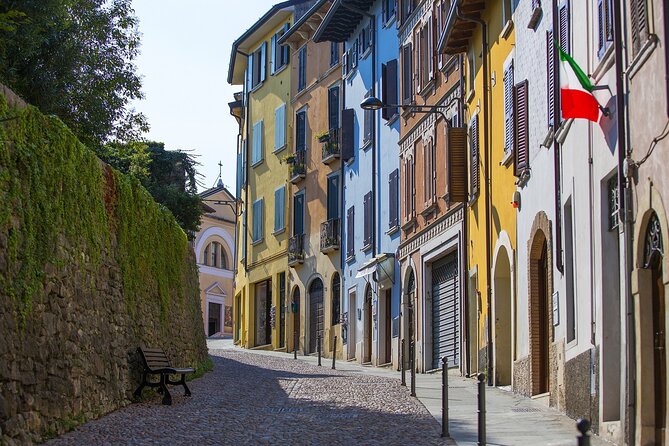
Desenzano is a practical starting point because it has rail and motorway connections, a lakeside promenade, and plenty to see in a compact area. The old town rises toward the morainic hills, so expect narrow, sloping streets rather than a flat lakeside stroll.
The castle is a strong first stop. Its courtyard is used for summer music and theater, while the terrace below the entrance looks across Desenzano and the Brescia side of the lake. You get both a sense of the town’s defensive past and a useful orientation to the water.
At Palazzo Todeschini, look toward the old port. The building once served as the municipal seat and now hosts conferences and exhibitions. The port was important during Venetian rule, when grain was unloaded beneath the building’s arcades. That detail helps you see Desenzano as a working commercial town, not only a holiday resort.
The bronze monument to the aviators of the High Speed Department in Piazza Matteotti is an unusual stop. The audio explains why this aviation subject belongs in Desenzano, which is exactly the sort of small local story a written guide can easily miss.
Other Desenzano points include the archaeological museum, with prehistoric finds from the Lavagnone pile-dwelling site, and the Roman villa discovered in 1921. The villa dates to the first half of the fourth century and may have belonged to Flavius Magnus Decentius, whose name may also be linked to Desenzano.
A later stop takes you to the tower and its long inclined spiral ramp, more than 400 meters in length. The site also includes a Risorgimento museum and an ossuary at the end of a tree-lined avenue. This part requires more physical effort than the short audio times suggest, so plan your energy around the visit rather than assuming every point is a quick glance.
Peschiera and Sirmione show two very different faces of the lake
Peschiera del Garda sits at the Mincio River’s outlet and has strong rail and road connections. Its most memorable feature is the Venetian fortress, which encloses the historic center itself. You are not simply looking at a fortification from outside. The town’s streets and buildings occupy the old defensive citadel.
The audio stop here is brief, but the setting deserves time. Walk slowly along the fortified area and notice how the waterways and walls work together. Peschiera is especially useful for visitors arriving by train or using it as a base for the southern lake.
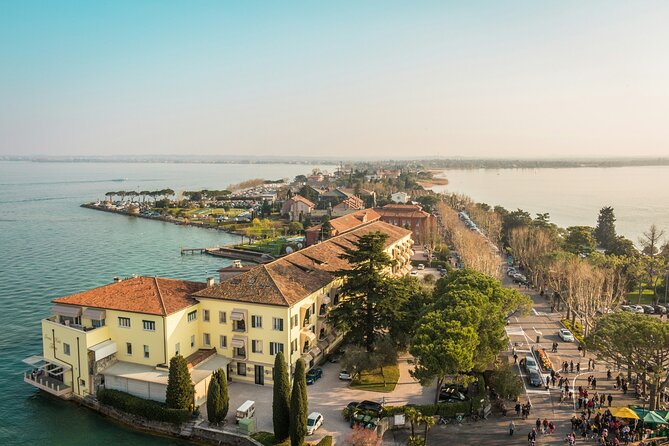
Sirmione offers a more dramatic arrival. The Scaliger Castle greets you near the entrance to the historic center, and its keep rises 37 meters above the town. The view from the top is one of the best in Sirmione, though reaching it requires admission to the paid attraction, which is not included.
The guide also covers the Caves of Catullus, the remains of a large Roman villa at the peninsula’s end. The name connects the site with the poet Catullus, who praised Sirmione in his poetry and is traditionally associated with the area. The connection is partly traditional rather than fully proven, a useful distinction that keeps the story from becoming too tidy.
Sirmione can become crowded, and the audio cannot solve that practical problem. Use it to choose your priorities before walking through the monumental gate. The castle, old center, thermal-water reputation, and Roman remains are enough for a full visit, but not all are free.
Lazise, Bardolino, Garda, and Torri offer an easy eastern shore route
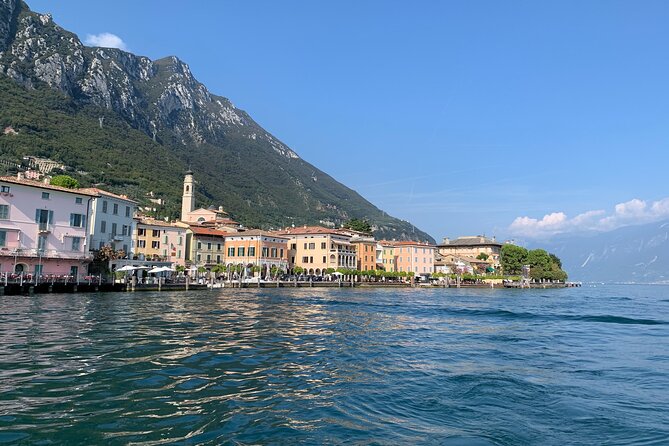
Lazise combines medieval walls and castle remains with beaches and access to major family attractions such as Gardaland, Caneva Aquapark, and Parco Natura Viva. The guide gives you the historic layer, while the town’s position makes it a useful stop for a mixed-age day.
Bardolino adds museums linked to olive oil, fish, and the birds of Lake Garda. At the end of town, a 30-meter Ferris wheel provides a high view over the area. That ride is separate from the audio experience, but the guide can help you decide if Bardolino deserves more than a quick promenade stop.
Garda itself is linked to the region’s Lombard past and to Punta San Vigilio, a small peninsula at the northwest end of the gulf. The Baia delle Sirene natural park has a bathing beach, so this stop suits a day that mixes sightseeing with time beside the water.
Torri del Benaco is known for medieval fortifications and a castle setting. The nearby Tibetan bridge at Pai di Sopra crosses a gorge 45 meters deep and is 34 meters long. The description is enough to warn anyone with vertigo before making a special trip.
Same place, a different route to walk:
- Rome: City Sightseeing Hop-on Hop-off Bus with Audioguide
★ 4.0 · 16,045 reviews - Pompeii: Entry Ticket with Audio Guide
★ 4.1 · 13,491 reviews - Venice: La Fenice Opera House Entry Ticket with Audio Guide
★ 4.6 · 11,742 reviews - Rome: Colosseum, Forum, Palatine Hill Entry & Audioguide App
★ 4.4 · 10,957 reviews
Brenzone, Malcesine, and the northern shore bring more outdoor appeal
Brenzone is quieter than some of the lake’s larger resort towns. Its free beaches appeal to water-sports enthusiasts, and a cycle and pedestrian path reaches toward Malcesine. The audio gives this stretch a useful sense of place, but you will need to arrange any cycling equipment yourself.
Malcesine brings together old buildings, food, views, and sports. The guide treats it as a broad introduction rather than a detailed museum tour. That is appropriate for a town where you may want to wander and choose your own stops.
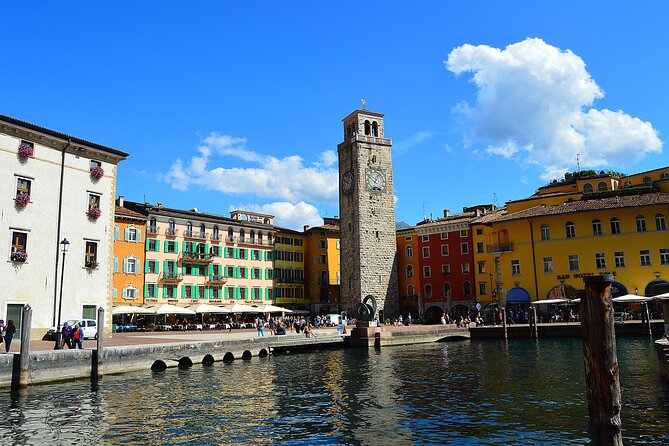
Nago-Torbole is presented through its history and natural setting. Riva del Garda then adds a strong military layer. Under Austro-Hungarian rule, Riva was home to a military flotilla, and the surrounding fortifications later played a role during the Great War. Several defensive structures remain and are now attractions in their own right.
This northern section feels more varied than the southern resort towns. You move from beaches and cycling to fortifications and mountain views. It is also the part where self-driving or a carefully planned route matters most, since the guide does not include transport.
Limone to Gardone follows the western shore’s best stories
Limone sul Garda keeps its identity as a small port town with links to fishing. Its lemon groves and the elevated Garda cycle path are the key attractions. The guide’s one-minute stop is a prompt, not a substitute for walking through the port or visiting the groves.
At Tremosine, the Terrazza del Brivido gives a high view over Lake Garda and Monte Baldo. The name signals the experience clearly. If heights are not your thing, enjoy the view from a comfortable distance.
Campione del Garda brings water sports, the San Michele stream, and the neoclassical church of Sant’Ercolano. Tignale adds the Limonaia Pra dela Fam and the Sanctuary of Montecastello, perched on limestone above the lake.
Gargnano continues the lemon-growing story with historic groves such as Trevisani and Gandossi. Toscolano-Maderno shifts the focus to paper production. The Valle delle Cartiere offers a walk suitable for children, ruins of old paper mills, and a paper museum.
Gardone Riviera is one of the most rewarding stops for culture. The Vittoriale degli Italiani is a national monument, house, building complex, and park connected with Gabriele D’Annunzio, who rented and later bought the Cargnacco estate in 1921. The Heller botanical garden was created through the work of Austrian botanist Arthur Hruska and later acquired its current name from owner André Heller.
Both Gardone attractions require separate admission. The audio can explain why they matter, but it does not replace the time needed to see them properly.
Salò and the southern western shore slow the pace
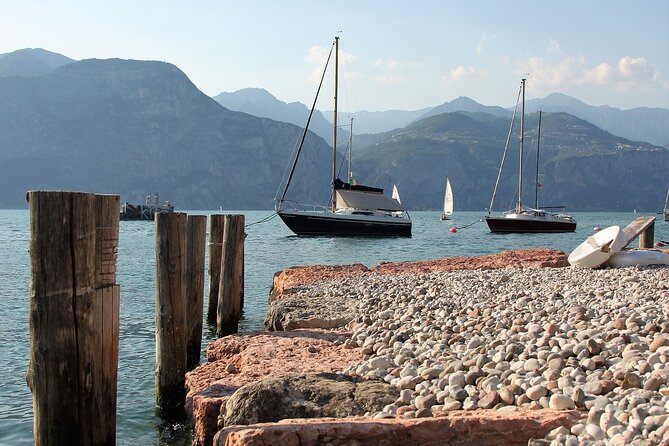
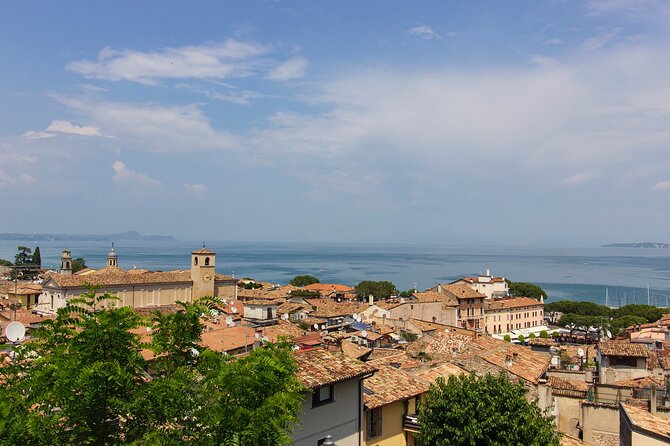
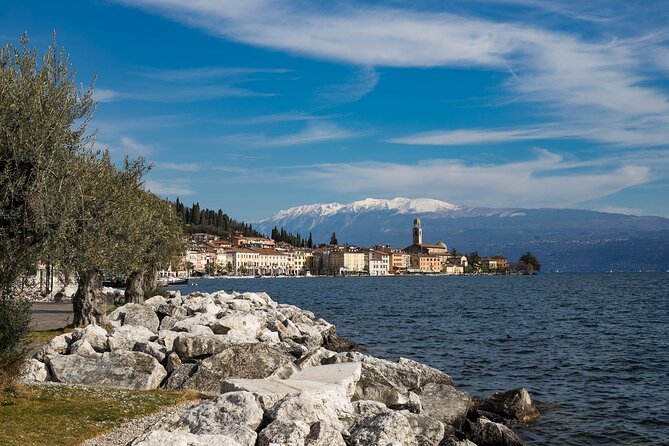
Salò sits at the center of its gulf, with a lakeside promenade lined by historic buildings. This is a good place to pause after the more spread-out western shore stops. The guide points you toward the view, but the real pleasure comes from walking the waterfront at your own speed.
Puegnago sul Garda is known for the three morainic lakes of Sovenigo. In July and August, lotus flowers cover parts of the water, and the area also attracts horseback riders. Timing matters here because the flowers are seasonal.
San Felice del Benaco offers the promontory of San Fermo, with views toward Isola del Garda, the lake’s largest island. Manerba follows with the Rocca di Manerba, within a 114-hectare nature reserve containing birds and Mediterranean plants. The elevated site provides a broad view across the lake.
Soiano del Lago has a well-preserved castle with walls, keep, and bell tower. Its open area still hosts summer events. Moniga is the gentler beach stop, where the audio can accompany a rest beside the water rather than a demanding sightseeing session.
Padenghe is dominated by its twelfth-century castle, whose current form reflects additions made over several centuries. Lonato del Garda closes the lake section with a dense group of sights: the restored House of the Podestà, the large Rocca, the Mille Miglia museum, and an art gallery.
The Rocca is nearly 180 meters long and 45 meters wide, making it one of Lombardy’s most imposing defensive structures. The Mille Miglia museum occupies the former Benedictine monastery of Sant’Eufemia and follows the famous car race through nine time sections. The art gallery ranges from medieval works to the nineteenth century, including pieces associated with Hayez, Canova, Romanino, Moretto, and Savoldo.
Brescia adds Roman ruins, churches, and 1930s architecture
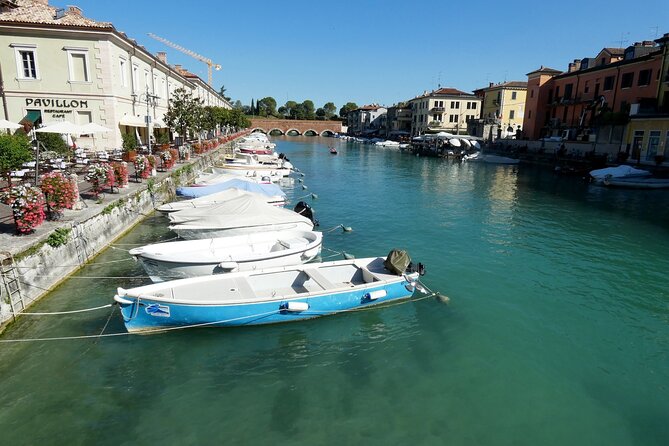
Brescia gives the audio guide a second purpose. The city section moves beyond lake scenery into urban history, art, and archaeology. Its points include Piazza della Vittoria, Piazza Paolo VI, the Old Cathedral, the Queriniana Library, Piazza della Loggia, San Francesco d’Assisi, Santa Maria delle Grazie, and the castle.
Piazza della Vittoria is the place to notice rationalist architecture from the period between 1927 and 1932. Piazza Paolo VI forms the historic center’s religious heart, with the Old Cathedral and New Cathedral facing one another.
The Duomo Vecchio is immediately recognizable for its circular form. Nearby, the Queriniana Library was commissioned by Bishop Angelo Maria Querini between 1746 and 1749 within the bishop’s palace complex.
Piazza della Loggia was created as a major public space, and the Church of San Francesco d’Assisi dates from the thirteenth century. Santa Maria delle Grazie provides a strong contrast, with its Baroque decoration added over time.
The Castle of Brescia occupies the top of Cidneo Hill and is impossible to miss from the city. It gives you a broader view of Brescia and a reminder that the city’s past was shaped by defense as much as by religion and trade.
The Roman archaeological area is particularly important. It is the largest Roman archaeological area in northern Italy and forms part of the UNESCO World Heritage site that also includes the San Salvatore and Santa Giulia complex. The complex contains material from the Bronze Age through the nineteenth century.
The main caution is the audio length. The provider says Brescia includes 15 famous points and more than 30 minutes in four languages, but one purchase produced an audio message of only about two minutes for a customer seeking Brescia specifically. I would confirm that the Brescia points appear correctly on the map before your visit and contact support promptly if they do not.
Is $4.84 good value?
At roughly $4.84 per person, the price is easy to justify if you want background information without joining a scheduled group. The value is strongest when you already have transport and plan to visit several towns.
It is less useful if you expect a fully organized excursion. No transport, parking, meals, drinks, headphones, or paid admission are included. The castles, Vittoriale degli Italiani, museums, and other ticketed sites cost extra.
The short recordings also mean you should not confuse the guide with a full audio tour inside every attraction. Think of it as a low-cost layer of context that helps you notice why a place matters.
Who should choose this experience?
I would choose it for independent visitors who enjoy walking, driving between towns, and deciding the day as they go. It also suits families and couples who do not want to match a guide’s pace.
It is a good fit for repeat visitors who have already seen the main sights and want local history around smaller places such as Puegnago, Soiano, Campione, or Tignale. The guide also works for first-time visitors who want help choosing where to stop.
I would be cautious if you have no transport plan, limited phone access, or little patience for troubleshooting an app. You need moderate physical fitness, and places of worship require appropriate clothing. Service animals are allowed, and the stops are near public transportation in some areas, but the experience itself does not arrange your connections.
Should you book it?
Book it if you want a cheap, flexible introduction to Lake Garda and Brescia, especially if your itinerary already includes a car, trains, or several independent day trips. The clear, well-paced audio and wide geographic coverage are its strongest points.
Skip it if you want a human guide, included admissions, or a simple point-to-point tour. Before setting out, redeem the minutes, check the Brescia locations, download the audio, and decide which paid attractions deserve your budget. Free cancellation is available up to 24 hours before the start time, so you have some protection while making that decision.
FAQ
Where does the experience start?
The indicative starting point is in Desenzano del Garda, at 25015 in the Province of Brescia, Italy.
Where does the experience end?
The listed endpoint is Lonato del Garda, at 25017 in the Province of Brescia. You can end the itinerary wherever you prefer.
How long does the audio experience last?
The approximate duration ranges from 30 minutes to 1 hour 40 minutes, depending on how many audio points you use.
What language is offered?
The tour information lists English for this experience. The provider also states that the Brescia audio guides are available in Italian, English, French, and German.
Is transportation included?
No. Transportation and parking are not included, so you must arrange travel between towns and attractions yourself.
Are entrance tickets included?
Entrance to free attractions is included, but tickets for paid places are not. The Vittoriale degli Italiani is specifically given as an example of an attraction requiring a separate ticket.
Do I need headphones?
Headphones are not provided. You can listen directly from your smartphone, using your own headphones if desired.
Can I listen offline?
Yes. You should download the audio tracks beforehand if you want to listen without relying on an internet connection later.
What happens to unused minutes?
Unused minutes remain available until they run out and can be used with other Audiogiro audio guides on the platform. The purchase remains active for one year.
Just added around Italy
- Torino Walking Tour with Audio and Written Guide by a Local★ 4.5 · 35 reviews
- Medieval Canals and Fountains: A Treviso Self-Guided Audio Tour★ 4.5 · 4 reviews
- Trapani Walking Tour with Audio and Written Guide by a Local★ 4.0 · 8 reviews
- Trento Walking Tour with Audio and Written Guide★ 4.5 · 11 reviews
- Sicily: Selinunte Park Entry Ticket & Sicily Digital Audio Guide★ 4.5 · 4 reviews
- Taormina Walking Tour with Audio and Written Guide by a Local★ 4.5 · 41 reviews
- Taranto Walking Tour with Audio and Written Guide by a Local★ 5.0 · 5 reviews
- Siracusa Walking Tour with Audio and Written Guide by a Local★ 5.0 · 59 reviews
Italy Audio Tours, compared.
Pantheon Fast-Track Ticket and Official Audioguide
Read our review →
Colosseum & Forum with Audio Guide App -Optional Arena
Read our review →
Timed Entry to Michelangelo’s David + Audio App
Read our review →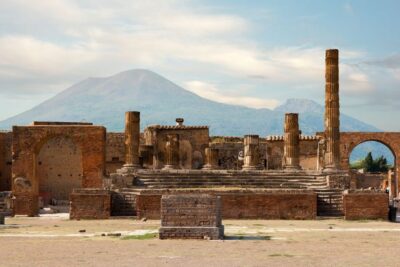
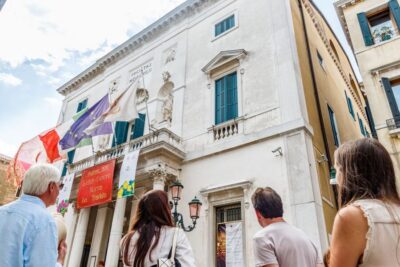
La Fenice Opera House Entry Ticket with Audio Guide
Read our review →
Colosseum, Forum, Palatine Hill Entry & Audioguide App
Read our review →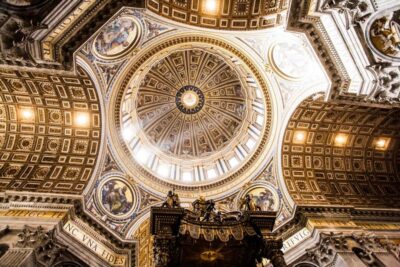
St. Peter’s Basilica & Dome Entry Ticket & Audio Tour
Read our review →