
REVIEW · ATHENS AUDIO TOURS
Ancient Agora Self-Guided Tour with 3D & Audio (No Ticket)
Democracy began here, among temples and stoas. This $8 smartphone tour gives you a flexible way to explore Athens’ Ancient Agora, the 6th-century BC center of political, commercial, and daily life. I like the offline access, which saves you from chasing a mobile signal, and the 3D reconstructions, which help turn weathered ruins into places you can picture.
I also like that you can move at your own pace instead of following a guide or a fixed group schedule. The main drawback is that the app can feel less clear while you are walking between monuments, and some of its explanations may feel brief if you want a very detailed study of the site.
The tour is valid for five days after first activation, so you can spread out your visit if your Athens plans change. Just remember that the Ancient Agora entrance ticket is not included. You pay $8 for the digital guide, then buy the site ticket separately, listed at €20 for full admission or €10 at the reduced rate.
Key points to know before you go

- Ancient Athens in one important setting: Explore the political, administrative, and commercial center of the city, where democratic life first took shape.
- Temple of Hephaistos: See one of Greece’s best-preserved ancient temples, with audio and visual material to explain its place in the Agora.
- 3D views of vanished buildings: Use reconstructions, panoramas, videos, and 360-degree views to picture the Agora as it once looked.
- Download before arrival: The app works offline, but you need Wi-Fi or enough mobile data to download its content first.
- Eight language choices: Audio and text are available in English, Greek, German, Spanish, Italian, French, Dutch, and Chinese.
- Low price, separate ticket: At $8, this is inexpensive, but you still need to budget for admission to the archaeological site.
What the Ancient Agora meant to Athens
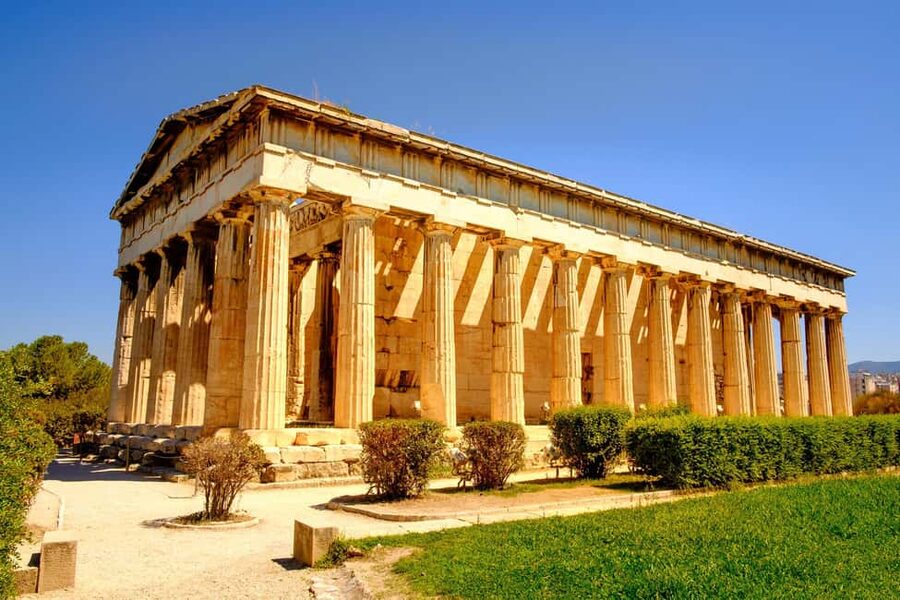
The Ancient Agora was not simply an open space filled with ruins. It was the working center of ancient Athens, tied to politics, administration, trade, public life, and conversation. This is where the city handled the business of government and where ordinary people went about daily affairs.
That setting gives the site unusual weight. You are not looking at one isolated monument. You are walking through a place connected with citizens, philosophers, merchants, officials, and public debate. The app helps by adding background to stones that can otherwise be hard to read at a glance.
The experience focuses on the Agora during a period reaching back to the 6th century BC. The audio explains how the site functioned and points you toward the surviving temples, stoas, and other remains. It also connects the area with Socrates and other philosophers who taught and argued in Athens.
I find this kind of setting easier to appreciate with context. A broken column can seem like one more ancient fragment. A short explanation about public life, civic duties, or philosophical teaching gives it a role in the larger story.
More History Audio Tours in Athens
- Athens: National Archaeological Museum Ticket w/ Opt. Audio
★ 4.4 · 713 reviews - Athens: Ancient Agora E-Ticket and Audio Tour
★ 3.9 · 413 reviews - Athens: Roman Agora & Ancient Agora E-ticket & 2 Audio Tours
★ 4.1 · 107 reviews
Starting with the app and finding your way
This is a digital product, not a guided walk with a person. After booking, you receive an email from Culture App with instructions for downloading the content. Check your spam folder if the message does not appear quickly.
Download everything while you have reliable Wi-Fi. The tour needs about 200MB of storage, and you should have a fully charged phone before entering the site. Earphones are essential if you want to hear the narration clearly, especially when other people are nearby.
Once the content is stored on your phone, you do not need internet access inside the Agora. That is useful if you are avoiding roaming charges or have limited data. It also makes the experience less dependent on the signal around the archaeological site.
The app uses GPS tracking to help match audio with the location you are visiting. That can make the visit easier, but do not expect the phone to solve every bit of navigation for you. One of the weaker points is that it may not always be obvious which audio track belongs to which monument. Take a moment to check the title, image, or location before pressing play.
The material is delivered through an Android or iOS app. It requires iOS 11.0 or later, or Android 5.1 or later.
Exploring the political heart of ancient Athens
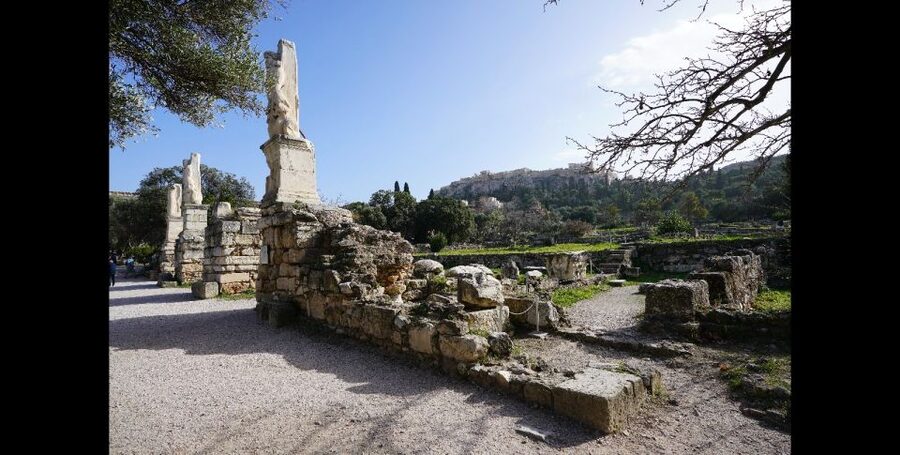
The first major value of this tour is its explanation of the Agora as a center of democracy. The site is linked to the place where democratic government was first established, so the audio gives you more than a list of construction dates.
You learn to picture the Agora as a place where public decisions, administration, trade, and social life met. The app’s text and narration help explain why this open civic area mattered and how its different functions related to one another.
Do not expect a modern museum-style presentation at every turn. The information is delivered through your phone, and much of the value comes from looking at the remains while listening. If you prefer to read long panels or study every known detail, the material may feel too brief.
For a first visit, though, the format works well. You can stop the audio, look around, return to an earlier section, or skip material that does not interest you. You are not held in place while a guide finishes a speech.
Temples, stoas, and the everyday Agora
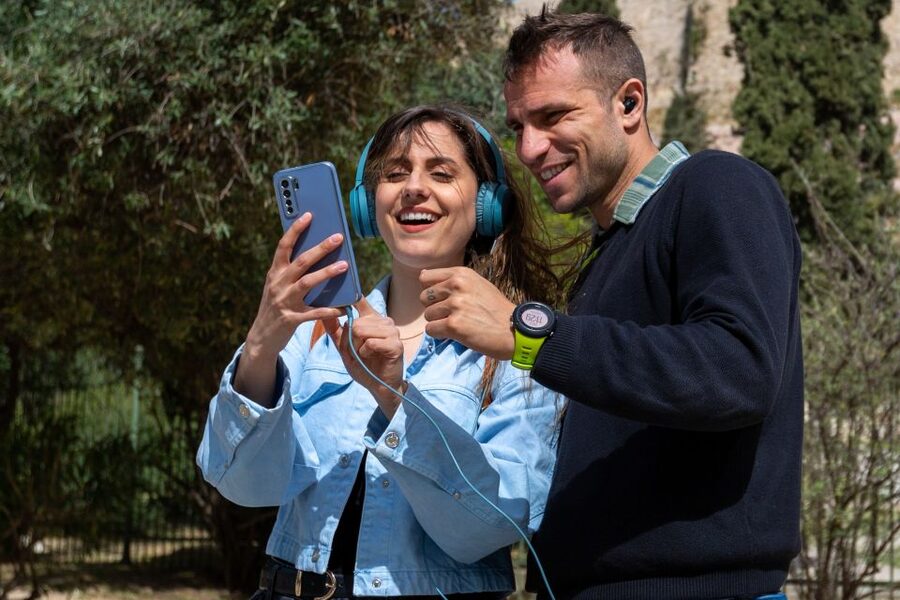
The tour covers the main types of structures you expect in the Agora, including temples and stoas. The audio helps you understand that these were not decorative pieces placed in an empty park. They formed part of the practical and religious life of the city.
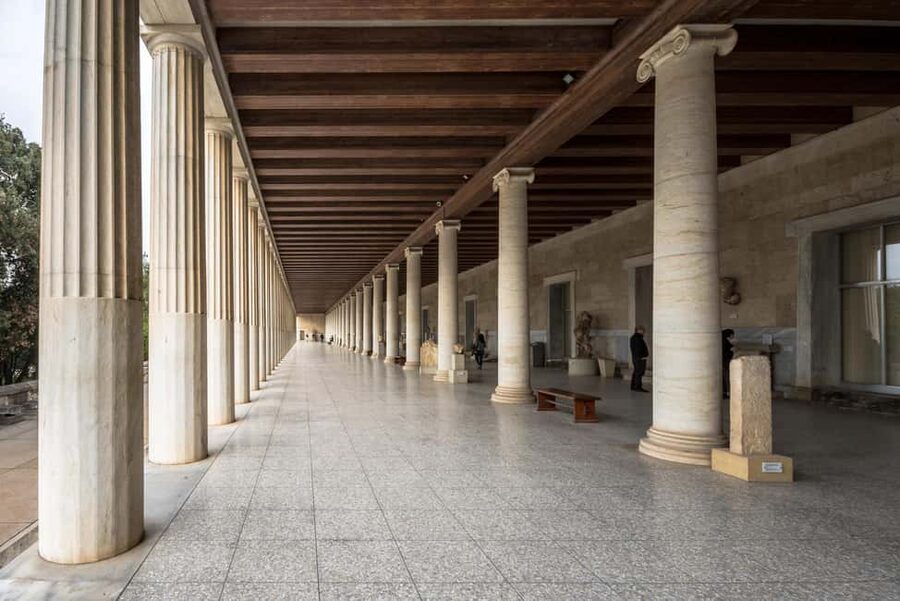
The stoas are especially useful to consider through the app’s reconstructions. Today, ruins can make a building seem flat and incomplete. A 3D model or panorama can show the scale and form of a structure more clearly, even if the reconstruction is only a visual aid.
The tour also looks beyond famous names. It addresses the daily life of ancient Athenians, including the role of citizens and the people who used the Agora for work, public business, and social contact. That wider view is one of the better features of the experience. It keeps the visit from becoming a parade of famous philosophers and grand buildings only.
At the same time, the content does not appear designed for specialists. One person found it useful but felt it only covered the surface of what the Agora has to offer. I think that is a fair way to approach it: use this as a clear introduction, not as the final word on every ruin.
More History Audio Tours in Greece
- Half Day Ancient Corinth and Canal VR Audio Guided Tour
★ 5.0 · 104 reviews - Athens National Archaeological Museum E-Ticket with Audio Guide
★ 3.0 · 57 reviews - Athens: Archaeological & Acropolis Museum Entry & Audio Tour
★ 4.3 · 21 reviews - Ancient Agora of Athens E-Ticket and Audio Tour
★ 3.5 · 5 reviews
Meeting Socrates and the philosophers
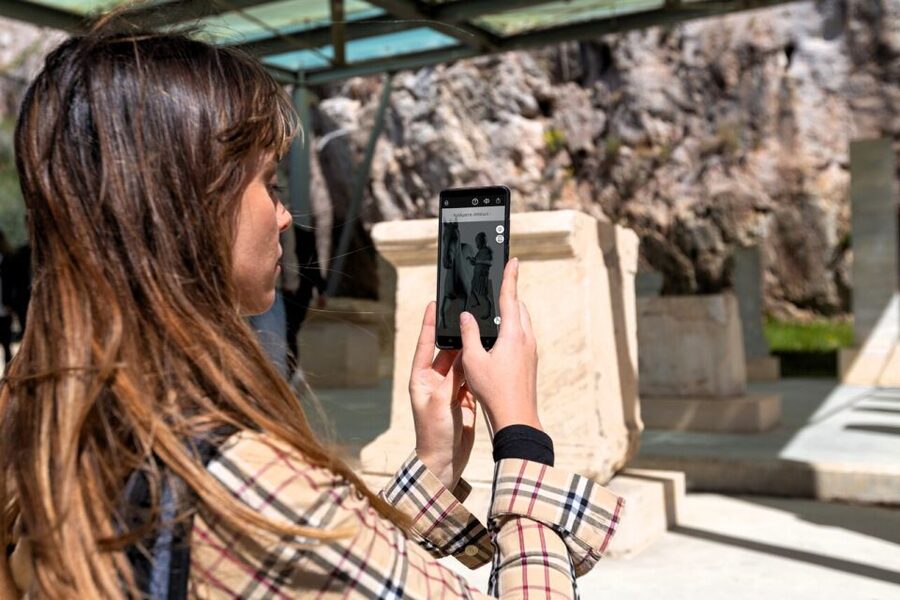
The connection with Socrates gives the Agora a strong human dimension. Instead of treating the site as a silent collection of stones, the audio places philosophical teaching and public argument within the setting.
That matters because the Agora was a place of conversation as much as construction. The experience helps you think about ancient Athens as a society shaped by people speaking, questioning, buying, governing, and observing one another in public.
The material about philosophers is likely to appeal to first-time visitors who want a story they can follow. It also gives families and younger visitors an easier way into the site. You can ask what it meant for a philosopher to teach in a public place, then compare that idea with the formal buildings around you.
Do keep your expectations measured. The guide is not a long academic course on Socrates or ancient philosophy. The explanations are intended to support a visit, so someone seeking a full treatment of the subject may want additional reading.
The Temple of Hephaistos deserves extra time
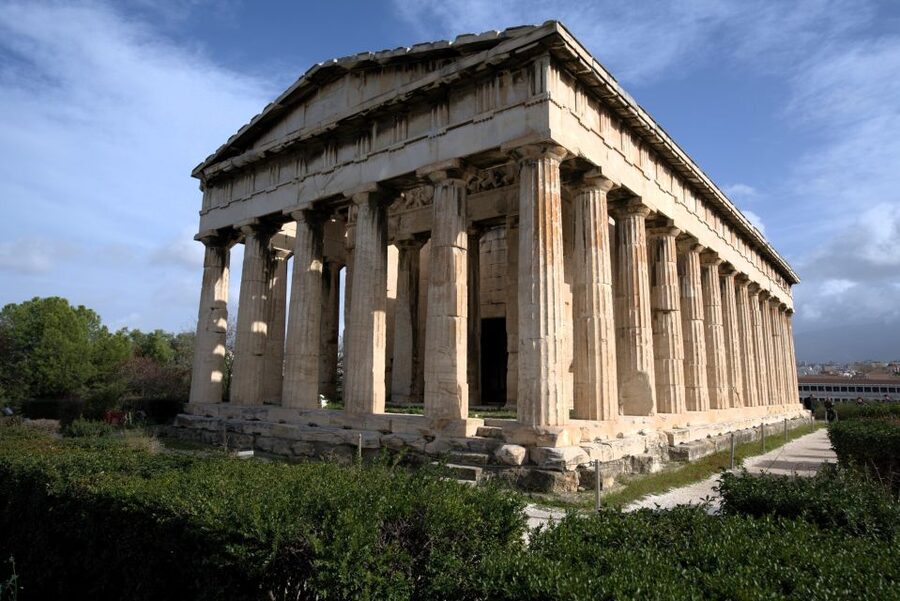
The Temple of Hephaistos is the clear architectural highlight. It is described as one of Greece’s finest-preserved ancient monuments, and the app gives you visual and spoken material to help explain why it matters.
Preservation makes a difference here. When you can still recognize the shape of a temple, it is easier to understand how ancient architecture was planned and experienced. The audio can add the historical setting, while the 3D and image features help you compare the surviving structure with its earlier appearance.
I would give this stop more time than a quick photograph. Listen to the relevant section, study the building, then use the reconstruction or panorama to fill in what is missing. The best use of the app is not to stare at your screen for the entire visit. It is to look down briefly, gain context, and then look back at the actual monument.
This is also where the visual material earns its $8 price. A standard audio file can tell you what a building was. A good reconstruction gives you a stronger sense of its shape and presence.
How useful are the 3D models and videos?
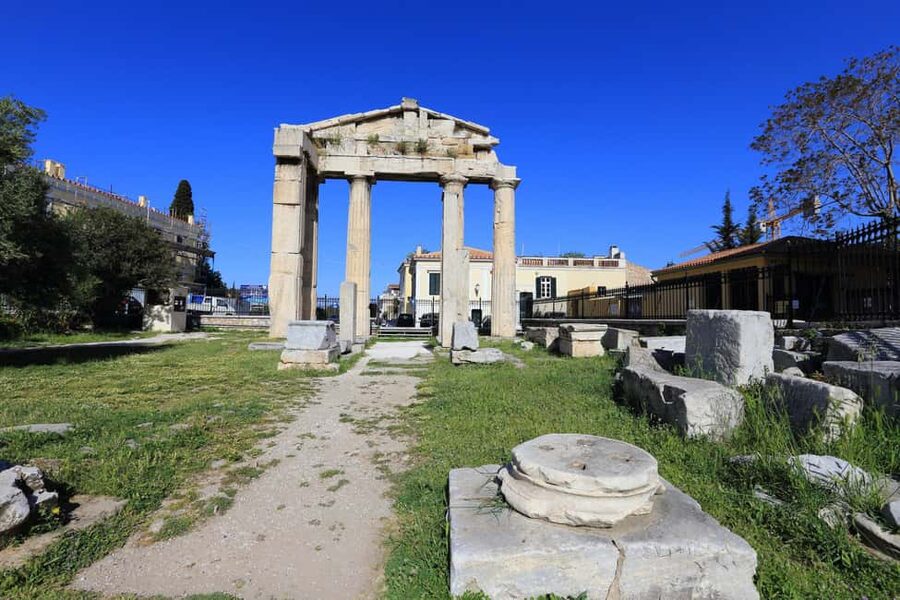
The app combines text and audio with 3D reconstructions, 360-degree views, panoramas, photographs, and short videos. These tools are meant to bridge the gap between the surviving ruins and the ancient Agora.
The 3D features are most useful when a monument is incomplete. They can help you imagine walls, roofs, columns, or surrounding activity that no longer survives. The 360-degree views also give you a better sense of how the buildings relate to one another.
One strong point is the ability to see how the Agora looked in ancient times. That visual comparison can make the site easier to understand, especially if this is your first archaeological visit in Athens.
The weakness is practical rather than technical. You may need to switch between audio, text, maps, and visual content while standing outdoors. One user found the selection process confusing and felt forced to download all the material instead of choosing only certain sites. Since the full download is required for offline use, plan for that step rather than trying to pick and choose at the entrance.
Languages and listening choices
Audio narration and text are available in eight languages:
- English
- Greek
- German
- Spanish
- Italian
- French
- Dutch
- Chinese
That range makes the guide useful for mixed-language groups. You can each use the language that suits you without joining a shared group or waiting for a scheduled tour.
The experience is also quiet and private. You listen through your own earphones and decide when to pause. That gives you more control than a group audio system, though it also means you must manage the phone, battery, and track selection yourself.
If you want every explanation, allow plenty of time. If you are mainly interested in the Temple of Hephaistos, the philosophers, or the democratic role of the Agora, you can use the app selectively. Its five-day validity gives you room to return to sections after your first visit, although the paid price is not refundable once the content has been downloaded.
Is $8 good value when the ticket costs extra?

At $8 per person, the digital guide is reasonably priced for visitors who want more than basic signs but do not want to pay for a private guide. The separate admission fee changes the calculation, since a full ticket is listed at €20 and a reduced ticket at €10.
The guide is best value if you will actually use the audio, reconstructions, and visual material. If you only want to walk through quickly, the extra cost may not feel necessary. The tour also makes more sense for people who prefer independent sightseeing and do not need a guide to keep them moving.
The low price does not guarantee a detailed scholarly treatment. The score of 3.9 out of 5 from 59 ratings reflects that mixed position. The strongest points are the clear basic explanations, easy offline use, and visual reconstructions. The main concerns are shallow content and confusion about matching each audio track with the correct monument.
I would treat the $8 as a modest add-on that can improve a self-guided visit, not as a replacement for an expert guide.
Who should choose this Agora tour?
I would recommend it most strongly for:
- First-time visitors who want a clear introduction to the Ancient Agora
- Independent sightseers who dislike fixed schedules
- People who want to explore without joining a group
- Visitors who appreciate images and reconstructions alongside narration
- Anyone trying to avoid mobile data use on site
- Families or mixed-language groups that need several language options
It may be less suitable if you want long, detailed explanations for every monument. It may also frustrate you if you dislike using a phone while sightseeing or if you expect the GPS to identify every stop perfectly.
Before you go, download the content, charge your phone, pack earphones, and allow enough storage. These simple steps will prevent most of the avoidable problems.
Final verdict: a useful low-cost guide with limits
I like this Ancient Agora tour because it gives structure to a site that can otherwise feel difficult to read. The offline function is practical, the language choices are generous, and the 3D material helps you picture ancient buildings rather than seeing only partial remains.
Its limits are just as clear. The content can feel surface-level, and the app may not always make the connection between audio and monument obvious. You also pay the €20 or €10 site admission separately, so the total cost is higher than the advertised $8.
Book it if you want an affordable, flexible introduction and are willing to prepare your phone before arrival. Skip it if you want a full expert lecture at every stop. For most independent visitors, it is a useful companion, especially when you spend time with the Temple of Hephaistos and use the visual reconstructions to make sense of the Agora.
FAQ
Is the Ancient Agora entrance ticket included?
No. The entrance ticket must be purchased separately at the site or online. The listed prices are €20 for a full ticket and €10 for a reduced ticket.
How much does the self-guided tour cost?
The digital tour costs $8 per person.
How long is the tour valid?
The tour is valid for five days from the time you first activate it.
Does the app work without internet?
Yes. It works offline after you download the tour content.
When should I download the tour?
Download the content over Wi-Fi before visiting, unless you have enough mobile data available.
Which phones support the tour?
The app supports iOS 11.0 or later and Android 5.1 or later.
How much storage does the download require?
You need approximately 200MB of storage space on your phone.
Which languages are available?
Audio and text are available in English, Greek, German, Spanish, Italian, French, Dutch, and Chinese.
Do I need earphones?
Yes. You should bring earphones to listen to the audio narration comfortably.
Can I cancel for a full refund?
You can cancel up to 24 hours before the activity for a full refund. Once you download the content, the paid price is not refundable.
More Self-Guided Audio Tours in Greece
- Athens: Acropolis Self-Guided Audiovisual Tour w/ 3D Models
★ 4.1 · 25 reviews - Temple of Olympian Zeus: Self-Guided Audio Tour on your Phone (without ticket)
★ 4.0 · 8 reviews - Kerameikos: Self-Guided Audio Tour on Your Android/iOS Phone
★ 4.1 · 8 reviews - Self Guided Tour In Athens With 100 Captivating Audio Stories
★ 4.0 · 4 reviews
More Self-Guided Audio Tours in Athens
- Acropolis & Parthenon Admission Ticket w/ self guided audio tours
★ 3.5 · 172 reviews - Acropolis Self-Guided Smartphone Tour w/Audio & 3D(No entry)
★ 3.9 · 62 reviews - Athens: Acropolis Museum Ticket with Self-Guided Audio tour App
★ 3.5 · 40 reviews - Acropolis of Athens Self-Guided Tour with 3D & Audio (No Ticket)
★ 3.5 · 25 reviews
Just added around Athens
- Temple of Olympian Zeus: Self-Guided Audio Tour on your Phone (without ticket)★ 4.0 · 8 reviews
- Athens Ticket Pass: Acropolis & 6 Sites with 5 Audio Guides★ 3.5 · 84 reviews
- Ancient Agora of Athens: A Self-Guided Audio Tour★ 3.5 · 3 reviews
- Self Guided Tour In Athens With 100 Captivating Audio Stories★ 4.0 · 4 reviews
- Athens Hop-On Hop Off w/ Acropolis & Acr.Museum tickets & 3 audio★ 3.0 · 5 reviews
- E-ticket for Kerameikos with Audio Tour on Your Phone★ 5.0 · 4 reviews
- Athens Acropolis Museum Reserved Entry Ticket and Audio Tour★ 3.0 · 2 reviews
- Audioguided tour of Athens’ alternative neighbourhood of Exarchia★ 5.0 · 2 reviews
Self-Guided Tours, compared.

Acropolis Ticket & Optional Self-Guided Audio Tours
Read our review →


Ultimate Acadia National Park Self-Guided Driving Audio Tour
Read our review →

Santorini: Akrotiri Ticket with Optional Self-Guided Audios
Read our review →