
REVIEW · TOULOUSE AUDIO TOURS
Toulouse Self-Guided Audio Experience
Toulouse rewards slow looking. This $6 audio tour links 11 major sights, from Matabiau station to Pont Neuf, with short historical commentaries you can hear at your own pace. I like the excellent price and the freedom to begin anywhere, skip a stop, or split the route across several days. I also like the choice of places: it goes beyond the obvious basilica and square to Saint-Aubin Church, the Victor Hugo Market, and the Japanese Garden.
The main catch is simple: you must bring your own phone, headphones, and internet connection. The audio is delivered through SoundCloud and the route through Google My Maps, so the experience depends on your comfort with web links and smartphone use. One stop, Saint-Aubin Church, may also be closed except for Mass, so checking opening times before setting out is wise.
Five things to know before you go
- Eleven stops cover Toulouse’s best central sights, including Saint-Sernin, the Capitole, the Jacobins, and Pont Neuf.
- You are not tied to a route or schedule. Start and finish wherever you like, and spread the experience over as much as six days.
- The commentary runs about 20 minutes per stop, but the full outing can take three to nine hours depending on walking, visits, meals, and pauses.
- The $6 price is hard to beat if you want background information without paying for a private guide or group tour.
- You need your own equipment. Bring a charged smartphone, earphones, and mobile data or Wi-Fi.
- The average score is mixed at 3.3 from three ratings, with one very positive response and one strong complaint about access and presentation.
What the $6 price really buys you
At $6 per person, this is an inexpensive way to put shape around a day in Toulouse. You receive one private audio playlist with all 11 commentaries and a separate Google My Maps route with each attraction marked. You are paying for researched narration and a sightseeing plan, not transport, admission, food, or a live guide.
That distinction matters. A paid walking tour usually gives you a person who can answer questions, adjust the pace, and point out details in real time. This experience gives you privacy and freedom instead. You can pause the audio while taking photographs, skip a church that is closed, or sit by the Garonne without worrying about holding up a group.
The value is strongest if you already plan to visit several of these sights. At $6, even using only three or four commentaries can make the purchase worthwhile. The value is weaker if you expect a polished app with built-in navigation or a fully guided walking route. This is a web-based audio service, and you need to handle the technology yourself.
The supplied directions say the links arrive through the booking platform’s messaging system before your selected date. One link opens a SoundCloud playlist, and the other opens a Google My Maps page in a web browser. The map is not meant to replace Google Maps navigation. It marks the stops and connects you to the individual audio tracks.
More Self-Guided Audio Tours in France
- The Famous Graves of Père Lachaise – Self-Guided Audio Tour
★ 3.5 · 44 reviews - Strasbourg Scavenger Hunt and Highlights Self-Guided Audio Tour
★ 4.5 · 42 reviews - Montmartre Self-Guided Audio Tour: More Than Meets the Eye
★ 4.5 · 35 reviews
Start at Matabiau station, where Toulouse tells its first story
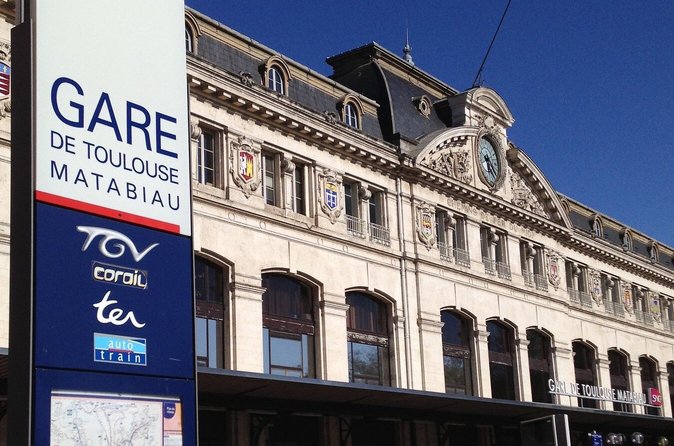
The suggested opening at Gare de Toulouse Matabiau is practical if you arrive by train. The station’s early 20th-century façade gives the audio an immediate subject: the meeting of modern transport and older local history.
The commentary explains the unusual name Matabiau, linked to a medieval cattle slaughterhouse once located here. It also directs your attention to artistic details in the façade and to the station’s industrial symbolism. The station’s role during World War II, including resistance activity, adds a more serious layer to what might otherwise be a quick passage between platform and city center.
Allow about 20 minutes for the recording. You do not need an admission ticket. This is a useful first stop because you can listen while getting your bearings, though the station may be noisy. Headphones are important here, both for hearing the narration and for staying aware of people moving around you.
Saint-Aubin Church rewards careful timing
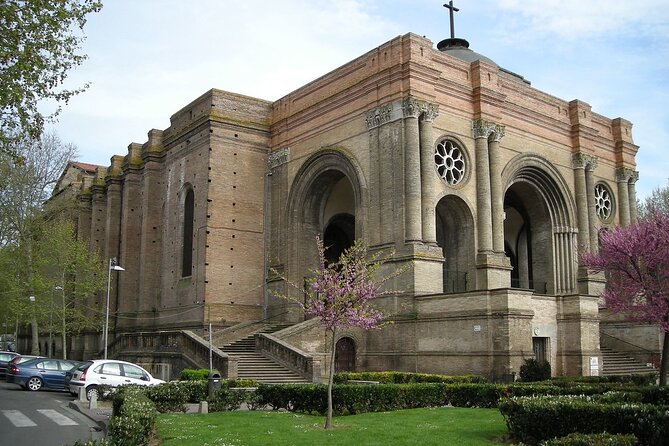
Saint-Aubin Church is one of the more unusual choices on the route. It is less likely to be part of a first-time Toulouse walk than the Capitole or Saint-Sernin, and its octagonal bell tower gives the building a distinctive profile.
The audio focuses on the church’s disputed construction, its narrow escapes from demolition, and stained glass by Louis-Victor Gesta. It also explains the social and political tensions reflected in the design. The organ and the church’s strong acoustics receive attention too, which gives you a reason to listen rather than simply step inside, glance around, and leave.
Plan for 20 minutes, but first check access. The church may be closed except during Mass. This is the clearest practical warning attached to the route. Since the audio links remain available for up to six days, you can shift this stop to another day instead of losing it completely.
Saint-Étienne Cathedral shows Toulouse in two halves
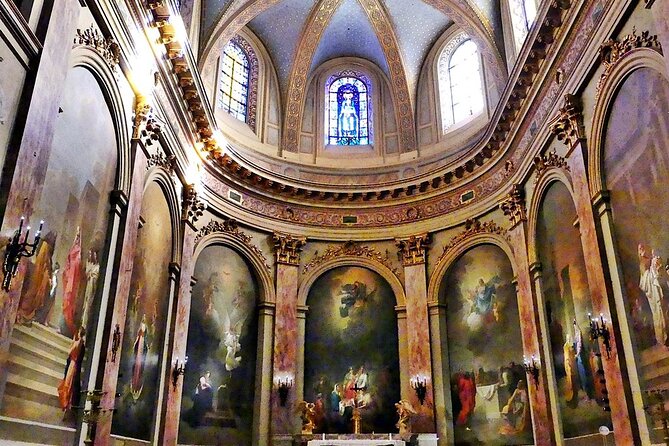
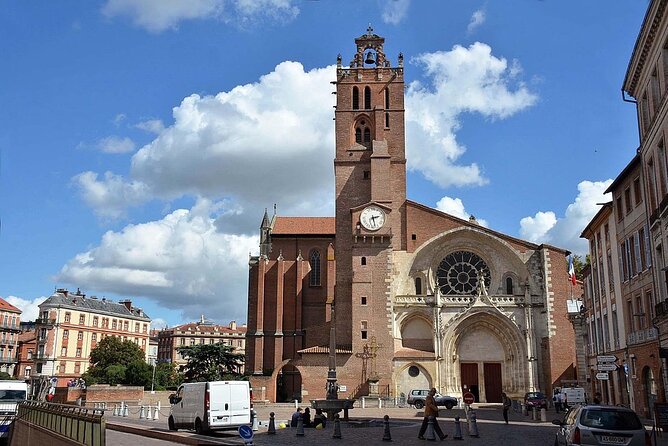
Cathédrale Saint-Étienne is a rewarding stop for anyone who likes buildings that refuse to behave neatly. Its asymmetrical form comes from centuries of construction, alteration, and competing architectural ideas. The result looks almost like two churches joined together.
The commentary traces about 500 years of change and directs you toward the rose window, a lesser-noticed chapel, and the story of a bishop whose tomb puzzled historians. It also covers the cathedral’s survival through the Wars of Religion and the French Revolution. A detail about the building’s acoustics, including the way quiet speech can carry across the nave, may encourage you to pause after the recording and test the space for yourself.
The 20-minute audio gives you a framework, but it cannot control the light, noise, or access inside the cathedral. Use the track as a set of prompts. Look up when it describes the upper sections, then look down at floor level for the smaller details that are easy to pass.
Same place, a different route to walk:
- Paris: Illuminations River Cruise with Audio Commentary
★ 4.3 · 12,340 reviews - Paris: Louvre Museum Hosted Entry and Mona Lisa Audioguide
★ 4.6 · 5,235 reviews - Paris: Orsay Museum Entry Ticket and Digital Audio Guide App
★ 4.4 · 3,170 reviews - From Paris: Giverny Day Trip with Audio Guide or Live Guide
★ 4.3 · 2,372 reviews
Victor Hugo Market brings the city down to earth
Marché Victor Hugo changes the tone of the route. After stations and churches, you get a close look at Toulouse through food, trade, and daily life. The market’s story includes a surprising proposal to build an opera house on the site, along with the later role the market played during food shortages.
The audio points out long-established family stalls and discusses the regional foods locals seek at different times of year. It also explains how the iron and glass structure represented modern design when it was built. That mix of architecture and cooking makes the stop useful even if you are not planning a full meal.
The best way to handle this stop is to listen in sections. Market noise can make a full 20-minute track difficult to follow, and vendors are working rather than performing for sightseers. Pause when you want to buy something, then resume in a quieter place. Food and drinks are not included, so budget separately if you want to sample local products.
Saint-Sernin is the grand centerpiece
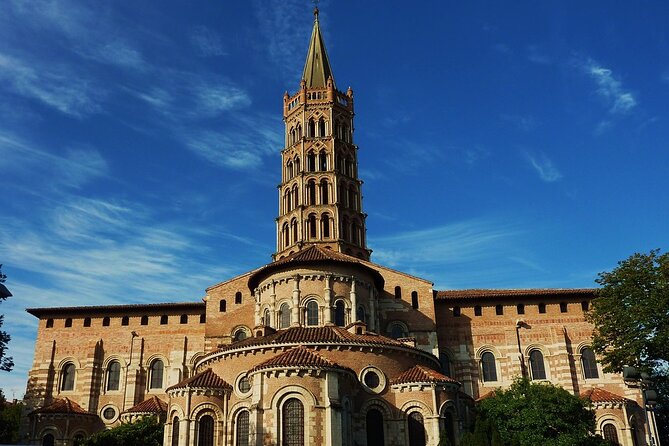
Basilique Saint-Sernin is the major architectural prize on this route. It is the world’s largest remaining Romanesque church and part of the UNESCO-listed pilgrimage route to Santiago de Compostela. The building deserves more than a quick photograph from the square.
The audio explains the story of Saint Saturnin, whose martyrdom involved being dragged by a bull, and connects that story to the basilica’s design. It also directs you to carvings touched by pilgrims, the five-tiered bell tower, and medieval musical marks found on stone pillars. These details help you read the building as a place shaped by pilgrimage, ritual, and practical church life.
Allow at least 20 minutes for the recording, then give yourself extra time to walk the ambulatory and look upward. The narration can tell you where to focus, but the scale of Saint-Sernin needs a quiet pause of its own. This is one of the stops where the audio format works especially well because you can stop, replay a section, and continue only when you are ready.
The Japanese Garden gives you a needed pause
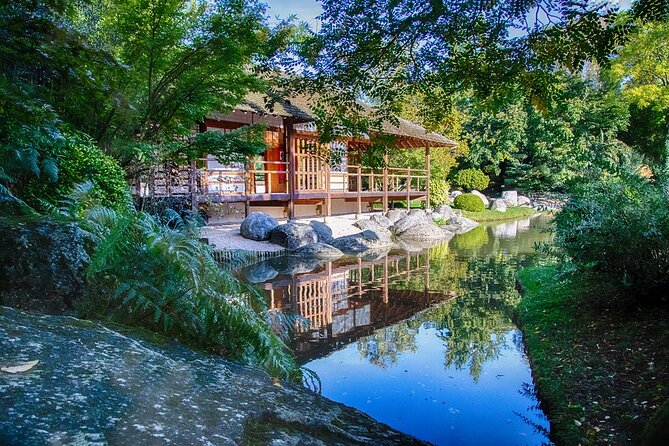
Jardin Japonais offers a welcome change after Toulouse’s dense center. The commentary presents the garden as more than a pleasant green space, explaining its Cold War origins, diplomatic links, and Japanese design elements.
You hear about the red bridge, stone placement, maple varieties, cherry blossom timing, and iris season. The track also discusses the garden’s carefully planned sound zones, where city noise can fade. That is a useful prompt: do not rush through this stop with your eyes fixed on the map. Find a quiet place, stop the audio, and enjoy the setting.
The garden’s position away from some of the central monuments means you may choose to visit it separately rather than force it into one long walk. The tour allows that. Since no transport is included, you handle the journey between stops yourself.
The Capitole explains Toulouse’s civic pride
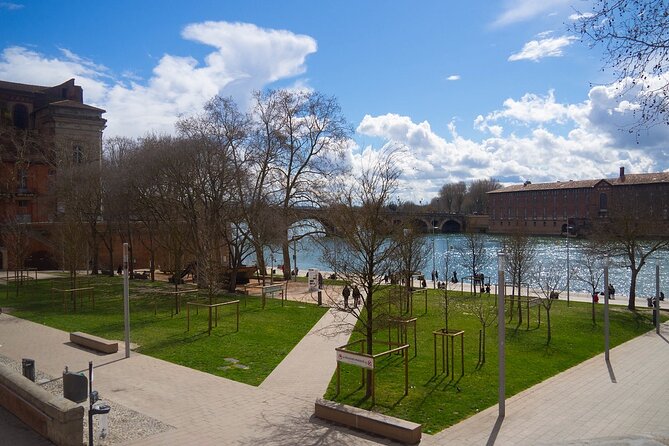
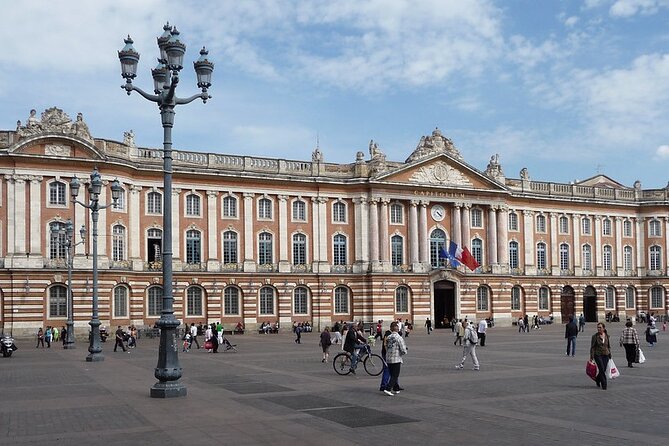
Le Capitole is the city’s symbolic center and the seat of local government. The audio focuses on more than the grand façade. It covers the discovery of remains linked to the ancient Roman capitol beneath the square, the proportions of the Henri IV courtyard, and details in the Hall of Illustrious.
You also hear how local officials protected the building during the French Revolution and how its design expresses Toulouse’s old tradition of self-government. Look closely at the façade while listening. The commentary asks you to notice symbols that communicate local independence rather than simply admire the pink brick and formal scale.
This stop works well as a central meeting point for your own route. You can begin here, use the square to plan the next section, or place it between the market and the churches. Access to interiors may vary, so the audio remains useful even if you can only view parts of the building from outside.
The Jacobins reveal a medieval engineering trick
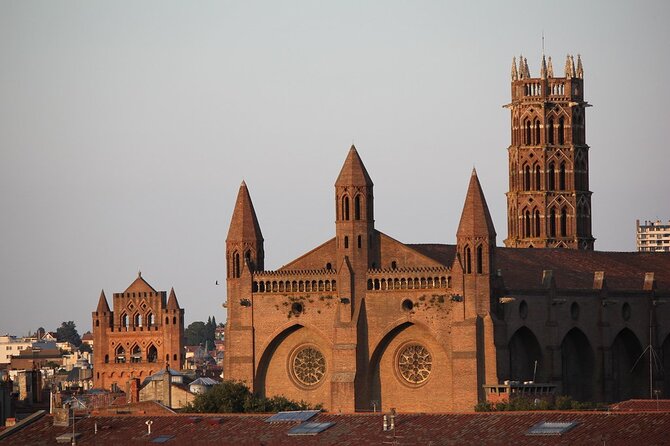
The Dominican church of the Jacobins is a strong choice for architecture fans. Its famous palm-tree column spreads into 22 ribs beneath the choir, creating an effect that looks both delicate and remarkably engineered.
The commentary explains the structure, the building’s unusual acoustics, and marks left by medieval builders. It also points to symbols and artistic details that are easy to miss in the spare interior. This is a place where standing in the right location matters, and the audio suggests spots where music carries especially well.
Give yourself time after the 20-minute track to walk around the column and view it from several angles. The church is not only about decoration. It shows how mathematical planning solved the problem of supporting a large roof while producing one of Toulouse’s most memorable interiors.
Notre-Dame de la Daurade connects the river and religion
Notre-Dame de la Daurade sits near the Garonne and carries a long religious story. The audio traces its origins to a Roman temple dedicated to Apollo, its former golden mosaics, and the movement through Roman, Romanesque, and Baroque forms.
The Black Madonna receives special attention, including links to older fertility traditions. The church also served as a spiritual center for river pilots who faced the Garonne’s difficult navigation. That connection prepares you for the next stop along the waterfront.
The track also covers annual rituals that continue old traditions. As with Saint-Aubin, check access before making this a fixed part of your day. If the interior is closed, the nearby quay still offers a useful continuation of the story.
The Daurade quay makes the river part of the tour
Quai de la Daurade is not just a scenic place to sit. The audio explains its former role as Toulouse’s main port, the merchant houses and warehouses that once lined the water, and the brotherhood of pilots who controlled river navigation.
You also hear about Toulouse’s violet industry and the flower’s role as a city emblem. The transition from working port to public and artistic space gives the waterfront more meaning. Look across the river as you listen, then pay attention to the older buildings and any symbols connected with river life.
This is one of the easiest stops to adapt. You can listen while walking, pause beside the river, or save it for late afternoon. The route’s final bridge is close by, so the quay and Pont Neuf make a natural finishing section.
Pont Neuf ends with clever flood engineering
Pont Neuf means New Bridge, yet it is Toulouse’s oldest bridge. Its importance lies in the way it handles the Garonne, a river known for powerful floods.
The audio explains the bridge’s asymmetrical design, open spans above the piers, and the engineering choices that helped water pass through. It also covers toll markers, bridge houses, and attempts to remove the bridge during later modernization. The result is a better understanding of why those large openings are there. They are not random gaps in a handsome structure.
Finish here if you follow the suggested order, or begin here if you want to walk inland. The bridge is a strong last stop because the river brings together many themes from the route: trade, religion, engineering, city power, and Toulouse’s changing relationship with water.
How to use the audio without technical trouble
The audio system is straightforward once you understand the two links. Open the SoundCloud playlist in Safari, Chrome, or another browser. Open the Google My Maps route in a browser too, not directly in the Google Maps app.
Before leaving, check that both links open and that the tracks play. The directions specifically say that no media player download is required. A complaint about sign-ins, download errors, and an unhelpful map appears to have come from trying a different access method, so stick to the browser links and read the instructions carefully.
Bring:
- A fully charged smartphone
- Earphones or headphones
- Mobile data or Wi-Fi
- A little time to check opening hours
- Separate money for food and drinks
You can listen before your visit and choose your priority stops. The access links remain valid until the tour is complete, for a maximum of six days. That makes this a good fit for a relaxed city break rather than a forced single-day march.
Who should book this Toulouse audio tour?
I would choose this experience if you like setting your own pace, prefer private sightseeing, and want context at a very low price. It suits couples, families with older children, and independent visitors who enjoy pausing often or changing plans.
I would not choose it if you want a live guide, instant answers, transport between stops, or a polished app with automatic GPS narration. The material is accessed through ordinary web services, and you must manage the map and playlist yourself.
The mixed 3.3 rating from three scores should encourage realistic expectations. The strongest praise centers on detail, ease of use, and informative commentary. The main warning concerns setup and presentation, not the price or choice of sights. If you prepare your phone before setting out and accept that some sites may be closed, the $6 cost makes this a sensible add-on to a Toulouse visit.
FAQ
How much does the Toulouse Self-Guided Audio Experience cost?
The price is $6 per person.
How long does the experience take?
The estimated duration is about three to nine hours. Each of the 11 stop commentaries lasts about 20 minutes, with extra time needed for walking, sightseeing, meals, and breaks.
Can I choose where to start and finish?
Yes. This is a self-guided tour, so you can start and end wherever you prefer and visit the attractions in any order.
Can I spread the tour over several days?
Yes. The private access links remain valid until the tour is complete, for a maximum of six days.
What do I need to bring?
Bring a fully charged smartphone, earphones or headphones, and internet access through mobile data or Wi-Fi.
How do I access the audio and map?
You receive two private links through the booking platform’s messaging system. One opens the SoundCloud audio playlist in a web browser. The other opens an interactive Google My Maps route, also in a web browser.
Is transportation included?
No. Pick-up, drop-off, and transportation between the stops are not included. Food and drinks are also separate.
Just added around France
- Toulouse : Albi and Cordes/Ciel Day Trip with audio guides★ 4.0 · 70 reviews
- Toulouse : Carcassonne Day Trip by Coach with audio guides★ 4.0 · 73 reviews
- Rouen Cathedral Self Guided Audio Tour★ 4.0 · 2 reviews
- Rouen: Audio Guided City and Joan of Arc Tour★ 4.0 · 2 reviews
- Rouen audio guided tour★ 4.0 · 19 reviews
- The Hardest City to Invade: Saint Malo’s Secrets Audio Guide★ 4.5 · 9 reviews
- The Tuileries Garden’s Classic Sights: A Self-Guided Audio Tour★ 4.0 · 3 reviews
- Self-Guided Audio Tour -The Eiffel Tower, Exterior★ 4.0 · 9 reviews
Self-Guided Tours, compared.

Acropolis Ticket & Optional Self-Guided Audio Tours
Read our review →


Ultimate Acadia National Park Self-Guided Driving Audio Tour
Read our review →

Santorini: Akrotiri Ticket with Optional Self-Guided Audios
Read our review →
Browse the lists this tour appears in