
REVIEW · PARIS AUDIO TOURS
Montmartre Self-Guided Audio Tour: More Than Meets the Eye
Montmartre rewards slow, curious walkers. This self-guided audio tour turns a hilly Paris neighborhood into a storybook of painters, cabarets, vineyards, churches, and movie-worthy streets. I especially like the GPS-guided narration, which tells you where to go and gently redirects you if you wander, and the lifetime access, which lets you repeat the route or listen again later.
The main catch is the hill. Montmartre involves inclines, stairs, and plenty of walking. The advertised time is one to two hours, but you should allow much longer if you stop for photographs, music, coffee, or a look inside Sacré-Cœur. A fully charged phone is essential, too.
Key points at a glance
- The route begins on Rue des Abbesses and ends at Sacré-Cœur, making a useful uphill path through Montmartre.
- You hear stories about Picasso, Renoir, Van Gogh, Dalida, Utrillo, and Edith Piaf as you walk past places connected to their lives.
- The Wall of Love features 311 ways to say I love you in 250 languages, a quick but memorable stop near the start.
- The VoiceMap app works offline, including the audio, map, and location data.
- You control the pace, with the option to pause, restart, speed up the recording, or repeat the tour.
- The route is not effortless, with hills, stairs, and some reports of unclear GPS behavior or app problems.
What this Montmartre tour is really like
This is not a live walking tour with a guide waiting at a meeting point. It is a private audio walk for your phone. You download the VoiceMap app, use the supplied access details, and follow the route from 22 Rue des Abbesses to the Basilica of Sacré-Cœur.
The female narrator provides directions and background as you move. The app uses your location to trigger the next section, so you can look at the street instead of constantly checking a map. If you take a wrong turn, the narration may prompt you back toward the route.
That freedom is the central appeal. You do not have to keep up with a group or wait for anyone. Stop for a pastry, browse a shop, sit in a small square, or pause the audio inside a church. You can also speed up the recording if you want a quicker visit.
At $14.99 per person, the price is reasonable for anyone who wants context without paying for a private guide. It is especially good value if you use the lifetime access more than once or replay sections later. The value drops if the app refuses to work, so download the tour and check that it opens before setting out.
More Self-Guided Audio Tours in France
- The Famous Graves of Père Lachaise – Self-Guided Audio Tour
★ 3.5 · 44 reviews - One Hour Père Lachaise Cemetery: A Self-guided Audio Tour
★ 3.5 · 26 reviews - Montmartre: Secret Stories of Paris – Self-Guided Audio Tour
★ 4.0 · 13 reviews
Starting near Rue des Abbesses and the Wall of Love
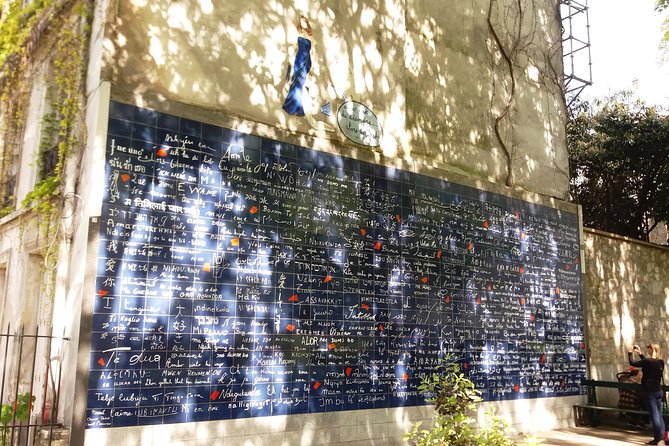
The route starts at 22 Rue des Abbesses, a practical location in the lower part of Montmartre. From here, the walk leads to the Mur des je t’aime, usually called the Wall of Love in English.
The artwork was created in 2000 by Frédéric Baron and Claire Kito. Its blue-and-white tiles show 311 ways to write I love you in 250 languages. It is a brief stop, but a useful introduction to Montmartre’s romantic image.
Do not expect a long visit here. You will likely spend a few minutes reading the tiles and taking photographs before moving on. The stop works best as part of the wider route rather than as a reason to book the tour by itself.
Old Christian Paris before the painters
The tour then brings you to one of Paris’s oldest Christian sites. Written records of the church date to 885, giving this part of Montmartre a very different feel from its later reputation as an artists’ quarter.
This historical contrast is one of the audio walk’s strengths. Montmartre is often reduced to street painters, cabarets, and Sacré-Cœur, but the church stop reminds you that the hill’s story began long before the famous cafés and studios.
The precise experience depends on whether the church is open when you arrive. Entrance fees are not included for attractions along the route, so treat any interior visit as optional. One practical warning is worth noting: the GPS may think you have gone off course while you are inside a building. If that happens, pause the tour and restart it once you return outdoors.
Picasso’s studio and Montmartre’s art circle
A major part of the route follows Montmartre’s artistic past. You pass the workshop where Picasso lived from 1904 to 1909. Modigliani also lived and worked there, along with Renoir, Juan Gris, Max Jacob, and Henri Rousseau, often called le Douanier Rousseau.
The tour also passes Picasso’s first studio. These are exterior stops, so you should not expect a museum visit or guaranteed access inside. Their value comes from the location and the stories attached to it. The audio helps you picture Montmartre as a place where artists lived close together, shared ideas, and crossed paths.
This section suits anyone who enjoys biography more than formal art criticism. The narration focuses on people and places, making it easier to connect famous names with ordinary streets and buildings.
You also pass Place Émile-Goudeau, another stop linked to the area’s creative past. It is a good place to pause because the walk is not just a march from one famous address to the next. The square gives you a chance to notice the scale and layout of the neighborhood.
More Self-Guided Audio Tours in Paris
- Self-Guided Audio Tour -The Eiffel Tower, Exterior
★ 4.0 · 9 reviews - Self-Guided Audio Tour Tickets To The d’Orsay Museum
★ 3.0 · 9 reviews - Self-Guided Audio Tour – Montmartre: The heart of art and bohemia
★ 3.5 · 7 reviews - Bundle of Père Lachaise Cemetery: Self-Guided Audio Tours
★ 4.0 · 7 reviews
From Dalida’s house to the old windmill
The route continues past La Maison de Dalida, associated with the French singer Dalida. This stop adds a modern musical chapter to the tour, balancing the earlier focus on painters.
Next comes one of Montmartre’s best-known windmills. Only two remain in the neighborhood, and this one once specialized in grinding wheat. It later became a restaurant, attracting artists such as Renoir, Van Gogh, and Pissarro.
The site is especially interesting because it links a real place to famous paintings. Renoir’s Bal du moulin de la Galette shows the party held behind the well-known façade rather than the windmill itself. Van Gogh painted several versions of the windmill, partly because his brother Theo lived nearby and knew the area well.
This is the kind of detail that makes an audio tour useful. Without context, you might see an old windmill and take a quick photograph. With the story, you understand why it appears so often in the art of Montmartre.
Le Passe-Muraille and the streets below
The audio walk passes Le Passe-Muraille, a sculpture based on a story about a man who could walk through walls. This is one of the more playful stops and gives the route a break from dates, artists, and church history.
You also pass the Statue of Saint-Denis before heading down Rue de l’Abreuvoir. The change in elevation is important. The tour is not a flat stroll, and descending one street does not mean the route is easy overall. You will still deal with uphill sections and stairs at other points.
Rue de l’Abreuvoir is one of the most photographed streets in Montmartre. The audio helps turn a pretty view into a place with context. Give yourself time here, since the street is better enjoyed slowly than crossed while staring at your phone.
Maison Rose and Montmartre’s village character
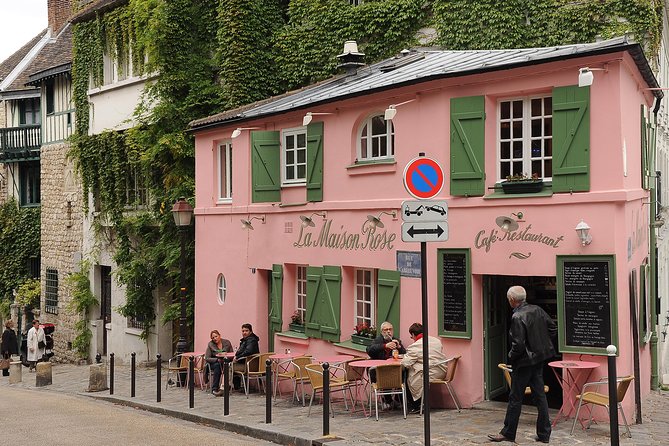
The pink Maison Rose is one of the route’s signature sights. A local painter named Maurice Utrillo helped make the building famous, and its bright exterior became one of the classic images of Montmartre.
The building’s story also reaches into Parisian music and literature. It was later bought by someone connected with well-known singers, and Edith Piaf, Charles Aznavour, and Jacques Brel were frequent visitors. Albert Camus also enjoyed the place before them.
You should think of this as a photo stop with a story, not automatically as a meal stop. The tour does not include food or drinks, and the route gives you the background without requiring you to dine there.
Montmartre’s last vineyard
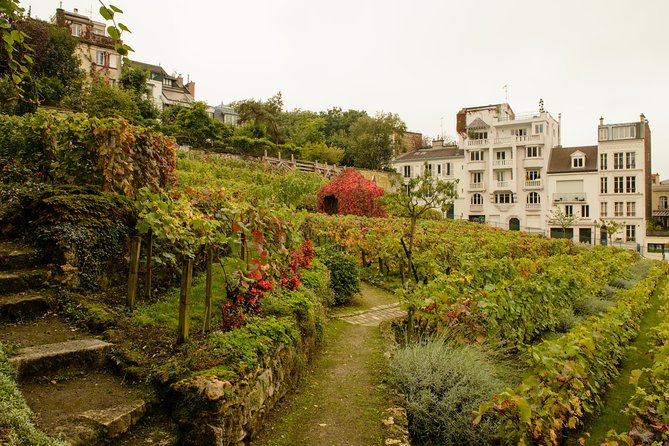
Paris once had many vineyards. Today, Montmartre’s remaining vineyard is one of the few reminders of that agricultural past.
It is small enough for one person to care for, which helps explain its tidy appearance. The audio also points out that the vineyard is maintained for visitors, tour guides, the mayor, and television crews. That small detail makes the place feel less like a grand estate and more like a carefully protected piece of local identity.
You cannot treat this as a wine-country visit. The vineyard is a short sightseeing stop, not a tasting experience. Still, it adds welcome variety to a route otherwise filled with studios, monuments, and cafés.
Lapin Agile and the old cabaret tradition
The Lapin Agile first opened in 1795 as a cabaret and drinking establishment. Its early names included Rendez-vous of Thieves and Cabaret of the Assassins.
In 1880, the caricaturist André Gill was asked to give the place a new look. He created the rabbit image that led to the name Lapin Agile, meaning nimble rabbit.
This stop helps explain why Montmartre attracted more than painters. The neighborhood was also a place for performers, writers, singers, and people looking for an evening outside formal Paris society.
The tour passes the cabaret rather than including a show. If you want to go inside, you will need to arrange that separately. The audio’s role is to give you the backstory as you view the exterior.
Place du Tertre and the painters’ square
Place du Tertre is one of the most famous places in Montmartre, and it is an important stop on this route. It is also where time management matters.
The square is closely linked to the neighborhood’s artists, but it can be busy and commercial. If it is your main reason for visiting Montmartre, preview the route before you begin and make sure you understand where it appears in the sequence. One person using the tour missed the square after running out of time near the end, a disappointment that could have been avoided with a quick look at the map.
This is a good example of the difference between a self-guided tour and a private guide. You get freedom, but you must manage your own clock. If you have only one afternoon in Paris, do not start late and assume the one-to-two-hour estimate includes every photograph and stop.
A classic restaurant and Van Gogh’s painted view
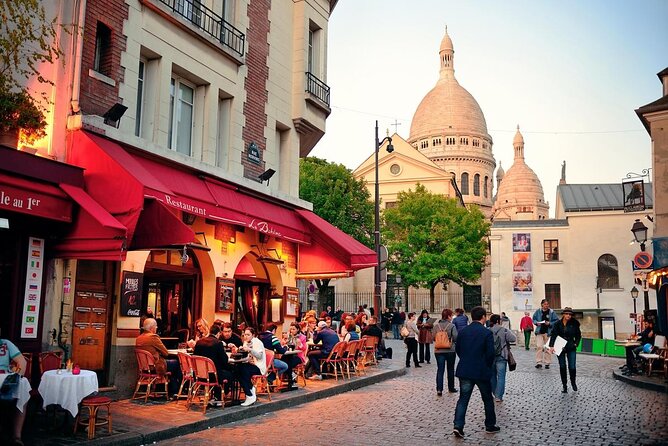
The route passes a classic Montmartre restaurant whose name means simple and without ceremony. A restaurant has occupied the site since the 1500s, although the building has been rebuilt and renamed over time.
Degas, Renoir, Monet, Cézanne, Sisley, and Toulouse-Lautrec all came here for food or a drink. In 1886, Van Gogh painted his famous La Guinguette à Montmartre at this location.
This stop is another strong example of the tour’s approach. It does not merely point out an attractive restaurant. It connects the building to the people who used it and to a painting you may already know from a museum.
The tour does not include a table, food, or drinks. You can stop independently, but allow extra time and budget if you want to turn the audio walk into a meal.
The final climb to Sacré-Cœur
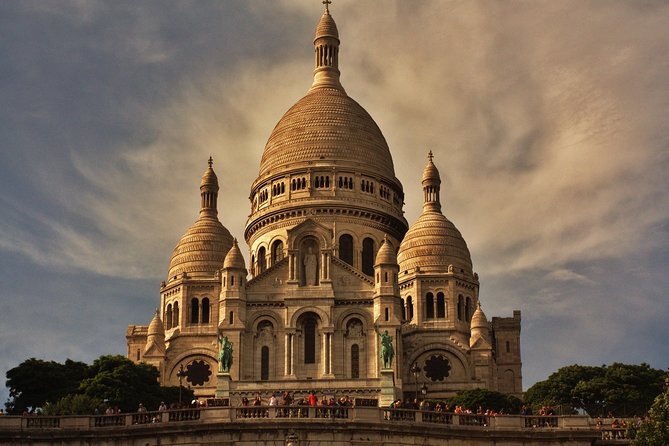
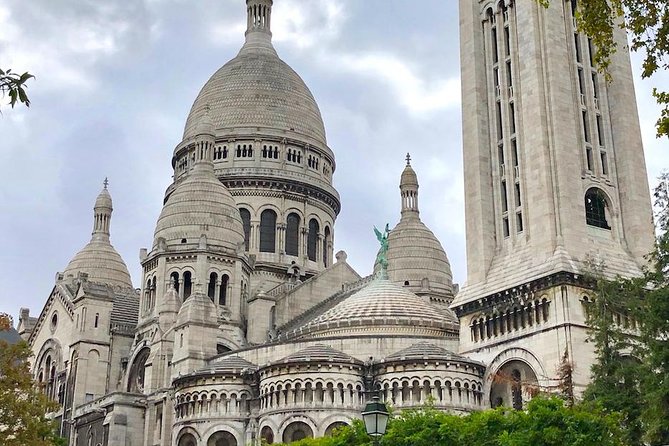
Near the end, the route passes the second Statue du Chevalier de la Barre before finishing in front of the Basilica of Sacré-Cœur at 35 Rue du Chevalier de la Barre.
The final destination gives the walk a clear payoff. Sacré-Cœur is one of Montmartre’s defining sights, and the tour ends with a look inside the basilica. Check the opening conditions on the day you go, since an audio tour cannot guarantee access to every interior.
The route’s ending is also practical. You finish at one of the area’s major sights rather than returning to the starting point. From there, you can continue exploring, visit the basilica, or stop for the views around the hill.
How much time should you allow?
The stated duration is about one to two hours. That is best understood as the time needed to follow the audio route without long breaks.
In practice, I would allow at least two hours and preferably more if you want to enjoy the neighborhood. One person estimated four hours when walking slowly, stopping for street music, and taking breaks at cafés. That sounds realistic for a relaxed visit.
Plan extra time for:
- Photographs at the Wall of Love, Rue de l’Abreuvoir, Maison Rose, and Place du Tertre
- A church interior or Sacré-Cœur visit
- Coffee, food, or a drink
- Pausing the narration to explore a square
- The hill and stair sections
The route is private, so you can split it across days because access lasts for your lifetime. That is useful if you have knee problems, children with you, or a packed Paris schedule.
Phone, battery, and navigation tips
The app includes offline audio, maps, and geodata. Download what you need before starting and leave with a fully charged phone. A portable charger is a sensible backup, since GPS and audio can use a lot of battery.
The navigation was praised for accurate directions and gentle reminders when someone wandered away from the route. Still, the experience was not perfect for every phone. Some people found the GPS points slightly off, unclear, or confused when they entered a church. Others had trouble pausing the audio, resuming after a crash, or getting automatic narration to start.
You can reduce the risk by checking the app before leaving your accommodation. Make sure the tour opens, the voucher code works, and the audio plays. If something goes wrong, VoiceMap offers support by phone and email. The supplied confirmation instructions matter, since entering a booking confirmation number instead of the correct voucher code can prevent access.
Headphones are not included. Bring your own, and keep the volume low enough to hear bicycles, cars, and other people on the narrow streets.
Who should book this audio walk?
I would choose this tour if you want to explore alone, dislike keeping pace with a group, or prefer to pause whenever a street catches your eye. It also suits couples and small private groups who want a guide’s stories without a scheduled meeting time.
The route is especially good for:
- Art lovers interested in Picasso, Modigliani, Renoir, and Van Gogh
- Visitors who want more than the usual Sacré-Cœur photograph
- Solo visitors who prefer audio company while walking
- People who enjoy local stories, buildings, and street details
- Anyone looking for an inexpensive alternative to a private walking guide
I would hesitate if you want a flat, effortless stroll or if Place du Tertre is your one essential sight and you do not have time to check the route. I would also choose another option if your phone battery is unreliable or you dislike troubleshooting apps.
At $14.99, the price is fair for the amount of material and the lifetime access. It is not a substitute for a live guide who can answer questions or change the route for you, but it gives you a useful amount of history for less money and more freedom.
Should you book the Montmartre audio tour?
Book it if you want Montmartre to make sense as you walk. The best parts are the links between streets, artists, paintings, singers, cabarets, and old Parisian traditions. The narrator is pleasant, the stories are entertaining, and the GPS format lets you explore at your own speed.
Go prepared for hills, stairs, a long afternoon if you stop often, and the occasional app issue. Download the tour early, charge your phone, preview the route, and protect enough time for Place du Tertre and Sacré-Cœur.
For an independent visit at a modest price, this is a strong choice. Just do not mistake a one-to-two-hour audio estimate for a full, leisurely day in Montmartre.
FAQ
How long does the Montmartre audio tour take?
The stated duration is approximately one to two hours. If you walk slowly, take photographs, stop for refreshments, enjoy street music, or visit churches, it can take four hours or more.
Where does the tour start and end?
It starts at 22 Rue des Abbesses in Paris. It ends in front of the Basilica of Sacré-Cœur at 35 Rue du Chevalier de la Barre.
What language is the audio tour offered in?
The tour is offered in English.
Does the tour include a smartphone and headphones?
No. You need to provide your own smartphone and headphones. Food, drinks, transportation, museum tickets, and other entrance fees are also excluded.
Can I use the tour without mobile data?
Yes. The tour includes offline access to the audio, maps, and geodata through the VoiceMap app for Android and iOS.
Is the tour suitable for people who do not want to walk uphill?
Montmartre has hills, stairs, and inclines, so the route can be physically demanding. You can pause the tour, take breaks, or split it across more than one day because access is provided for life.
Just added around Paris
- The Tuileries Garden’s Classic Sights: A Self-Guided Audio Tour★ 4.0 · 3 reviews
- Self-Guided Audio Tour -The Eiffel Tower, Exterior★ 4.0 · 9 reviews
- Audioguide – The Eiffel Tower and its secrets★ 4.0 · 4 reviews
- A Self-Guided Audio Tour Around Parc Montsouris★ 3.5 · 6 reviews
- The French Revolution: Self Guided Audio Tour of Paris★ 4.5 · 3 reviews
- Summit Eiffel Tower Audio Guide Tour with Unlimited Time Access★ 4.5 · 58 reviews
- Self-Guided Audio Tour – Montmartre: The heart of art and bohemia★ 3.5 · 7 reviews
- Latin Quarter, Paris Walking Tour with Audioguide★ 4.5 · 2 reviews
Self-Guided Tours, compared.

Acropolis Ticket & Optional Self-Guided Audio Tours
Read our review →


Ultimate Acadia National Park Self-Guided Driving Audio Tour
Read our review →

Santorini: Akrotiri Ticket with Optional Self-Guided Audios
Read our review →
Browse the lists this tour appears in