
REVIEW · ITALY AUDIO TOURS
Rimini Walking Tour with Audio and Written Guide by a Local
Rimini rewards a slower look. This self-guided walk links Roman monuments and Malatesta-era buildings with a fishing quarter, market, murals, and two useful museums. I like the freedom to pause wherever you wish, and I like the low price, about $7.82 per person, for a route that covers much of the historic center. The main drawback is simple: you must navigate with your phone, and unclear directions could make the 3 to 4 hour walk tiring.
You begin at Piazza Cavour and finish at Piazza Tre Martiri, with eleven stops along the way. The audio and written guide works in English, Spanish, Italian, German, and French, and includes restaurant suggestions, monument tips, historical notes, and curiosities. Bring an internet-connected smartphone and read the voucher carefully before setting out.
Key points to know before you go
- Eleven central stops: The route covers squares, Roman remains, a cathedral, a market, a castle, and the old fishing district.
- A self-guided format: There is no meeting with a live guide, so you choose your own pace and pauses.
- Two museums cost extra: The Domus del Chirurgo and Luigi Tonini City Museum are optional, with a combined museum ticket priced at 7 euros.
- Borgo San Giuliano adds local character: Narrow lanes, small colorful homes, and large murals provide a welcome change from formal monuments.
- The route is easy to personalize: You can listen through your phone speaker or use headphones, stop for food, or skip an attraction.
- Navigation matters: Google Maps links are provided before each attraction, but you still need your phone, data connection, and attention to the route.
What this Rimini walk covers in three to four hours
This is not a guided group stroll with a fixed pace. It is a digital route that gives you the information, then leaves you in charge. That arrangement works well if you dislike being hurried or want to stop for photographs, coffee, lunch, or a closer look inside a church.
The route moves through Rimini’s historic center in a sensible broad arc. It begins at Piazza Cavour, heads toward Castel Sismondo and the Tiberius Bridge, crosses into Borgo San Giuliano, returns toward the center, then continues through the archaeological museum area, the cathedral, market, Arch of Augustus, and Piazza Tre Martiri.
The listed stop times add up to roughly four hours, although some are only short orientation stops. If you enter both museums, pause for food, or take time with the murals, allow extra time. The route is not described as difficult, but one person found the walk exhausting after getting lost. The practical lesson is to follow the map links carefully instead of treating the route as a loose list of sights.
More Audio Walking Tours in Italy
- Florence: 2.5 hour Audio Guided Walking Tour led by Host
★ 4.6 · 293 reviews - Verona Walking Tour with Audio and Written Guide by a Local
★ 4.5 · 157 reviews - Bologna Walking Tour with Audio and Written Guide
★ 4.5 · 132 reviews
Starting at Piazza Cavour, Rimini’s civic heart
Piazza Cavour is a good place to begin because it gives you an immediate sense of central Rimini. The square is one of the city’s main social and cultural gathering places, surrounded by important historic buildings.
The guide allows about ten minutes here. Use that time to orient yourself, check the next map link, and listen to the introduction before moving on. Since Piazza Cavour is the stated starting point, locating it before you begin will save frustration. The directions and Google Maps link are included in the booking voucher and at the start of the digital guide.
This first stop is more than a quick photo opportunity. It establishes the contrast that makes Rimini interesting: the city has a modern daily rhythm, but it unfolds around layers of Roman, medieval, and Renaissance history.
Castel Sismondo and the power of the Malatesta family
From Piazza Cavour, the route takes you to Castel Sismondo, one of Rimini’s best-known buildings. Construction began in 1437 at the order of Sigismondo Pandolfo Malatesta, the local lord whose name appears again at the cathedral.
The stop lasts about 20 minutes and has no admission charge listed. The castle gives the walk a strong medieval and Renaissance center. Rather than seeing Rimini only as a seaside destination, you get a reminder that this was also a city shaped by powerful rulers, fortifications, churches, and court culture.
The digital commentary is useful here because a castle can otherwise be a quick exterior photograph. Take time to hear the background before continuing. The self-guided format also lets you look at the building without a group waiting for you.
Crossing the Tiberius Bridge, a Roman survivor

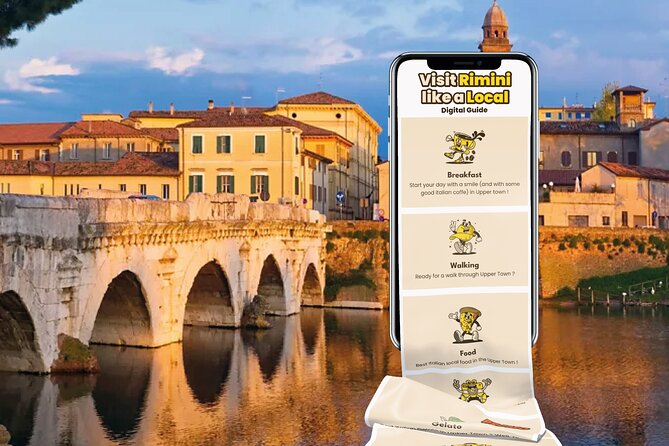
The Tiberius Bridge is one of the most rewarding stops for anyone interested in Roman engineering. Construction began under Emperor Augustus in 14 AD and ended in 21 AD under Emperor Tiberius. Built from Istrian stone, it has five arches and crosses the Marecchia River.
The planned stop is about 15 minutes. You do not need an admission ticket, and the bridge is a natural place for photographs. It also gives the route a clear sense of age. This is not a reconstructed Roman display behind glass. It is an old crossing that still defines movement through the city.
The guide’s historical notes help you understand why the bridge matters, but the setting also carries the moment. Pause in the middle, look along the arches, and then continue toward Borgo San Giuliano.
Same place, a different route to walk:
- Rome: Pantheon Fast-Track Ticket and Official Audioguide
★ 4.5 · 27,353 reviews - Rome: Colosseum & Forum with Audio Guide App -Optional Arena
★ 4.2 · 24,770 reviews - Florence: Timed Entry to Michelangelo’s David + Audio App
★ 4.6 · 19,496 reviews - Rome: City Sightseeing Hop-on Hop-off Bus with Audioguide
★ 4.0 · 16,045 reviews
Borgo San Giuliano, where Rimini gets personal
Borgo San Giuliano is the part of the route I find most appealing. This neighborhood developed around the year 1000 as a fishing district. Today, its narrow alleys, stone-paved streets, small colorful houses, and murals give the walk a more intimate feel.
The suggested time here is 30 minutes, but this is one place where you may want to linger. The murals are the main visual draw, and the compact streets reward a slower pace. After several formal sights, Borgo San Giuliano offers a change of scale. You are no longer looking mainly at grand civic buildings or Roman structures. You are seeing a neighborhood with a strong local identity.
The guide’s information about the district helps you read what you are seeing instead of simply wandering through attractive lanes. If you enjoy street art and ordinary city corners more than grand interiors, this may be your favorite stop.
Piazza Luigi Ferrari and the Roman surgeon’s house

The route then returns toward Piazza Luigi Ferrari, another gathering place with gardens. The square itself receives about ten minutes, but its main importance is archaeological.
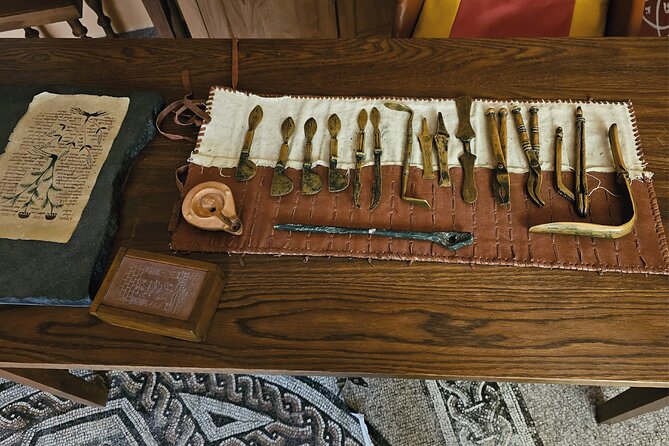
During work in the area in the late 1980s, archaeologists found remains and objects dating from Roman times through the Middle Ages. The most notable discovery was the Domus del Chirurgo, or Surgeon’s House, named for the last owner, a Greek-educated physician.
The site is especially valuable because it brings private Roman life into the itinerary. An arch or bridge shows public power and engineering. The Domus del Chirurgo suggests something more personal: a home, a profession, and the tools connected with medical practice.
Admission is optional. The information provided lists a 7 euro ticket and says it includes the museum as well. The safest way to understand the value is to treat the Domus and the city museum as a paired visit, rather than assuming you need to pay 7 euros twice. If archaeology interests you, this is one of the best uses of the extra time and money.
Luigi Tonini City Museum, the route’s historical anchor
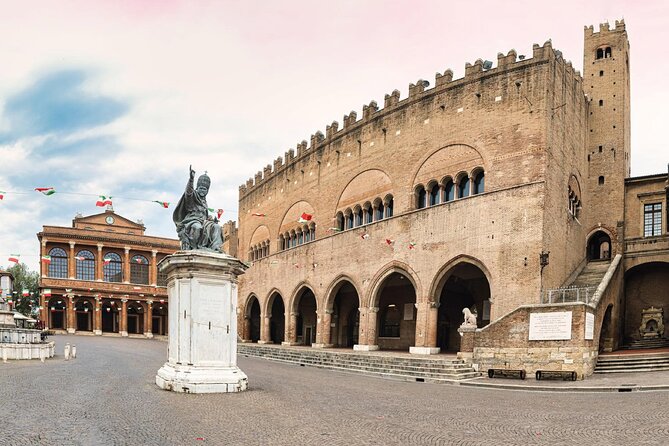
The Museo della Città Luigi Tonini preserves objects gathered from excavations, churches, and city buildings. Its purpose is to tell Rimini’s story across several thousand years, from early local evidence through later periods.
The suggested visit lasts about 45 minutes. That makes it the longest stop on the route, and for good reason. The museum supplies the broad context that individual monuments cannot. After seeing the bridge, castle, archaeological site, and cathedral, you can connect those pieces inside one collection.
Admission is listed as 7 euros and includes the Surgeon’s House. The museum is not mandatory, but I would consider it worthwhile if you have at least half a day in the center and want more than exterior views. If your visit is short, you can follow the rest of the route without entering.
A useful planning point: the route is flexible. You can listen to the museum section outside, continue to the cathedral, and return later if opening arrangements suit you. The experience does not require you to complete every stop in one uninterrupted push.
Tempio Malatestiano, Rimini’s unusual cathedral
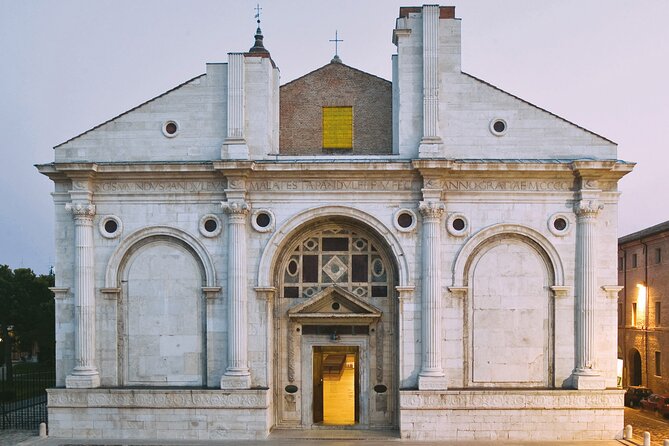
The Basilica Cattedrale, also called the Tempio Malatestiano, is one of the route’s most important buildings. It began as a Gothic Franciscan church and was transformed in the 15th century at the command of Sigismondo Pandolfo Malatesta.
Leon Battista Alberti was commissioned to redesign it, giving the exterior a classical appearance. The planned stop is about 20 minutes, with free admission listed. That short time is enough for an introduction, but you may want longer if the interior interests you.
The cathedral is where several strands of the walk meet: the Malatesta family, Renaissance design, religious history, and Rimini’s changing identity. The digital guide is particularly useful here because the building’s story is not obvious from the outside. Listen before entering, then look for the contrast between the older Franciscan church and the later classical treatment.
Mercato Coperto, a practical taste of daily Rimini
I always like a market stop, and the Mercato Coperto gives this route a welcome everyday pause. The market occupies two floors. On the ground floor, you can find fruit, vegetables, a few bars, and a small supermarket.
The suggested stop is 20 minutes, with no admission charge. This is not presented as a grand food hall or a formal tasting experience. Its value is simpler. You get to see where ordinary shopping fits into the city, and you have a useful place to pause during a long walk.
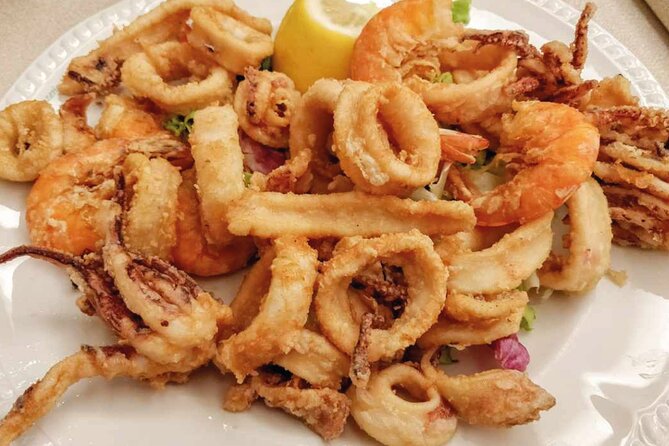
The guide also includes advice for local restaurants serving authentic food. That information may be most useful after you finish the route, since the walk ends near Piazza Tre Martiri. If you have only one day in Rimini, the restaurant suggestions could help you choose a local meal instead of defaulting to the first place near the beach.
The Arch of Augustus and Rome’s road to Rimini
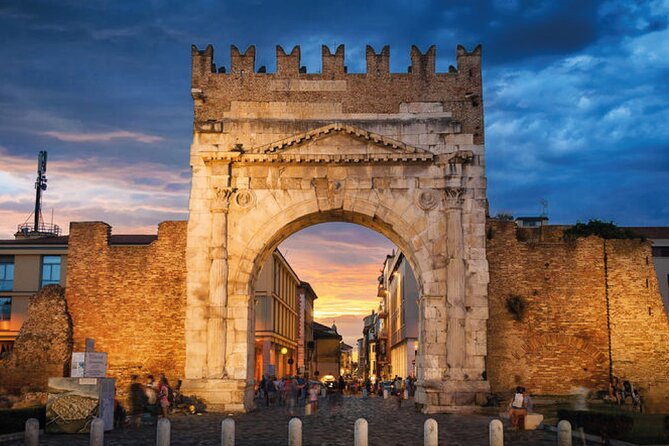
The Arco d’Augusto dates from 27 BC and honors Caesar Octavian Augustus. It marks the endpoint of the Via Flaminia, the Roman road connecting Rome with Rimini.
The stop lasts about 15 minutes and is free. Like the Tiberius Bridge, it shows how firmly Rimini fits into the Roman road network. The arch is also a clear marker for the city’s ancient importance.
This is a good place to slow down for the audio explanation. The structure can look like a simple photo stop if you do not know why it was built or where the road led. With that context, it becomes a physical sign of Rimini’s place in the Roman world.
Piazza Tre Martiri, finishing in the old Roman forum
The route ends at Piazza Tre Martiri, whose origins reach back to the ancient forum of Ariminum. In Roman times, this was the political and commercial center of the colony.
The final stop is planned for about ten minutes. Ending here makes sense because the square brings the walk back to the city’s oldest civic role. You begin in Piazza Cavour, another major public square, and finish in a place that once served as the heart of Roman Rimini.
This is also a convenient point to stop the audio, review the restaurant advice, or continue exploring independently. The tour does not return you to the start, so plan around the one-way route.
What the $7.82 price really gives you
At about $7.82 per person, this is an inexpensive way to organize a half-day in Rimini. You receive a digital guide, audio and written commentary, restaurant suggestions, monument advice, and historical notes in several languages.
The price is strongest if you want structure without paying for a private guide. You can move at your own speed, repeat sections, and pause for photographs. It is also a good fit for friends who do not all walk at the same pace.
The extra museum cost changes the calculation slightly. The Domus del Chirurgo and Luigi Tonini City Museum are optional, and the stated ticket price is 7 euros including both. If you enter, your total remains modest for a route that combines outdoor monuments with indoor archaeology and local history.
The value is weaker if you expect personal explanations, live questions, or someone physically leading you from one point to the next. This is a phone-based tool, not a traditional guided tour.
Phone setup, walking pace, and the main risk
You need a smartphone with an internet connection. The activation details are in the voucher, so read them before you arrive at Piazza Cavour. Audio can play through your phone’s speaker or headphones.
The guide places a Google Maps button before each attraction. That is important because one person struggled to find several stops and felt worn out by the end. Piazza Cavour is in the city center, but a wrong turn at the beginning can affect the whole route.
The maximum group size is listed as 104 people, but since the format is self-guided, that number does not mean you will walk in one organized pack. You can use the guide alone, with friends, or with family. Service animals are allowed, and the route is near public transportation.
The activity is offered every day from noon to 11:30 PM according to the supplied schedule. The broad hours give you flexibility, but the museum portions may require more careful timing than the outdoor stops. Free cancellation is available if you cancel at least 24 hours before the start time. Inside that window, the amount paid is not refunded.
Who should choose this Rimini experience?
I would choose this walk if you want to see the historic center without committing to a live group schedule. It suits independent visitors, couples, families, and friends who like to stop often and set their own rhythm.
It is especially good for a first look at Rimini because the route covers the main eras in one sweep: Roman bridges and roads, medieval neighborhood life, Malatesta power, Renaissance architecture, archaeology, and present-day markets.
I would think twice if you dislike phone navigation or want a guide to answer questions on the spot. A rainy day does not necessarily ruin it, since one person still enjoyed the route in bad weather, but outdoor stops will naturally be less pleasant. Comfortable shoes and a charged phone are sensible choices, even though the route is described as manageable.
Should you book the Rimini walking tour?
Book it if you want a low-cost, flexible introduction to Rimini and are comfortable guiding yourself with Google Maps. The strongest parts are the mix of Roman sights, the colorful Borgo San Giuliano, and the option to add two worthwhile museums for 7 euros.
Skip it if you need a live guide or very precise hand-holding. For the best experience, activate the guide before starting, follow each map link, allow at least three hours, and save extra time for the Domus del Chirurgo and Luigi Tonini Museum. With those small preparations, this is a practical way to see far more of central Rimini than the beach alone suggests.
FAQ
How long does the Rimini walking tour take?
The walk takes approximately 3 to 4 hours. Entering the museums, stopping for food, or spending longer in Borgo San Giuliano may extend the visit.
Where does the tour start and finish?
It starts at Piazza Cavour in Rimini and finishes at Piazza Tre Martiri.
Is the tour led by a live guide?
No. It is a self-guided experience using an audio guide and written guide on your smartphone.
What languages are available?
The audio and written guide are available in English, Spanish, Italian, German, and French.
Are museum tickets included?
The Domus del Chirurgo and Luigi Tonini City Museum are optional. The supplied information lists a 7 euro ticket that includes both museums.
What do I need to use the digital guide?
You need a smartphone with an internet connection. Activation instructions are provided in the voucher, and you can listen through the phone speaker or headphones.
Just added around Italy
- Torino Walking Tour with Audio and Written Guide by a Local★ 4.5 · 35 reviews
- Medieval Canals and Fountains: A Treviso Self-Guided Audio Tour★ 4.5 · 4 reviews
- Trapani Walking Tour with Audio and Written Guide by a Local★ 4.0 · 8 reviews
- Trento Walking Tour with Audio and Written Guide★ 4.5 · 11 reviews
- Sicily: Selinunte Park Entry Ticket & Sicily Digital Audio Guide★ 4.5 · 4 reviews
- Taormina Walking Tour with Audio and Written Guide by a Local★ 4.5 · 41 reviews
- Taranto Walking Tour with Audio and Written Guide by a Local★ 5.0 · 5 reviews
- Siracusa Walking Tour with Audio and Written Guide by a Local★ 5.0 · 59 reviews
Walking Tours, compared.

City Monuments Guided Walking Tour with Audio Guide
Read our review →

Self Guided Classic Freedom Trail Location Aware (GPS) Walking Audio Tour
Read our review →
Self-Guided Historical Walking Tour (Audio Guide)
Read our review →
Cape Cod & Provincetown Self-Guided Driving & Walking Audio Tour
Read our review →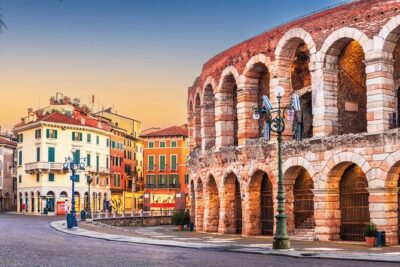
Verona Walking Tour with Audio and Written Guide by a Local
Read our review →
Royal Walking Tour and Buckingham Palace Audio Tour
Read our review →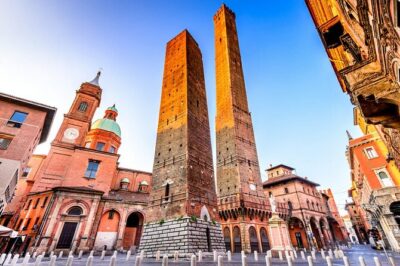
Bologna Walking Tour with Audio and Written Guide
Read our review →Browse the lists this tour appears in