

REVIEW · ITALY AUDIO TOURS
Pescara Walking Tour with Audio and Written Guide by a local
Pescara reveals itself on foot. This inexpensive self-guided audio tour links churches, museums, river views, public art, and central squares in about two to three hours. I like the low price and the freedom to pause whenever you want. I also like the practical restaurant advice and the choice of audio and written guides in five languages. The main drawback is simple: there is no person with you, so you need a working smartphone, internet access, and enough confidence to follow the route alone.
At $7.26 per person, this is a useful way to get your bearings without paying for a private guide. The route includes the birthplace of Gabriele d’Annunzio, a free cathedral visit, and the long Ponte del Mare. Still, one user felt uneasy reaching the poet’s house alone on a quiet Sunday, so I would plan the timing carefully rather than treat this as a fully escorted city tour.
Key points to know before you go
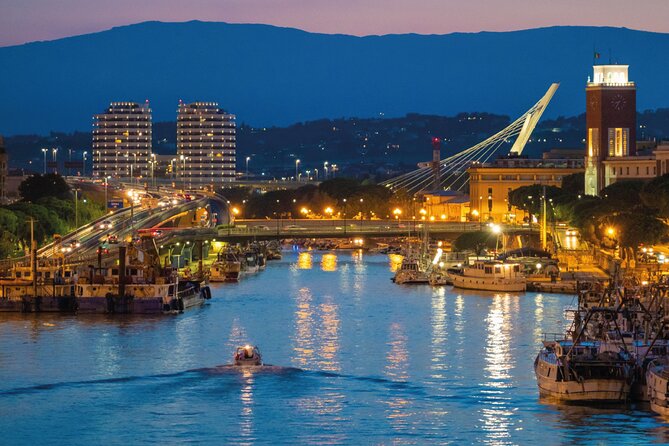
- Seven stops connect old Pescara with the seafront, including churches, a museum, a bridge, a fountain, and two major squares.
- The digital guide costs $7.26, making it good value if you want orientation, history, and food advice at a modest price.
- Audio and written instructions are available in English, Italian, Spanish, German, and French.
- The Gabriele d’Annunzio house costs extra, while the other listed stops are free.
- You need your own smartphone and internet connection, and headphones are optional but useful.
- The tour ends at Piazza della Rinascita, a central square where you can continue exploring on your own.
What this Pescara walk is really offering
This is not a traditional walking tour with a guide holding a sign and answering questions as you go. It is a digital city route from Walking Cap, designed for independent sightseeing. You receive access details with your voucher, then use your phone to hear the commentary or read the written material at each stop.
That format suits me when I want to move at my own speed. You can stop for coffee, spend longer inside the museum, skip a church if it is closed, or replay a section without holding up a group. It also works well for two or more people sharing the cost, since the guide can provide structure without requiring each person to book a full guided experience.
The current rating is 3.3 out of 5 from three recorded ratings, so I would keep expectations sensible. The strongest praise focuses on the useful route, historical notes, and local food suggestions. The weak point is not the price or the number of sights. It is the lack of a human guide when navigation or local reassurance matters.
The advertised duration is two to three hours. That should be enough for the route at a steady pace, though the one-hour visit at Casa Natale di Gabriele d’Annunzio can affect your total time. You may also want extra time at Ponte del Mare and Piazza Salotto, especially if you are taking photos or making stops along the way.
More Audio Walking Tours in Italy
- Florence: 2.5 hour Audio Guided Walking Tour led by Host
★ 4.6 · 293 reviews - Verona Walking Tour with Audio and Written Guide by a Local
★ 4.5 · 157 reviews - Bologna Walking Tour with Audio and Written Guide
★ 4.5 · 132 reviews
Starting at the Sacred Heart church
The route begins at Piazza del Sacro Cuore, at the Santuario della Divina Misericordia, also known as the Church of the Sacred Heart of Jesus. The church dates from work begun in 1886 and was designed by the architect Porta di Torino.
You have about 20 minutes here, and admission is free. The stop gives the tour a clear starting point in central Pescara rather than sending you immediately toward a generic shopping street. The digital commentary is meant to point out historical and artistic details, which is helpful if you would otherwise glance inside and move on.
I would treat this first stop as an orientation point. Listen to the opening section before setting off, check that your audio is working, and make sure the written guide loads while you have a reliable connection. Since there is no in-person leader, a few minutes of preparation here can prevent confusion later.
The church is also a reminder that Pescara is more than a beach destination. Religious buildings provide some of the city’s older layers, while later stops show its links to modern Italian culture, public art, and the Adriatic waterfront.
Gabriele d’Annunzio’s birthplace and the route’s most important paid stop
The Museo Casa Natale di Gabriele d’Annunzio is scheduled for one hour, making it the longest stop. This is the birthplace of the famous Italian poet and writer, located along the main street of old Pescara. The building once stood within a military fortress, which was demolished during d’Annunzio’s childhood.
Admission is not included in the tour price. That matters because the $7.26 fee covers the digital guide, not every attraction along the way. You should allow for this separate museum cost when deciding how much time and money to set aside.
I like this stop because it gives the walk a strong cultural center. You are not simply ticking off churches and viewpoints. The house connects Pescara to one of Italy’s major literary figures and explains why Gabriele d’Annunzio’s name appears elsewhere in the city, including on Viale Gabriele d’Annunzio near the cathedral.
There is one practical caution. A person using the guide alone felt uncomfortable reaching the house on a Sunday, describing the area as desolate at that time. The provider replied that the route follows a famous street in Pescara, but the experience can still feel different depending on the hour, day, and your own comfort level. If you are alone, I would visit during the daytime and avoid leaving this stop until a very quiet period.
Because the guide is digital, it cannot open the museum, answer questions about an exhibit, or adjust the commentary to your interests. If you enjoy literature and want detailed discussion, you may want to spend extra time inside and read the material carefully rather than rushing through the scheduled hour.
San Cetteo Cathedral and Pescara’s older center

The Cattedrale San Cetteo is dedicated to Pescara’s patron saint and takes about 25 minutes. It sits on Viale Gabriele d’Annunzio, in an area that was once central to the old settlement of Pescara.
Admission is free. That makes it an easy stop to keep even if you decide not to enter the museum. The guide can help you connect the cathedral with the earlier church and the d’Annunzio house, giving the walk a better sense of place than a simple list of monuments.
I find churches particularly useful on an audio route because the written notes can explain what you are seeing without requiring you to search for information on the spot. You can listen before entering, keep your phone in hand, and then look around with some context.
Keep in mind that religious sites may have their own visitor expectations or temporary closures, but no special closure information is supplied for this experience. The tour gives you a planned stop, not a guarantee that every interior detail will be available at every moment.
Same place, a different route to walk:
- Rome: Pantheon Fast-Track Ticket and Official Audioguide
★ 4.5 · 27,353 reviews - Rome: Colosseum & Forum with Audio Guide App -Optional Arena
★ 4.2 · 24,770 reviews - Florence: Timed Entry to Michelangelo’s David + Audio App
★ 4.6 · 19,496 reviews - Rome: City Sightseeing Hop-on Hop-off Bus with Audioguide
★ 4.0 · 16,045 reviews
Crossing the 466-meter Ponte del Mare
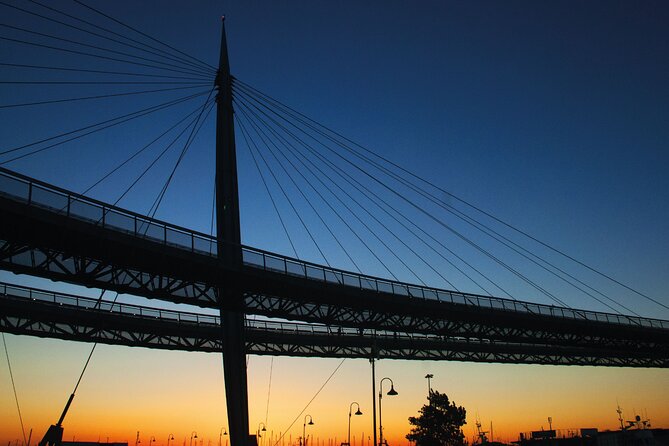
The Ponte del Mare is the route’s big outdoor reward. Opened in 2009, this cable-stayed pedestrian and cycling bridge crosses the Aterno-Pescara River and links the northern and southern marinas.
The bridge is 466 meters long and is described as Italy’s longest cable-stayed cycle-pedestrian bridge, as well as one of Europe’s largest. You have about 20 minutes here, and there is no admission fee.
This is where the tour shifts from old buildings to modern Pescara. The bridge offers a sense of how the river and marinas shape the city. You can walk across, pause for views, and use the audio guide to understand why the structure matters rather than seeing it as just a convenient crossing.
The bridge may be the most satisfying stop for anyone who prefers open space and photographs to indoor museums. It is also one of the places where self-guided touring works well. You can slow down, take pictures, and replay the explanation without worrying about a group waiting at the far side.
The 20-minute estimate is realistic for a straightforward visit, but it does not need to be a hard limit. If weather is poor, wind or rain could make this part less comfortable. The supplied information does not promise shelter or weather alternatives, so check conditions before starting.
La Nave di Cascella beside the beach
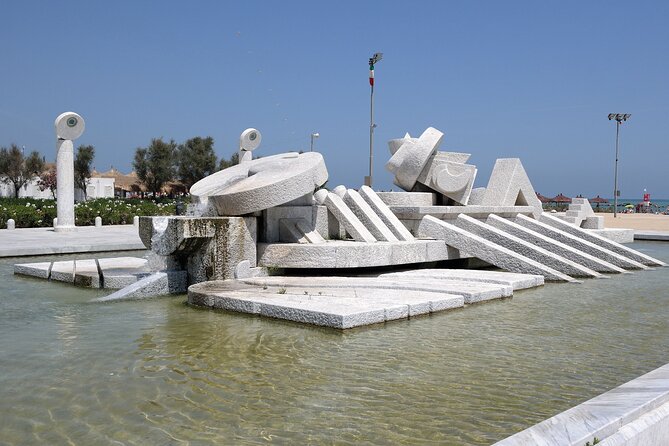
Near the seafront, you reach La Fontana Nave di Cascella, a sculpture by Pietro Cascella. Created in 1986, it was donated to the Municipality of Pescara, displayed in Florence for several months, and inaugurated in Pescara on July 4, 1987.
The fountain is located in Largo Mediterraneo, close to the beach, and the planned visit lasts about 10 minutes. Admission is free.
This is a short stop, but it adds a modern artistic note to the route. The ship form fits Pescara’s coastal setting, while the date and movement from Florence to Pescara give the work a small civic story. I would listen to the explanation before taking a closer look, since public sculpture can be easy to pass without context.
Do not expect a long museum visit here. It is a pause on the seafront, useful for seeing how the city presents its identity in public spaces. If the beach or waterfront catches your attention, you may naturally spend more than the suggested 10 minutes.
Piazza Salotto and the memory of wartime Pescara
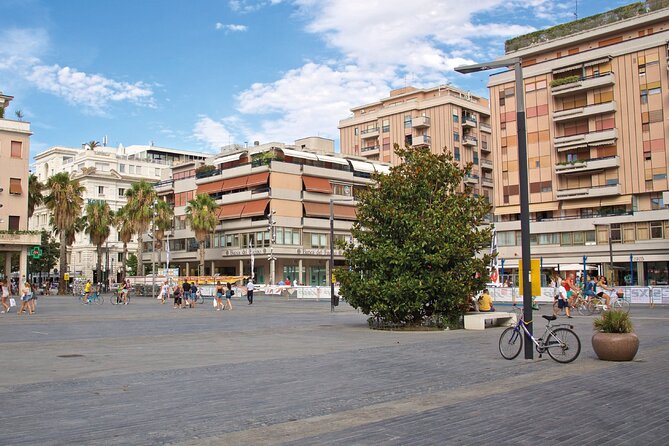
Piazza Salotto is one of Pescara’s best-known gathering places. The stop lasts around 20 minutes and focuses on the square’s past, including its connection to the tragic events of the Second World War.
This section may be more valuable than it first sounds. A central square can look ordinary if you only see cafés, paving, and passing pedestrians. Historical notes help you read the space as part of the city’s wartime story and explain why it matters beyond its present-day role.
The audio format works especially well here because you can stand in the square, take in the surroundings, and listen at your own pace. The route also gives you a chance to pause before the final church visit and end at a major central area.
The tour finishes at Piazza della Rinascita, not at the starting church. That is convenient if you want to continue with shopping, food, or a relaxed walk through the center. The information does not specify a return transfer, so you should plan to make your own way back or continue from the final square.
Madonna dei Sette Dolori and the final church visit
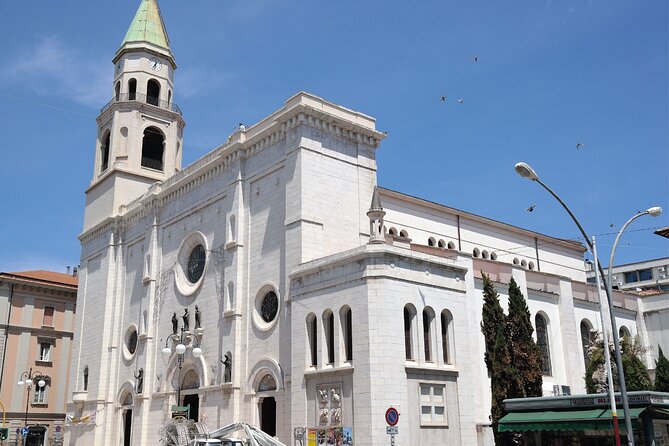
The Basilica of Madonna dei Sette Dolori, or Our Lady of Sorrows, is the final listed religious stop. You have about 20 minutes here, and admission is free.
The church is important to Pescara and the wider Abruzzo region. Its devotional focus is the Seven Sorrows of Mary, a Christian tradition centered on episodes of suffering in the Virgin Mary’s life.
This stop gives the route a quieter finish after the bridge, seafront, and central squares. If you prefer art, architecture, and religious traditions, you will likely find the explanation useful. If churches are not your main interest, the stop is short enough that it will not dominate the day.
The route then ends at Piazza della Rinascita. The materials describe this as a beautiful square, but they do not provide a detailed schedule of activities there. Think of it as a practical finish in the city center, not as another formally timed attraction.
Audio, written notes, and the phone question
The guide is available in English, Italian, Spanish, German, and French. English access is specifically offered, which makes the route usable for visitors who do not speak Italian.
You need a smartphone with an internet connection. Activation details are included in your voucher, so read that message carefully before arriving. The audio can play through your phone’s speaker, though headphones are not included.
I strongly prefer headphones for this kind of route, especially near traffic, on the bridge, or in busy public areas. They are optional, but your own pair can make the commentary easier to hear without holding the phone close to your face. Also charge your phone before starting, since the entire experience depends on it.
A written guide is a useful backup. You can read sections if the audio is hard to hear, and written notes let you scan the information while looking at a building or sculpture. The digital format also means you are not tied to a single pace or group schedule.
The maximum group size is listed as 108 people, but that figure does not mean you will be placed in a conventional 108-person walking group. This is a self-guided product, so the practical experience is still independent rather than a guided procession.
Is $7.26 good value?
At $7.26 per person, the price is low for a route that covers seven stops, provides audio and written content, and includes restaurant recommendations. The value is strongest if you want a quick introduction to Pescara and do not need a local person beside you.
The culinary advice may be the most useful extra. The guide includes suggestions for authentic local food, which can save you from choosing a restaurant at random after the walk. The supplied feedback gives this feature especially positive attention, along with the historical notes and simple help getting around on foot.
The cost is less attractive if you only want a short bridge-and-seafront walk, or if you will not use the museum and church explanations. It also does not include entry to Casa Natale di Gabriele d’Annunzio, headphones, transport, or an in-person guide.
Group discounts are available, so the price may work particularly well for two or more people. One solo user felt the experience was more useful for a pair or group, partly because of the confidence that comes from navigating together.
Who should book this Pescara tour?
I would choose this for a first visit to Pescara, a short stop between other destinations, or a free afternoon when you want a clear route without a costly private tour. It suits independent people who like to pause, read, and decide how long to stay.
It is also a good fit if you enjoy a mix of subjects: religious buildings, Italian literature, wartime history, public sculpture, and waterfront architecture. You get a broader picture of the city than a route focused only on the beach.
I would hesitate if you need a guide to handle navigation, answer questions, or provide company throughout the walk. I would also plan with extra care if you are alone and intend to reach the d’Annunzio house on a quiet Sunday. The provider says the walk follows a famous street, but personal comfort and timing still matter.
Free cancellation is available if you cancel at least 24 hours before the start time. Changes or cancellations within 24 hours are not refunded.
Should you book it?
Book this Pescara walking tour if you want a cheap, flexible introduction with solid coverage of the city’s central sights and useful food tips. The price is hard to criticize, and the combination of audio and written material gives you a practical safety net.
Skip it if you expect a personal guide or want detailed, live conversation at every stop. For most independent visitors, the best plan is to start in daylight, bring headphones, charge your phone, read the activation instructions, and allow extra time at the d’Annunzio museum and Ponte del Mare.
FAQ
How long does the Pescara walking tour take?
The tour takes approximately two to three hours, depending on how long you spend at each stop.
What is the price of the tour?
The price is $7.26 per person.
Is the tour led by a person?
No. It is a self-guided digital experience with audio and written information.
What languages are available?
The audio and written guide are available in English, Italian, Spanish, German, and French.
Do I need a smartphone?
Yes. You need a smartphone with an internet connection to activate and use the digital guide.
Are headphones provided?
No. Headphones are not included. You can listen through your phone’s speaker or use your own headphones.
Is museum admission included?
No. Admission to the Museo Casa Natale di Gabriele d’Annunzio is not included. The other listed stops have free admission.
Where does the tour start?
It starts at the Santuario della Divina Misericordia, also called the Church of the Sacred Heart of Jesus, at Piazza del Sacro Cuore, Pescara.
Where does the tour end?
The activity ends at Piazza della Rinascita in Pescara.
Can I cancel for a full refund?
Yes, if you cancel at least 24 hours before the experience start time. Cancellations within 24 hours are not refunded.
Just added around Italy
- Torino Walking Tour with Audio and Written Guide by a Local★ 4.5 · 35 reviews
- Medieval Canals and Fountains: A Treviso Self-Guided Audio Tour★ 4.5 · 4 reviews
- Trapani Walking Tour with Audio and Written Guide by a Local★ 4.0 · 8 reviews
- Trento Walking Tour with Audio and Written Guide★ 4.5 · 11 reviews
- Sicily: Selinunte Park Entry Ticket & Sicily Digital Audio Guide★ 4.5 · 4 reviews
- Taormina Walking Tour with Audio and Written Guide by a Local★ 4.5 · 41 reviews
- Taranto Walking Tour with Audio and Written Guide by a Local★ 5.0 · 5 reviews
- Siracusa Walking Tour with Audio and Written Guide by a Local★ 5.0 · 59 reviews
Walking Tours, compared.
City Monuments Guided Walking Tour with Audio Guide
Read our review →
Self Guided Classic Freedom Trail Location Aware (GPS) Walking Audio Tour
Read our review →
Self-Guided Historical Walking Tour (Audio Guide)
Read our review →
Cape Cod & Provincetown Self-Guided Driving & Walking Audio Tour
Read our review →
Verona Walking Tour with Audio and Written Guide by a Local
Read our review →
Royal Walking Tour and Buckingham Palace Audio Tour
Read our review →
Bologna Walking Tour with Audio and Written Guide
Read our review →Browse the lists this tour appears in