

REVIEW · NEW YORK CITY AUDIO TOURS
The Battery: A Self-Guided Audio Tour from Bowling Green Park to Stone St
New York’s oldest stories hide in plain sight. This self-guided walk links Bowling Green Park with Stone Street while explaining how a dirt-walled fort and trading post grew into a world power. I like the offline audio and maps, which let you walk without cellular service, and I like the freedom to pause, look around, or repeat a story. The main drawback is that you need your own smartphone and headphones, and the route can be less smooth while construction affects parts of the Battery.
This is a good-value way to spend about 90 minutes to two hours in Lower Manhattan. You pay $14.99 for lifetime access in English, including the audio, map, geodata, and a virtual version of the tour. I would choose it if you want historical context without joining a group, but not if you prefer a live guide who can answer questions on the spot.
Key points to know before you go

- The route begins at Bowling Green Park: Start at Broadway and Whitehall Street, near the southern tip of Manhattan.
- The Battery supplies the main story: Learn how defensive artillery batteries, trade, immigration, and public memory shaped New York.
- You pass major memorials and monuments: The walk includes the Korean War Memorial, American Merchant Marines Memorial, East Coast Memorial, and The Immigrants statue.
- Castle Clinton has several past lives: The old fort has served more than one purpose, including a connection to the New York Aquarium.
- The finish is atmospheric: The tour ends on the cobbled section of Stone Street near Fraunces Tavern.
- Offline access adds real value: Downloading the audio and map means you do not need Wi-Fi or cellular service during the walk.
Why this short walk explains Lower Manhattan so well

Lower Manhattan can feel like a wall of office towers, traffic, and ferry terminals. This audio walk gives the southern tip of the island a clear storyline. You move through places connected to defense, immigration, war, commerce, and public memory, often within a few minutes of one another.
The route is private in the simplest sense: only your group uses it. There is no scheduled meeting with a guide and no need to keep pace with strangers. You follow directions through the VoiceMap app, and the audio plays as you reach each location.
That format suits people who like to stop for photos or read a plaque without holding up a group. It also means you must pay attention to the route and keep your phone charged. The experience depends on your device, your headphones, and your willingness to listen while walking.
The walk is advertised at about one hour and 30 minutes to two hours. Your exact time will depend on how long you spend at the monuments, whether you pause the recording, and how much construction affects your path around the Battery.
More Self-Guided Audio Tours in the USA
- NYC: St. Patrick’s Cathedral Official Self-Guided Audio Tour
★ 3.5 · 45 reviews - New York City’s Financial District: A Self-Guided Audio Tour
★ 4.5 · 8 reviews - New York City’s High Line: A Self-Guided Audio Tour
★ 5.0 · 4 reviews
Starting at Bowling Green Park and Broadway
The tour opens in Bowling Green Park, at the bottom of Broadway near Whitehall Street. This is a useful starting point because the park sits close to the place where New York’s early colonial and commercial stories began.
The first audio instructions explain how VoiceMap works and introduce the origins of New York. You get the basic setting before moving into the Battery, which makes the later stops easier to understand. Rather than treating each monument as an isolated sight, the tour connects them to the city’s growth.
Bowling Green is also a practical place to get your bearings. The starting point is near public transportation, and the tour is available every day at any time listed for the operating period, from midnight to 11:59 p.m. That does not mean every hour will feel equally pleasant, but it gives you room to fit the walk around a larger day in Manhattan.
You should open the app and confirm the route before setting off. Since the tour is self-guided, you will not have a person waiting to solve a wrong turn or explain a technical problem.
Walking the Battery, from fort to public park
The Battery is the heart of the experience. The audio explains how New York began with a modest fortified settlement and trading outpost, protected by artillery batteries. From there, the story widens to the city’s later power and influence.
This is the tour’s strongest feature. You are not simply looking at lawns, harbor views, and monuments. You are hearing why this waterfront mattered and how its purpose changed over time. The name The Battery itself points back to the guns that once defended the settlement.
Construction has affected parts of the Battery, so you should expect that the route may not feel perfectly polished at every point. Still, the content remains useful, and the tour can help you notice details you might otherwise pass without understanding. One especially strong assessment described it as worth doing and said it should be even better once construction is complete.
The audio format works well here because the Battery is an open public area rather than a single building. You can keep walking while the story continues, then stop when a view or monument catches your eye.
The Korean War Memorial and the idea of absence
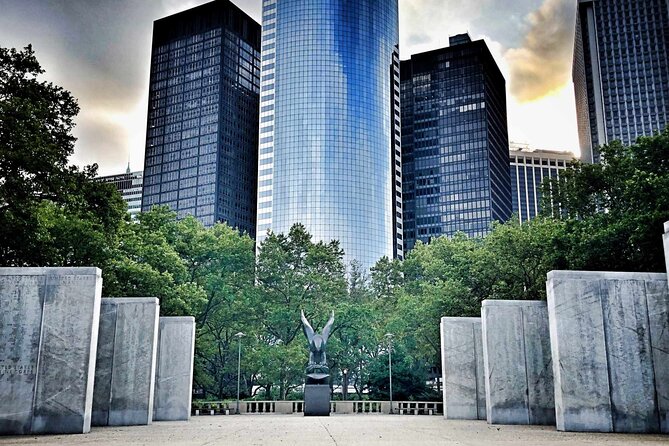
The route passes the Korean War Memorial, whose central figure is called The Universal Soldier. The monument honors those who died, as well as those who disappeared.
That detail gives this stop a different mood from the early colonial stories. The audio moves from New York’s beginnings to the human cost of war, using a memorial that asks you to think about loss without requiring a museum visit or entrance ticket.
You will not be entering an attraction here. The stop is viewed from the public route, so the value comes from the explanation and the chance to pause beside the monument. If you like military history, memorial design, or the way cities remember conflict, this part adds weight to the walk.
More Self-Guided Audio Tours in New York City:
- West Village’s Flappers, Freaks & Punks: A Self-Guided Audio Tour
★ 5.0 · 4 reviews - New York’s Iconic Central Park: A Self-Guided Audio Tour
★ 4.0 · 4 reviews - Boho Greenwich Village: A Self-Guided Audio Tour
★ 5.0 · 3 reviews - Broadway: A Self-Guided Audio Tour of the World’s Iconic Theatre District
★ 4.5 · 3 reviews
The American Merchant Marines Memorial and a wartime harbor
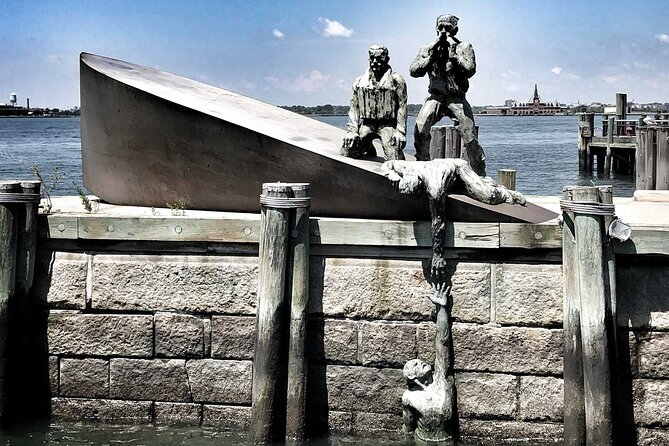
The next stop is the American Merchant Marines Memorial. While you walk, the tour tells the story of German U-boat submarines secretly entering New York Harbor in 1940 on a daring mission.
This is the kind of detail that makes an audio walk worthwhile. A harbor can look peaceful from the promenade, yet it has also been a place of surveillance, danger, shipping, and military planning. The story gives the waterfront a wartime edge without asking you to travel to a separate museum.
The memorial also broadens the definition of wartime service. Instead of focusing only on soldiers, it points toward the merchant mariners whose work supported shipping and supply. You can take in the harbor setting while listening, which helps connect the memorial with the water and the city’s long dependence on trade.
Castle Clinton and its many identities

Castle Clinton is one of the key stops. The 19th-century fort has had several identities, and the audio explains how its purpose changed over time. It is also named for DeWitt Clinton, one of New York’s most powerful political figures, not the more famous Clintons most people first associate with the name.
The tour’s treatment of Castle Clinton is especially helpful because the building can look self-explanatory at first glance. Its sturdy walls suggest a military past, but the site’s later uses are part of what makes it unusual. The audio points out that Castle Clinton was once home to the New York Aquarium, which also explains the nearby carousel’s connection to the site.
You should allow a little extra time here if the fort catches your interest. The tour does not include entrance fees to museums or other attractions, so the experience is built around passing by and learning from the outside. That keeps the price low, but it also means you should not expect an indoor Castle Clinton visit to be included.
The Immigrants statue and the Ellis Island connection
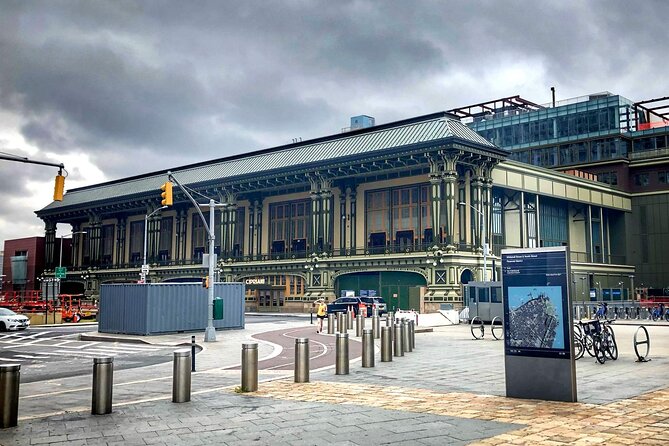
The walk continues past The Immigrants statue and turns toward the immigrant experience. One story concerns Annie Moore, the first immigrant to disembark at Ellis Island’s inspection station.
This stop places personal experience alongside the larger story of New York. Immigration is often discussed through numbers and institutions, but a name such as Annie Moore gives the subject a human point of reference. The setting near the harbor also helps you picture how newcomers encountered the city.
The audio does not replace a full visit to Ellis Island. Instead, it gives you a concise introduction while you remain on the Lower Manhattan route. That makes this tour a useful choice if your schedule does not include the ferry or if you want a short historical walk before exploring elsewhere.
The East Coast Memorial and the wartime Atlantic
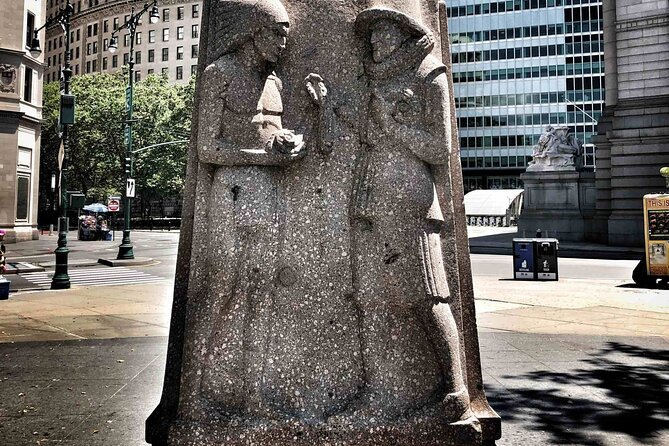
The East Coast Memorial honors American servicemen who lost their lives in the Atlantic during World War II. Its position near the water gives the memorial a direct connection to the place named in its meaning.
This is another quiet section of the route. You may find that the audio works best if you slow down and look carefully rather than treating the memorial as a quick passing point. The tour links the monument to the wider role of the Atlantic during the war, adding a somber layer to the harbor walk.
With no live guide, you control the pace. You can pause the recording, spend a few minutes taking in the memorial, or continue if the stop is not a main interest. That flexibility is one of the best reasons to choose a self-guided tour.
The carousel and Castle Clinton’s surprising past
The Battery’s carousel provides a lighter moment. Its design was inspired by the memory that Castle Clinton was once the New York Aquarium, creating a link between a family attraction and the fort’s former life.
This is a small but memorable detail. It shows how public spaces carry old uses into new ones. A carousel is easy to overlook when you are focused on forts and memorials, yet the audio gives it a place in the story.
Families may particularly enjoy this section, though the tour itself is not presented as a children’s program. The history includes war, immigration, and colonial development, so younger children may need help staying engaged. The ability to stop and move at your own pace helps, but the audio remains most suitable for listeners who can follow a sustained historical narrative.
Peter Minuit Plaza and the Dutch beginnings
The route passes through Peter Minuit Plaza, named for the Dutchman associated with the purchase of Manhattan, then known as Manahatta, using wampum.
This is a compact stop with a large subject. It brings the story back to the Dutch period and to the early exchange that is often used to explain New York’s colonial beginnings. The mention of wampum also gives the story a more specific sense of the people and trade systems involved, rather than presenting the city’s origins as a simple empty-land tale.
Because the plaza is part of the city’s working transportation zone, you should expect movement around you. Keep one ear aware of your surroundings if you use headphones, and follow the app’s directions carefully.
Fraunces Tavern and the final walk to Stone Street
The tour passes Fraunces Tavern, described as Manhattan’s oldest surviving building. The audio explains the notable events connected with its walls, making this one of the best places to slow down near the end of the route.
Fraunces Tavern is a fitting bridge between early New York and the city’s later commercial life. Its age gives the walk a physical reminder of how much of Lower Manhattan has changed. The building is not just an old facade. It is part of the political and social story the tour has been building from the start.
The final destination is Stone Street, where the walk ends on a cobbled stretch that many lifelong New Yorkers never discover. That ending feels well chosen. After parks, memorials, waterfront views, and broad avenues, the narrow historic street gives you a different sense of old Manhattan.
Stone Street also makes a practical finish. You can end the audio there and decide whether to continue exploring Lower Manhattan on your own. The tour does not include food or drinks, so plan separately if you want to stay for a meal.
Is $14.99 a fair price?
At $14.99 per person, the tour offers good value if you use the lifetime access more than once or share it with someone who already has the app and their own device. You receive the English audio, offline maps, geodata, and a virtual tour, with no extra guide gratuity or group scheduling.
The value comes from the amount of ground covered and the number of subjects connected by the route. You get colonial beginnings, military defenses, immigration, World War II, the Korean War, public monuments, and historic buildings in one compact walk.
The price is less attractive if you expect personal interaction or admission to historic sites. A live guide could answer questions and adjust the route, while this experience gives you a fixed audio program. Museum and attraction tickets are not included, and neither are food, drinks, transport, a smartphone, or headphones.
The non-refundable booking policy also makes timing important. Since you cannot change or cancel for a refund, choose a day when you are likely to complete the walk.
Who should choose this audio tour?
I would recommend it to independent walkers, history-minded visitors, couples, and small private groups who want structure without a scheduled guide. It also suits repeat visitors who want to see Lower Manhattan differently and people who prefer listening to a story while moving through the city.
Families may enjoy the carousel and open-air route, but the historical material is better for children who can follow spoken narration. Anyone with limited interest in monuments may find the pace slow.
You should also choose it if offline access matters. Downloaded audio and maps remove the need for Wi-Fi or cellular service, which is useful in a crowded city where connections can be uneven.
FAQ
Where does the tour begin?
It begins at Bowling Green Park, near Broadway and Whitehall Street in New York City.
Where does the tour end?
The tour ends on Stone Street in Lower Manhattan, on the cobbled section of the street.
How long does the tour take?
The estimated duration is about one hour and 30 minutes to two hours.
Is the audio tour available in languages other than English?
No. The supplied information lists English as the available language.
Do I need cellular service or Wi-Fi?
No. The tour includes offline access to the audio, maps, and geodata through the VoiceMap app.
Are food, transportation, museum tickets, and headphones included?
No. You need to arrange food, drinks, transportation, museum or attraction entry fees, a smartphone, and headphones yourself.
Should you book it?
Book this tour if you want a flexible, low-cost way to connect Lower Manhattan’s major monuments and stories. Its best qualities are the offline access, the freedom to walk at your own pace, and the unusual range of subjects packed into a short route.
Skip it if you want a live historian, indoor attraction visits, or a fully guided experience with questions answered as you go. For most independent visitors, especially those interested in New York’s beginnings, wartime memorials, immigration, and old streets, $14.99 is a sensible price for a focused introduction to the southern tip of Manhattan.
Just added around New York City
- New York City’s High Line: A Self-Guided Audio Tour★ 5.0 · 4 reviews
- West Village’s Flappers, Freaks & Punks: A Self-Guided Audio Tour★ 5.0 · 4 reviews
- Boho Greenwich Village: A Self-Guided Audio Tour★ 5.0 · 3 reviews
- New York City’s Financial District: A Self-Guided Audio Tour★ 4.5 · 8 reviews
- Self-Guided Audio Tour of New York City★ 4.5 · 2 reviews
- Guided Tour (with Audio) Hamilton Musical in Lower Manhattan NYC★ 5.0 · 11 reviews
- New York’s Iconic Central Park: A Self-Guided Audio Tour★ 4.0 · 4 reviews
- Broadway: A Self-Guided Audio Tour of the World’s Iconic Theatre District★ 4.5 · 3 reviews
Self-Guided Tours, compared.

Acropolis Ticket & Optional Self-Guided Audio Tours
Read our review →


Ultimate Acadia National Park Self-Guided Driving Audio Tour
Read our review →


Santorini: Akrotiri Ticket with Optional Self-Guided Audios
Read our review →
Browse the lists this tour appears in